Delivery jobs in Australia are one of the easiest and most flexible ways to start earning, whether you want quick cash on the side or a steady role behind the wheel. They suit students, newcomers, and anyone who values setting their own hours. This complete guide explains the types of delivery work, what they really pay, whether they are worth it once costs are counted, the age, licence, and visa requirements, and exactly how to apply.
| Looking for delivery and driving work? Browse roles on CloudColleague or create your free profile to find flexible work near you. |
Types of Delivery Jobs
Delivery work splits into a few clear categories, and they differ a lot in pay structure, flexibility, and what you need to start. The table below gives the overview, and the notes that follow add detail.
| Type | Main Platforms | How It Works |
| Food delivery | Uber Eats, DoorDash | Flexible hours, bike or car, gig-based |
| Parcel / courier | Australia Post, couriers | Vans or cars, often set routes or shifts |
| Grocery delivery | Supermarket and quick-commerce | Scheduled shifts, sometimes employee roles |
| Amazon delivery | Amazon Flex, DSPs | App-based blocks or employed driver roles |
Food delivery is the most flexible and the easiest to enter, working through apps like Uber Eats and Door Dash on a bike, scooter, or car. Note that Menu log closed its Australian operations in late 2025, leaving Uber Eats and Door Dash as the dominant platforms. For a deep dive into one platform, see our guide to Uber Eats driver jobs.
Parcel and courier work covers everything from Australia Post rounds to independent couriers, usually in a van or car with set routes. Grocery and quick-commerce delivery often comes as scheduled shifts, sometimes as an employee rather than a contractor. Amazon delivery runs through Amazon Flex blocks or delivery service partners; our guide to Amazon delivery jobs covers how that works in detail.
Read Next: Ethical & Not-for-Profit Jobs in Canberra
How Much Do Delivery Jobs Pay?
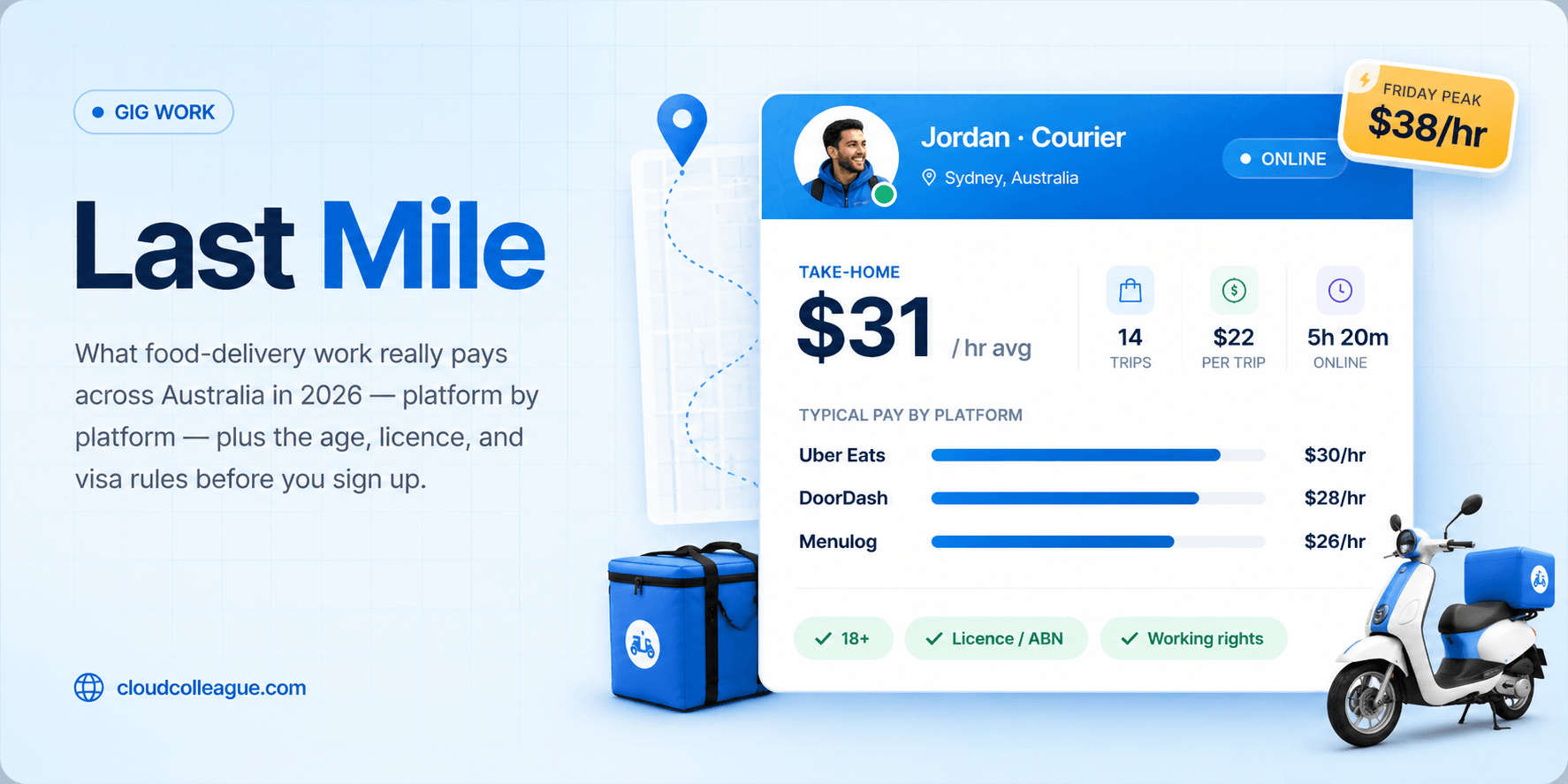
Pay depends heavily on the type of delivery work and how busy your area is. Traditionally, food delivery has paid per completed job rather than by the hour, often around $8 to $12 a delivery, which means your hourly earnings swing with demand. During quiet periods, some riders have reported earning as little as $12 to $18 an hour, while busy peak times pay much more.
That picture is changing significantly. Under a world-first agreement between Uber Eats, DoorDash, and the Transport Workers’ Union, a minimum safety-net rate of about $31.30 an hour for riders and $32 an hour for car drivers is proposed to take effect from 1 July 2026, with a further rise in 2027. This is still subject to Fair Work Commission approval, but it would guarantee pay for time spent working, not just completed jobs, a roughly 25 percent increase for many.
Employed courier, grocery, and Amazon driver roles work differently. They typically pay the casual minimum wage or above, in the range of $25 to $35 an hour, with more predictable income and, as employees, entitlements like superannuation. The trade-off is less flexibility than app-based gig work.
| Big change ahead: from July 2026, food delivery riders and drivers on the major apps are set to receive a guaranteed hourly minimum for the first time, pending final approval. This shifts gig delivery from purely per-job pay toward something closer to an hourly wage. |
Read Next: Full-Time Jobs in Perth: Where to Look?
Are Delivery Jobs Worth It?
Whether delivery work pays off depends on doing the maths honestly, because the headline earnings are not what you keep. The big advantages are real: you choose your own hours, you can start quickly, and the work requires no formal qualifications. For students and newcomers, that flexibility is genuinely valuable.
The costs are equally real, and they hit gig drivers hardest. If you use a car, you must cover fuel, servicing, tyres, and depreciation, plus appropriate insurance, since standard personal cover often excludes delivery use. Bicycle and e-bike delivery cuts most of these costs, which is why many city riders prefer it. Employed roles avoid most personal vehicle costs because the employer usually provides the vehicle, making them more predictable.
The honest verdict is that delivery work is worth it if you value flexibility, choose the right vehicle for your city, and track your true hourly rate after costs. The coming minimum standards make app-based food delivery more attractive than it has been. If you want maximum stability, an employed courier or grocery role is the safer bet.
Read Next: How to Become an Uber Eats Delivery Driver in Australia?
Requirements: Age, Licence, Vehicle, and ABN
The basics are straightforward, but they vary by the type of delivery and the platform. For most app-based gig work, you register as an independent contractor, which means you need an Australian Business Number (ABN), an Australian bank account, and a tax file number. You also need the right vehicle and licence for your chosen mode, plus the legal right to work in Australia. Employed roles handle tax and super for you and usually provide the vehicle.
What Delivery Jobs Can You Do at 17?
Most food delivery apps require you to be at least 18, so options at 17 are more limited. Your best route at 17 is usually an employed grocery or courier role with an employer that accepts under-18s, provided you hold a valid licence for the vehicle you will use. Always check the specific platform or employer’s minimum age before applying, as it is set by their policy and insurance, not just the law.
Can You Deliver With a Learner Licence?
For car-based delivery, the answer is generally no. A learner permit requires you to drive under supervision, which is incompatible with delivering alone, and platforms and insurers almost always require a full or provisional licence. However, you can often do bicycle or e-bike food delivery without any driver’s licence at all, as long as you meet the platform’s age requirement and have the right to work. That makes cycling the common entry point for younger or newly arrived workers.
Can International Students Do Delivery Jobs in Australia?
Yes, international students can do delivery work, and many do, but the visa rules are strict and getting them wrong is serious. Student visa (Subclass 500) holders can work a maximum of 48 hours per fortnight while their course is in session, and unlimited hours during scheduled course breaks. A fortnight is any rolling 14-day period starting on a Monday, not a flexible average.
| Important for students: the 48-hour cap covers ALL your work combined, including gig delivery done through an ABN. If you deliver for 22 hours and work a cafe shift for 28 hours in the same fortnight, that is 50 hours and a visa breach. Track every hour across every job, because breaching your work condition can lead to visa cancellation. |
A proposal to lift the cap to 60 hours per fortnight from July 2026 has been discussed but is not yet law, so do not rely on it until it is official. Your workplace rights are identical to any other worker regardless of visa status. For the full picture, read your work rights in Australia, and always verify your specific conditions through VEVO.
How to Apply for a Delivery Job
Applying is quick compared with most jobs, especially for app-based work. Follow these general steps.
- Choose your type and platform. Platform like CloudColleague can be useful to land your delivery job. Decide between flexible gig food delivery and a steadier employed courier or grocery role, then pick a platform or employer that fits.
- Sort your essentials. Get the right licence for your vehicle, set up an ABN and bank account for gig work, and confirm your work rights and visa conditions.
- Prepare your vehicle and insurance. Make sure your bike or car is roadworthy and that you have insurance that covers delivery use, not just personal driving.
- Sign up or apply. For apps, complete the online onboarding, identity checks, and any background check. For employed roles, submit a short resume highlighting reliability and customer service.
- Complete onboarding and start. Finish any induction, set your availability, and begin accepting deliveries or shifts. Track your hours and earnings from day one.
| Ready to start earning? Start your journey as a seeker on CloudColleague or Start bidding on tasks to get matched with flexible work in your area. |
Frequently Asked Questions
It varies by type and how busy you are. Food delivery has traditionally paid per delivery, often $8 to $12 a drop, but a world-first agreement proposes a minimum of about $31.30 an hour for riders and $32 for car drivers from July 2026, pending Fair Work Commission approval. Employed courier and grocery roles pay the casual minimum wage or above, around $25 to $35 an hour.
They can be, for flexibility and quick income, but you must subtract running costs like fuel, vehicle wear, and insurance from gig earnings. Employed courier and grocery roles offer steadier, more predictable pay. Whether it is worth it depends on your vehicle, your city, and how you value flexibility.
Some platforms and employers accept 17-year-olds, but most food delivery apps require you to be at least 18. At 17 you are more likely to find work through employed grocery or courier roles that accept under-18s, subject to a valid license for the vehicle you use.
For car delivery, generally no, because most platforms and insurers require a full or provisional licence and you cannot drive unsupervised on a learner permit. You may still be able to do bicycle or e-bike food delivery, which does not require a driver’s license, if you meet the age and visa rules.
Yes, but you must stay within your visa work limit of 48 hours per fortnight while your course is in session, and this includes gig work done through an ABN. Exceeding it can risk your visa, so track your hours carefully across all jobs.