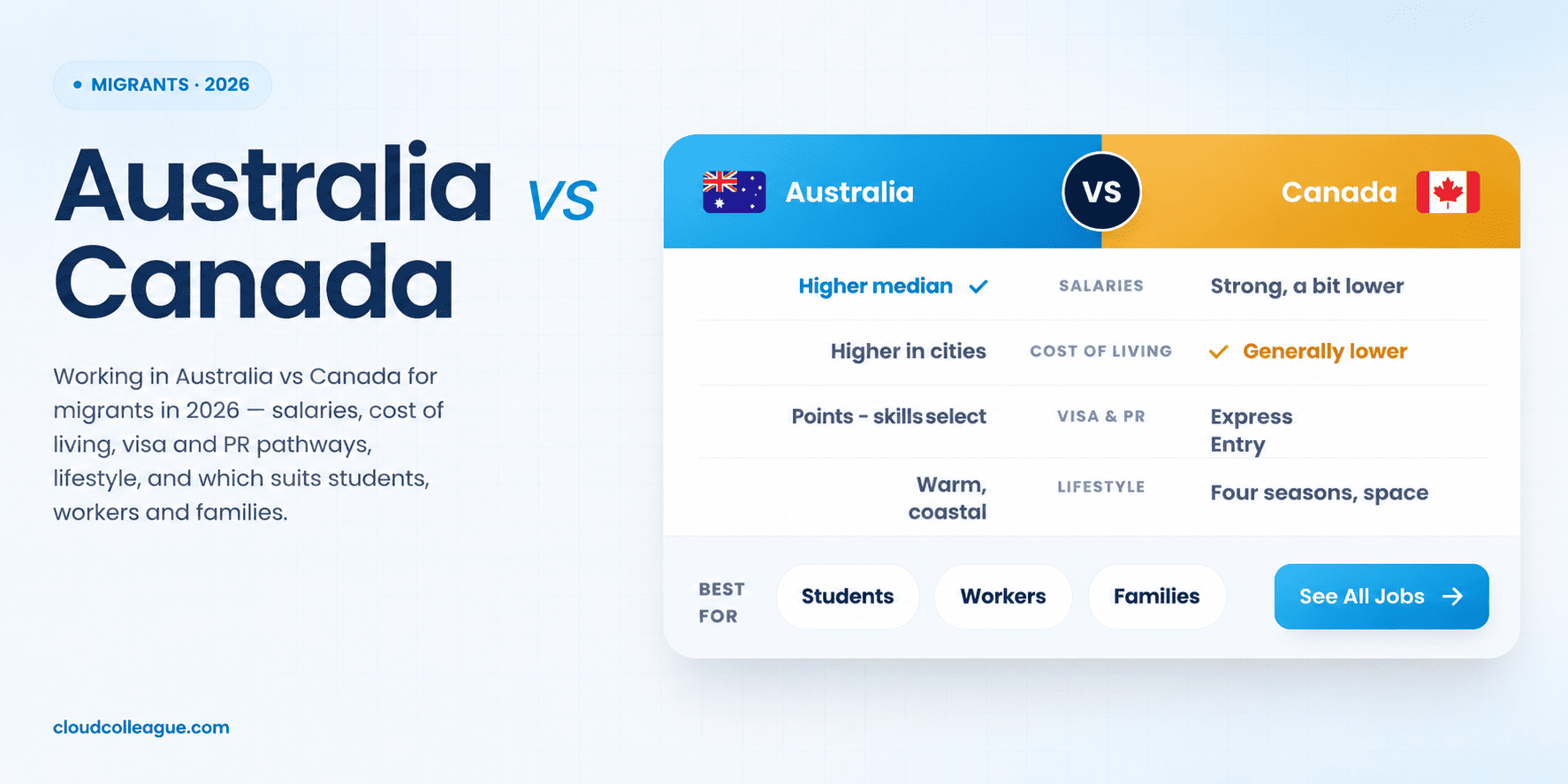
If you are weighing up working in Australia vs Canada, you are choosing between the two most popular destinations for skilled migrants in the world. Both run points-based immigration systems, both have strong economies with chronic labour shortages, and both offer a clear path from permanent residency to citizenship. Yet they differ in important ways, and recent policy changes in 2026 have widened the gap. This guide compares salaries, cost of living, visas, lifestyle, and more, then helps you choose based on your profile.
| Considering a move to Australia? Start as a Seeker to explore opportunities or Browse Tasks to discover flexible ways to earn and gain local experience. |
Quick Comparison: Australia Visa vs Canada Visa
Before the detail, here is the high-level picture across the factors that matter most to migrants. The table summarises where each country tends to lead in 2026.
| Factor | Australia | Canada |
| Average salaries | Higher, especially trades and resources | Solid, generally a little lower |
| Cost of living | Higher, especially housing | Generally lower, cheaper groceries |
| Visa difficulty | Apply from anywhere on points | Now favours those with Canadian experience |
| PR processing | Often 3 to 5 months, priority under 70 days | Express Entry around 6 months |
| PR target 2026 | Maintained at about 185,000 places | Reduced from prior years |
| Climate | Warm to hot, mild winters | Cold, harsh winters in much of the country |
As a rough summary, Australia tends to win on salary, climate, and, in 2026, openness of its skilled pathway, while Canada tends to win on affordability and its study-to-residency route. The right answer still depends heavily on your occupation, age, and goals, which the sections below unpack.
Read Next: Work Rights for International Students in Australia.
Job Market and In-Demand Sectors
Both countries are actively recruiting skilled workers, and their shortage areas overlap closely: IT, healthcare, engineering, construction, and the trades feature strongly in each. If your skills sit in one of these fields, you will find demand on both sides of the Pacific.
The difference lies in emphasis and access. Australia leans heavily on healthcare, mining and resources, construction, and engineering, and it is maintaining a large migration program to fill these gaps. Canada spreads demand across technology, healthcare, and skilled trades, with strong provincial programs. A notable 2026 shift is that Canada’s system increasingly rewards candidates who already have Canadian work experience, which can disadvantage those applying purely from overseas, whereas Australia continues to invite skilled applicants from anywhere in the world.
Salaries and Take-Home Pay Compared
Australia generally offers higher average salaries than Canada, and the gap is widest in trades, mining, and resources. A skilled tradesperson or engineer often earns more in Australia, and healthcare and IT pay competitively in both. With the Australian dollar roughly on par with or slightly above the Canadian dollar, the nominal salary advantage usually favours Australia.
Take-home pay tells a subtler story, because higher Australian salaries come with higher living costs, especially housing. The smart comparison is net savings after rent, tax, and essentials, not gross pay. To work through the Australian side of that equation in detail, see our cost of living guide, which breaks down typical monthly budgets.
| Key point: Australia usually wins on gross salary; Canada often wins on living costs. Your real financial outcome depends on the city you choose and how much you can save, not the headline figure. |
Visa and PR Pathways Compared
Both countries use an expression-of-interest model: you submit a profile, receive a score, and wait for an invitation to apply for permanent residency. But the mechanics and the 2026 climate differ significantly. Australia’s General Skilled Migration visas, the Subclass 189, 190, and 491, are points-tested, and crucially the 189 lets you apply from anywhere based on your skills and score alone, with no requirement for prior Australian experience.
Canada’s Express Entry uses a competitive ranking called the CRS, where you compete against everyone in the pool and cut-off scores shift with each draw. In 2026, Canada has reduced its PR targets and tightened Express Entry to favour candidates with Canadian work experience, making it harder for purely offshore applicants. Australia, by contrast, has maintained around 185,000 migration places and continues to invite skilled workers, with some trades receiving invitations at the lowest 65-point threshold.
Processing and cost differ too. Many Australian PR visas are processed in three to five months, with high-priority occupations granted in under 70 days, while Canada’s Express Entry typically takes around six months. Australian visa fees are higher, with the Subclass 189 costing several thousand dollars, versus a lower Canadian government fee. To estimate where you would stand in Australia, use our Australia PR points calculator, and for the full visa breakdown read our Australian work visa guide.
Cost of Living and Lifestyle in both Different Nations
Canada generally has a lower cost of living than Australia, with cheaper groceries and, in many cities, more affordable housing, although major centres like Toronto and Vancouver are exceptions. Australia’s housing costs, particularly in Sydney and Melbourne, are among the highest in the world, which is the single biggest pressure on migrant budgets there.
Lifestyle is where personal preference matters most, and climate is the clearest divider. Australia offers warm to hot weather, mild winters, beaches, and an outdoor culture year-round. Canada has four distinct seasons and long, cold winters across much of the country, which some people love and others find difficult. Both offer high quality of life, excellent healthcare, strong education, and multicultural cities, so this often comes down to whether you prefer sun or snow.
Read Next: Working in Australia vs USA: Which Is Better for Migrants?
Which Should You Choose?
There is no universal winner, so match the country to your situation. The guidance below sorts it by the most common migrant profiles.
If you are a skilled worker applying from overseas, Australia currently has the edge in 2026, because you can apply on points from anywhere without needing prior local experience, salaries are higher, and processing can be fast for in-demand occupations. Trades, healthcare, and engineering professionals in particular are well placed.
If you are an international student, Canada has historically offered a smoother, clearer study-to-PR pathway through its Post-Graduation Work Permit, though Australia is also strong and pays higher graduate salaries. Recent policy tightening in both countries means you should verify current settings before committing.
If you are moving as a family, weigh the cost of living against income. Canada’s lower everyday costs can stretch a household budget further, while Australia’s higher salaries and warm climate appeal to many families. Both offer excellent schools and public healthcare, so the decision often turns on affordability versus earning power and the lifestyle you want for your children.
| Bottom line: in 2026, Australia leans ahead for offshore skilled workers and higher earners, while Canada appeals to students and those prioritising lower living costs. Your occupation and stage of life should drive the choice. |
| Leaning toward Australia? Search roles on CloudColleague or create your free profile to start connecting with employers who hire skilled migrants. |
Frequently Asked Questions
It depends on your profile. Australia offers higher salaries, a warmer climate, and in 2026 a more open skilled pathway, since you can apply from anywhere on points and it has maintained around 185,000 PR places. Canada offers a lower cost of living and a smoother study-to-PR route, but now strongly favours applicants with Canadian work experience.
Australia generally has higher average salaries, particularly in trades, mining, healthcare, and engineering. However, Australia’s higher cost of living, especially housing, can offset some of that advantage, so compare net savings rather than gross pay.
In early 2026, Australia is often the more accessible route for applicants still offshore, because its Subclass 189 visa is points-tested from anywhere, while Canada’s Express Entry increasingly prioritises candidates with Canadian experience. Both remain competitive and depend on your occupation and score.
Generally yes. Canada tends to have lower living costs, including groceries and housing in many cities, though this varies by location. Australia’s salaries are higher, so the better question is how much you can save after costs in each country.
Canada has historically offered a smoother, well-defined study-to-PR pathway through the Post-Graduation Work Permit and Express Entry. Australia is also strong, with post-study work rights and skilled pathways, and higher graduate salaries. Recent policy shifts in both countries mean you should check current settings.