Resume formats decide whether your application survives the first ten seconds of screening. Around four in five Australian employers now run software over every resume before a human reads it. Consequently, the wrong layout can bury a strong career under a parsing error.
This guide explains the three main resume formats in plain terms. You will see how each one works, who it suits, and which one Australian recruiters actually trust in 2026. Then you can test your choice against live jobs on CloudColleague.
Want a head start? Start as a seeker on CloudColleague, apply and go through our guide on interview tips.
What Are the Three Main Resume Formats?
The three main resume formats are chronological, functional and hybrid. A chronological resume lists work history from newest to oldest. A functional resume leads with skills and pushes dates down. A hybrid resume opens with a skills summary, then adds a full dated work history underneath.
Each structure sends a different signal. Recruiters read chronological layouts fastest, because the timeline sits exactly where they expect it. Meanwhile, applicant tracking systems (ATS) parse dated entries far more reliably than skill groupings.
Therefore, your choice is not cosmetic. It shapes how both software and people judge your experience. The sections below break down each format, with honest pros, cons and Australian context.
Chronological Resume Format: The Australian Default
The chronological format remains the default choice across Australian hiring in 2026. SEEK uploads, government portals and corporate ATS platforms all expect this structure. As a result, it carries the lowest rejection risk of all resume formats.
How the Reverse Chronological Format Works
A reverse chronological resume starts with your contact details and a short summary. Your most recent role sits first, followed by earlier roles in descending order. Each entry lists job title, employer and dates, plus achievement bullets with numbers.
Education, skills and certifications follow the work history. Importantly, consistent date formatting matters as much as order. Mixed date styles confuse parsers and look careless to recruiters. For bullet-level guidance, see our guide on how to show career growth on your resume.
Who Should Use It, and Who Should Not
Choose chronological if your work history is steady and relevant. Of all resume formats, this one rewards consistency most. Industry benchmark testing in 2026 shows this structure parsing at roughly 92 to 97 percent across major ATS platforms. Recruiters also rate it the easiest layout to scan.
However, this format exposes gaps and career pivots. A six-month break sits in plain sight. Similarly, a career changer’s most recent title may not match the target role. If that sounds like you, keep reading before you commit.
Not sure your current layout passes? Upload your resume to CloudColleague for a free format check. It takes seconds, and your verified profile stays free.
Functional Resume Format: Why Recruiters Distrust It in 2026
The functional format groups experience by skill category instead of by employer. Dates shrink to a brief list near the bottom. In theory, this helps people with gaps or scattered histories. In practice, it now carries the highest risk of all resume formats.
The ATS Parsing Problem
ATS software hunts for a dated work history section. When it cannot find one, the parse fails or the ranking collapses. Benchmark testing in 2026 puts functional parsing success at roughly 70 to 85 percent, well below chronological layouts. Some legacy platforms even auto-reject entries without clear dates.
Recruiters add a second penalty. Surveys consistently show most recruiters treat skills-first layouts with suspicion. Many assume the candidate is hiding something. Consequently, the format built to disguise weaknesses often advertises them instead.
The Narrow Cases Where Functional Still Works
A skills-based resume still suits a few situations. Someone returning after a decade away may have no recent timeline worth leading with. Likewise, a portfolio-driven creative applying directly by email can bypass ATS entirely.
Outside those edge cases, choose a safer structure. Fortunately, the hybrid format delivers the same skills-first emphasis without the parsing risk. That is where most former functional users should land.
Hybrid Resume Format: Best of Both for Career Changers
The hybrid format, also called the combination resume, is the fastest-growing choice of 2026. It pairs a prominent skills section with a full dated work history. Therefore, it satisfies skills-based ATS filters and traditional parsers at the same time.
Structure of a Hybrid Resume
A hybrid resume follows a simple order. Contact details come first, then a short summary. Next sits a core skills or competencies block, usually four to eight items. A complete reverse chronological work history follows, then education and certifications.
Among the three resume formats, this order balances software and human readers best. The skills block creates a keyword-dense zone at the top of the page. Meanwhile, the dated history below keeps parsers happy. Benchmark testing shows properly built hybrid layouts parsing at around 94 percent, nearly matching chronological.
Why Hybrid Wins for Career Changers and Freelancers
Career changers benefit most, because transferable skills lead before unrelated job titles appear. Freelancers gain too, since a skills block frames varied contracts as one coherent offer. Additionally, skills-based hiring keeps growing across Australian employers, which favours this structure.
CloudColleague’s AI matching reads the same signals. Create a free verified profile, and the platform matches your skills to live Australian jobs and tasks. Career changers often see relevant matches their old job titles would never have surfaced.
How to Choose a Resume Format for Your Situation
Choosing between resume formats gets easier with a scenario table. Find your situation below, then apply the recommendation.
| Your situation | Best format | Why |
| Steady history, same industry | Chronological | Fastest to scan, safest to parse |
| Fresher, no experience | Chronological with education first | Recruiters still expect a timeline |
| Career changer | Hybrid | Transferable skills lead the page |
| Employment gap over six months | Hybrid | Skills block softens the timeline |
| Freelancer or contractor | Hybrid | Frames varied work as one skill set |
| Senior or executive | Chronological or hybrid | Progression story matters most |
| Government or banking role | Chronological | Conservative sectors expect it |
Freshers should read our dedicated guide to the best resume format for freshers with no experience. Senior candidates can go deeper with our senior-level resume guide for Australia.
Once you pick a structure, test it against reality. Browse live jobs on CloudColleague and compare your layout to what real Australian ads demand. Matching your format to actual listings beats guessing every time.
Formatting Rules That Apply to Every Resume Format
Structure is only half the battle. Visual formatting decides whether software can read your content at all. These rules apply across all resume formats in 2026.
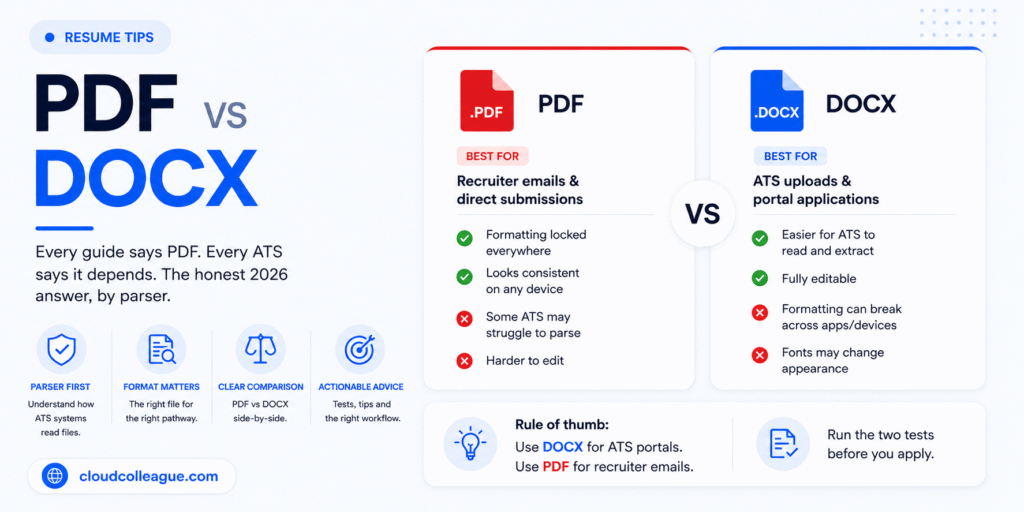
Use a single-column layout with standard headings such as Summary, Experience and Skills. Avoid tables, columns, icons and graphics, because parsers scramble them. Save as a Word .docx or a text-based PDF, never an image export.
Pick a clean font between 10 and 12 points. Keep length to one page under ten years of experience, and two pages beyond that. Finally, mirror the exact wording of the job ad, including acronyms and full terms. For section-by-section help, our complete resume writing guide covers every element.
Check Your Resume Format Free with CloudColleague
You now know how the three resume formats compare in 2026. Between resume formats, chronological wins for steady careers. Hybrid wins for changers, freelancers and gap-holders. Functional stays a last resort in an ATS-driven market.
The final step is putting your resume to work. CloudColleague lets you upload your finished resume free and confirm the format parses cleanly. Then AI matching connects you to live Australian jobs and tasks that fit your skills. Built-in video and chat interviews keep the whole process on one platform.
Task workers get the same advantage, plus same-day Stripe payouts and a transparent 7 percent commission. For a full walkthrough, read how to use CloudColleague to find jobs. Ready to apply? Create your free CloudColleague profile and start matching today.
Frequently Asked Questions About Resume Formats
Most Australian employers prefer the reverse chronological format. It parses cleanly through ATS software and lets recruiters verify progression quickly. Government, banking and corporate roles expect it as standard. Hybrid layouts are increasingly accepted, especially for skills-heavy roles, while functional layouts remain a red flag for many recruiters.
Yes, in most cases. ATS platforms search for dated work entries, and functional layouts hide or remove them. Benchmark testing in 2026 shows functional resumes parsing at roughly 70 to 85 percent, with some systems auto-rejecting them. A hybrid layout delivers similar skills emphasis with far lower parsing risk.
Nothing. Hybrid and combination describe the same structure under two names. Both open with a prominent skills or competencies section, then present a complete reverse chronological work history. The dual structure satisfies skills-based ATS filters and human recruiters at once, which explains its rapid growth through 2026.
A chronological layout with education placed first works best for freshers. Recruiters still expect a timeline, so lead with study, projects, internships and volunteering. Avoid functional layouts, because empty skill claims without dated proof raise doubts. Our freshers format guide walks through the full structure with examples.
Yes. Australian government and public sector roles expect a conservative chronological format with no photo and no personal details. Selection criteria responses often accompany the resume as separate documents. Keep the layout single column, use standard headings, and follow the exact submission instructions in the position description.