Scroll through any Australian job board and you will see the terms “CV” and “resume” used as if they mean exactly the same thing. Often they do. However, they are not always identical, and choosing the wrong one can quietly weaken your application. So the resume vs CV question is worth getting right.
This guide explains the real differences, when to use each document, and what Australian employers actually expect. By the end, you will know precisely which one to send and how to make it work for you.
| Want a head start? Create a free profile on CloudColleague, and build your ATS friendly resume. |
Resume vs CV: The Quick Answer
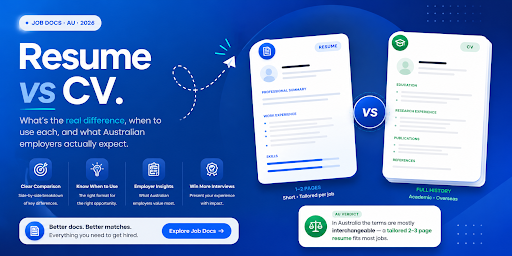
Here is the short version. A resume is a short, targeted document, usually one to two pages, focused on a single role. A CV, on the other hand, is a comprehensive record of your full career and education history.
In Australia, though, the line is blurry. Most employers use the two words interchangeably, and resume is the more common term. Therefore, for the majority of Australian jobs, the resume vs CV choice comes down to what the job ad calls it, not a strict rule. The detail below shows exactly when the difference matters.
What Is a Resume?
A resume is a targeted marketing document, not a complete history. Its only job is to prove, quickly, that you fit a specific role. As a result, it stays short and sharp, typically one to two pages.
A strong resume includes your contact details, a brief summary, relevant work experience, key skills, and education. Crucially, you remove anything that does not support the target job. This is the default document for most private-sector applications in Australia. For the full method, see our guide to resume writing.
Read Next: Common Resume Mistakes to Avoid in 2026
What Is a CV (Curriculum Vitae)?
CV stands for “curriculum vitae,” a Latin phrase meaning “course of life.” That name is a clue. A CV is a comprehensive document that records your entire professional and academic journey.
Because of this, a CV is far more detailed than a resume. It typically includes your full work history, education, publications, research, awards, and professional memberships. In Australia and New Zealand, a CV usually runs two to four pages. For academic roles abroad, it can stretch much longer.
Resume vs CV: The Key Differences
So how do the two documents actually compare? This table makes the differences clear at a glance.
| Factor | Resume | CV |
| Length | 1 to 2 pages | 2 to 4+ pages |
| Focus | One target role | Full career and academic history |
| Content | Relevant highlights only | Comprehensive record |
| Common use in Australia | Most private-sector jobs | Academic, medical, research, government |
In short, a resume answers “why you fit this role,” while a CV answers “here is everything I have done.” That difference in purpose drives every other choice.
Read Next: PDF vs DOCX Resume: What ATS Systems Actually Prefer in 2026
Is a CV the Same as a Resume in Australia?
This is where Australia differs from much of the world, so it pays to understand it. In practice, Australian employers use “CV” and “resume” interchangeably, and resume is the preferred word.
As a result, you do not usually need to agonies over the label. A two-to-three page document that blends the focus of a resume with a little extra detail, often called a CV-resume hybrid, is common and perfectly acceptable here. Above all, the content matters more than the name. Include the most relevant information, and call it whatever the job ad calls it.
When to Use a CV vs a Resume
While the terms overlap in Australia, the right document still depends on the role. So use this simple rule.
Choose a resume for most private-sector jobs, where employers want clarity, relevance, and quick insight into your suitability. Choose a CV when the role is academic, medical, scientific, research, or government, because these employers want the bigger picture, including your projects, publications, and long-term progression. Of course, if the ad explicitly asks for one or the other, follow it.
CV for Academic, Medical and Research Roles
These sectors expect depth. A full CV lets you show your complete record, including research, publications, and contributions over time. Therefore, do not trim it down the way you would a resume.
Resume vs CV for Overseas Jobs
Applying abroad changes the rules, so do your research first. In the United States and Canada, a CV means an academic document only, while a resume is the standard for most jobs. In the United Kingdom, Ireland, and New Zealand, people say “CV” but usually mean a one-to-two page resume. The safe approach is to follow the conventions of the country where the employer operates.
How Long Should a Resume or CV Be?
Length trips up many job seekers, so keep it simple. A resume should be one to two pages. A CV in Australia generally runs two to four pages, and longer for academic roles.
However, always respect the job ad. If it specifies a page limit, follow it exactly. When in doubt, prioritise relevance over volume, because a focused document beats a padded one every time.
Which One Do You Need? Build It and Apply
Once you know which document fits the role, the next step is building it well and getting it in front of the right employers. This is where most applications stall.
CloudColleague closes that gap. You upload your resume or CV for a free review, confirm it suits the job you want, and instantly see live Australian roles that match your skills. Then you apply in a few clicks, rather than guessing which document to send. For a full walkthrough, read how to use CloudColleague to find jobs.
The resume vs CV question is simpler than it looks. A resume is short and targeted, while a CV is long and comprehensive. In Australia, the terms mostly overlap, so the role, not the label, decides which one you send. So pick the right document for the job, build it well, and put it to work. Find out which you need on CloudColleague, then apply to matched roles with confidence.
| Stop second-guessing the format. Start as a Seeker on CloudColleague and geta free review on CLoudColleague. |
Frequently Asked Questions
A resume is a short, targeted document focused on one role, usually one to two pages. A CV is a comprehensive record of your full career and education, and it is typically longer.
In most cases, yes. Australian employers use the terms interchangeably, with resume the more common word. The main exception is academic, medical, research, and government roles, which expect a fuller CV.
Use a resume for most private-sector roles. Choose a CV for academic, medical, research, or government positions, or whenever the job ad specifically asks for one.
A CV in Australia usually runs two to four pages, depending on your experience. Academic CVs can be longer. A resume, by contrast, should stay within one to two pages.
You can upload your resume or CV to CloudColleague for a free review. You will see how it performs and which live roles match your skills.