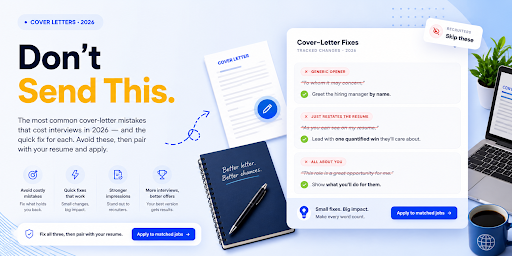
Your cover letter has about ten seconds to clear a recruiter’s first skim. A weak one does not just fail to help. It actively hurts you. In fact, 36 percent of recruiters say a poor cover letter lowers their confidence in an otherwise strong candidate. So small cover letter mistakes can sink a good application.
The good news is that these errors are common, predictable, and easy to fix. Most letters fail for the same handful of reasons, not for a lack of talent. This guide walks through the most common cover letter mistakes of 2026, explains why each one hurts, and shows you how to fix it fast.
| Want a head start? Create a free profile on CloudColleague, upload your resume and cover letter, and start applying for various jobs. |
Why Cover Letter Mistakes Cost You Interviews?
Your cover letter is often the first thing a recruiter reads, sometimes before your resume. So a single weak line can shape their whole impression. With hundreds of applicants per role, recruiters look for reasons to filter you out fast.
That is why most letters fail, and it is rarely about qualifications. They simply repeat the same predictable errors. These errors fall into four groups: poor personalisation, weak content, lazy language, and careless accuracy. Fix those four, and your letter immediately rises above the pile.
Read Next: Best Cover Letter Format in 2026 (With Examples)
Mistake 1: Sending a Generic, Unpersonalised Letter
This is the single biggest cover letter mistake. A letter that could be sent to any company screams mass application. Hiring managers spot it instantly, because nothing in it references their specific role or culture.
Why it hurts: a generic letter signals you did not care enough to research. That impression is hard to undo.
How to fix it: spend five minutes on the company’s website, LinkedIn, and recent news. Then reference one genuine, specific detail, such as a product launch or a stated value. Explain why it resonates with how you work.
Mistake 2: Just Repeating Your Resume
Your cover letter is not your resume in paragraph form. When it simply restates your work history, it wastes the reader’s time.
Why it hurts: a recruiter already has your resume. A duplicate adds nothing new and gives them no reason to keep reading.
How to fix it: use the letter to expand on one or two key achievements. Explain the context, the impact, and why it makes you a strong fit. For the resume itself, see our resume writing guide, and keep the two documents distinct.
Mistake 3: Clichés and Empty Buzzwords
Recruiters read the same tired phrases hundreds of times. “Team player,” “hard worker,” and “go-getter” all blur together. Worse are buzzwords like “ninja,” and “rockstar.”
Why it hurts: these phrases prove nothing. Anyone can claim them, so they carry no weight.
How to fix it: replace each cliché with a specific, quantified result. Instead of “excellent communicator,” write “presented monthly reports to a board of twelve and secured budget approval twice.” Proof beats adjectives every time.
Mistake 4: Ignoring Keywords From the Job Description
Many companies scan cover letters with software before a human reads them. If you miss the key terms, you may never surface in their search.
Why it hurts: missing keywords means qualified candidates get filtered out. The human reader also misses your fit at a glance.
How to fix it: review the job description closely, then identify the key skills and responsibilities. Weave those exact terms into your letter naturally, tied to real experience. For the full keyword method, see our guide to an ATS-friendly resume.
Mistake 5: Talking About Yourself, Not the Employer
Many letters read like a wishlist of what the candidate wants. That focus is backwards.
Why it hurts: recruiters care about their needs, not yours. A self-focused letter fails to show how you solve their problem.
How to fix it: frame every strength around the employer. Show how your skills meet the role’s requirements and help the team succeed. Think about what the recruiter wants to read, not only what you want to say.
Mistake 6: Getting the Company Name Wrong
This happens far more often than you would think. You apply to many jobs, copy and paste, and edit in a hurry. Suddenly your letter to Company B says how excited you are to join Company A.
Why it hurts: it signals carelessness and ends your chances instantly. Recruiters treat it as an automatic rejection.
How to fix it: check the company name, role title, and hiring manager before every single submission. Make this your final step, every time.
Mistake 7: The Wrong Length
Length sends a signal before a word is read. Too short looks lazy, while too long goes unread.
Why it hurts: half a page suggests minimal effort. A full page or more gets skimmed past, as recruiters jump to the resume.
How to fix it: keep it to three or four tight paragraphs, around 250 to 400 words. For more on length, see the cover letter pillar.
Mistake 8: Typos and Grammar Errors
Few mistakes do more damage for less reason. A single typo can undo an otherwise strong letter.
Why it hurts: errors read as careless and unprofessional. Many recruiters treat them as an instant rejection.
How to fix it: proofread in several passes, and read the letter aloud to catch what your eye skips. Run it through a tool like Grammarly, then ask someone else to review it. Aim for zero errors.
Formatting Mistakes (Quick Note)
Layout errors also cause rejections. Cluttered text, decorative fonts, and contact details buried in a header all hurt you. However, those are formatting issues, so we cover them fully in our guide to cover letter format.
How to Catch Cover Letter Mistakes Before You Apply?
Here is the hard truth: you cannot reliably spot your own errors. After editing for an hour, your eye glides past the very mistakes a recruiter will catch in seconds. So get a second opinion before you send.
CloudColleague helps you do exactly that. You can build your profile, pair your checked resume with your cover letter, and apply to matched Australian roles in a few clicks. You also get AI-matched recommendations, so you focus on jobs that fit. For the next step, see how to use CloudColleague to find jobs.
Most cover letter mistakes are common, predictable, and easy to fix. Personalise every letter, add value instead of repeating your resume, cut the clichés, and proofread carefully. Then check the company name and length before you send.
| Stop losing interviews to avoidable errors. Start as a Seeker on CloudColleague and start applying for different roles. |
| Are you actively hiring? Start as an employer on CloudColleague and start hiring employees as your preferences. |
Frequently Asked Questions
Sending a generic, unpersonalised letter that could go to any company. Recruiters spot it instantly. Research the employer and reference one specific, genuine detail to show you actually care about the role.
No. Your resume already lists your history. Use the cover letter to expand on one or two achievements and explain your fit, adding something new rather than restating the same points.
Avoid clichés like “team player,” “hard worker,” and buzzwords like “ninja” or “rockstar.” They prove nothing. Replace them with specific, quantified achievements that show your value.
Keep it to three or four short paragraphs, around 250 to 400 words on one page. Too short looks lazy, and too long goes unread.
You can create a free CloudColleague profile, pair your resume and cover letter, and apply to live Australian roles that match your skills.