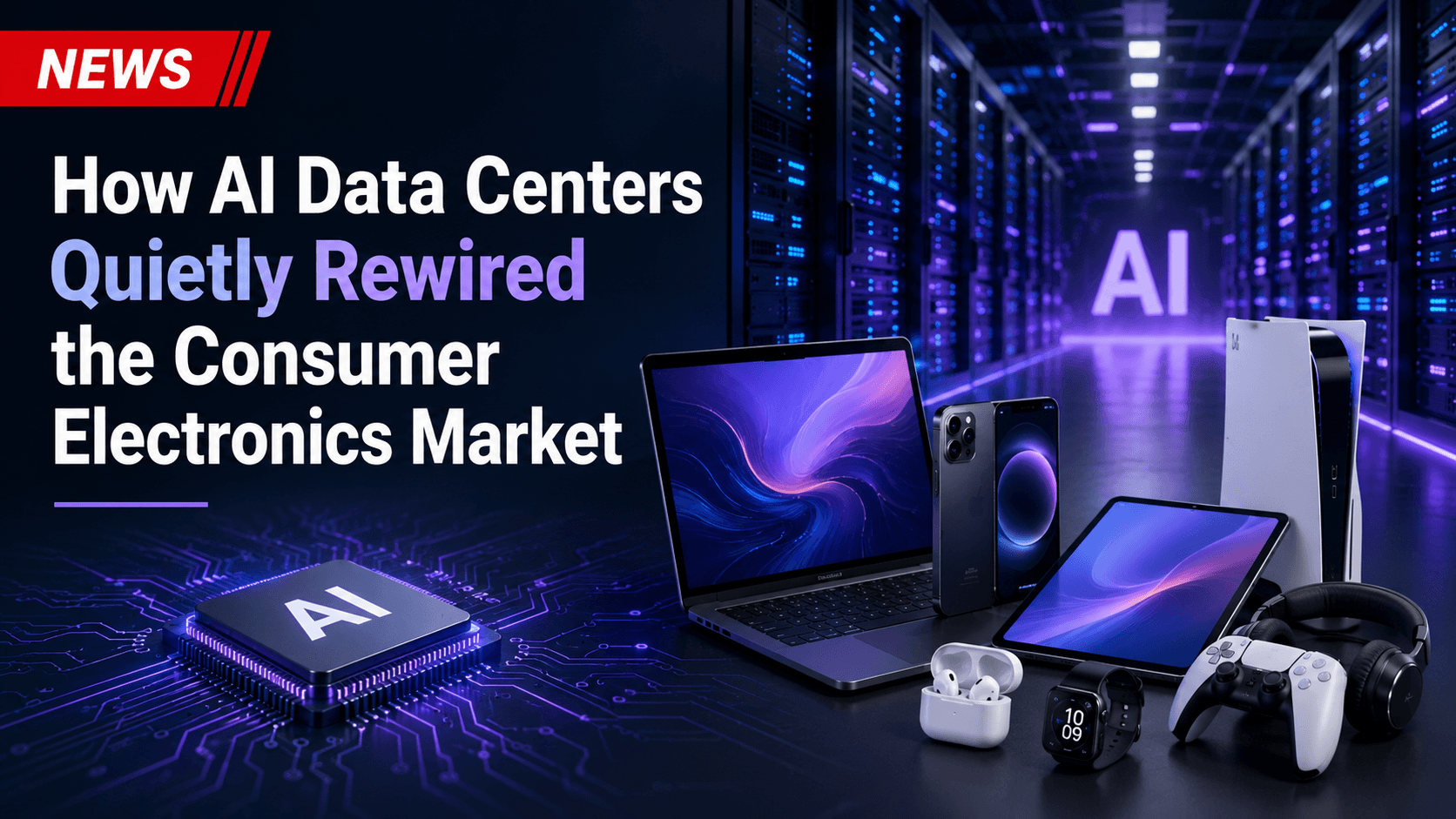
AI data centers and consumer electronics now share a hidden link that shapes the price of nearly every gadget on the market. What happens inside a server farm directly affects what you pay at checkout, and in 2026 that connection moved from the financial pages to the front pages.
Few shoppers see the mechanism, yet it explains the Apple price increase 2026 and the wider wave of device hikes from Dell, Lenovo, Microsoft and Sony. The story is one of capacity quietly draining away from the products people buy.
What is an AI data center?
An AI data center is a large facility packed with specialised servers built to train and run artificial intelligence. These sites host thousands of powerful chips working in parallel, and companies are building them at record speed.
Each new facility demands enormous quantities of advanced memory and storage. Combined capital spending from the world’s largest cloud providers is rising sharply, with one forecast pointing to roughly 79 percent growth in 2026 alone.
Why AI needs so much hardware?
AI models are hungry by design. They process huge datasets, so they need fast memory close to the processor and vast storage for training data, checkpoints and vector databases. High bandwidth memory meets that need, and demand for it has soared.
Consequently, chipmakers earn far more from AI memory than from the standard chips inside phones and laptops. High bandwidth memory commands margins near 60 percent, against roughly 40 percent for commodity memory, which gives makers every reason to prioritise it.
How AI data centers reshape the supply chain?
Here lies the pivotal shift. Memory makers have reallocated wafer capacity toward AI products, so the supply of consumer DRAM and NAND has tightened sharply. By 2026, high bandwidth memory is expected to account for roughly a quarter of total DRAM wafer production, while consuming an even larger share of effective capacity because it is so wafer intensive.
Bloomberg and other outlets traced Apple’s increases directly to this reallocation. Our memory shortage explainer unpacks the underlying mechanics in more detail.
“For every wafer devoted to HBM stacks for AI servers, others are unavailable for smartphones, PCs, or vehicles.”
Deutsche Bank research note (via Fortune)
The effects ripple across electronics
The downstream effects are broad and concrete. Laptops and tablets cost more, as the laptop brand price increase shows. Phones face pressure too, fuelling the iPhone 18 price hike forecast. Gaming consoles have already risen, with Valve and Microsoft both citing memory costs, and storage upgrades now carry a steeper premium than before.
The volume numbers reveal the strain. IDC has forecast the smartphone market will see its biggest ever annual decline, near 14 percent, in 2026, while the PC market falls 11.3 percent. Fewer devices are shipping, yet revenue is rising, because price is doing the work.
Industries most affected
Consumer technology sits on the front line, since PC and smartphone makers must either absorb higher costs or pass them to buyers. Most now pass them along. The strain extends to hard drives and CPUs as well, with reports of long lead times and forecast CPU price increases of up to 15 percent.
Analysts describe memory production as a zero sum game, in which AI growth and affordable consumer electronics pull in opposite directions. That framing captures the core tension of 2026.
The future outlook
The trend is unlikely to reverse soon. As long as AI spending grows, and every major forecast says it will, chipmakers have a durable incentive to keep producing high margin AI memory rather than consumer chips. IDC has even described the change as a “permanent reallocation” of capacity. So consumers should plan for higher prices through 2026 and beyond. We assess when, or whether, relief arrives in will Apple prices return to normal.