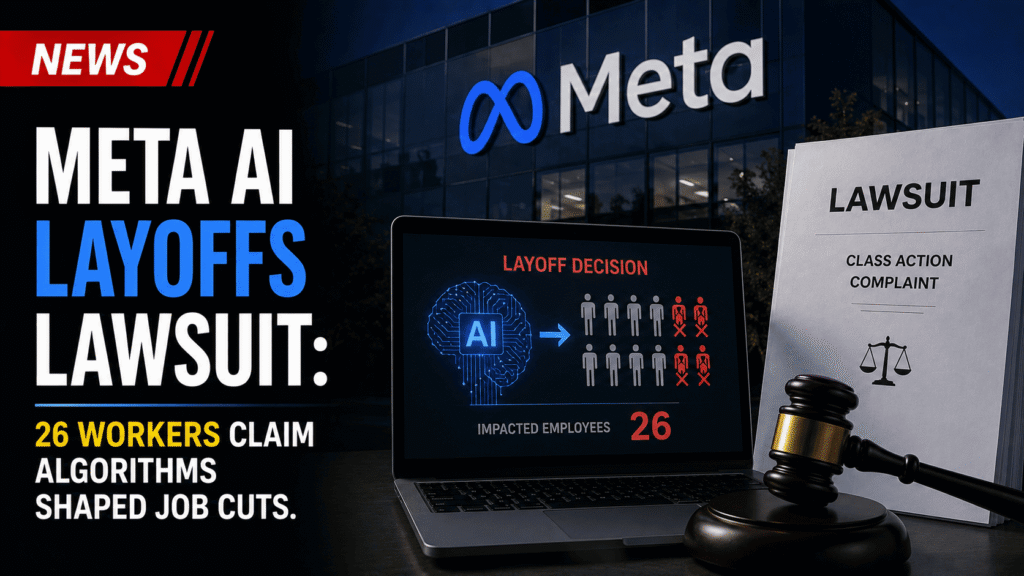
Twenty-six Meta employees have filed a Meta AI layoffs lawsuit, alleging the company used AI-assisted systems and workplace activity data to help select workers for its 2026 job cuts. The complaint, filed in federal court in Oakland, California, claims the process disproportionately affected employees who took medical, pregnancy, parental or family leave. Meta denies the allegations and says people, not AI, made its workforce decisions. The claims have not been proven, and no court has ruled on whether discrimination occurred.
Meta AI layoffs lawsuit: Key facts
- 26 plaintiffs, all filed anonymously, from six states and Washington, D.C.
- Filed 13 July 2026 in the US District Court for the Northern District of California, Oakland.
- Central allegation: Meta’s layoff selection relied on AI-assisted systems and activity metrics that disadvantaged workers on protected leave.
- Meta’s response: the claims lack merit, and workforce decisions were made by people, not AI.
- Current status: all 26 remain employed, with separations set to begin 22 July 2026.
- Relief sought: a court order preserving the status quo while the workers pursue claims in individual arbitration.
What does the lawsuit allege?
The plaintiffs claim Meta assembled its termination list using internal systems rather than direct managerial review.
According to Reuters, the complaint says Meta relied on factors such as productivity and AI token usage when it cut thousands of jobs earlier this year. The lawsuit lists internal AI systems, keystroke and activity-monitoring data, AI token-usage dashboards and algorithmically assisted performance rankings among the methods used.
The core argument is about how those metrics accumulate. The complaint states that many of these scores, by design, cannot be built up by someone on protected medical or family leave, or whose output is reduced by a disability.
It is worth distinguishing several things the complaint raises. Data collection, algorithmic scoring, AI-assisted recommendations and final human decisions are not the same. The plaintiffs allege the scoring fed the outcome without proper adjustment for leave. What role a human played in each final decision is disputed and unresolved.
Who are the 26 plaintiffs?
All 26 filed anonymously, and all remain Meta employees for now.
They come from six states, including California, New York, Florida, Illinois and Pennsylvania, as well as Washington, D.C. Each, according to the complaint, took protected leave and had requested or received a reasonable accommodation for a disability.
The categories of leave involved include pregnancy and parental leave, during which measured output would naturally fall, and medical leave. In one instance described in the complaint, an employee said a manager discouraged him from taking approved leave, warning it could lead to his selection in the anticipated layoffs.
These are the plaintiffs’ descriptions of their circumstances. Meta has not accepted them, and they have not been tested in court.
What does Meta say?
Meta disputes the allegations directly and says the premise is wrong.
A Meta spokesperson told Fox Business that the claims lack merit and are not based on facts. The company stated that workforce management and organisational decisions were, and are, made by people rather than AI.
Meta’s position is that human managers, not algorithms, made the final calls. That denial deserves weight. It does not, on its own, prove the lawsuit is wrong, just as the complaint does not on its own prove the allegations are right. Both accounts are now before the court.
Which AI and monitoring tools are mentioned?
The complaint references a set of measurement systems rather than a single automated firing tool.
Named or described in reporting are AI token-usage dashboards, keystroke and activity-monitoring data, and algorithmically assisted performance rankings. Meta has previously faced internal concern about workplace monitoring, with some US staff organising against activity-tracking technology in May 2026.
An important caution applies here. Being named in the complaint does not make a tool an automated decision-maker. What each system actually did, and how much weight it carried in a human decision, is precisely what remains unclear and contested.
Why protected leave matters?
The mechanism the plaintiffs describe is straightforward, even if the law around it is not.
A worker on approved leave is legally absent. During that time they may naturally show lower output, fewer logged interactions, reduced AI-tool usage and less keyboard or messaging activity.
The plaintiffs argue that using raw activity metrics, without adjusting for approved leave, produces unequal outcomes. Their lawyers contend the process falls more heavily on women, because women disproportionately take pregnancy and caregiving leave. The complaint invokes disparate impact, a long-standing civil rights concept holding that a neutral-looking practice can still be unlawful if it disproportionately burdens a protected group.
This is the plaintiffs’ argument, not a court finding. It is general information, not legal advice for any individual situation.
Lawsuit timeline
- May 2026: Meta announces cuts affecting about 8,000 roles, roughly 10% of its workforce, tied to its AI reorganisation. Affected staff, including the plaintiffs, are notified.
- 13 July 2026: The complaint is filed late Monday in Oakland federal court, assigned to Judge William Orrick.
- 14 July 2026: Reuters, AP and others report the filing.
- 22 July 2026: Scheduled start date for the plaintiffs’ separations, which they are asking the court to pause.
For background on the underlying job cuts, see CloudColleague’s earlier breakdown of Meta’s 2026 layoffs.
Why this case could matter beyond Meta?
The dispute touches questions many employers are now grappling with.
Reuters described the case as appearing to be among the first to challenge the use of AI in a major company’s layoff process. That framing is why it is drawing attention well beyond Meta.
The broader issues include how much transparency workers get about employee scoring, whether a human can understand and override an algorithmic recommendation, and whether such systems are tested for biased outcomes. The plaintiffs also allege Meta failed to test its AI systems for bias under recently adopted California and New York City laws. These themes sit alongside the wider pattern tracked in the 2026 technology layoffs tracker. No outcome is predictable at this stage.
What it means for Australian workers and employers
This lawsuit was filed in the United States, and US employment laws do not automatically apply in Australia. The specific statutes cited, such as the Family and Medical Leave Act and the Americans with Disabilities Act, are American.
That said, the underlying questions are portable. Australian organisations using AI in employment decisions can reasonably ask themselves several things. Is the data actually relevant to job performance? Is approved leave excluded or adjusted before scores are used? Can a human understand and challenge the recommendation? Has the system been tested for discriminatory outcomes? Is any monitoring transparent and proportionate? And who remains accountable for the final decision?
Australian workplaces are governed by the Fair Work framework and federal anti-discrimination law, overseen by bodies including the Fair Work Ombudsman and the Australian Human Rights Commission. Privacy obligations sit with the Office of the Australian Information Commissioner. None of this means Australia bans the practice alleged here, but the fairness and accountability principles are already familiar to local employers building transparent, human-led hiring workflows.
What workers should document?
Workers navigating restructures may consider keeping lawful records of relevant material.
That can include approved leave, performance reviews, accommodation requests, layoff notices, employer communications and any changes to how performance is measured.
This is general information only. Anyone concerned about their own situation should seek qualified legal or workplace advice.
What happens next?
A short watchlist:
- Whether the court grants the requested preliminary relief before 22 July.
- Whether the scheduled separations proceed or pause.
- Meta’s formal legal response to the complaint.
- Whether the individual claims move into arbitration as Meta’s agreements require.
- Whether more detail emerges about how the alleged systems worked.
- Whether regulators take interest in similar workplace AI tools.
No hearing outcome can be assumed, and the court has set no public ruling date.
A test case for AI at work, not a verdict
This case matters because it puts a concrete question before a court. When AI-assisted systems inform who loses a job, who is accountable, and what happens to workers whose measured output drops for legally protected reasons?
For now, those questions are open. The allegations are disputed, Meta denies that AI made its decisions, and no court has found the company liable. Readers can follow developments through CloudColleague News, and those weighing their own next move can explore current jobs in Australia in the meantime.