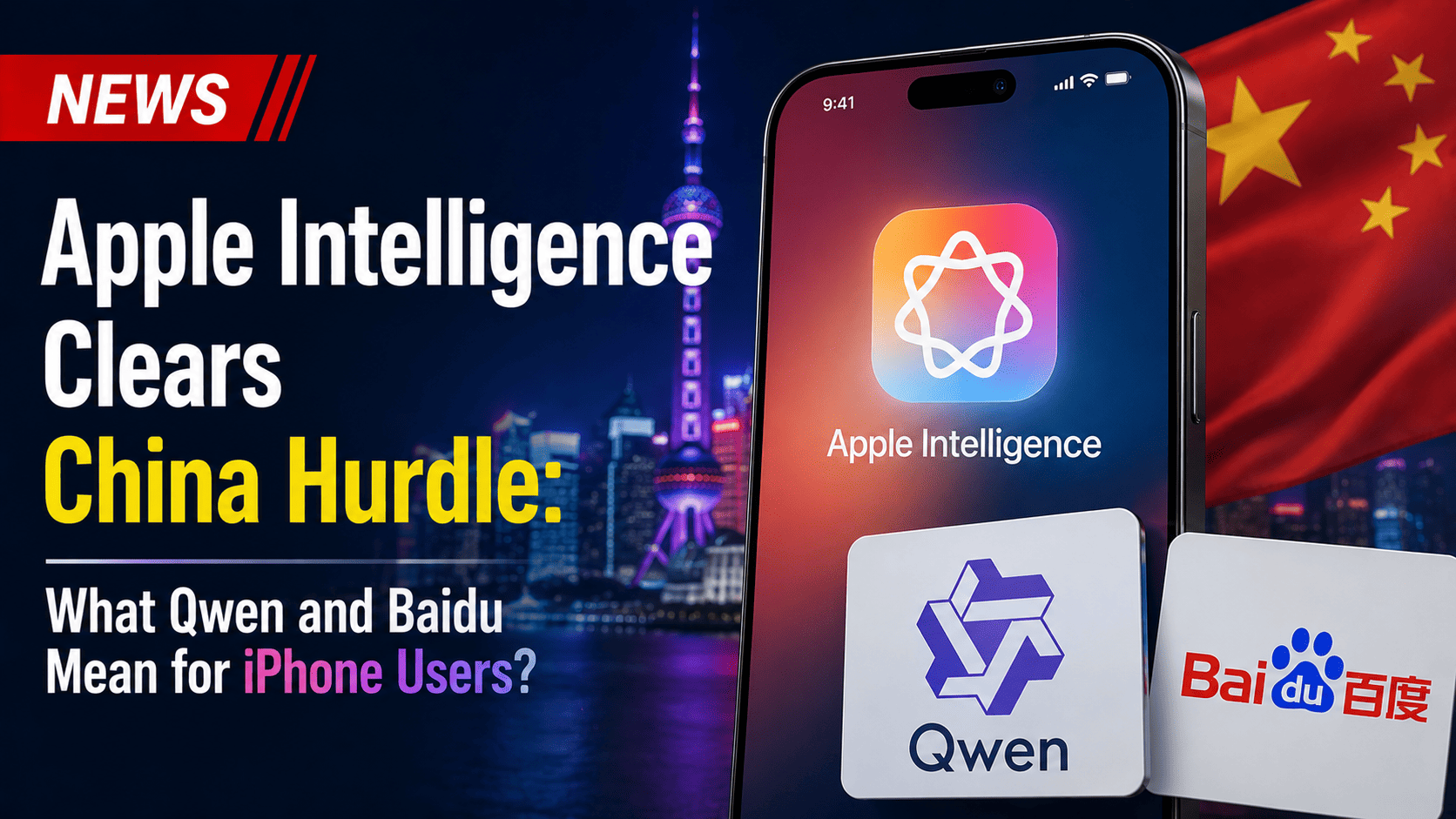
Apple Intelligence has been registered with China’s cyberspace regulator, clearing one of the biggest obstacles to launching Apple’s generative AI service in mainland China. The Cyberspace Administration of China confirmed the registration on Wednesday 15 July 2026, a step Reuters reported as paving the way for a long-awaited rollout. Alibaba’s Qwen model and technology from Baidu are expected to power the Chinese version. Importantly, no launch date has been confirmed.
Apple Intelligence China approval: Key facts
- Registered, not launched. China’s cyberspace regulator has listed Apple Intelligence as an approved generative AI service.
- Alibaba Qwen confirmed. Alibaba told Reuters its Qwen model will be integrated across iOS, iPadOS, macOS and visionOS in China.
- Baidu involved. A Baidu spokesperson confirmed it is also working with Apple on features for Chinese iPhone users.
- Platforms covered. The registration relates to Apple’s on-device generative AI service on iPhones, with wider platform support expected.
- No launch date. The regulator’s statement did not name a rollout date, and Apple has not commented.
What happened?
On 15 July 2026, China’s cyberspace regulator confirmed that Apple Intelligence had been added to its list of approved generative AI providers.
China requires companies to register large language models and public generative AI services with regulators before releasing them. Clearing that step is mandatory, which is why the registration matters.
It is worth separating three distinct stages. Regulatory registration means the service has legal clearance to operate. Technical preparation means the features have been built and adapted. Public availability means users can actually turn them on.
Registration covers only the first stage. Apple appears to have completed much of the technical work already. In fact, Apple Intelligence was briefly and apparently accidentally enabled in China in March 2026, which suggested the build was close to ready.
What role will Alibaba Qwen and Baidu play?
Apple is required to work with local partners, because foreign AI services cannot operate freely in China. OpenAI’s ChatGPT, for example, is not available there.
Alibaba said in a statement to Reuters that its Qwen model will be integrated into Apple Intelligence across four operating systems in China:
- iOS (iPhone)
- iPadOS (iPad)
- macOS (Mac)
- visionOS (Vision Pro)
According to detail an Alibaba spokesperson gave CNBC, users will be able to draw on Qwen’s capabilities, including text and image generation, from within Apple’s own interface rather than opening a separate app.
Baidu’s role is confirmed but less detailed. A Baidu spokesperson said Apple is also working with the company to develop Apple Intelligence features for Chinese iPhone users. Exactly which features each partner will handle has not been publicly specified, and CloudColleague will not speculate on that split.
When will Apple Intelligence launch in China?
Apple has not announced a confirmed Apple Intelligence launch date for mainland China.
Registration is a significant milestone, but it does not prove that every feature is immediately available to the public. The regulator’s statement gave no timeline.
Apple’s own support documentation still reflects the current restriction. As of publication, Apple’s guidance states that Apple Intelligence does not currently work on supported devices purchased in mainland China. Until that changes, the service remains unavailable there regardless of the registration.
As Engadget noted in its coverage, a rollout now would arrive roughly two years after Apple Intelligence first launched in the United States.
What could change for Chinese iPhone users?
The following outlines possibilities, not confirmed outcomes.
Chinese iPhone owners could gain access to AI features built to comply with local rules, delivered through Qwen and Baidu rather than the international model stack. That is the likely shape of any launch.
The Chinese version will probably differ from the international one. Apple uses different AI providers in China, and content moderation requirements are stricter, so feature parity is not guaranteed. Some capabilities available elsewhere may be adjusted or absent.
Several questions remain genuinely unanswered. How data is handled, how content is filtered, and where responsibility sits between Apple and its local partners have not been detailed publicly. These are the areas worth watching once Apple comments.
Why this matters to Apple?
China is one of Apple’s most important and most competitive markets, which is what makes AI availability strategically significant.
Apple reported a 24.4% year-on-year increase in its China shipments in the second quarter, according to Reuters. Adding locally compliant AI features could strengthen that momentum by giving buyers a reason to upgrade.
The competitive pressure is real. Huawei, Xiaomi and other Chinese smartphone makers have shipped AI features to domestic users for some time. Apple has been visibly behind on this front in China, and closing that gap matters for its standing in the market.
This development also fits Apple’s broader, and at times turbulent, AI strategy. The company has leaned on external model partners in different regions, a pattern that runs alongside CloudColleague’s coverage of Apple’s dispute with OpenAI. The China registration is a separate matter and was not caused by that lawsuit, but both reflect how central AI partnerships have become to Apple’s plans.
What it could mean for AI and technology jobs
A rollout of this scale draws on a specific set of skills, which points to where demand tends to concentrate.
Localising a global AI product for China requires machine-learning engineers, AI localisation specialists and evaluators who can test model behaviour in Mandarin. Privacy and compliance professionals are central, because the entire launch hinges on meeting local regulatory standards. Trust and safety teams carry particular weight where content moderation rules are strict.
Mobile AI development, product management and cross-border partnership roles also feature heavily when two large firms integrate technology across platforms. These are the capabilities behind almost any major AI deployment, and they map closely to the technology changing how employers identify talent worldwide.
No specific hiring figure has been announced by Apple, Alibaba or Baidu. What the story illustrates is the type of expertise that large AI integrations reward, rather than a confirmed headcount. For readers tracking these shifts, CloudColleague publishes ongoing technology and employment news.
What happens next?
A short watchlist for the coming weeks:
- An official Apple launch announcement, which has not yet come.
- Changes to Apple’s China support documentation lifting the current restriction.
- Confirmation of which devices and features are supported at launch.
- Further detail from Alibaba or Baidu on their respective roles.
- Clarity on privacy, data handling and content responsibility.
The step that matters, and the ones still missing
Registration with China’s cyberspace regulator is a meaningful milestone. It removes a hurdle that has held Apple Intelligence back from Apple’s most important growth market for two years.
What remains unresolved is just as important. There is no confirmed launch date, no finalised feature list, and no public detail on how data and content will be governed. Until Apple speaks, the service is cleared to launch in China but has not launched. Readers can follow more global technology developments as this story updates.