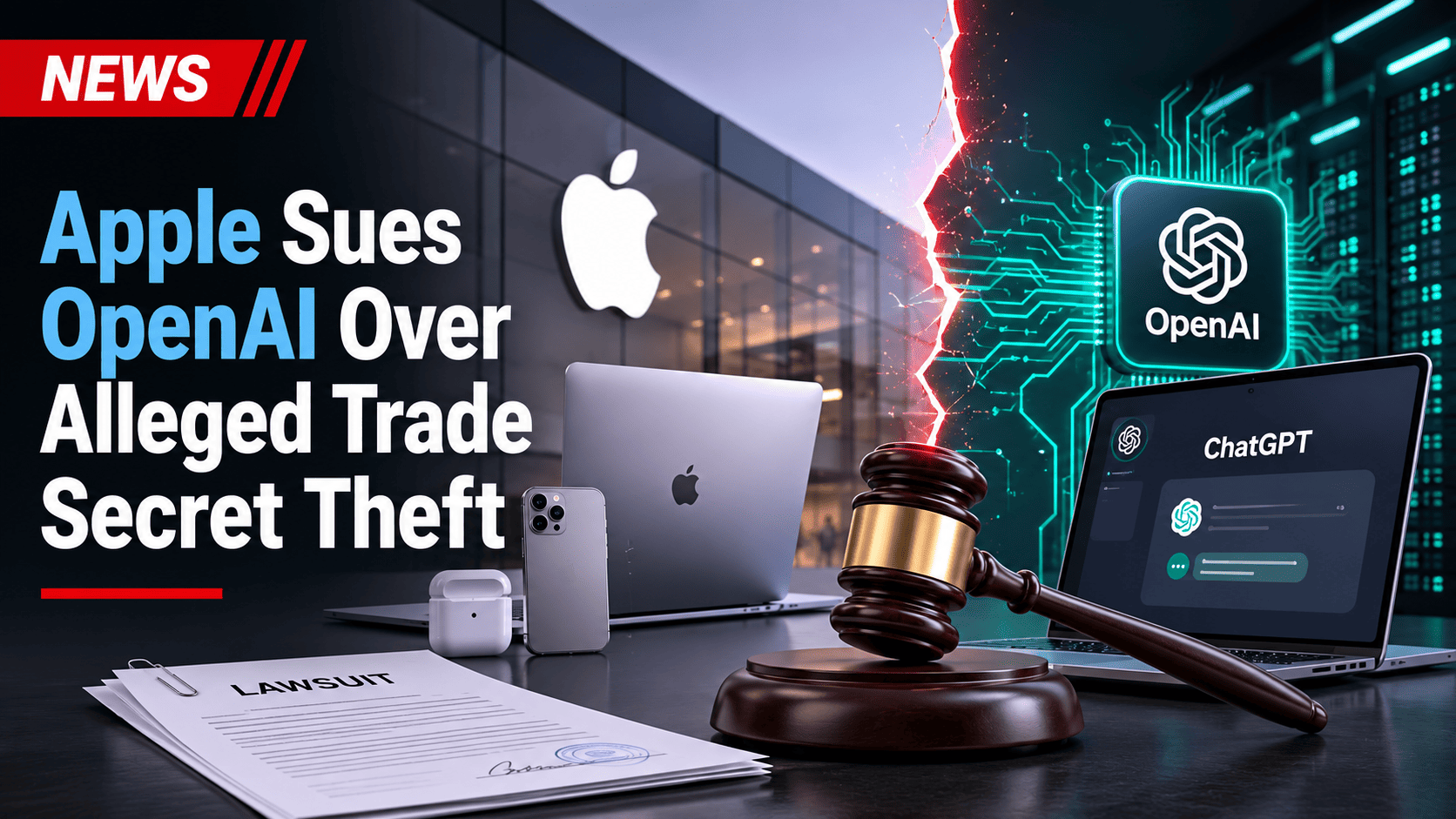
Apple has sued OpenAI, related OpenAI entities, hardware company io Products and two former Apple employees, in a complaint filed on 10 July 2026 in the US District Court for the Northern District of California. Apple alleges a coordinated effort to take confidential information covering product designs, manufacturing processes and supply chain strategy, allegedly used to accelerate OpenAI’s push into consumer hardware. The case lands directly on OpenAI’s unreleased ChatGPT device.
Apple alleges that OpenAI and two former Apple staff, Tang Yew Tan and Chang Liu, took confidential hardware information to help build a consumer ChatGPT device. OpenAI says it has no interest in other companies’ trade secrets and remains focused on building innovative technology. No court has tested the claims. The outcome could shape AI hardware competition, hiring practices and technology employment worldwide. Fortune
The two individual defendants are named directly in the filing. Tan is OpenAI’s chief hardware officer and spent 24 years at Apple, most recently as vice president of product design for iPhone and Apple Watch. Liu spent eight years at Apple as a senior systems electrical engineer before leaving for OpenAI. CloudColleague
Apple is asking the court to bar OpenAI from using or disclosing its trade secrets, to require the return of confidential Apple materials, and to preserve evidence connected to the case. It is also seeking damages and injunctions.
Every claim below remains an allegation. Apple has proved nothing yet, and OpenAI denies wrongdoing.
Why Apple is suing OpenAI?
The complaint is built on two legal theories: trade secret misappropriation and breach of contract. In plain English, Apple says former staff walked out with protected material and that OpenAI benefited from it.
Trade secret law does not stop people changing employers. Engineers who leave Apple are free to take their skill, judgement and general professional knowledge to a rival. That is ordinary employee mobility, and courts protect it.
The line is drawn at protected material. Confidential documents, unreleased product specifications, supplier lists, manufacturing techniques and internal project data usually sit behind confidentiality agreements. Taking those items, or using them at a new employer, is what trade secret law targets.
Apple’s argument is that this dispute falls on the wrong side of that line. The filing describes a pattern by employees departing for OpenAI of taking steps to evade the security processes intended to protect Apple’s confidential information. Axios
Apple also puts the alleged conduct at senior level. The filing claims the behaviour ran from members of technical staff through to the chief hardware officer, in coordination with business partners. TechCrunch
Apple states that its 2024 agreement with OpenAI is not at issue in the case. This is a personnel and confidentiality dispute, not a contract fight over ChatGPT in Siri. CNN
This article explains the allegations for general readers. It is not legal advice.
What Apple alleges the former employees took or shared?
Apple treats the two individuals differently in the complaint. The allegations against each are separate.
Apple alleges Liu failed to return a company-issued work laptop, then used an authentication bug to reach Apple’s internal network and download dozens of confidential hardware-related files. Those files are described in the suit as covering unreleased products, engineering presentations, technical specifications and proprietary project data. Apple further alleges Liu shared confidential information with Apple employees applying to OpenAI, including advice on what to study before an interview.
The allegations against Tan centre on recruitment. Apple claims he emailed himself information about Apple suppliers and internal industry summaries before he departed. The complaint also accuses Tan of using confidential Apple project code names during recruiting, and of asking candidates to bring Apple hardware components to interviews. Apple additionally alleges he circulated an internal Apple offboarding document to new OpenAI hires.
| Defendant | Former role at Apple | Apple’s allegation | Current status |
| Tang Yew Tan | Vice president of product design, iPhone and Apple Watch | Allegedly emailed himself supplier and internal industry information before leaving, and allegedly used interviews with Apple staff to elicit confidential project detail | Named defendant. Now OpenAI’s chief hardware officer. Allegations untested in court |
| Chang Liu | Senior systems electrical engineer | Allegedly did not return an Apple-issued laptop and allegedly used a software bug to download confidential hardware files after departure | Named defendant. Joined OpenAI in 2026. Allegations untested in court |
| OpenAI and io Products | Not applicable | Allegedly benefited from and coordinated the use of Apple confidential information in consumer hardware development | Corporate defendants. OpenAI denies the claims |
The complaint states that more than 400 former Apple employees now work at OpenAI. That figure is context, not an accusation. Hiring former staff from a competitor is entirely lawful, and large technology companies do it constantly.
How OpenAI responded to Apple’s lawsuit?
OpenAI has rejected the allegations. Company spokesperson Drew Pusateri said OpenAI has no interest in other companies’ trade secrets, and that the company remains focused on building innovative technology that empowers people everywhere. CNBC
OpenAI issued that statement publicly on 10 July 2026, the day Apple filed.
OpenAI has not yet filed its formal legal answer. Until it does, its detailed defence is unknown. Nothing in the record establishes that OpenAI or either individual took anything unlawfully.
From ChatGPT partner to hardware rival?
The dispute is remarkable because the two companies were partners. Apple and OpenAI announced a high-profile partnership in 2024 that brought ChatGPT into the iPhone’s operating system. Users could reach ChatGPT results through Siri and sign up for ChatGPT memberships from the iOS settings menu.
Relations cooled once OpenAI moved into hardware, buying former Apple designer Jony Ive’s startup io Products for a reported figure of around US$6.4 billion. Other reports place the value at roughly US$6.5 billion. Ive now leads OpenAI’s device work, though he is not named as a defendant and is not accused of wrongdoing.
Apple’s revamped Siri, due this year, is built on Google’s Gemini models rather than OpenAI’s technology. Neither company has said the 2024 partnership has formally ended, and Apple declined to comment on whether the lawsuit affects it.
The strategic logic is straightforward. Today OpenAI reaches most consumers through devices Apple controls. A ChatGPT hardware device would give OpenAI a direct channel to users, and would reduce that dependence.
Could the lawsuit delay OpenAI’s ChatGPT hardware device?
Any impact is possible rather than certain. Apple’s requested remedies, however, target the hardware programme itself.
Apple is seeking a preliminary injunction requiring defendants to preserve evidence, stop using Apple technologies and return trade secrets, an order that could slow OpenAI’s young hardware operation.
If Apple proves its allegations, several consequences could follow. Discovery may force OpenAI to open internal engineering records. Development could pause while material is quarantined. Suppliers may become cautious about dual relationships. Legal and compliance costs could rise. Recruitment from Apple could face tighter scrutiny.
None of this is guaranteed. Companies frequently settle, and injunctions are often narrowed or denied. But the timing matters, because the case arrives while OpenAI is preparing hardware and, according to CNN, a widely anticipated public listing.
What the Apple OpenAI lawsuit means for technology workers?
The case is a practical lesson in offboarding, and the issues apply well beyond Silicon Valley.
Confidentiality agreements usually survive employment. Signing an exit reminder is routine, and ignoring it can create exposure.
Company devices should be returned promptly. Retaining a laptop is one of the clearest allegations in Apple’s complaint.
System access should end on the final day. Continuing to reach internal servers after departure is difficult to justify, whatever the technical route.
Files should not travel. Copying documents, presentations or project data to a personal device or a new employer is the classic trade secret risk.
Interviews demand care. Candidates should describe capability and outcomes, not unreleased products, supplier terms or manufacturing techniques.
Expertise is portable, and Australian courts recognise that too. The knowledge in your head is generally yours. The documents on your drive generally are not. If you are unsure, seek independent legal advice about your own contract.
What it could mean for Australian AI and technology jobs?
Competition in AI hardware is broadening, and that reaches Australian employers. Every serious consumer device programme needs hardware engineers, electrical engineers, industrial designers, product designers and supply chain specialists. Local demand tends to follow global build-outs, as CloudColleague reported in its coverage of the $10 billion IREN data centre in South Australia.
The lawsuit also raises the profile of protective roles. Cybersecurity professionals, intellectual property lawyers, compliance officers and information security teams all sit closer to the centre of hiring decisions when trade secret litigation becomes routine.
Australian employers recruiting from competitors are likely to tighten process rather than slow hiring. Expect stricter onboarding attestations, narrower data access, cleaner offboarding checklists and clearer interview rules about what candidates may discuss.
Technology professionals should read that shift alongside recent volatility in the sector, including the Microsoft job cuts announced in July 2026 and the Meta restructure earlier this year. Demand is shifting rather than disappearing.
If you work in hardware, design, security or compliance, this is a sensible moment to review your positioning. You can browse current Australian technology roles on CloudColleague or start as a seeker with a free verified profile.
What happens next in Apple’s case against OpenAI?
The matter is at its earliest stage. OpenAI and the individual defendants must file a formal response, which may include motions to dismiss or to narrow the claims.
Apple’s request for a preliminary injunction is likely to be heard early, because the relief it seeks is time sensitive. Evidence preservation orders often follow quickly.
Discovery would then begin, covering devices, messages, file access logs and internal communications. Settlement talks are possible at any point. A trial, if one occurs, would be years away.
No court has determined that OpenAI, Tan or Liu did anything unlawful.
The bigger battle behind the Apple OpenAI lawsuit.
This case reaches past two former employees. It sits inside a contest over who owns the next mainstream computing platform after the smartphone.
Apple built its position on decades of hardware engineering, supplier relationships and manufacturing know-how. OpenAI built its position on models and distribution, and now wants a device of its own. The people who can bridge those two worlds are scarce, and both sides want them.
That scarcity is the real pressure behind the filing. As AI companies chase physical products, the boundary between portable expertise and protected information will be tested repeatedly, in courtrooms and in exit interviews. CloudColleague will continue tracking the case and its effect on technology employment across Australia.