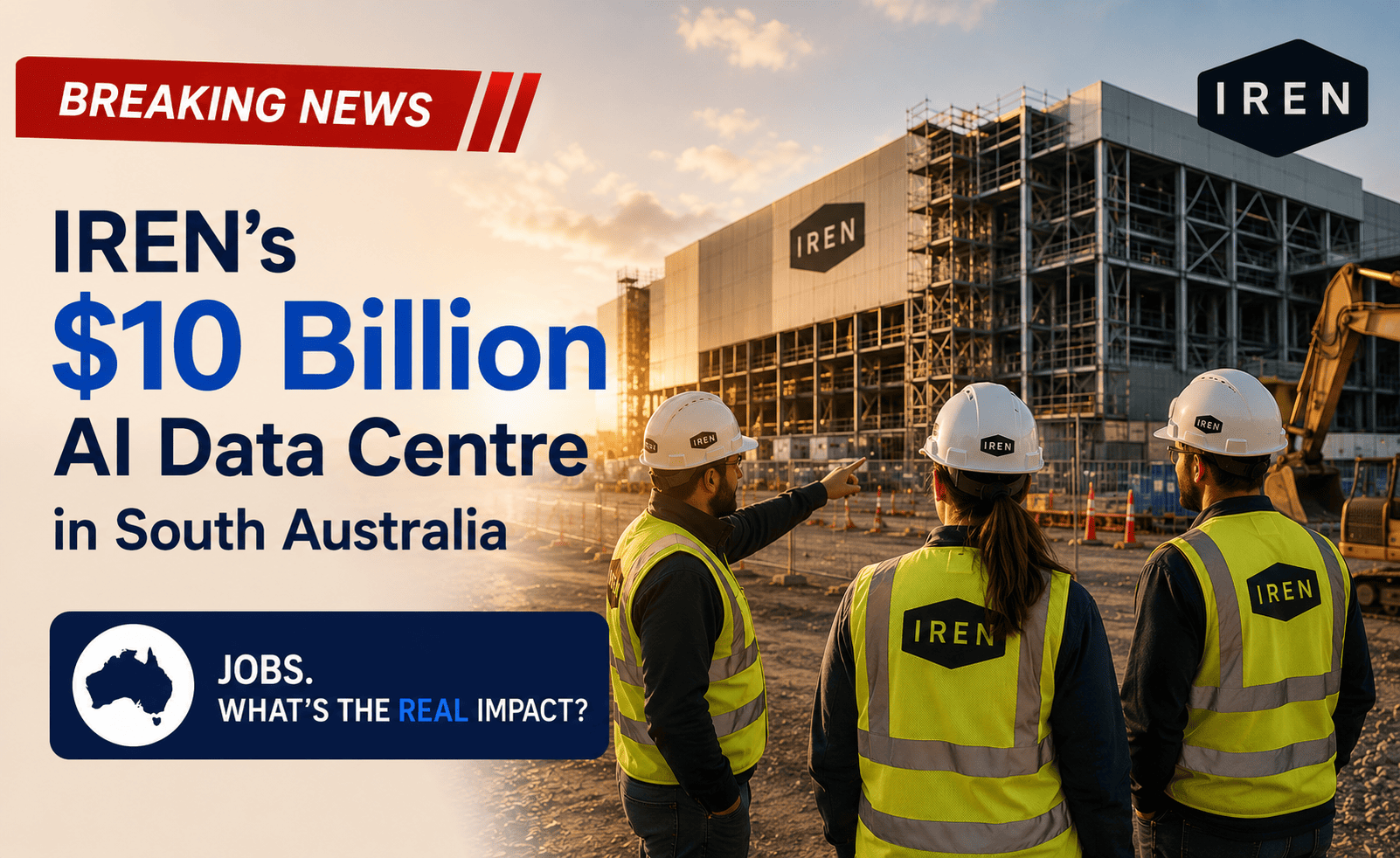
| Project | 800 MW AI data centre campus at Bundey, South Australia |
| Developer | IREN Limited (Nasdaq: IREN), founded by Australian brothers Daniel and Will Roberts |
| Estimated cost | About $10 billion |
| Announced | 3 June 2026 |
| Construction jobs | More than 500 |
| Ongoing skilled jobs | More than 200 |
| First power | Staged from 2028 |
| Status | Transmission connection agreement signed; regulatory approval still required |
A project on a scale Australia has not seen
IREN, the Nasdaq-listed technology company founded by Australian brothers Daniel and Will Roberts, announced on 3 June 2026 that it had signed a transmission connection agreement for an 800 megawatt artificial intelligence data center campus at Bundey, in South Australia’s Mid North, roughly 125 kilometers north-east of Adelaide. Reported at around $10 billion, the facility would be more than twice the size of any data center built in Australia to date, and one of the largest announced anywhere in the Asia-Pacific.
The site is an unusual choice. Bundey has had no permanent residents since 2021, but it sits beside the state’s largest electricity transformers and a major transmission hub, with submarine fibre links reaching Singapore, Indonesia, South Korea and Japan. That combination of cheap land, existing grid infrastructure and abundant clean power is exactly what IREN, formerly the Bitcoin miner Iris Energy, has been chasing as it pivots toward AI computing. The company already operates large sites across Texas, Oklahoma and Canada, and has described the Australian opportunity as among the most significant in its portfolio.
For South Australia, the appeal is the jobs and the prestige of hosting the country’s biggest AI facility. But the employment story is more layered than the two figures now doing the rounds in headlines.
The headline jobs figures
IREN says the Bundey campus will create more than 500 jobs during construction and more than 200 ongoing skilled roles once it is operational. South Australian Premier Peter Malinauskas welcomed the announcement, describing data centres as “a significant economic opportunity” capable of bringing high-quality jobs and new prospects to regional communities. The state has leaned hard into the sector, appointing the nation’s first dedicated Minister for Artificial Intelligence and promoting its renewable grid as a drawcard for power-hungry industry.
Those numbers are real, but they need unpacking. Construction jobs and operational jobs are very different things, and a $10 billion project that supports a little over 200 permanent roles says something important about how AI infrastructure actually employs people.
Where the work is: the construction phase
The bulk of the direct employment sits in the build, not in the running of the facility. Constructing an 800 megawatt campus is a multi-year civil and electrical undertaking. It draws in earthworks and concrete crews, electricians, mechanical and air-conditioning specialists, steel fabricators, fibre and network installers, plant operators, engineers, surveyors and project managers, alongside the administrative and logistics staff who keep a remote site moving.
IREN has said it is already beginning to assemble a local team, and the staged rollout from 2028 means construction labour would be needed across several years rather than in a single burst. For a depopulated part of regional South Australia, several hundred construction roles concentrated in one area is a meaningful injection, even if much of that work is temporary by nature.
The ongoing roles, and why 200 is the honest figure
Once a data centre is switched on, it runs on a comparatively small permanent crew. The 200-plus ongoing positions IREN describes would typically include data centre technicians, electrical and mechanical engineers, network and systems specialists, security personnel, and facilities teams who manage cooling, power and uptime around the clock.
This is the part of the AI boom that is easy to oversell. Data centres are capital-intensive, not labour-intensive. They concentrate enormous investment and electricity into highly automated facilities that, by design, do not need large workforces to operate. Two hundred permanent jobs for a $10 billion outlay is modest in headcount terms. What those jobs lack in volume, though, they make up for in quality and durability: they are skilled, well-paid, long-term roles landing in a region that has few of them, and they anchor a high-value industry in the state for decades.
The jobs you do not see: indirect and induced work
The official figures also understate total employment, because they count only the people IREN hires directly. Large infrastructure projects generate a second tier of work through their supply chains and the spending they trigger.
A build of this size pulls in materials, equipment and specialist contractors from across South Australia and beyond. The workers on site need accommodation, food, transport and services, supporting regional businesses through the construction years. There is also a natural overlap with the renewable energy sector: Bundey sits near some of the country’s largest wind, solar and battery developments, and a major new AI customer strengthens the case for further generation, storage and transmission projects, each with its own construction and maintenance workforce. Economists usually capture this through a multiplier, and for regional projects the indirect and induced jobs can comfortably exceed the direct ones.
What it means for Australian workers and their skills
For job seekers, the clearest message is about skills. The roles this project demands, both in the build and in operations, sit squarely in areas Australia is already short of: licensed electricians, refrigeration and air-conditioning technicians, network and systems engineers, cybersecurity professionals and data-centre operators. Demand for these trades and tech skills is rising faster than supply, and a wave of data-centre investment will only sharpen that competition.
That is also where the longer-term opportunity lies. South Australia has tied the announcement to its investment in higher education and training, and IREN has framed its arrival as a chance to, in co-chief executive Daniel Roberts’ words, “help build the skills and jobs the AI economy requires.” Whether that translates into apprenticeships, TAFE pathways and genuine local hiring, rather than fly-in specialists, will determine how much of the benefit actually reaches South Australian workers.
The strategic prize: Australia in the AI economy
Beyond Bundey, the project matters because of what it signals. Australia has watched much of the AI infrastructure wave land overseas. A facility of this scale, serving both domestic and Asia-Pacific demand, puts the country on the map as a place to build AI compute, not just consume it. Domestic capacity supports local startups, researchers and businesses that currently rent computing power abroad, and a successful first project tends to attract the next.
Australia is already in the middle of a data-centre boom, with operators racing to secure power and land. If Bundey proceeds smoothly, it strengthens the pipeline of similar developments, and it is that pipeline, rather than any single site, that adds up to durable employment across construction, energy and technology.
The caveats that could reshape the jobs picture
None of this is guaranteed. What IREN has secured so far is a transmission connection agreement, not full development approval. The project still has to pass formal assessment, including environmental review and community consultation, before construction can begin. The job numbers are projections attached to that approval, not commitments already in hand.
There is local resistance, too. Nearby landholders have raised concerns about the development’s water requirements and its potential draw on the already stressed River Murray, and some say the proposal arrived with little warning. How those issues are resolved will shape both the timeline and the social licence the project depends on. For now, the employment benefits remain a forecast tied to a facility that has cleared its first hurdle but not its last.
What to watch next?
The next milestones are regulatory. Approval decisions, the start of early works and procurement, and IREN’s local hiring commitments will show whether the headline figures hold. Also worth watching is how the project dovetails with South Australia’s renewable build-out, and whether it encourages further data-centre investment in the state. If it does, the lasting jobs story may be less about the 700 or so roles at Bundey and more about the industry the project helps put down roots in Australia.