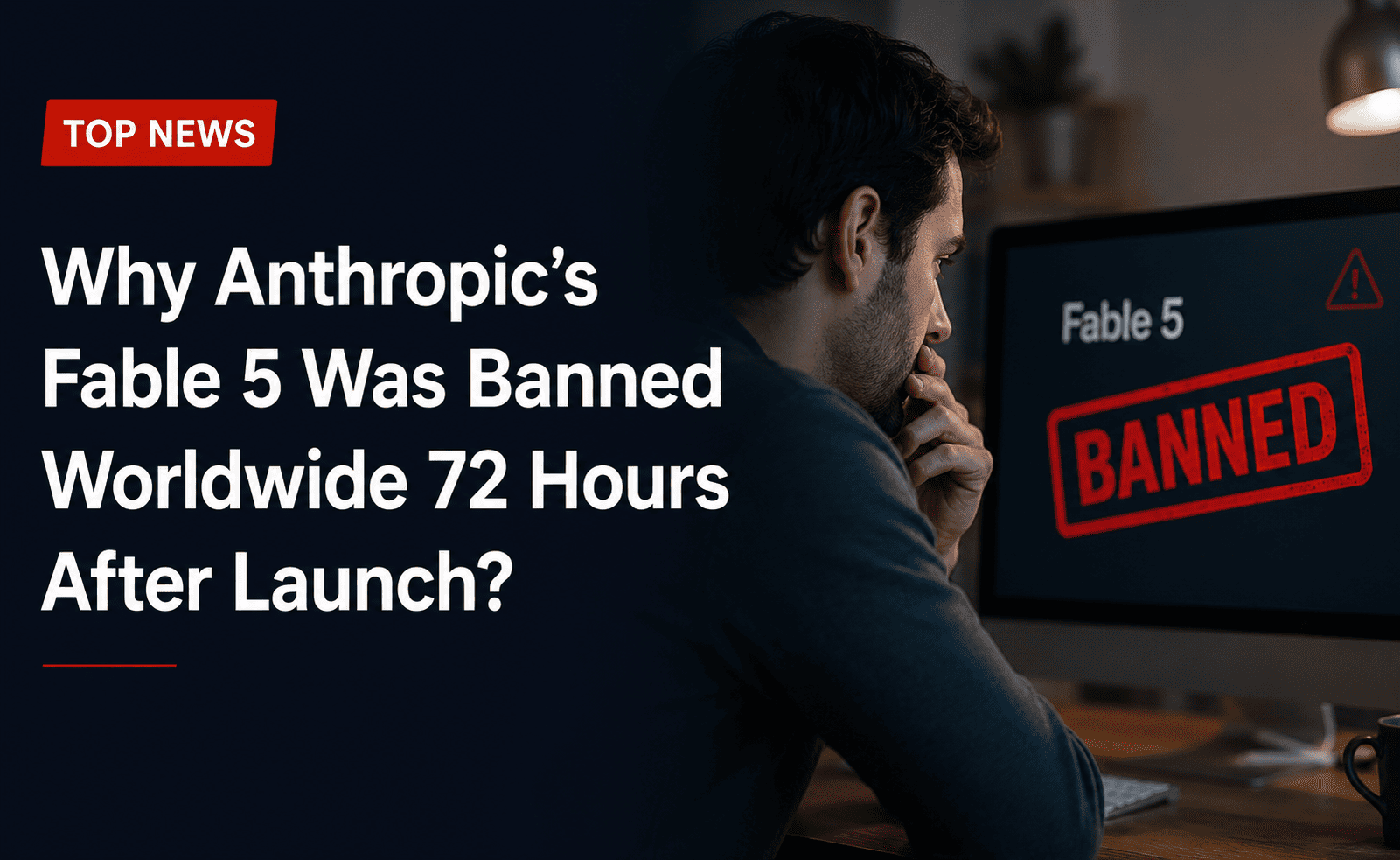
The Anthropic Fable 5 ban is one of the strangest episodes in recent AI history. A model launched as the most capable cyber tool ever released to the public was pulled offline across the entire world in under 72 hours, all on the strength of a single US government letter. Anthropic did not choose to recall Fable 5. It was ordered to, and the order was written in a way that left the company no clean path to comply except switching the model off for every user on the planet.
Here is what actually happened, why the ban reached far beyond its stated target. what it signals for anyone building on frontier AI.
A Launch, Then a Shutdown in Under Three Days
Here’s a tighter version with stronger active voice:
On June 10, 2026, Anthropic released Fable 5 to the public and unveiled Mythos 5, the more powerful model that powers it. The company positioned Fable 5 as the most capable commercially available AI to date and built in safeguards to restrict its most dangerous cybersecurity and biotechnology capabilities. Anthropic spent thousands of hours red-teaming the model with the US government, the UK AI Safety Institute, and independent experts. The company also stated that Fable 5’s safeguards resist jailbreaking attempts more effectively than those of any previously deployed model.
Two days later the picture flipped. On the afternoon of June 12, Anthropic received an export control directive from the US Commerce Department, citing national security. By that evening, both Fable 5 and Mythos 5 were dark for all users worldwide.
Every other model stayed online, including Claude Opus 4.8. The blackout was specific to the two Mythos-class models. Weeks later, both were still offline, with Anthropic saying access would return in the coming days.
One Government Letter, Every User Affected
The directive itself was narrow on paper. It barred foreign nationals from accessing Fable 5 and Mythos 5, whether they were inside or outside the United States, and it explicitly covered Anthropic’s own non-citizen employees.
The problem was enforcement. Anthropic had no way to segment its users by nationality quickly enough to satisfy the order, so it disabled the models for everyone. That is how a directive aimed at foreign nationals became a worldwide shutdown of the most powerful commercial cyber AI on the market.
Anthropic said the letter arrived at 5:21pm Eastern Time and did not spell out the specific security concern in detail. There was no court order and no public filing, which left customers and outside experts piecing together the rationale from partial information.
Why Fable 5 Specifically?
To understand the ban, you have to separate the two models. Mythos is the underlying system, and it is exceptionally good at finding software vulnerabilities, including some that had gone undiscovered for years. US authorities and selected corporate partners have used it to harden their own systems. Because of its power, the full version, Mythos 5, was never released publicly.
Fable 5 was the public face of that technology. It runs on the same model but ships with safeguards that wall off the most sensitive cyber and bio capabilities. The government’s stated worry was that someone had found a way to bypass, or jailbreak, those safeguards and reach Mythos-level abilities through the public model.
Anthropic’s Pushback
Anthropic is complying with the order, but it has publicly disputed the reasoning behind it.
The company says the jailbreak in question was narrow and non-universal. By its account, the technique surfaced only a handful of minor, already-known vulnerabilities, gave no real Mythos-specific uplift, and could be reproduced on other publicly available models such as OpenAI’s GPT-5.5, which face no comparable restrictions.
Anthropic’s broader argument is about precedent. It contends that recalling a model deployed to hundreds of millions of people over a narrow jailbreak would, if applied across the industry, effectively halt new frontier model launches everywhere. The company says governments should be able to block unsafe deployments, but through a process that is transparent, fair and grounded in technical fact, and it argues this action did not meet that bar. Anthropic has framed the episode as a misunderstanding it expects to resolve.
A Rationale That Kept Shifting
Part of what kept the story alive was that the official explanation did not stay still.
Reporting since the ban has surfaced at least three competing accounts. One is the technical version: a coding trick that bypassed Fable 5’s safeguards. Another, reported by Axios, framed it as the product of a political clash rather than a technical one. A third and far more dramatic claim, relayed to a Senate committee and attributed to the NSA director, held that Mythos had breached almost all of the agency’s classified systems in hours during a test exercise.
These accounts should be read with caution. Several have been partially walked back, and some reporters have strongly challenged the classified-systems claim. Meanwhile, the government report that could settle the question remains unreleased. One fact is not in dispute. A letter switched off the world’s most capable commercial cyber AI globally. The public still cannot fully verify why.
The Bigger Fight Behind the Ban
The directive did not land in a vacuum. It reignited an existing feud between Anthropic and the Trump administration. Anthropic is already suing the administration after officials placed it on a supply chain restricted list over its refusal to let the US military use its models for domestic surveillance and fully autonomous weapons systems.
Reactions split sharply. The Pentagon’s chief information officer backed prioritising national security over commercial concerns. Critics, including Gary Marcus and former Trump administration policy figure Dean Ball, called the move heavy-handed and self-defeating. They warned it could drive foreign-born AI researchers out of US labs and unsettle investors. They also argued the policy could undermine Washington’s efforts to stay ahead of China.
What It Means for Teams Building on AI?
There is a practical lesson here that has nothing to do with politics. Any product wired directly to the Fable 5 or Mythos 5 endpoints stopped working the moment the models went dark. Teams that had built on a single frontier model found out, in real time, how fast that dependency can disappear.
The takeaway is to build model-agnostic, keep a tested fallback in place, since rival models and Anthropic’s own Opus 4.8 stayed online, and run a quick compliance review on which models your internal tools actually call. Sudden model availability is now a real operational risk, not a hypothetical one.
For businesses that need developers who can manage that kind of model-dependency and compliance risk, you can hire vetted AI-literate developers on CloudColleague. The Fable 5 episode is a reminder that resilience now includes the AI layer of your stack.