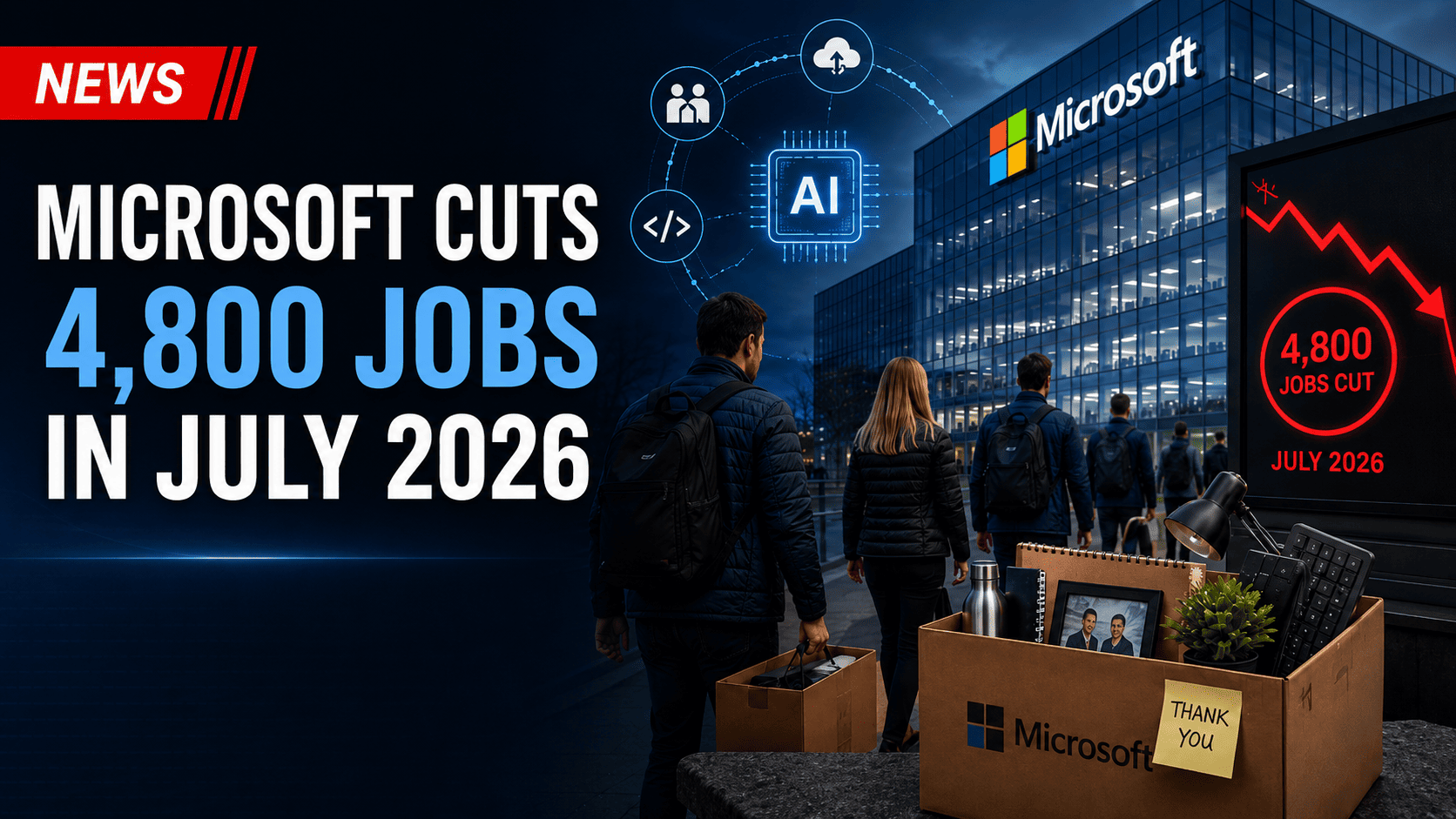
Microsoft on Monday 6 July 2026 announced it will eliminate 4,800 jobs, roughly 2.1% of its 220,000-person workforce, in what CEO of gaming Asha Sharma called the most significant restructure in Xbox history. Australian Microsoft staff are among those affected, though the company has not disclosed which local teams will lose roles.
The announcement is more than another round of Big Tech redundancies. It arrives just three weeks after Microsoft CEO Satya Nadella published an unusually philosophical essay warning that AI must not be allowed to hollow out entire industries, and just six weeks after Microsoft’s own reports revealed that AI usage inside the company was costing more per engineer than a human employee. If you work in tech in Australia, the contradiction sitting inside those three data points is exactly the story you need to understand.
This piece covers what Microsoft announced, why the layoffs happened despite Microsoft’s own warnings about AI cost, whether the company is quietly hiring AI-fluent workers to replace those cut, and what the Australian IT job market looks like on the other side of the largest tech restructuring cycle since 2001.
| The story in 55 words Microsoft is cutting 4,800 jobs globally in July 2026, or 2.1% of its workforce, with 1,600 immediate Xbox layoffs and 3,200 gaming roles gone by FY27. Microsoft Australia’s 3,000 staff across six offices are affected. The company says the roles are not being replaced by AI, but the cuts land as Microsoft channels $190 billion into AI infrastructure. |
What Microsoft actually announced on 6 July 2026?
The numbers came out in three memos, one internal-then-public statement from Chief People Officer Amy Coleman, one from Xbox CEO Asha Sharma, and a follow-up interview by Microsoft president Brad Smith with GeekWire. Between them, they define the shape of the cut.
The topline numbers
| Metric | Figure | Notes |
| Total roles cut | 4,800 | 2.1% of Microsoft’s global workforce |
| Xbox roles cut immediately | 1,600 | Announced Monday, exits underway |
| Total Xbox roles cut through FY27 | 3,200 | Approx. 20% of the global Xbox workforce |
| Roles cut in Washington state | 605 | Confirmed via WARN Act filing |
| Global workforce before cuts | 220,000 | Confirmed by Microsoft |
| Microsoft Australia headcount | ~3,000 | Across six Australian offices |
| Australian roles affected | Not yet disclosed | Company confirming individually |
The Xbox restructure, in plain terms
Xbox is the deepest cut. On top of the 1,600 immediate exits, Xbox will lose a further 1,600 roles through the 2027 financial year, taking the total gaming reduction to about 3,200 people. Xbox is also flattening its management structure from 14 layers to a target of three to five, and spinning off four studios: Compulsion Games (South of Midnight) and Double Fine Productions (Psychonauts) will become independent, while Ninja Theory (Senua) and Undead Labs (State of Decay 3) will be spun off to grow their existing franchises.
Longtime Xbox executive Helen Chiang has been named chief operating officer of the gaming division with end-to-end profit and loss authority across content, hardware, platform, and services. Xbox’s stated new focus is on its two proven money-makers: Mojang (Minecraft) and King (Candy Crush).
The commercial and consulting cuts
The layoffs also hit Microsoft’s commercial and consulting teams. Coleman’s memo indicated the reductions are designed to reshape how Microsoft sells and delivers services to enterprise customers, particularly around AI. This is the piece that connects directly to Microsoft’s new $2.5 billion Microsoft Frontier Company initiative, launched just days before the layoffs, which embeds up to 6,000 engineers inside customer organisations to deploy AI at enterprise scale.
What the layoffs mean for Australian Microsoft workers?
Microsoft Australia employs about 3,000 people across six offices, including Sydney, Melbourne, Canberra, Brisbane, Perth, and Adelaide. As of publication on 8 July 2026, the company has not disclosed how many Australian roles are affected or which teams. Precedent from previous Microsoft global cuts suggests Australian layoffs typically track close to the global percentage, which would imply between 45 and 70 Australian positions on a 2.1% ratio, though gaming-heavy cuts could push that number lower given Microsoft Australia’s smaller Xbox footprint.
Affected Australian workers are eligible for standard Australian redundancy entitlements under the National Employment Standards, including notice periods and redundancy pay based on length of service, plus any additional package Microsoft chooses to offer. Fair Work Ombudsman guidance on redundancy remains the baseline.
If AI is more expensive than humans, why is Microsoft cutting jobs to invest in AI?
This is the question most readers will not see answered anywhere else, because it requires holding two Microsoft data points side by side that Microsoft’s public communications keep apart.
Data point 1: Microsoft’s own reports say AI costs more than employees
In May 2026, Fortune reported that Microsoft had begun cancelling most of its direct Claude Code licenses after monthly usage rates among Microsoft engineers reached 84 to 95%, with per-engineer AI API costs ranging between $500 and $2,000 per month. Microsoft was reportedly exhausting portions of its annual AI budget in months, not years. The story exposed a bigger problem: for many white-collar roles at Microsoft, giving an engineer unrestricted access to frontier AI models was costing the company more than employing that engineer’s time in the first place.
The economic logic that AI would replace expensive humans with cheap software has, at least at scale inside Microsoft, so far failed to hold.
Data point 2: Microsoft is spending $190 billion on AI infrastructure this year anyway
Microsoft’s capital expenditure hit $37.5 billion in a single quarter in early 2026, up nearly 66% year on year, and the company has guided to roughly $190 billion in total capex for the 2026 calendar year. Almost all of that is going into AI infrastructure: data centres, GPUs, cooling systems, power contracts, and the physical build-out required to run frontier AI models at Azure scale.
Data point 3: Wall Street has punished Microsoft for it
Microsoft shares fell roughly 20 to 30% in the first six months of 2026, wiping out approximately $1.2 trillion in market value over nine months. The company was the worst-performing megacap tech stock in the first half of 2026. Shareholders have filed a proposed class-action lawsuit in Seattle federal court accusing Microsoft of inflating its stock price by failing to disclose slowing Azure growth and the scale of AI infrastructure spending required to sustain the story.
Data point 4: The 4,800 layoffs are the pressure valve
Put the three facts together and the layoffs make painful commercial sense. Microsoft cannot cut AI spending, because AI is the entire investor narrative that supports the stock. Microsoft cannot deliver AI-driven revenue growth fast enough to justify the capex, because AI’s per-token cost is still uneconomic against its own workforce. And Microsoft cannot keep operating expenses flat while continuing to spend $190 billion on infrastructure. The only lever left is headcount.
The layoffs are not, strictly speaking, AI replacing humans. They are humans being cut to fund the AI investment that is expected to eventually replace some of them. That distinction matters, but it does not change the outcome for the people losing their jobs this week.
| If you have been affected by tech layoffs in Australia CloudColleague is Australia’s jobs and tasks marketplace. Create a free profile in three minutes, browse permanent roles across every state, or bridge cash flow with short paid tasks while you plan your next move. Sign up free on CloudColleague → |
Is Microsoft quietly hiring AI-fluent workers to replace the roles it just cut?
Yes, but not one-for-one, and not in the same categories. The pattern coming out of the July memos and interviews shows Microsoft reallocating headcount rather than restoring it.
What Microsoft is expanding
- Microsoft Frontier Company. Launched days before the layoffs with a $2.5 billion investment, this new unit embeds up to 6,000 engineers inside customer organisations to deploy AI at enterprise scale. These are hybrid roles: part software engineer, part consultant, part product manager. They are being recruited actively.
- Customer-facing and AI-focused engineering. Coleman confirmed the company has redeployed more than 4,000 employees into new roles over the past year, including 500 in the month of June alone. The direction of the redeployment is toward customer-embedded and AI-adjacent work.
- Product management and AI product design. In his GeekWire interview, Microsoft president Brad Smith noted that while coding requires less software developer time in an AI-assisted workflow, there is growing demand for product management, software design, and customer-facing engineering.
- AI infrastructure roles. Data centre engineering, power systems, cooling design, GPU procurement, and cloud architecture are all growing headcount categories at Microsoft globally, though these hires concentrate near data centre sites rather than in Australia.
What Microsoft is contracting
- Individual-contributor coding roles where AI tools have absorbed the routine work. Especially at mid-level, where senior developers still command the design and review, and juniors are increasingly hard to justify.
- Traditional sales and account management roles that do not carry AI deployment expertise. The commercial cuts are targeted at this profile.
- Xbox-specific game design, production, and platform engineering roles tied to studios being spun off or shut down.
- Middle management, particularly in gaming. Xbox is compressing 14 management layers to three-to-five. Similar flattening is likely elsewhere as the company reduces layers to speed decision-making.
The net picture: Microsoft is not hiring AI-updated employees in a one-for-one exchange. It is transferring headcount out of maintenance and delivery categories and into AI deployment, customer-embedded consulting, and product management roles. Workers with AI fluency who can also sell, design, or embed are the winners inside this transition. Workers with only routine execution skills are the losers.
What Satya Nadella actually said about AI, and why it contradicts these layoffs?
On 14 June 2026, three weeks before the layoffs, Nadella published a public essay on X titled “A frontier without an ecosystem is not stable.” In it, he argued that if a small number of AI models capture all the value of the AI economy, the result will be politically unsustainable. His central line was that there is no social permission for an AI future that hollows out entire industries.
A week later, in a Wall Street Journal interview on 21 June, Nadella went further. He argued that a scenario where all white-collar jobs are gone and all capital is directed into data centres is not one society will accept.
On 6 July, Microsoft laid off 4,800 people, primarily white-collar workers in gaming, sales, and consulting, and simultaneously announced a $2.5 billion initiative to embed engineers inside customers to deploy AI at scale, funded in part by a $190 billion annual capex program on data centres and AI infrastructure.
The contradiction between Nadella’s public position and Microsoft’s operational actions is not subtle. Industry commentators have pointed it out; IBTimes ran a headline directly framing Nadella’s essay as a warning that his own workforce is now living out. The most charitable reading of the gap is that Nadella is genuinely worried about the long-term societal effect while running a business that has short-term shareholder pressure Microsoft cannot escape. The less charitable reading, which the Seattle class action seems to embrace, is that Microsoft’s public AI narrative and its actual AI economics have diverged.
For Australian tech workers, the practical takeaway is simpler. The public commentary from Big Tech CEOs about AI’s limits will not stop the layoffs. Assume the pattern continues, and plan accordingly.
What comes next for the Australian IT job market?
The Australian IT job market in the second half of 2026 will not look like a mirror of the US market. Three structural differences protect Australian tech workers from the worst US pattern, and three risks amplify it.
Three structural protections
- Persistent shortage. Jobs and Skills Australia’s 2025 Occupation Shortage List shows 139 occupations have been in shortage every year from 2021 to 2025, and Information and Communication Technology remains one of the most persistently short. Australian employers are still trying to hire faster than they can find qualified candidates.
- Cybersecurity demand. Cybersecurity engineering, incident response, and cloud security roles are in acute demand in Australia in 2026, driven by government mandates, regulated industries, and the same AI security concerns that are driving budgets globally. This category has essentially no automation exposure.
- Public sector and regulated industries. Federal and state government, healthcare, education, energy, and financial services are all continuing to hire IT workers steadily. These employers are legally, culturally, and operationally slower to automate than US Big Tech.
Three amplifying risks
- Copycat layoffs. When a company as visible as Microsoft cuts jobs, other Australian tech employers often follow within one or two quarters. Watch for announcements from Australian arms of Amazon, Google, Oracle, Salesforce, Meta, and IBM in the September to December window.
- Junior role compression. Entry-level developer and analyst roles are the most exposed to AI-assisted workflows. Australian employers are quietly reducing graduate intake in these categories, mirroring US patterns.
- Salary compression at the middle. Mid-level developers without AI fluency are seeing offer letters trend flat or decline year-on-year, while AI-fluent mid-level developers, product managers, and cloud engineers are seeing 10 to 20% salary growth. The middle is being pulled in two directions.
The Australian IT roles growing hardest in 2026
| Role category | Demand signal | Salary range (AUD, per year) |
| AI implementation engineer / AI deployment specialist | Very high, mostly enterprise | $130,000 to $220,000+ |
| Cybersecurity engineer, cloud security architect | Acute, government + regulated | $140,000 to $230,000+ |
| Cloud architect (Azure, AWS, GCP) | High, stable | $150,000 to $250,000 |
| Data engineer, ML platform engineer | High | $140,000 to $220,000 |
| AI product manager | Growing rapidly | $150,000 to $240,000 |
| Prompt engineer / model evaluation specialist | Emerging, high growth | $110,000 to $180,000 |
| Full-stack developer with AI fluency | High | $110,000 to $180,000 |
| Junior developer without AI fluency | Contracting | $65,000 to $95,000 |
Salary ranges above are indicative and drawn from live listings across Australian job boards in July 2026. Actual offers vary by employer, city, and specific stack. ABS Average Weekly Earnings and Fair Work Commission benchmarks remain the defensible external anchors for any negotiation.
What Australian tech workers should do right now?
Whether you have been laid off, work at a company that might follow Microsoft’s lead, or simply want to defend your career against the next 18 months of restructuring, four actions matter more than everything else.
1. Add proven AI fluency to your resume this quarter
Not AI awareness. Not “exposure to AI tools.” Proven fluency, evidenced by shipped work. That means using an AI assistant across a real project, documenting outcomes with numbers (time saved, defects reduced, feature velocity increased), and being able to speak confidently about which model to use for which problem. AI fluency without evidence carries almost no weight in a 2026 Australian interview.
2. Position toward customer-embedded, product-adjacent, or security roles
These are the three categories least exposed to AI automation and most likely to see hiring growth over the next 18 months. If your current role is pure individual-contributor coding, deliberately take on scope in customer conversations, product decisions, or security reviews before your next role change.
3. Keep cash flow steady if a search takes months
A senior tech role search in Australia in 2026 is taking 10 to 20 weeks on average. If your redundancy package or savings do not comfortably cover that window, short paid tasks are a legitimate bridge. Tasks on CloudColleague cover digital work (design, dev, content, admin) at $45 to $150 per hour depending on category, with a flat 7% completion fee and no upfront costs. Two or three tasks per week can generate $1,000 to $4,000 without interfering with interview availability.
4. Apply strategically, not spray-and-pray
Five to eight tailored applications per week to well-fitting roles outperforms 30 mass applications every time, and this is more true in a 2026 employer market where recruiters see hundreds of applications per listing. Browse open Australian tech roles on CloudColleague, filter to your target level and location, and go deep on the roles that fit.