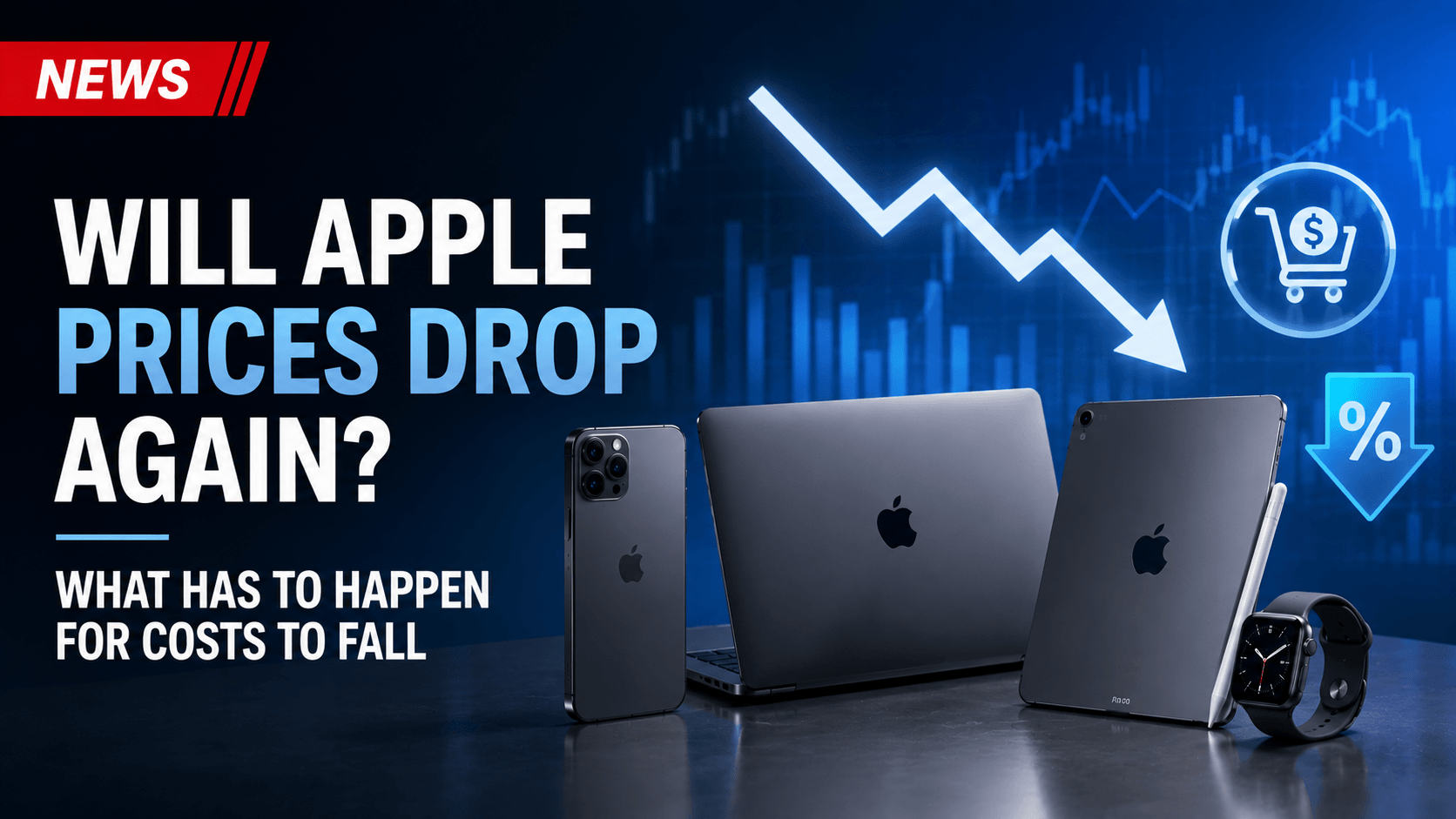
Will Apple prices drop back to where they were? It is the question on every shopper’s mind after the Apple price increase 2026, and the honest answer is nuanced. Prices could ease eventually, but several things must happen first, and most of them lie years away rather than months.
Tim Cook has framed the shortage as temporary, saying he expects memory pricing and supply to “return to reasonable levels for consumer products.” Many independent analysts disagree, and that disagreement sits at the heart of the forecast.
Why Apple raised prices in the first place?
Apple raised prices because memory and storage costs surged to record highs. The global memory shortage pushed component prices up so sharply that the company said it could no longer absorb them. This matters for the outlook, because prices will only fall if that underlying cost pressure eases.
What needs to happen for Apple prices to drop?
Three conditions must align before Apple prices retreat:
- Memory supply must grow enough to serve AI and consumer demand at the same time.
- Chipmakers must choose to produce more consumer memory again, rather than higher margin AI memory.
- Component costs must fall far enough for Apple to pass savings back to buyers.
Until those line up, expect stable to higher pricing. That outlook directly shapes our buy now or wait advice.
When the memory market might recover?
Recovery depends on new factory capacity, and that takes time. A new chip fab takes two to three years to build, and most announced projects will not deliver volume until 2027 at the earliest.
Forecasts cluster around that horizon. Micron chief executive Sanjay Mehrotra expects improvement by 2028, while Counterpoint Research points to late 2027 for any inflection. Intel’s Lip-Bu Tan has been blunter, warning of “no relief until 2028.”
“IDC describes the underlying shik as a permanent reallocation of manufacturing capacity, not a cyclical shortage.”
Industry analysis, June 2026
Supply chain improvements and wild cards
Beyond new factories, the industry needs balance to return, which means AI demand growth slowing or supply expanding fast enough to serve both markets. Software could help too. Google’s TurboQuant compression technology, announced in March, claims to cut memory use sharply in some AI workloads.
However, analysts caution about the Jevons paradox, the idea that cheaper or more efficient memory often spurs even more usage, which can offset the savings. So efficiency gains alone may not rescue consumer prices.
The risks that could keep prices high
Several risks point to a longer squeeze. Long term, take or pay contracts between memory makers and AI giants lock in demand and remove the market’s usual self correction. Micron has already sold out much of its high bandwidth memory capacity under such agreements.
More fundamentally, IDC describes the shift as a permanent reallocation toward AI. If that view holds, consumer prices may never fully return to 2024 levels, even after the acute crunch eases, because chipmakers retain the option to stay in profitable AI production.
What the analyst forecasts say?
The expert consensus leans cautious across the board:
- Counterpoint Research: relief no earlier than late 2027.
- Intel leadership: no real relief until 2028.
- Micron: gradual improvement by 2028.
- One industry analysis: pressure possibly lasting toward 2030.
Fortune summarised the mood well, reporting that few expect the crisis to subside soon.
What consumers should realistically expect?
Plan for higher prices through 2026 and likely into 2027. A gradual easing may begin late in that window, but a full return to old prices looks unlikely on current evidence. In the meantime, shop smart.
Compare value with our best MacBook alternatives, and watch the iPhone 18 price hike forecast for the next major signal of where Apple pricing heads next.