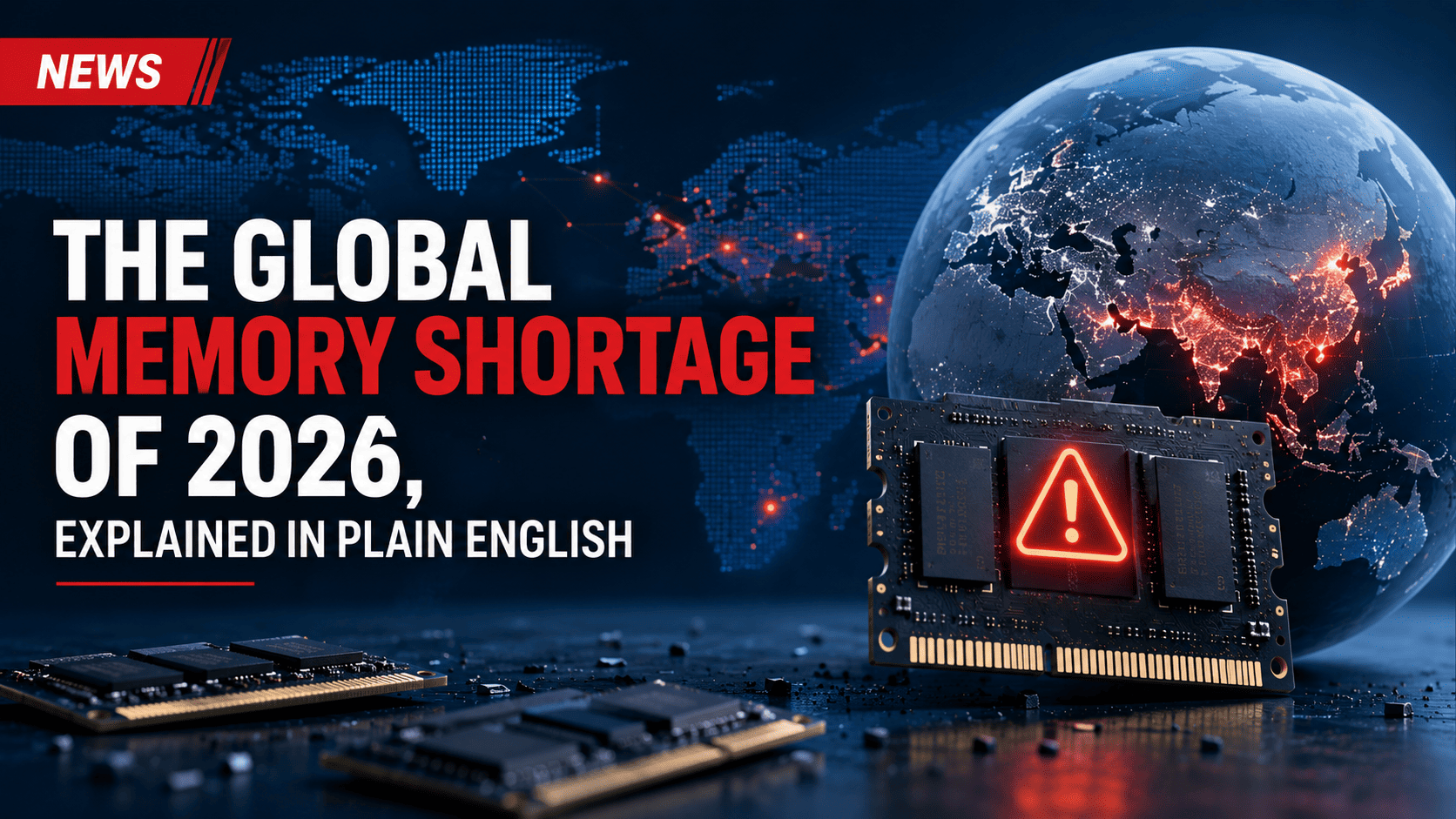
The global memory shortage 2026 is the single biggest force reshaping technology prices this year. It explains why your next laptop, phone or console costs more, even with no new features, and why a company as powerful as Apple was forced to raise prices it almost never touches.
This explainer breaks the crisis down in plain English, with the data and expert views that show how serious it has become. The short version: artificial intelligence is consuming memory faster than the world can make it.
What is a memory shortage?
A memory shortage occurs when demand for memory chips outpaces supply, so buyers compete for limited stock and prices climb quickly. Two chip types sit at the centre of this crisis. DRAM handles active data for fast access, while NAND flash stores files on SSDs and inside phones.
Both became scarce at once, which made the 2026 shock unusually severe. Gartner research director Ranjit Atwal summed up the mood, saying the speed of the price increases “has shocked everybody.”
How RAM and NAND flash are made?
RAM and NAND are built on silicon wafers inside highly specialised factories that cost billions of dollars and take years to expand. Each wafer can be turned into different products, depending on what the manufacturer chooses to make, and that flexibility is the root of the problem.
When makers shift wafers toward AI memory, fewer wafers remain for the standard chips inside consumer devices. Because capacity is essentially fixed in the short term, any spike in demand pushes prices up fast, exactly as it did in 2026.
What started the global memory shortage of 2026?
The trigger was the AI boom. Demand for high bandwidth memory, used in AI servers, surged far beyond anything the industry had planned for, and chipmakers rushed to serve it.
Crucially, this shortage differs from the pandemic era crunch of 2020 to 2022. That earlier crisis stemmed from supply chain disruption and corrected itself once those issues cleared. The current shortage is structural. Manufacturers are not failing to produce chips. Instead, they are choosing to make a different, more profitable kind, as a detailed overview of the shortage documents.
“The memory environment is tough and remains structurally tough for the foreseeable future.” Ben Bajarin, CEO, Creative Strategies
The role of AI demand
AI demand is relentless and still growing. The shift from training models to running them, known as inference, multiplies memory needs even further, since each query can trigger continuous cycles of computation.
TrendForce now projects the global memory market will swell to roughly $889 billion in 2026 and surpass $1.28 trillion in 2027, growth driven by price rather than volume. We explore that dynamic in our piece on AI data centres and consumer electronics.
Why supply cannot respond quickly?
High bandwidth memory makes the squeeze worse, because it uses several times more wafer capacity per bit than standard memory, so producing it drains supply quickly. It also needs a special advanced packaging step that faces its own bottleneck.
As a result, makers cannot simply switch production back to consumer memory overnight. The tools and lines for high bandwidth memory are dedicated and cannot be repurposed in a hurry.
How this shortage differs from the past?
Previous memory crunches, including those in 2017 and during the pandemic, resolved within roughly 16 to 22 months as manufacturers expanded output and the market rebalanced. This time, the usual self correcting mechanism is broken.
The reason is contracts. Memory makers and AI hyperscalers have signed long term, take or pay agreements that lock in demand, so chipmakers have a durable incentive to keep producing AI memory rather than return to consumer chips. Counterpoint Research found the distortion is so deep that older DDR4 spot prices now exceed advanced HBM3e on a per gigabit basis.
Expected recovery timeline
Forecasts vary, but none are short. Micron chief executive Sanjay Mehrotra expects the shortage to last through 2027, with gradual improvement by 2028. Counterpoint Research points to late 2027 at the earliest, while Intel’s Lip-Bu Tan has warned of “no relief until 2028.”
One analysis is bleaker still, suggesting the squeeze could persist toward 2030. We compile every estimate in will Apple prices return to normal. For now, the Apple price increase 2026 stands as a direct symptom of this shortage.