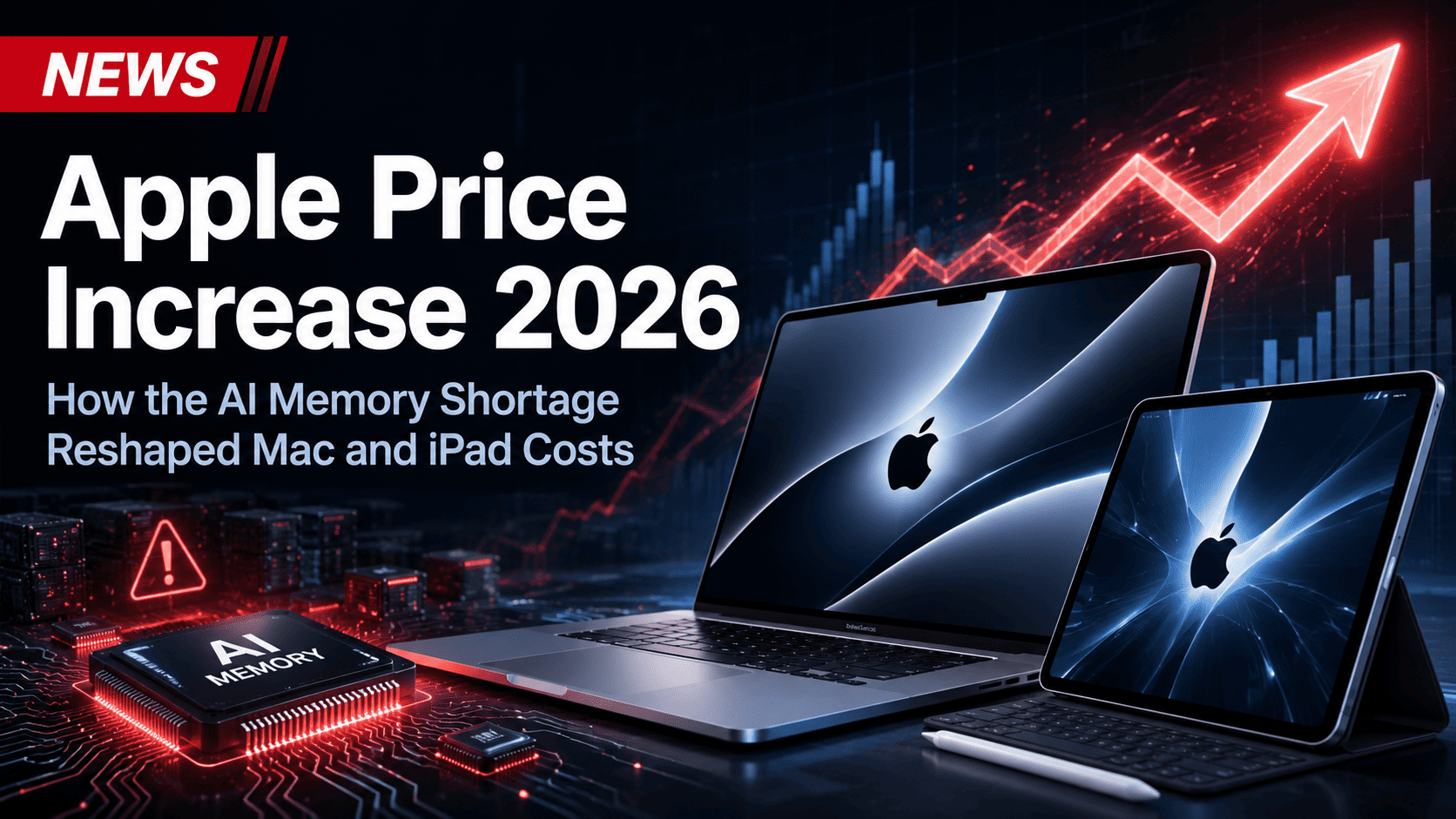
The Apple price increase 2026 arrived on Thursday 25 June, and it broke one of the company’s oldest habits. Apple raised prices across nearly its entire hardware lineup mid cycle, added no new features to justify the change, and blamed a single force: a brutal shortage of memory and storage chips driven by the AI boom.
The new figures went live globally on Apple’s online store the same morning. The store briefly went dark, then returned with the higher prices already in place, according to Bloomberg. Investors reacted within hours. Apple shares fell 6.12 percent to $275.15, the stock’s worst single session since the April 2025 market selloff, while the Nasdaq slid 1.4 percent on fears about what rising memory costs mean for the wider tech sector.
In a statement issued to several outlets, Apple did not hedge. “We have never seen a component price increase this much, this quickly,” the company said, adding that the rapid expansion of AI data centers had “created an extraordinary surge in demand for memory and storage.”
What changed in the Apple price increase 2026?
Apple lifted prices on Macs, iPads, the Apple TV, the HomePod and the Apple Vision Pro. Some Mac models rose by as much as $300. The entry level MacBook Neo, launched only in March as Apple’s budget play, climbed from $599 to $699, erasing the price edge it had carefully built against cheap Windows laptops and Chromebooks.
The headline changes break down as follows, based on figures confirmed by PBS and Fox Business:
- MacBook Neo: $599 to $699, a $100 increase on the budget laptop.
- MacBook Air, 512GB: $1,099 to $1,299.
- MacBook Pro, 1TB: $1,699 to $1,999.
- iPad Air, 128GB: $599 to $749, and the iPad Pro 256GB Wi-Fi: $999 to $1,199.
- Apple TV: $129 to $199, HomePod: $299 to $349, and Apple Vision Pro: up $200 to $3,699.
Crucially, Apple left the iPhone, Apple Watch and AirPods untouched, at least for now. For the complete model by model breakdown, see our full list of Apple products that increased in price.
Why Apple raised prices when it almost never does?
Apple rarely touches the price of an existing product, so the move signalled real pressure inside the supply chain. CEO Tim Cook had spent weeks preparing the ground. Earlier in June, he told The Wall Street Journal that price increases were “unavoidable” and that the situation had “become unsustainable.”
Cook described the memory crunch in stark terms, reportedly calling it a once in a generation event. Apple’s statement leaned on the same logic, noting that the company had shielded customers for as long as it could before reaching “a point where we need to begin raising prices.” Analysts seized on that single word, begin, reading it as a clear warning that further increases lie ahead.
| “The memory environment is tough and remains structurally tough for the foreseeable future.” Ben Bajarin, CEO, Creative Strategies (via Reuters) |
How the AI memory shortage drove the increase?
The root cause sits far from Cupertino, inside the factories of three dominant chipmakers. Samsung, SK Hynix and Micron together control more than 95 percent of global DRAM output, and all three have aggressively shifted capacity toward high bandwidth memory, the specialised chips that feed Nvidia’s AI accelerators.
The economics explain the pivot. High bandwidth memory carries gross margins near 60 percent, against roughly 40 percent for the commodity memory inside phones and laptops, and it earns several times more revenue per wafer. Therefore, every wafer redirected to AI is a wafer pulled away from consumer devices. Micron said it had locked in roughly $22 billion in long term commitments from customers racing to secure supply, as reported by Tom’s Hardware.
The price data underscores the scale. Conventional DRAM contract prices surged roughly 90 to 95 percent in the first quarter of 2026, a record, before climbing another 58 to 63 percent in the second quarter, according to industry tracker TrendForce. We unpack the mechanics in our explainer on the global memory shortage and the wider AI memory and SSD price surge.
What it means for Apple’s margins?
The increase reflects a hard financial choice. Apple posted a 49.3 percent gross margin in its March quarter, helped by a record services business near $31 billion. However, the company guided June quarter margins down to a range of 47.5 to 48.5 percent, and every 100 basis points of margin pressure removes roughly $3.8 billion from annual operating income.
Faced with that math, Apple could either absorb the cost and watch margins compress, or pass it to buyers and risk softening demand. On 25 June, it chose to pass it on. The market read the move as an admission that the cost problem is real and arriving fast, which helps explain the sharp drop in a stock that had logged only one other move larger than 5 percent all year.
An industry wide squeeze, not an Apple problem
Apple was far from first. Counterpoint Research noted that Apple had delayed its increases at least two quarters longer than rivals, protecting its user base while absorbing the hit. Microsoft, Samsung, Sony,
Dell, HP and Lenovo had already raised prices on affected lines before Apple acted, a pattern we detail in why other laptop brands are raising prices.
That context shaped the analyst reaction. “Apple showed that even the best operators can’t fully escape the memory squeeze,” said Jake Behan, head of capital markets at Direxion. Deutsche Bank analysts went further in a research note, describing memory production as “a zero-sum game” in which every wafer devoted to AI servers becomes unavailable for smartphones, PCs or vehicles.
What consumers should do now?
For shoppers, the increase changes the buying calculus. Budget buyers feel it most, since the Neo lost its value advantage overnight. Many experts now advise holding existing devices longer until the worst of the crunch passes.
If you are weighing a purchase, our buy now or wait guide compares both options with current data, and our roundup of the best MacBook alternatives helps you judge value across brands. The pressure is also unlikely to ease soon, a point we examine in will Apple prices return to normal.
What comes next?
The biggest open question is the iPhone. IDC senior director Nabila Popal warned that the small increases of years past are finished. “I think the days of $50 price increases are over,” she said, predicting that the magnitude of the Mac and iPad hikes points to a steeper iPhone increase this autumn. We track every analyst forecast in our iPhone 18 price hike report.