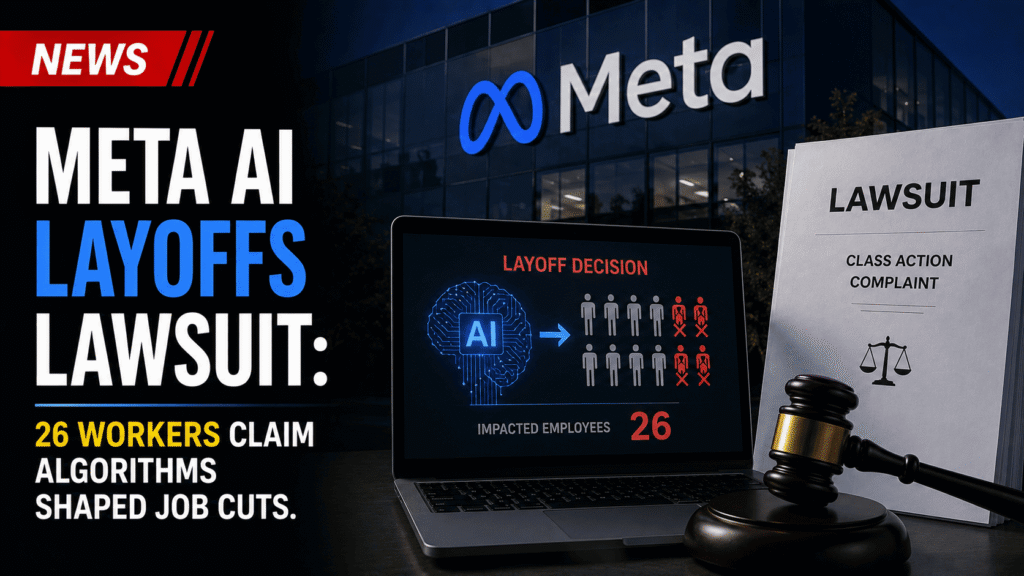
The Meta layoffs 2026 announcement sparked instant confusion, and two numbers sit at the center of it: 8,000 and 7,000. Many readers assumed both figures described the same event. They do not. One number counts people losing their jobs. The other counts people keep their jobs while moving to new teams. This article separates the two clearly, backs each claim with verified data, and explains why the story matters far beyond Menlo Park, especially for Australia’s tightening job market.
Meta Layoffs 2026: The 8,000 vs 7,000 Confusion, Cleared Up
Here is the simple version. Meta cut roughly 8,000 roles, and it separately moved about 7,000 staff into new AI teams. Both Reuters and Bloomberg reported the split, so the distinction is well documented.
The 8,000 figure represents the layoffs. These workers are leaving Meta entirely, mainly across engineering, product, and management. That total equal close to 10% of Meta’s workforce, which sat just under 80,000 at the end of March 2026.
The 7,000 figure represents internal transfers, not job losses. Meta’s Chief People Officer, Janelle Gale, confirmed these employees would move into newly created AI units, including Applied AI Engineering and the Agent Transformation Accelerator. In short, they stay employed.
Together, the two groups affect roughly 20% of Meta’s staff. However, only the 8,000 actually lose their jobs. The 7,000 simply change desks.
Quick comparison: the two Meta numbers side by side
| Factor | The 8,000 group | The 7,000 group |
| What happened | Roles eliminated | Roles reassigned |
| Employment status | Leaving Meta | Staying at Meta |
| Where they go next | The external job market | New internal AI teams |
| Share of workforce | About 10% | About 9% |
| Real impact | Job loss | Job change |
Why People Keep Merging the Two Meta Numbers?
Three factors fuel the mix-up. First, both numbers landed in the same week. Second, both trace back to the same cause, namely Meta’s pivot toward artificial intelligence. Third, the combined “20% of the workforce” headline blurred the line between cuts and transfers.
Timing made it worse. The rollout began on 20 May 2026 and moved across time zones. Singapore staff received their emails first, at 4am local time, followed by the United Kingdom and then the United States. Meta even asked North American employees to work from home that day.
As a result, fast-moving headlines often compressed “8,000 cut” and “7,000 moved” into one alarming figure. Careful readers, though, can see the two tracks clearly once the data sits side by side.
What Meta’s AI Restructuring Actually Signals?
Meta is not shrinking by accident. The company plans capital spending between $115 billion and $145 billion in 2026, largely on AI infrastructure. To fund that, it is reshaping its workforce around AI, with teams reorganised under Chief AI Officer Alexandr Wang and his Superintelligence Labs unit.
The leadership message is unusually candid. In a 12 June 2026 internal memo reviewed by Reuters, Zuckerberg admitted the company had made mistakes during the transition and warned that more could follow. Even so, he told staff Meta does not expect further company-wide layoffs in 2026.
This pattern extends well beyond one company. One 2026 layoff tracker found that 53% of recorded layoff events cited AI or automation as a factor, affecting roughly 155,000 workers. Analysts have even coined a term, “AI redundancy washing”, for firms that blame AI for cuts they would have made anyway.
How the Meta Layoffs 2026 Connect to Australia’s Job Market?
Meta’s decision lands in an Australian market already under pressure. The Australian Bureau of Statistics reported the unemployment rate rising to 4.5% in April 2026, its highest level since late 2021, with about 692,500 people out of work.
The local tech picture looks sharper still. The Australian Computer Society reported in March 2026 that Australia had climbed to second globally for tech job losses, while Sydney ranked third worldwide by volume. Local names such as WiseTech and Atlassian featured in that reshaping, and AI was named as the primary driver.
Demand has not vanished, though. ABS figures put total job vacancies at 337,900 in early 2026, with private-sector roles making up 299,000 of them. In other words, jobs still exist, but the skills employers want are shifting fast toward AI-literate work.
Real Problems Now Facing Australian Workers and Hirers
For workers, the first problem is the speed of re-entry. Global data shows the median time to re-employment for laid-off tech staff stretched to about 4.7 months in early 2026, up from 3.2 months in 2024. Longer searches strain savings during a cost-of-living squeeze.
The second problem is uneven demand. Indeed’s hiring data showed media and communications postings sitting 8% below their pre-pandemic baseline, while youth unemployment in Australia reached 11.1% in April 2026. Younger and content-focused workers therefore feel the pinch first.
For businesses, the challenge runs the other way. Many firms need AI-capable talent quickly, yet permanent hiring feels risky amid uncertainty. As a result, flexible and project-based hiring is becoming the safer route to skills without long-term overheads.
Practical Solutions for Australians Navigating the AI Hiring Shift
The good news is that practical options exist on both sides of the market.
For displaced or cautious workers, three moves help most. First, build visible proof of AI-literate skills, such as prompt design, automation, or AI-assisted delivery. Second, diversify income through project and freelance work rather than relying on a single employer. Third, target sectors with steady local demand instead of contracting niches.
For Australian businesses, flexible hiring solves the speed problem. Engaging vetted freelancers and project specialists lets teams access AI-ready skills fast, without the cost of permanent headcount. Platforms such as CloudColleague connect Australian businesses with vetted professionals, and tasks carry a 7% commission rather than the roughly 20% charged by larger global marketplaces. For workers, that gap means more take-home pay; for hirers, it means lower-cost access to local talent. In a market reshaped by AI, agility wins. Workers who package their skills well, and businesses that hire flexibly, will adapt faster than those waiting for the old model to return
The Meta layoffs 2026 story is really two stories: 8,000 people leaving, and 7,000 people moving. Keeping those numbers separate matters, because the difference shapes how workers and businesses should respond. For Australia, the lesson is clear. The market is not closing, but it is changing, and the fastest adapters, on both sides of the hiring table, will come out ahead.