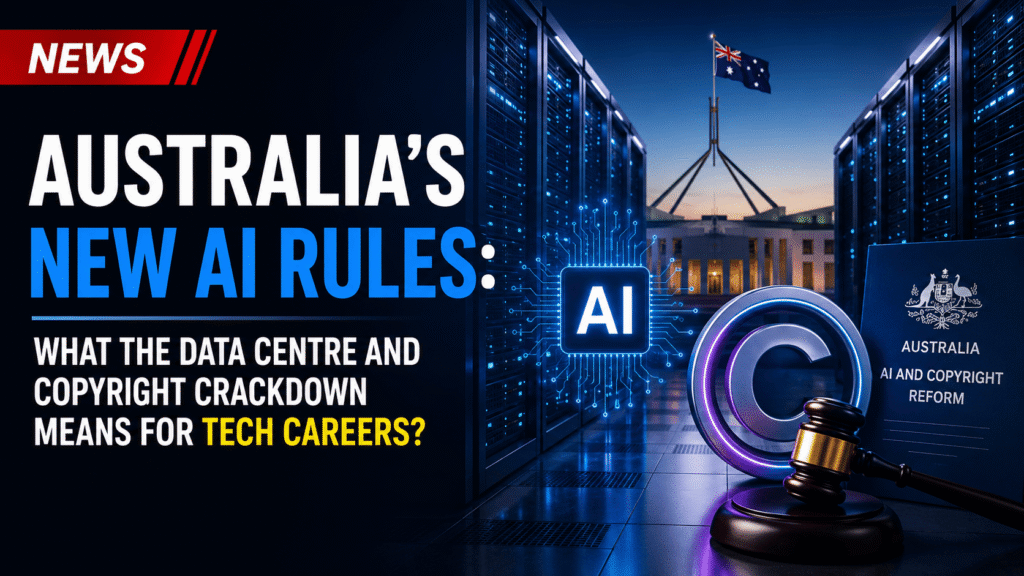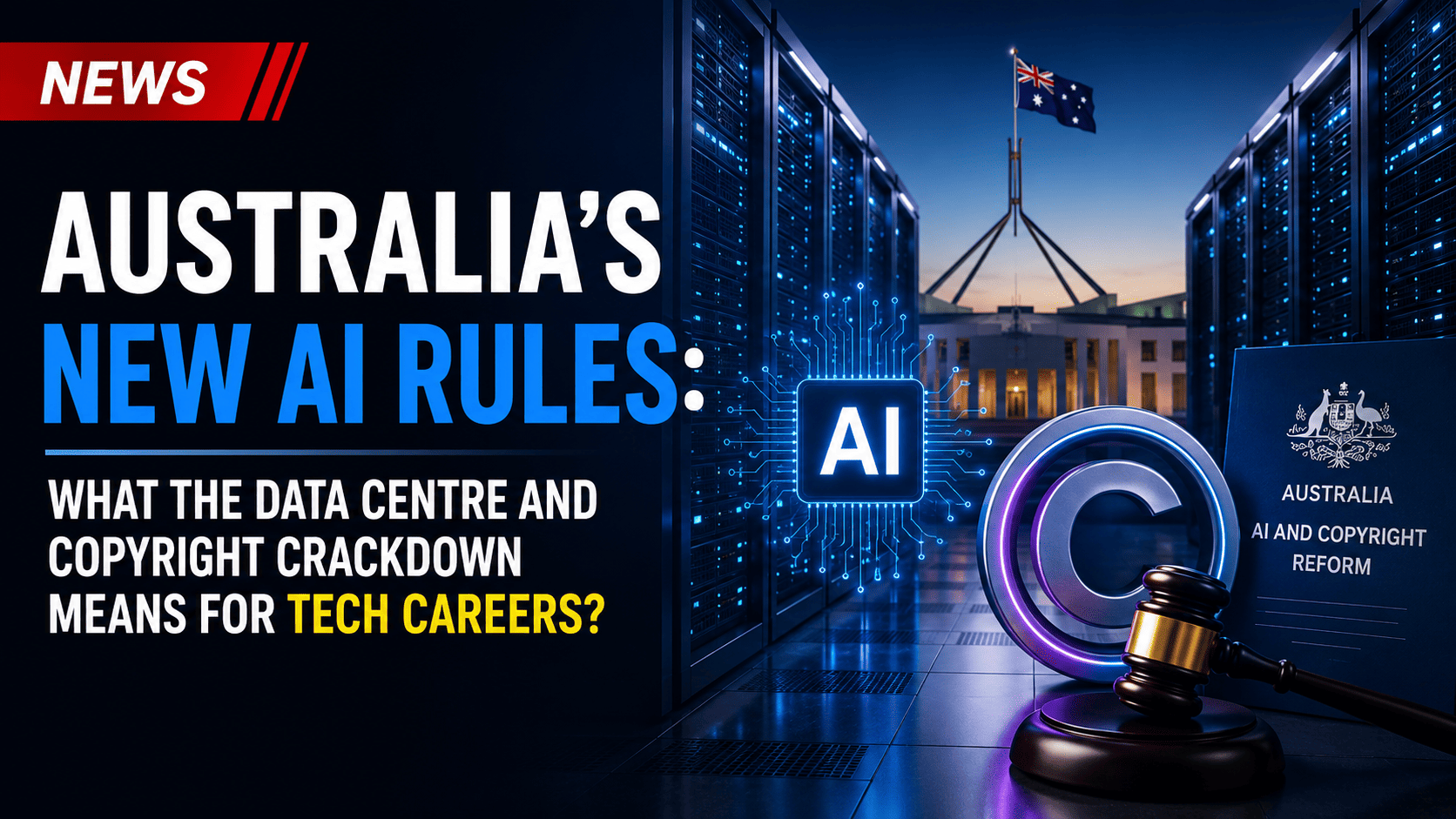
Australia’s new AI rules landed this week, and they will reshape tech careers across the country. Prime Minister Anthony Albanese unveiled the proposed framework at the University of Sydney on 15 July 2026. It covers energy, water, copyright and siting standards for the AI industry.
The announcement matters for anyone working in tech, trades or the creative industries. Billions of dollars in data centre investment now hinge on these rules. So do thousands of future jobs.
Data centres must give back more power than they take.
The headline rule is blunt. Large data centres built in Australia will be legally required to feed at least as much electricity into the grid as they draw out. That contribution must come entirely from renewable sources.
Operators could also be required to finance their own power generation and pay the full cost of connecting to the electricity grid. On top of that, the standards would require data centres to maximise energy efficiency and minimise water usage.
The Prime Minister framed it as a matter of leverage. AI needs Australian land, energy and computing power to operate, he argued, which means Australia can set the terms.
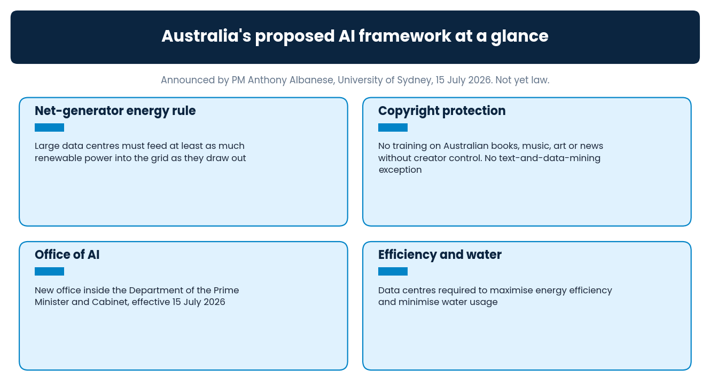
The four pillars of the proposed framework announced on 15 July 2026.
Why the energy rule exists?
The numbers explain the urgency. Electricity demand from Australian data centres is projected to rise from around 3 terawatt hours today to 30 terawatt hours by 2035. That is a tenfold increase inside a decade.
Industry groups had already warned that public backlash was unavoidable if data centres drew from existing renewable supply instead of funding new generation. The Government has now adopted that position as policy.
The Australian Energy Market Commission separately proposed technical standards in March 2026. These would require large data centres to stay connected to the grid during faults, preventing mass disconnections that could destabilise the National Electricity Market.
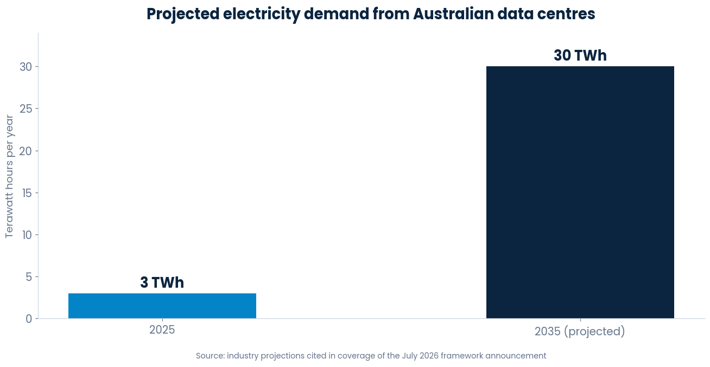
Data centre electricity demand is projected to grow tenfold by 2035.
Copyright: no free training data
The copyright language was the strongest any government has used. Albanese said no company should use Australian books, music, art or news to build or train AI without the artist’s control over their work, including its price and value. Anything less, he said, is theft.
This is not an empty threat. Australia’s Attorney-General ruled out a text-and-data-mining exception back in October 2025. The Copyright Act 1968 has never allowed one, so AI companies that trained on Australian content without licences may already face legal exposure.
Music publishers, the Media Entertainment and Arts Alliance and international rights bodies backed the framework. Publishers say copyright is non-negotiable but they are ready to negotiate fair licences.
What happens next?
None of this is law yet. A new Office of AI inside the Department of the Prime Minister and Cabinet became effective immediately on 15 July. It will coordinate the design of the new Australian AI Standards.
National Cabinet convenes in August 2026 to seek agreement from the states and territories. The Government then aims to introduce legislation to Parliament in early 2027.
Not everyone is on board. Environmental groups and the Greens have called for a moratorium on all new data centre approvals until the rules are finalised. The timing is also delicate: the announcement came days after reports that major AI companies were weighing tens of billions in Australian data centre investment.
Key milestones from the October 2025 copyright decision through to expected legislation in early 2027.
What this means for Australian careers?
The careers story sits underneath the politics. If the investment proceeds under these rules, every large data centre becomes two projects in one: the facility itself, plus the renewable generation required to power it.
That doubles the hiring footprint. Data centre builds already employ electricians, HVAC and mechanical trades, civil construction crews, project managers and commissioning engineers. The net-generator rule adds solar, wind, battery storage and grid connection roles to every project.
Once facilities are live, demand shifts to data centre technicians, network engineers, cybersecurity specialists and facilities managers. The new Office of AI and the coming standards also point to growth in AI governance, compliance and policy roles.
For creative professionals, the copyright stance cuts the other way. Writers, musicians, artists and journalists gain a stronger negotiating position, and licensing work itself may become a new income stream.
Find your place in Australia’s AI buildout?
Whether you are an electrician, engineer or AI specialist, the roles behind this buildout are appearing now. Browse live opportunities on CloudColleague Jobs, or pick up flexible project work through CloudColleague Tasks. Employers scaling up for data centre and renewable projects can find skilled workers fast at cloudcolleague.com/employers.