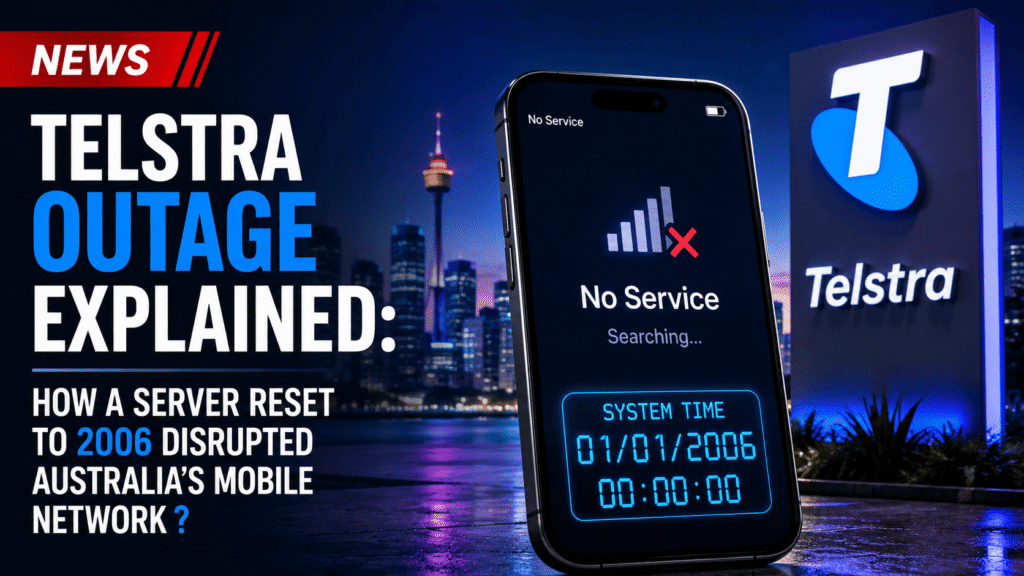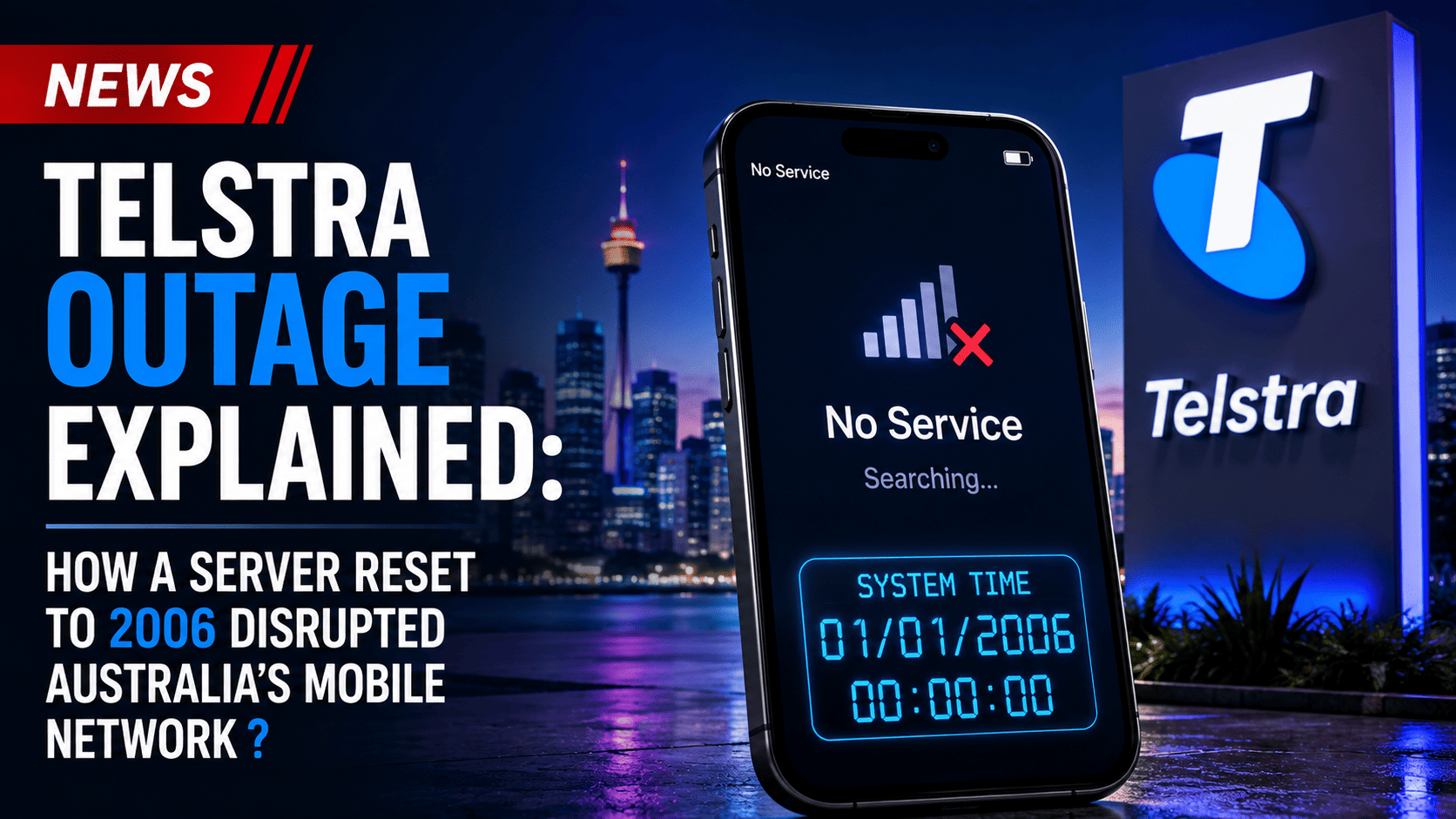
The Telstra outage that disrupted much of Australia’s mobile network began when a single time server restarted believing it was 2006, causing security certificates across the network to fail. The Senate inquiry examining the incident heard on 17 July 2026 that Telstra’s supplier had warned the company about the faulty equipment as far back as November 2020, and again in January 2026. Chief executive Vicki Brady apologised to customers. The fault disrupted calls, data, payments, transport and some Triple Zero calls.
Key facts
- Cause: A Network Time Protocol server reset to 2006, invalidating authentication certificates network-wide.
- The equipment: An ageing SSU 2000 timing server, about 15 years old and worth roughly $30,000.
- The warnings: Supplier Microchip Technology flagged the issue in November 2020 and again in January 2026, the inquiry heard.
- Triple Zero: Telstra later conducted welfare checks on 639 people who could not connect during the outage, with 170 referred to police.
- Senate inquiry: Executives, including CEO Vicki Brady, appeared before a Senate committee in Canberra on 17 July 2026.
- Restoration: Services were restored, and Telstra says a secondary issue has since been resolved.
- Compensation: Telstra has commissioned an external review. No blanket automatic compensation scheme has been confirmed.
What caused the Telstra outage?
The outage came down to time, specifically a system that keeps the whole network’s clocks in sync.
Modern mobile networks rely on Network Time Protocol, or NTP, to keep every connected device agreeing on the exact time. Think of it as a shared clock that the entire network trusts. When devices disagree about the time, systems that depend on precise timing start to fail.
That is what happened here. A Telstra timing server restarted with the wrong date, set to 2006. Security certificates, which verify that devices are allowed on the network, are time-sensitive. When the clock jumped back nearly two decades, those certificates were read as invalid, and devices could no longer authenticate.
The result was that customers could not make calls or use mobile data across large parts of the network.
Why did the server restart with a 2006 date?
The equipment at the centre of the failure was an SSU 2000 server, described at the inquiry as about 15 years old and costing roughly $30,000 to address.
Telstra executive Gerard Tracey, responsible for end-to-end service performance, told the hearing that US-based supplier Microchip Technology first warned about the impending problem in November 2020. The warning concerned a “rollover” issue in the timing server that required a software update.
Telstra received a further reminder in January 2026, the inquiry heard. The update was not applied in time, and the server rolled its date back to 2006 when it restarted.
Inquiry chair Sarah Hanson-Young questioned why the repeated warnings were not acted on, describing the failure as appearing to be incompetence rather than a simple hardware fault. Telstra has commissioned an external investigation into why the warnings went unheeded.
Why did Telstra’s backup systems not prevent it?
Having backup servers is not the same as stopping bad data from spreading.
Telstra maintained redundancy in its timing infrastructure. The problem was not a total absence of backups, but that connected systems accepted and propagated the incorrect time before the fault was contained.
Once the wrong date entered the network and certificates began failing, the cascade moved faster than the redundancy could correct. This is a recurring risk in complex networks. A backup protects against one component failing, but it offers less protection when a single bad input is trusted and passed along by many systems at once.
The external review is expected to examine why the design allowed the error to spread so widely.
How widespread was the disruption?
The fault reached well beyond phone calls.
Confirmed effects included disruption to mobile calls and data sessions, EFTPOS and payment terminals, train and transport systems, and connected infrastructure such as electric-vehicle chargers. Reporting has described trains thrown into disarray and payments failing during the incident.
Telstra’s submission to the inquiry addressed the scale of the mobile impact. The company has been pressed on what proportion of calls and data sessions failed at the peak, a figure central to the inquiry’s questioning.
For everyday Australians, the outage meant unreliable phones, failed card payments and interrupted services for much of the day. It hit remote workers, small businesses, delivery riders and anyone relying on a mobile connection to work.
Were Triple Zero calls affected?
Yes, and this is the most serious part of the incident, so the detail matters.
The Triple Zero emergency service did not shut down entirely, but some emergency calls could not connect during the outage. Telstra responded by conducting welfare checks on people who had been unable to reach Triple Zero.
By the time the secondary issue was resolved, Telstra had carried out SMS and phone welfare checks for 639 Triple Zero callers who could not connect. Of those, 170 were referred to police and seven to emergency services organisations.
It is important to distinguish between a failed connection attempt and a completed welfare check. A welfare check does not confirm harm occurred. Telstra has not reported deaths linked to this outage, which distinguishes it from the 2025 Optus emergency-calling failure.
What did Telstra tell the Senate inquiry?
The 17 July hearing produced the most significant revelations so far.
CEO Vicki Brady apologised for letting customers down. Executives confirmed the technical chain of events, from the 2006 server reset to the spread of invalid certificates.
The central admission was the warning history. Telstra acknowledged that its supplier had flagged the timing-server issue in 2020 and again in January 2026, before the outage occurred. Executives said the reasons the warnings were not acted on would be examined in the commissioned external review.
Telstra also faced questions about the potential regulatory consequences. Under powers introduced after the Optus outage, a carrier can face civil penalties of up to $30 million.
Can customers claim Telstra outage compensation?
Here the picture is not yet settled, so treat any compensation claim carefully.
As of publication, Telstra has not announced a confirmed blanket automatic compensation scheme for all affected customers. That could change, and the inquiry may increase pressure for one.
Customers who believe they were affected should contact Telstra directly and keep their own records. Small businesses that lost income should document the outage times and any financial losses, including failed transactions and missed work. That evidence is useful whether compensation comes through Telstra, a regulator or the Telecommunications Industry Ombudsman.
Official compensation details, if confirmed, will appear on Telstra’s own channels and through the Telecommunications Industry Ombudsman. Do not assume automatic payment until an official source states it.
How outages hit the modern workforce?
An outage of this scale is not only a consumer story. It is a work story.
Remote employees, contractors, delivery riders and rideshare drivers depend on a mobile connection to earn. When the network fails, so does their income for the day. Recruiters running phone or video interviews lose contact with candidates. Workers who rely on mobile authentication codes can be locked out of the very systems they need.
This is a reminder to build resilience into how you work, including a backup connection where possible. For people whose income depends on staying reachable, CloudColleague lists flexible tasks and jobs across Australia and offers platform features that keep work organised in one place. You can follow further developments through CloudColleague News.
What customers should do during another outage?
Practical steps for the next time a network fails:
- In an emergency, try Triple Zero again, and try from another phone or another carrier’s network if you can. Mobiles can sometimes reach Triple Zero via a rival network.
- Use Wi-Fi calling if you have already set it up on your device.
- Keep a landline number or a second contact method available where practical.
- Follow official emergency and government guidance, not social media rumour.
- If you run a business, record the outage times and any losses as they happen.
- Check Telstra’s official service-status page for confirmed updates.
What happens next?
Several threads will run from here.
The Senate committee will continue its scrutiny, and Telstra’s external investigation will report on why the supplier warnings were not acted on. The Australian Communications and Media Authority may examine whether any rules were breached.
Telstra has promised technical changes, and the inquiry is likely to push for firmer controls over software updates, documentation and redundancy. The threat of civil penalties of up to $30 million remains on the table.
Consumer-protection consequences, including any compensation framework, will become clearer as the inquiry proceeds.
The bottom line
The Telstra outage was not caused by a sophisticated attack. It was caused by an ageing server that reset itself to 2006, a required update that was not installed, and warnings that the inquiry heard were not acted on.
What remains unresolved is why those warnings were ignored, what penalties may follow, and whether affected customers and businesses will be compensated. The external review and the Senate inquiry will shape the answers, and CloudColleague will update this story as they emerge.