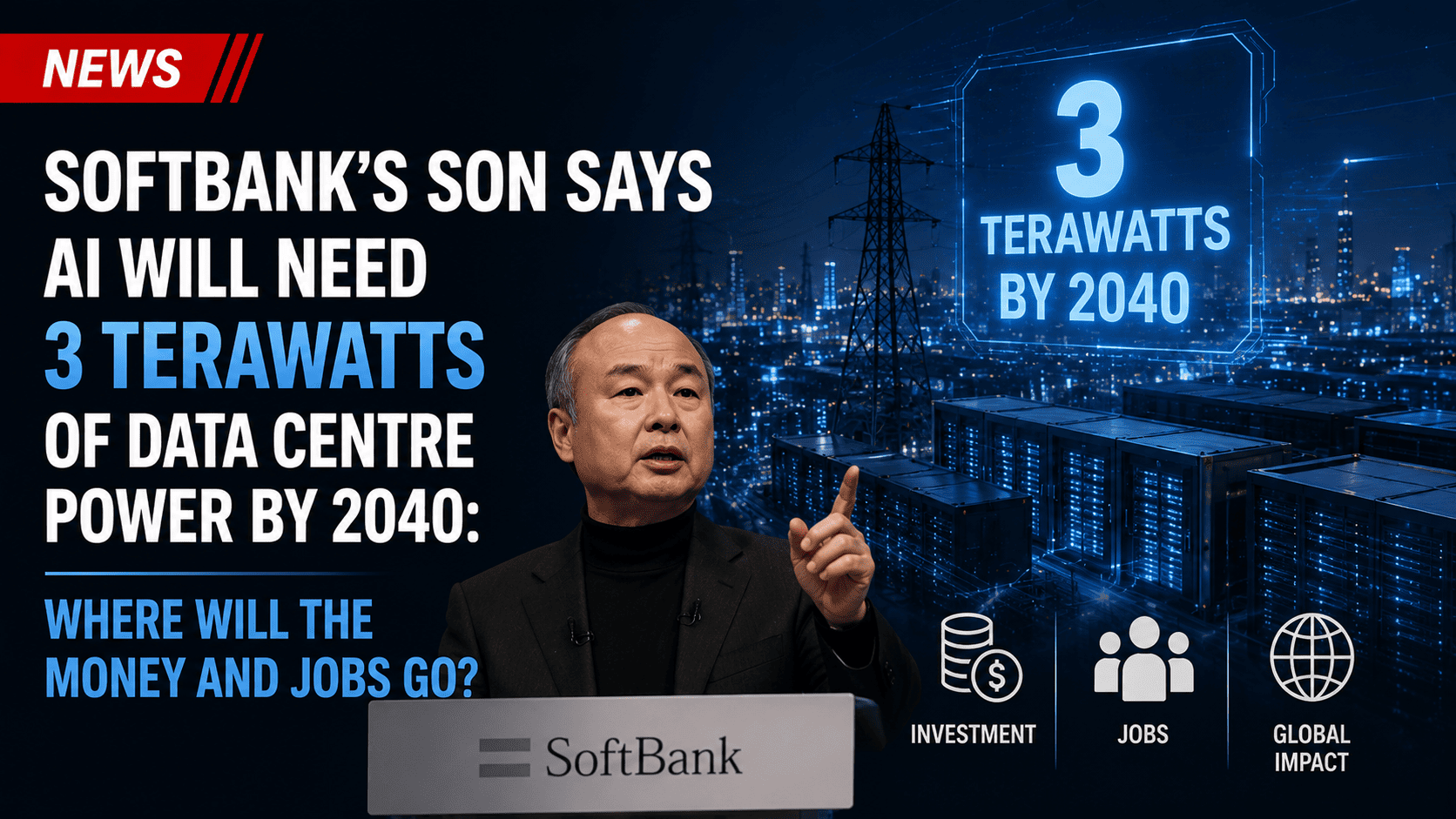
Son, 68, made the comments at SoftBank World, the company’s annual event in Tokyo, on Tuesday 14 July 2026.
He said natural gas will provide the bulk of data centres’ power needs for the time being. He then predicted that nuclear fusion has a role to play, forecasting that the world will need 3 terawatts of data centre capacity in 2040.
“Fusion will become the main source of a new kind of cheaper, clean and safe energy here on Earth,” Son said, according to reporting by Bloomberg and The Japan Times.
He also questioned the sustainability of relying so heavily on gas-fired power, and warned that Japan’s economy would miss out if the country failed to recognise AI’s potential.
On the bubble question, Son was blunt. He described asking whether AI is a bubble as an incredibly foolish question, posed by people who do not understand or thoroughly use AI.
Son did not publish a detailed methodology for the 3-terawatt figure. That absence matters, and it runs through the rest of this article.
How Big Is 3 Terawatts, Really?
This section is CloudColleague analysis, built on Son’s stated figure and published IEA data. It is not a SoftBank calculation.
Start with the unit. A terawatt is a measure of capacity, meaning power drawn at a moment in time. It is not the same as energy consumed over a year, which is measured in terawatt-hours.
Three terawatts of capacity running continuously for a year would consume roughly 26,300 terawatt-hours. Data centres do not run at 100 per cent, so assume a more realistic average utilisation of around 70 per cent. That still lands near 18,400TWh a year.
Now the comparison. According to the IEA’s Energy and AI analysis, global data centres consumed about 415TWh in 2024, roughly 1.5 per cent of world electricity. The IEA’s base case has that reaching around 945TWh by 2030 and roughly 1,200TWh by 2035.
Son’s figure implies annual consumption more than fifteen times the IEA’s 2035 base case. It also sits well above half of total global electricity consumption today, which the IEA expects to pass 29,000TWh in 2026.
Two readings are possible. Either Son is forecasting a transformation of the global energy system on a scale nobody else is currently modelling, or the number is directional rather than literal. He has not said which.
Where Would the Investment Go?
The following is analysis of where capital would need to flow if a build-out of this scale proceeded. It is not a confirmed SoftBank allocation plan.
Chips and semiconductor manufacturing. Accelerators, high-bandwidth memory, advanced packaging, foundry capacity and networking silicon. Memory supply is already tight, as CloudColleague set out in its reporting on how AI data centres are already reshaping hardware supply.
Data centres themselves. Land, buildings, servers, racks, liquid cooling, fibre and switching. At gigawatt scale, the constraint is rarely capital. It is grid connections, water and construction labour.
Electricity generation and grid. Generation plant, transmission, substations, storage and firming. Son’s own framing concedes this, since he named gas as the near-term answer and fusion as the eventual one.
Cloud platforms and software. Training and inference capacity, enterprise deployment, and the security layer that sits over both.
Robotics and physical AI. SoftBank has been explicit that it sees industrial and humanoid robotics as the next major category. It acquired ABB’s robotics division for US$5.4 billion in October.
Research, governance and safety. Model evaluation, auditing, compliance and risk management. This is the least glamorous category and the one most likely to be underfunded relative to need.
Why SoftBank Rejects the AI Bubble Argument?
The bubble case is not frivolous. Infrastructure spending is running well ahead of AI revenue, and several prominent investors have drawn parallels with the fibre-optic overbuild of the late 1990s.
Son’s counter is that the technology is early and the returns are ahead of the spending, not behind it. At SoftBank’s annual general meeting on 24 June, he told shareholders that calling AI a bubble was “blasphemy against AI”, adding that its potential had not yet been unlocked, according to Reuters.
He has also predicted that superintelligence would eventually add at least 10 per cent to global GDP. That is a forecast, not an established projection.
Readers should weigh one further fact. SoftBank is not a neutral observer. Its shares have risen sharply through 2026 on the strength of its AI positioning, and it briefly overtook Toyota as Japan’s most valuable company. Son’s forecast and SoftBank’s valuation point the same way.
That does not make him wrong. It does mean the forecast should be read as a position, not as an audit.
SoftBank’s AI Strategy and the OpenAI Bet.
SoftBank’s exposure is concrete, and it is worth separating what is done from what is proposed.
Confirmed. SoftBank completed a US$41 billion investment in OpenAI, giving it a stake of around 11 per cent, Reuters reported in December. It acquired chip designer Ampere for US$6.5 billion, and ABB’s robotics unit for US$5.4 billion. It owns Arm, whose designs sit throughout AI servers.
Committed. SoftBank has announced a commitment of up to €75 billion to develop 5GW of AI data centre capacity in France, with an initial €45 billion phase delivering 3.1GW in the Hauts-de-France region.
Proposed and partly funded. Stargate, the US data centre venture with OpenAI, Oracle and MGX, carries a headline figure of up to US$500 billion. Headline figures on projects of this type are targets, not bank transfers.
Vision. Artificial superintelligence, which Son defines as 10,000 times more capable than a human. There is no timetable that anyone outside SoftBank has validated.
The Power Problem Behind the Forecast.
Electricity, not capital, is the constraint that decides whether any of this happens.
The IEA notes that AI-focused data centres draw power like heavy industry, and that they cluster geographically. Nearly half of US data centre capacity sits in five regional clusters. Concentration makes grid integration harder, not easier.
Son’s answer is gas now and fusion later. The gas half is uncontroversial and already happening. The fusion half is not.
BloombergNEF’s assessment, cited alongside Son’s remarks, is that significant technological and financial challenges remain before fusion becomes a viable energy source. No fusion plant currently supplies power to any grid anywhere. Treating fusion as an available solution for a 2040 build-out is an act of faith, not a plan.
That leaves the realistic near-term mix: gas, renewables with firming, storage, grid upgrades and, in some jurisdictions, nuclear fission. Each carries its own approval timeline, community opposition and water considerations.
What the SoftBank AI Investment Forecast Could Mean for Jobs?
If even a fraction of this build-out proceeds, the demand is physical before it is digital.
Roles likely to grow. Electrical engineers and power-system engineers sit at the top of the list, because the grid is the bottleneck. Then data centre technicians, HVAC and liquid-cooling specialists, high-voltage electricians, construction project managers, and procurement professionals who can secure transformers and switchgear in a shortage. On the technology side, cloud architects, AI infrastructure engineers, machine-learning engineers, semiconductor engineers, robotics engineers and cybersecurity professionals.
Roles likely to change. AI governance specialists, model evaluators, compliance officers and technology lawyers are moving from peripheral to core. So are enterprise engineers who deploy AI inside real businesses rather than building it.
Roles exposed. Routine coding, basic testing, manual documentation and first-line support face genuine automation pressure. This is not a hypothetical. Technology companies are cutting staff while raising AI capital expenditure at the same time, a tension visible in Microsoft’s July 2026 job cuts.
Two honest caveats. Infrastructure jobs concentrate geographically, so the benefit is uneven. And nobody has produced a credible number showing that AI-created roles will match AI-displaced roles. Anyone who gives you that figure is guessing.
What It Could Mean for Australia?
Australia is an obvious candidate for AI infrastructure, and an awkward one.
The case for is straightforward. Land is abundant, solar and wind resources are strong, the legal system is stable, and the country already hosts significant capacity. CloudColleague reported on the IREN AI data centre project in South Australia, a US$10 billion development expected to support around 500 construction roles and 200 ongoing positions.
The case against is equally clear. Grid connection queues are long, transmission build is slow, and firming capacity is contested. Water availability constrains cooling in exactly the regions with the best solar. Community consent is not automatic.
Then there is the skills question. Jobs and Skills Australia data shows cyber security specialists and software engineers remain among the clearest technology shortages, while trade occupations record a vacancy fill rate of just 54.3 per cent against a national average of 70.2 per cent. A data centre build-out needs both, and the trades gap is the harder one to close.
No Australian allocation from SoftBank has been announced, and none should be assumed.
The strategic risk deserves naming. Australia could become a place where AI infrastructure is hosted rather than a place where AI value is created. Hosting produces construction jobs and electricity bills. Value creation produces companies. The difference depends on training, research investment and regulation, not on land.
Is the 3-Terawatt Forecast Realistic?
A simple yes or no would be dishonest, so here is the evidence on both sides.
Reasons spending could rise sharply. Enterprise AI adoption is genuinely accelerating. Inference demand grows with usage, not just with training runs. Governments are funding sovereign capacity, including Japan’s own multi-decade strategy targeting ¥370 trillion of public and private investment across seventeen sectors.
Reasons it may not. Chips, transformers, skilled labour and grid capacity are all physically constrained. Model and hardware efficiency keeps improving, which cuts the compute required per unit of output. Financing is not unlimited, and returns remain unproven at the scale implied. Overbuilding is a real risk, and it has happened before in telecoms.
The methodology problem. Son has not published the calculation. Without it, the figure cannot be tested, only believed or doubted.
The defensible conclusion is this. The direction of travel, meaning substantially higher AI infrastructure investment, is credible and already visible in company accounts. The specific 3-terawatt figure is a projection from an interested party with no published workings, and it sits far outside every independent forecast currently on the record.
What Happens Next?
Watch for a published SoftBank methodology, which would move this from assertion to argument.
Capital expenditure guidance from the major cloud providers matters because that is where the money actually shows up. Grid connection approvals and transmission announcements deserve equal attention, as they remain the true rate limiter. AI revenue growth should also be measured against infrastructure spending, since that ratio is the real bubble test. Treat fusion milestones sceptically and monitor chip supply closely.
SoftBank’s own decisions may be the clearest signal of all. Its next investment will tell you more than its next forecast.