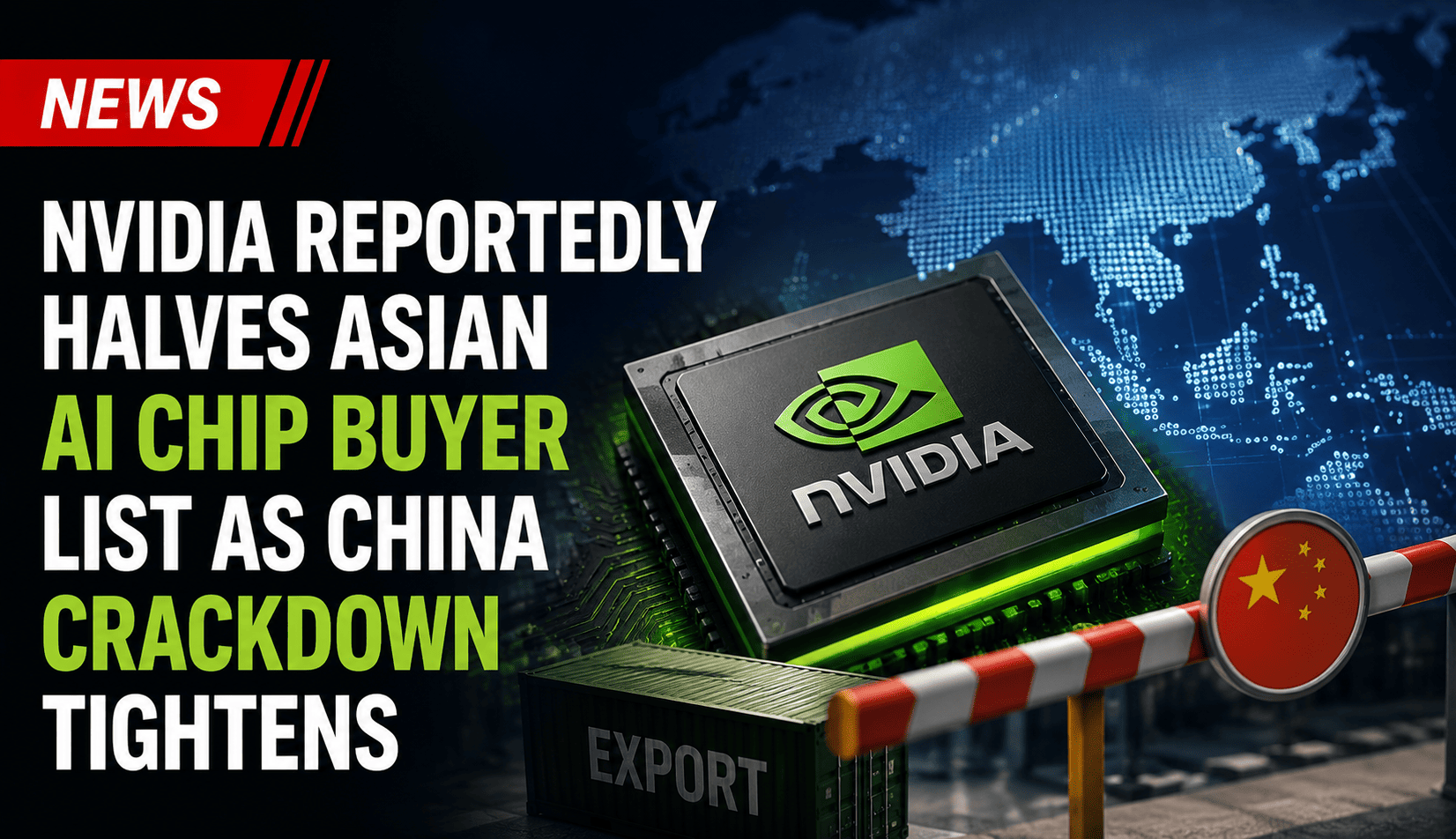
Nvidia has more than halved the number of Asian customers authorised to buy its artificial intelligence chips, according to a Financial Times report published on 14 July 2026. The FT, citing three people with knowledge of the matter, said the company built a new “white list” of approved buyers and intensified compliance checks across Singapore, Malaysia and Japan. Reuters carried the report and said it could not immediately verify it.
The change matters because Nvidia’s accelerators remain the default hardware for most large-scale AI training and inference, and Asia is where much of the world’s new AI data-centre capacity is being built.
Key Takeaways
- The FT reported that Nvidia has created a new white list of Asian buyers approved to purchase its products.
- More than half of Nvidia’s previous Asian customers were excluded by the new vetting, according to the FT.
- Excluded companies may reapply after making changes, the report said.
- Due diligence has intensified in Singapore, Malaysia and Japan, three markets central to Asian AI infrastructure.
- Reuters said it could not immediately verify the FT’s reporting, and Nvidia had not publicly responded at the time of publication.
What Nvidia Reportedly Changed?
The core of the reported change is a shift from a broad customer base to a vetted one.
According to the Financial Times, Nvidia now maintains a white list of Asian companies cleared to buy its AI processors. A white list, in this context, is simply a register of approved buyers. If a company is not on it, it cannot purchase directly.
The FT reported that the new vetting excluded more than half of Nvidia’s previous customers in the region. That is the most striking figure in the story, and it is worth stating plainly that it comes from the FT’s sources rather than from Nvidia or any regulator.
Exclusion appears to be provisional rather than permanent. Companies could reapply after making changes, the report said. In practice, that suggests failing the review is treated as a compliance gap to be closed, not a finding of wrongdoing.
An editorial note on scope. Some coverage of this story has speculated about which categories of buyer were affected, including so-called neo-cloud providers. A neo-cloud provider is a newer, GPU-focused cloud company that rents out AI computing capacity, as distinct from a hyperscaler such as AWS or Azure. The reporting available to CloudColleague on 14 July 2026 does not name the excluded companies or confirm which categories they fall into. We are not going to assert it.
Why Nvidia Is Tightening AI Chip Compliance Checks?
The regulatory backdrop explains the commercial decision.
Washington has restricted exports of advanced AI chips to China since at least 2021, and has repeatedly widened those controls. The concern driving the policy is that restricted Chinese entities can obtain controlled hardware indirectly, through overseas subsidiaries, distributors or intermediaries in third countries.
The FT reported that Nvidia tightened its compliance process following pressure from Washington.
Recent enforcement action gives that pressure weight. In March 2026, US prosecutors charged a Supermicro co-founder and two employees over an alleged scheme to smuggle roughly US$2.5 billion worth of Nvidia chips to China. The Department of Justice alleged the group used a South-East Asian company as a proxy to route chips to China from Taiwan.
For Nvidia, the exposure runs in two directions. Selling to a buyer who diverts chips creates legal and reputational risk in the United States. Over-restricting legitimate customers costs revenue in the fastest-growing AI infrastructure market on earth. Verification is the company’s attempt to hold both.
Washington’s approach has not been uniformly restrictive. It permitted sales of the older H200 chip to China last year, a move Beijing resisted by blocking domestic sales in part to support its own chipmakers.
Singapore, Malaysia and Japan Face Greater Scrutiny of Nvidia Asian AI Chip Buyers.
The FT identified these three markets as the focus of intensified due diligence. The reasons are structural, not accusatory.
Singapore is a major regional headquarters and re-export hub, with a large concentration of corporate entities that buy and resell technology hardware. Malaysia has become one of the fastest-growing data-centre construction markets in Asia, particularly around Johor. Japan hosts substantial AI infrastructure investment and a deep electronics supply chain.
High volumes of legitimate hardware flow through all three. That same volume is what makes verification difficult, and it is why compliance attention concentrates there.
This point deserves emphasis. Buying Nvidia chips in or through Singapore, Malaysia or Japan does not imply that a customer has breached export controls. No government or company named in this story has been found to have done anything unlawful in connection with the reported review, and the FT did not allege otherwise.
How Nvidia Is Reportedly Checking AI Chip Buyers?
Here the reporting is thinner than the headline, and it is important to say so.
The FT described intensified due diligence and enhanced compliance checks, without publishing a detailed breakdown of the specific procedures Nvidia now applies. CloudColleague has not seen a confirmed list of steps, and will not invent one.
What can be said, as context rather than reported fact, is that export-compliance programs in the semiconductor industry typically involve some combination of ownership and corporate-structure checks, contract and end-use verification, confirmation of the physical location where hardware will be installed, and direct engagement with the end user. Some vendors conduct site inspections. None of that is confirmed as part of Nvidia’s reported review.
If Nvidia publishes detail on its process, this section will be updated.
What This Means for AI Companies and Data Centres?
The following section is analysis, not confirmed consequence.
If the reported change holds, the most immediate effect is procedural. Asian AI startups and smaller cloud operators that previously bought through distributors may now need to demonstrate ownership structure, end use and installation site before an order proceeds. That takes time.
Procurement timelines could lengthen. Compliance costs could rise, particularly for smaller firms that have never needed an export-control function. Data-centre projects built on assumed GPU delivery dates may face schedule pressure if approvals slip.
Access is not the only variable. The AI hardware market already sits under strain from component scarcity, a dynamic covered in our explainer on the global memory shortage of 2026, and in our analysis of how AI data centres have reshaped the consumer electronics market. Tighter buyer vetting adds a compliance bottleneck on top of a supply bottleneck.
There is also a competitive dimension. Buyers who cannot clear vetting quickly may look at alternative accelerators from AMD, from cloud providers’ in-house silicon, or from domestic Asian suppliers. Whether that translates into meaningful market share movement is unknown, and anyone claiming certainty on that point is guessing.
Could the Restrictions Affect AI Jobs?
No job losses or job creation have been reported in connection with this story. Any figure suggesting otherwise would be invented.
What can be observed is a shift in where organisational effort goes. When hardware access becomes conditional on documented compliance, the people who produce that documentation become load-bearing.
That points to steady demand for semiconductor and export-control compliance specialists, trade lawyers, procurement professionals who understand end-use certification, and risk and governance staff inside cloud and data-centre operators. Cybersecurity professionals sit close to this work, because chip diversion cases often turn on supply-chain integrity and identity verification. Our overview of the cyber security roles most in demand covers where that demand is concentrated.
On the infrastructure side, AI infrastructure engineers, cloud architects, AI hardware engineers and data-centre technicians remain central to any build-out that does proceed. Australia’s own pipeline continues, as our reporting on the IREN AI data centre in South Australia sets out.
The honest summary is this. Tighter controls can slow hardware procurement while simultaneously increasing demand for compliance, governance and supply-chain expertise. Those two effects are not in tension. They are the same trend seen from opposite ends.
What Nvidia and US Authorities Have Said?
Nvidia had not publicly responded to the Financial Times report at the time of publication. CloudColleague found no Nvidia statement, filing or newsroom item addressing the reported white list.
The US Department of Commerce had not issued any statement specifically addressing this report. Existing export-control rules remain in force, but no new guidance has been published in response to the FT’s reporting.
Older Nvidia comments about export controls exist in the public record. They were not made in response to this report, and should not be read as such.
What Happens Next?
Several things are worth watching over the coming weeks.
First, whether Nvidia confirms, denies or declines to comment on the report. A denial would materially change the story.
Second, whether the approved buyer list expands as excluded companies complete reapplications, and how long that process takes in practice.
Third, whether the Commerce Department issues new guidance on third-country diversion, which would move this from a vendor policy to a regulatory requirement.
Fourth, whether affected cloud providers and data-centre operators in Asia disclose procurement delays in their own reporting.
None of these outcomes is certain. This is a developing story built on sourced reporting that has not been independently confirmed.