Send your first follow up job application email 7 to 10 business days after applying. Email beats phone, three attempts is the maximum, and interview thank-yous go within 24 hours. The five templates below are ready to copy. On CloudColleague, built-in chat with employers removes the follow-up guesswork entirely.
Follow-Up Timing Rules at a Glance
| Scenario | Wait time | Channel |
| After submitting an application | 7 to 10 business days | |
| Job ad states a review timeline | 1 to 2 days after that date | |
| After the closing date passes | 1 to 2 days | |
| After an interview | Within 24 hours | |
| Second follow-up | 7 to 10 days after the first | |
| No response after three attempts | Stop and move on | None |
When to Follow Up on a Job Application
The standard follow up job application window is 7 to 10 business days after submitting. Following up within 24 to 48 hours reads as impatient, and it lands as an interruption. Recruiters rarely review applications on the day they arrive.
Three caveats adjust the window. First, respect any stated timeline in the ad, then wait a day or two beyond it. Second, senior roles run slower, so allow two to three weeks. Third, honour “no contact” instructions completely, because ignoring them can disqualify you.
Following up is expected, not annoying. In Robert Half research, every HR manager surveyed agreed candidates should check back after submitting a resume. Email was their preferred channel by a wide margin.
How to Find the Right Person to Contact
Generic careers inboxes swallow follow up job application emails. Instead, hunt for a named contact before you write. Check the job ad first, since many list a hiring manager or recruiter directly.
No name listed? Search LinkedIn for the company plus the team’s likely manager title. Additionally, application confirmation emails sometimes reveal a real sender worth replying to. Modern search tools speed this up, and our roundup of AI tools for job search covers contact-finding options.
If nothing surfaces, use the platform’s own messaging where it exists. Applications sent through CloudColleague include built-in employer chat. Therefore, your follow up job application message reaches a real decision maker.
Follow Up Job Application Email Templates
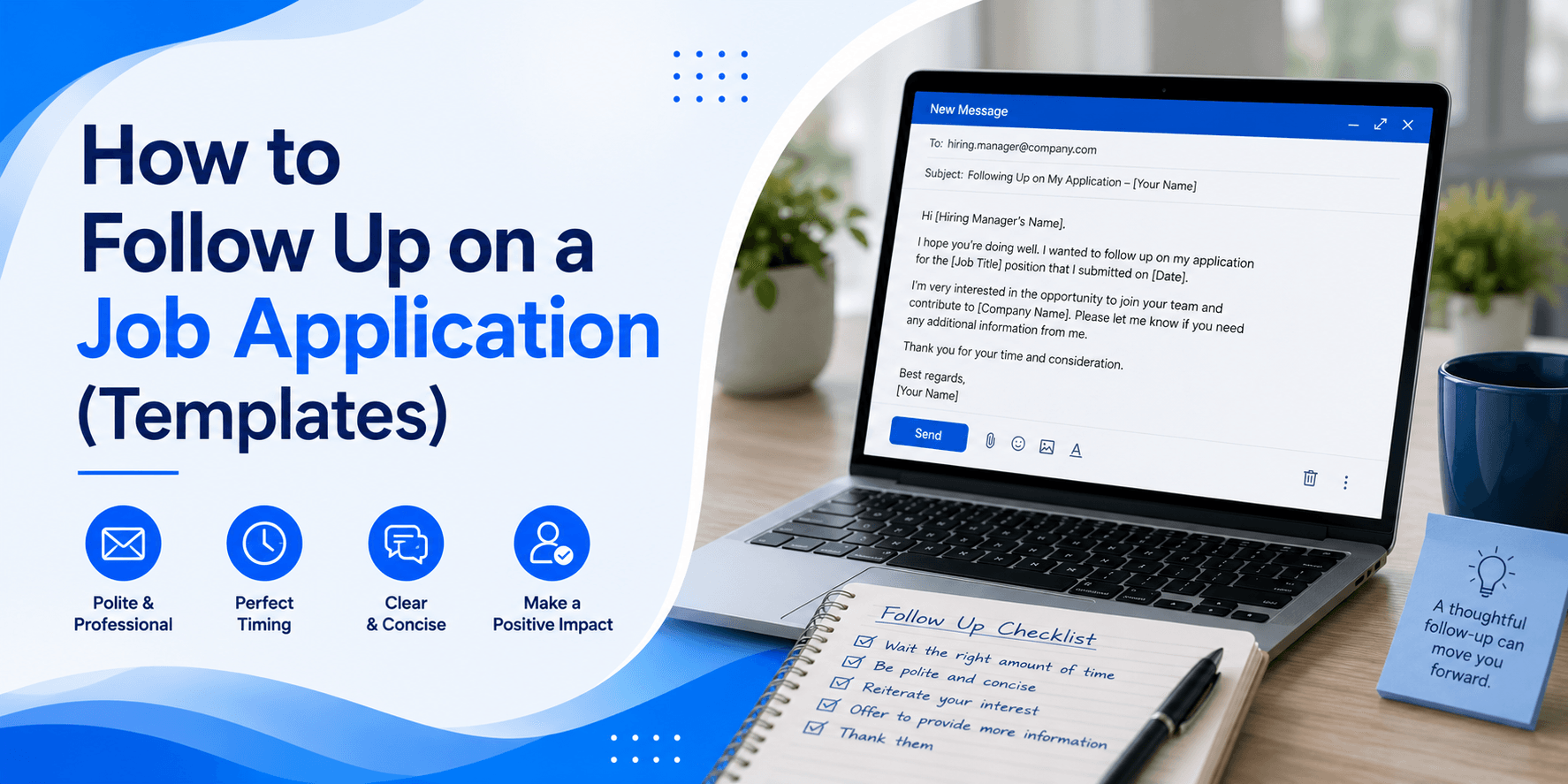
Keep every follow up job application email between 50 and 125 words. Restate interest, add one relevant strength, and close politely with your contact details. Copy the templates below, then replace the bracketed details.
Template 1: First Follow-Up After Applying
Subject: Following up: [Role Title] application, [Your Name]
Hi [Name],
I applied for the [Role Title] position on [date] and wanted to confirm my application was received. I remain very interested in the role. My [key skill] background aligns closely with your requirements, including [one specific example]. I would welcome the chance to discuss how I can contribute. Thank you for your time, and I look forward to hearing from you.
[Your Name] | [Phone] | [Email]
Send this first follow up job application email 7 to 10 business days after applying.
Template 2: After the Closing Date Passes
Subject: [Role Title] application, continued interest
Hi [Name],
I submitted my application for [Role Title] ahead of the [date] deadline. Now that applications have closed, I wanted to restate my strong interest as you begin reviewing candidates. My experience in [area] matches the role’s focus on [requirement]. Please let me know if any further information would help.
[Your Name] | [Phone] | [Email]
Send one to two days after the stated closing date.
Template 3: Referral Mention Follow-Up
Subject: Referred by [Referrer]: [Role Title] application
Hi [Name],
[Referrer Name] suggested I apply for the [Role Title] position, and I submitted my application on [date]. [Referrer] spoke highly of the team, which strengthened my interest. My background in [skill area] fits the role’s needs, particularly [specific point]. I would value the opportunity to discuss it further.
[Your Name] | [Phone] | [Email]
Lead with the referral, because named connections lift response rates sharply.
Template 4: Second and Final Follow-Up
Subject: Re: [Role Title] application, [Your Name]
Hi [Name],
I wanted to check in once more regarding my [Role Title] application from [date]. I remain genuinely interested, and I recently [new achievement or credential], which adds directly to what I would bring. I understand you are managing many applications. If the role has been filled, I would appreciate knowing, and I wish you well with the appointment.
[Your Name] | [Phone] | [Email]
Send this final follow up job application email 7 to 10 days after the first. Then stop.
Template 5: Thank-You Within 24 Hours of an Interview
Subject: Thank you, [Role Title] interview
Hi [Name],
Thank you for your time today. I enjoyed our discussion about [specific topic from the interview], and it strengthened my enthusiasm for the role. Our conversation confirmed my [skill] experience fits your team’s direction. I look forward to the next steps you outlined.
[Your Name] | [Phone] | [Email]
Reference one genuine moment from the conversation. Preparation helps here too, so review our guide to common interview questions before the interview itself.
Follow Up Rules That Protect Your Candidacy
Cap follow up job application attempts at three total, including the original thank-you. Past three, silence is your answer. Persisting further damages your name for future openings at the same company.
Follow up job application tone decides outcomes as much as timing. Stay professional and warm, never casual or demanding. Furthermore, weave the job ad’s own keywords naturally into your message. AI-assisted inboxes increasingly sort candidate mail by relevance.
Track every application and attempt, since memory fails fast past ten active applications. Our comparison of the best job tracker apps covers free options that log follow-up dates automatically.
Following Up on Applications in Australia
Australian follow up job application habits differ slightly. Applications mostly flow through portals, and SEEK forwards them into employer systems. Consequently, your follow-up email may reach a different person than the portal suggests. Confirm the employer’s identity from the ad before writing.
Agency recruiters welcome follow-up calls more than direct employers do. A brief, friendly call to a named recruiter is normal Australian practice. However, public service applications follow fixed process timelines, so follow-up rarely accelerates anything before the stated assessment date.
Keep Australian spelling and a direct, warm tone in every message. For the wider search playbook around applications, see our guide to finding a job online.
Skip the Silence: Apply Where Chat Is Built In on CloudColleague
Every follow up job application template above exists to solve one problem, which is silence. Traditional applications vanish into inboxes and tracking systems. You write into the dark and hope.
CloudColleague removes that darkness structurally. Applications happen on-platform, where built-in chat connects you directly with the employer. Verified profiles mean your application lands with credibility attached. Additionally, built-in video and chat interviews follow in the same thread, so momentum never leaks into lost emails.
Stop drafting follow-ups into the void. Create your free CloudColleague profile, browse live Australian jobs, and apply where employers can actually answer you.
Frequently Asked Questions
Wait 7 to 10 business days after submitting before any follow up job application email. Follow-ups within 48 hours read as impatient, because applications are rarely reviewed same-day. If the ad states a review timeline, wait until a day or two after that date. Senior roles justify waiting two to three weeks.
Email wins in almost every case. Robert Half research found HR managers prefer email follow-ups by a wide margin. Email lets them respond on their own schedule. Calls suit agency recruiters in Australia, who expect them. Never call employers who specify email-only or no-contact applications.
Keep it between 50 and 125 words. Confirm when you applied, restate genuine interest, and add one specific strength matching the role. Close politely with your contact details. Avoid demanding status updates or explaining your circumstances at length. The templates above cover the exact wording.
Three attempts is the professional maximum, spaced 7 to 10 days apart. After the third silent response, move on and redirect your energy into new applications. Continuing past three risks your reputation with that employer, which can affect future openings you may want more.
No. Honour no-contact instructions completely, because ignoring them signals you cannot follow directions and can disqualify you outright. Strictly administrative messages, such as confirming a technical submission issue, are the only exception. Put your effort into strengthening the application itself instead.