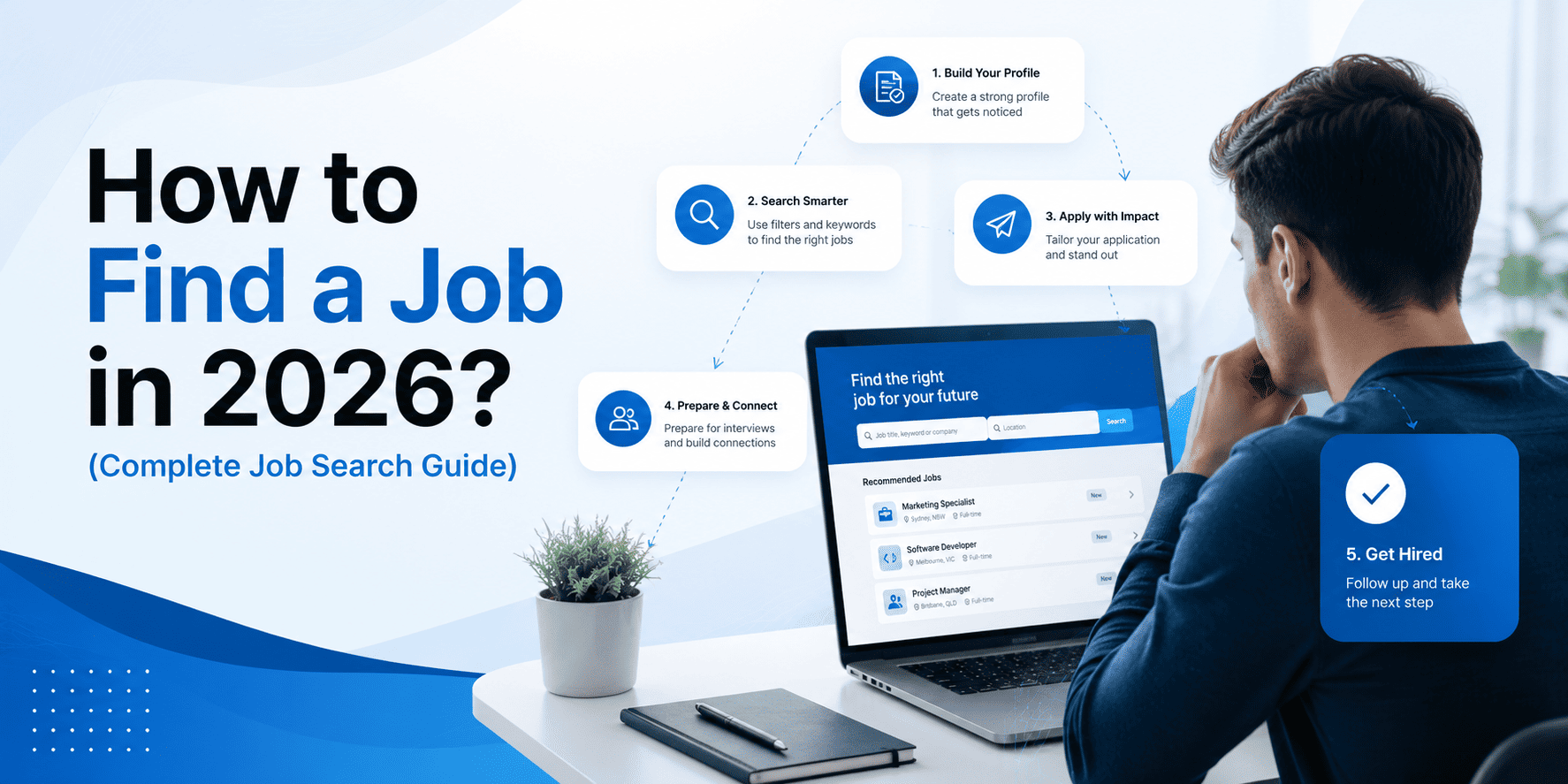
Finding a job in 2026 is not what it was two years ago. Artificial intelligence now screens most resumes before a recruiter sees them, hybrid work has become the default across every professional sector, and Google’s AI Overviews answer half the questions job seekers used to type into search. In Australia, the Australian Bureau of Statistics reported unemployment at 4.4% in May 2026, with 671,300 people out of work and youth unemployment sitting at 10.4%. The market is competitive, but it is far from stalled.
This guide walks through the exact sequence that works in the current market. It draws on Jobs and Skills Australia shortage data, Fair Work salary references, and the patterns we see across thousands of applications posted on CloudColleague every week. Whether you are switching industries, returning from a career break, or looking for your first permanent role in Australia, follow the steps below and you will save weeks of wasted effort.
| Quick answer: To find a job in 2026, define a specific target role and salary band, tailor an ATS-friendly resume with measurable outcomes, and apply through two or three trusted platforms such as CloudColleague, Seek, and LinkedIn. Combine warm-network referrals with AI-assisted applications, then prepare for AI-screened video interviews using STAR-format answers backed by evidence. |
| Want to earn money from short term tasks? Explore our Guides on Tasks to learn how task postings, how bidding works, payments, and successful applications work before you take on your first job. |
What has changed about finding a job in 2026?
Four shifts define the 2026 job market, and every one of them changes how you should search. Understanding them first is what separates candidates who land roles in four to eight weeks from those who spend six months applying into the void.
1. AI screens your resume before a human sees it
More than 75% of medium and large Australian employers now use an Applicant Tracking System (ATS) or AI resume screener as the first filter. These systems parse your resume for keyword matches, employment gaps, and structured data. A resume that a hiring manager would love can still get filtered out if it fails machine reading. Design for the algorithm first, the human second.
2. Skills-first hiring has replaced pedigree-first hiring
Australian employers, and particularly those hiring for tech, healthcare, and skilled trade roles, have moved to skills-based assessments. Jobs and Skills Australia reports 139 occupations have been in persistent shortage every year from 2021 to 2025, and 51% of those shortages sit inside Technicians and Trades Workers. Employers hiring into shortage roles will hire someone who can prove capability today over someone with a stronger degree but weaker portfolio.
3. Hybrid work is the default, not the exception
Fully remote roles have contracted since 2024, but hybrid arrangements (two or three days on site) are now standard for professional roles. If your resume or LinkedIn does not signal that you can work productively in a distributed team, you are competing on a shrinking pool of fully on-site listings.
4. Selection cycles are longer, but posts are shorter
Job ads in 2026 are trimmed for AI Overview readability, often 200 to 350 words. Selection processes behind them, though, have grown: a five-stage process with an AI video screen, a technical task, two panel interviews, and reference checks is now typical for a mid-level professional role. Plan for six to ten weeks per active application, and run three to five applications in parallel.
Read Next: Find High Salary Jobs on CloudColleague (2026 Guide).
Step 1: Define your job search target before you apply anywhere
The single biggest mistake in modern job hunting is starting with the search bar instead of the target. Candidates who type “marketing jobs Sydney” into a job board and start applying tend to send 60+ applications before landing an interview. Candidates who define their target first tend to land interviews inside 15 applications.
A clear target has five components: role title, industry vertical, seniority band, salary range, and location or work mode. Write them down in one sentence before you touch a job board.
Worked example
Vague target: “I want a marketing job.”
Sharp target: “B2B SaaS content marketer, 4 to 7 years experience, Sydney-based hybrid or fully remote within AEST, $105,000 to $130,000 total package.”
The sharp target changes every downstream decision. It tells you which two or three job boards to focus on, which 40 companies to shortlist, which keywords belong on your resume, and which recruiter conversations are worth taking. It also makes your salary conversation faster: you already know your range before it is asked.
If you are unsure which target roles are realistically in demand, browse the live CloudColleague jobs board and filter by industry and location before you commit. Seeing 40 open roles that match your target is a strong signal you are aiming at a genuine market.
Step 2: Build an ATS-friendly resume that passes AI screening
An ATS-friendly resume is one that a machine can parse cleanly and rank highly against the job description. The rules are boring, but they matter more in 2026 than at any point in the last decade because AI screening has moved from optional to standard in Australian recruitment.
The 2026 ATS-friendly resume checklist
- Length: one page for under 8 years of experience, two pages maximum for senior roles. Recruiters spend an average of 7.4 seconds on the first pass, so density is punished.
- Section headings: use the exact labels Summary, Experience, Education, Skills, Certifications. Creative labels like “My Journey” break parsers.
- File format: save as .docx unless the job ad specifies PDF. Many ATS platforms still misparse styled PDFs, dropping bullet points and dates.
- Keywords: mirror 60 to 70% of the hard skill terms from the job ad, using the ad’s exact phrasing (“content strategy”, not “content planning”).
- Quantified outcomes: every bullet in your Experience section should carry a number, a percentage, a dollar figure, or a named artefact. “Increased organic traffic 42% in nine months” beats “Grew organic traffic significantly” on every metric a hiring manager or an AI system uses.
- No headers, footers, tables, text boxes, or two-column layouts for the primary application. They look designed, but ATS parsers strip them or misread them.
- Contact block: name, phone, email, LinkedIn URL, and city or region. Never include date of birth, marital status, or a photo for Australian applications.
Rewrite a generic bullet into an ATS-ready one
Before: Responsible for managing social media accounts and increasing engagement across platforms.
After: Managed four B2B LinkedIn and Instagram accounts, growing follower base from 8,200 to 24,700 (+201%) and lifting average post engagement rate from 1.8% to 4.6% across the FY24-FY25 period.
The second version answers three questions a hiring manager silently asks on every bullet: what did you own, what changed because of you, and over what period. It also carries the numeric density AI systems weigh heavily when they rank candidates for a shortlist.
Step 3: Optimise your LinkedIn and online footprint
LinkedIn is now the single most-searched candidate database in Australian recruitment. Even when you apply through a job board, hiring managers and internal recruiters will pull up your profile before they read your resume. If your LinkedIn contradicts, underperforms, or lags your resume, you lose ground you did not know you were losing.
The five LinkedIn fields that move the needle
- Headline: 120 characters. Use the formula “[Role] helping [Audience] achieve [Outcome] | [Notable skill]”. Example: “Senior B2B Content Strategist helping SaaS scaleups grow qualified pipeline | SEO, GEO, Marketing Ops”.
- About section: Open with the same one-line sharpness as your resume summary. Then three short paragraphs: what you do, proof (metrics, notable projects), and what you are open to next. Include the location and work mode you accept.
- Featured section: Pin three to five artefacts: a case study, a talk, a piece of published writing, a portfolio link. This is often the first thing a recruiter clicks.
- Recommendations: Aim for three current recommendations from managers or senior peers. One recommendation, written specifically about a project outcome, outperforms 200 skill endorsements.
- Open to work: Turn on the recruiter-only signal, not the public green badge, unless you have already told your current employer. Recruiter-only signal is invisible to your network but ranks you higher in LinkedIn Recruiter searches.
Beyond LinkedIn, audit what a recruiter sees when they Google your name. A single unprofessional first-page result can cost you a role. Clean it up, or crowd it out with your own updated profiles, a personal site, or a GitHub or portfolio link.
Step 4: Apply through the right job platforms, not all of them
More is not better. Candidates who apply across ten job boards get worse response rates than candidates who go deep on two or three. Pick two general-purpose platforms and one specialist channel that matches your industry, then work them properly.
The 2026 Australian job platform stack
| Platform | Best for | Notes for 2026 |
| CloudColleague | Task and permanent roles, hybrid and remote, marketplace hires | Free to post, flat 7% completion fee on tasks. Growing fast in professional services and skilled trades. |
| Seek | Mid-market and enterprise permanent roles | Still the largest volume in Australia. High competition per listing. |
| LinkedIn Jobs | Professional, tech, marketing, executive | Best when combined with active LinkedIn presence and warm intros. |
| Indeed | High volume across all categories | Broad reach, weaker filtering. Use only if you can tolerate noise. |
| Industry specialists | Healthcare, trades, government, academia | For roles on the Jobs and Skills Australia shortage list, specialist boards often carry the best listings. |
For task-based work while you search, or for one-off contracts that turn into permanent offers, browse tasks on CloudColleague. Many candidates use short tasks to keep cash flow up and to build fresh work samples they can cite in interviews.
Read Next: How to Use CloudColleague to Find Jobs?
Step 5: Activate your network without cold-messaging burnout
Between 60 and 75% of professional roles in Australia are filled through referrals, internal moves, or warm introductions before they are ever advertised. This is the hidden job market. If you spend 100% of your search time on public listings, you are competing for the leftover 25 to 40% of the market against every other candidate doing the same.
The 60-40 rule for 2026
Spend 60% of your job search time on network activation and 40% on applications. That ratio feels wrong to most job seekers, who default to 90-10 in the opposite direction. Reversing it consistently produces more interviews per week.
A reconnection template that works
Subject: Quick hello and a small favour
“Hi [Name], hope you are well. It has been a while since [specific shared context]. I am starting a job search for [sharp target role, one sentence] and I remembered you know [company or industry] well. Would you have 20 minutes for a coffee or call in the next fortnight so I can pick your brain? Happy to work around your schedule. Cheers, [Your name].”
Three features make this template convert: specific shared context (proves you remember them), a one-line sharp target (makes it easy for them to help), and a small, bounded ask (20 minutes, not “pick your brain sometime”). Send it to 20 people in the first two weeks of your search. Expect 8 to 12 replies and 4 to 6 conversations.
Step 6: Use AI tools without sounding like AI
AI writing tools are now standard in job search, and Australian recruiters know it. The difference between a candidate who uses AI well and one who gets flagged is not whether they use it, but how.
What AI does well in a job search?
- First-draft tailoring of a resume against a specific job description.
- Rewriting weak resume bullets into stronger, quantified versions when you supply the numbers.
- Generating first-pass interview answers you then rehearse in your own voice.
- Summarising a company’s public filings, news, and product releases before an interview.
- Proofreading, grammar checks, and reducing passive voice.
Where AI hurts you?
- Full cover letters copied straight from a chatbot. Recruiters spot the tell-tale phrasing and rhythm within seconds.
- Generic achievements with no specific numbers, dates, or artefacts. AI fills gaps with fluff when you have not fed it evidence.
- Over-polished writing that has no trace of your voice. Slightly rough is more human than perfectly smooth.
- Fabricated skills or experience. AI will happily invent credentials that will collapse under a reference check.
The safest workflow: feed the AI your real evidence (project metrics, past bullets, the job ad), let it produce a first draft, then rewrite every paragraph in your own words with your own specifics. Treat the AI output as raw material, never as the final artefact.
Step 7: Prepare for AI-screened video interviews
The one-way video interview, where you record answers to preset questions on a platform such as HireVue, Modern Hire, or Sonru, is now the first live stage for most professional roles in Australia. An AI system scores your responses on content, structured language, and sometimes tone before a human ever watches the video.
How to score well on an AI-screened interview?
- Answer every behavioural question in STAR format: Situation, Task, Action, Result. AI scorers reward this structure heavily because it maps cleanly to the parsers.
- Front-load the outcome: Open with the result in one sentence, then walk backwards through the situation and actions. Machine scoring often weights the first 15 seconds.
- Include numbers in every answer: Percentages, dollar figures, timelines, team sizes. Numeric density is a strong ranking signal.
- Speak at a steady pace, neither rushed nor slow. Aim for 120 to 140 words per minute. AI transcription tools score cleaner audio higher.
- Look at the camera lens, not the screen. Good webcam framing at eye level, plain background, natural front light.
- Practice with three or four behavioural questions the day before: your biggest impact, a conflict you resolved, a project that failed and what you learnt, a time you led without formal authority.
Once you clear the AI screen, the live interviews that follow tend to be more structured than they were five years ago. Expect a competency-based panel where each interviewer owns two or three specific competencies. Prepare one concrete story per competency, not one polished story you try to bend to every question.
Step 8: Negotiate salary using 2026 Australian data
Salary negotiation is where most Australian candidates leave the most money on the table, usually because they anchor on their current salary rather than the market. In 2026, three data anchors will hold up in any negotiation.
Three salary anchors that hold up
- ABS Average Weekly Earnings: The Australian Bureau of Statistics publishes full-time adult ordinary time earnings by industry every six months. It is the most defensible external benchmark.
- Fair Work modern award minimums: For roles covered by an award, the Fair Work Commission publishes the floor. Your target salary should sit meaningfully above the award minimum.
- Jobs and Skills Australia shortage rating: If your role is on the persistent-shortage list, you have leverage. Employers competing for scarce skills will move on salary before they lose the candidate.
The negotiation move that works
When asked for a salary expectation, state a range with your target as the bottom of the range: “$120,000 to $135,000 base, plus super, based on the responsibilities in the role and market benchmarks for the industry.” Never disclose your current salary unprompted, and remember that superannuation, bonus, equity, leave loading, salary sacrifice arrangements, and remote work flexibility are all negotiable components of the total package.
| Ready to put this into practice? Start as a Seeker on CloudColleague profile in under three minutes, get matched to roles and tasks across Australia, and start applying with a resume built for 2026 hiring. Create your free CloudColleague profile → |
Common job search mistakes to avoid in 2026
Six mistakes account for the majority of stalled job searches we see across CloudColleague candidates. Avoid these and you cut your average time-to-offer by weeks.
1. Mass applying with the same resume
A single generic resume sent to 80 roles produces worse outcomes than a tailored resume sent to 15. Tailoring means changing your summary, adjusting three to five bullets, and mirroring the job ad’s key phrases.
2. Treating LinkedIn as an afterthought
If your LinkedIn was last updated in 2023, recruiters treat you as inactive. Update your headline, About, and Featured sections before you send a single application.
3. Ignoring the hidden job market
Most professional roles in Australia are filled through referrals or warm intros before they hit the public boards. If you skip network activation, you are competing on the visible minority of the market.
4. Waiting for the perfect role
The 90% match role does not exist. Apply for 70% matches with a strong tailored application. Employers hire on trajectory, not on ticked boxes.
5. Not following up
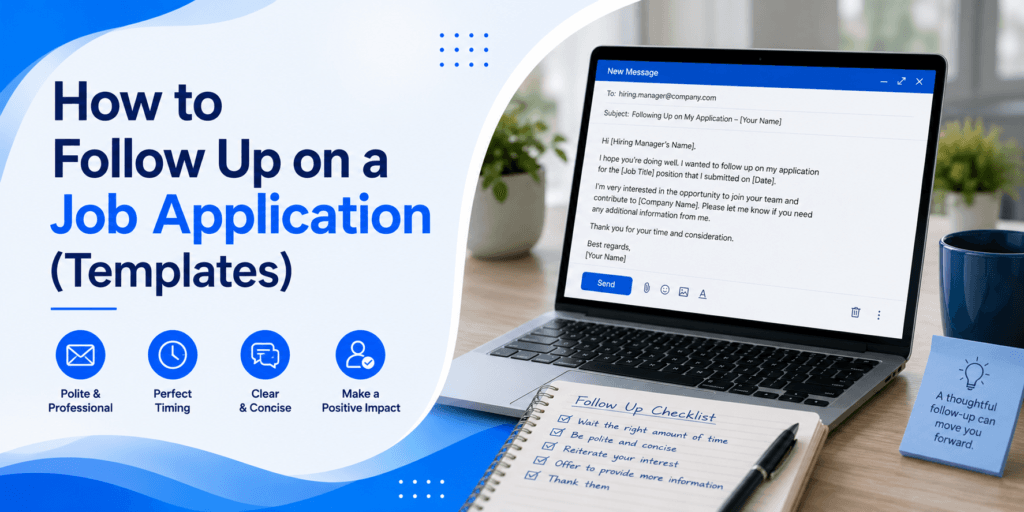
A polite follow-up email seven to ten days after an application, or three to five days after an interview, keeps you top of a recruiter’s mind without being pushy. Most candidates never send one.
6. Neglecting cash flow during the search
A job search takes weeks or months. Financial pressure produces bad decisions and rushed acceptances. Short tasks on CloudColleague or short contracts through a specialist agency can bridge the gap without pausing your search.
How long does it take to find a job in 2026?
The honest answer is that it depends on seniority, industry, and how prepared you are before you start. The averages we see across CloudColleague candidates in 2026 look like this.
| Role type | Typical time to first offer | Applications per week |
| Entry-level, in-demand sector | 4 to 8 weeks | 8 to 12 |
| Mid-level professional (3 to 7 years) | 6 to 12 weeks | 5 to 8 |
| Senior professional (8+ years) | 10 to 20 weeks | 3 to 5 |
| Executive or specialist | 12 to 24 weeks | 2 to 4 |
| Career changer | 12 to 26 weeks | 5 to 8 |
| Shortage-list role (e.g. RN, electrician) | 2 to 6 weeks | 4 to 6 |
Three actions consistently shorten the timeline: a sharp target defined in week one, a resume rebuilt to 2026 ATS standards before the first application, and 60% of search time spent on network activation. Skip any of the three and the search stretches.
Read Next: How to Find Jobs That Match Your Skills on CloudColleague?
Frequently asked questions
The fastest path is a sharp target role plus warm-network activation. Candidates who define a specific role and reach out to 20 relevant contacts in the first two weeks typically land interviews within three to four weeks. Broad applications to generic job boards without a target take two to three times longer.
Yes, as a starting point. AI resume builders produce solid first drafts and can tailor bullets to a job description quickly. But every AI draft needs a human rewrite pass in your voice with your specific numbers and outcomes. Recruiters spot untouched AI writing within seconds.
According to the 2025 Occupation Shortage List published by Jobs and Skills Australia, healthcare, skilled trades and construction, education, engineering, and information and communication technology (particularly cybersecurity) remain the strongest hiring sectors. Roughly 29% of assessed occupations are in acute shortage, and 139 occupations have been in persistent shortage every year from 2021 to 2025.
Both, but not for the same role. Apply directly when you have a warm intro or a strong referral. Use a specialist recruiter when the role is confidential, senior, or you need coverage across multiple listings you cannot personally track. Never let a recruiter submit you without seeing the job description and the employer name.
For mid-level professional roles, five to eight tailored applications per week is a healthy rate. Beyond that number, quality collapses. Pair that with 8 to 12 network conversations per week for the fastest results.
For applications through an ATS, most recruiters do not read cover letters unless the resume passes screening first. For direct emails to a hiring manager, a short and specific cover note (150 to 200 words) still lifts response rates measurably. Skip generic templates. Reference something specific about the role or the company.
Address it briefly in your summary and Experience section rather than hiding it. Recruiters value honest, short explanations: parental leave, caring responsibilities, health, study, or a deliberate reset. Add any freelance work, tasks, volunteering, or study completed during the gap. A gap treated matter-of-factly rarely blocks an offer. A hidden gap almost always surfaces.
Yes. CloudColleague hosts both permanent roles and one-off tasks. Many candidates use tasks to bridge income and to build fresh, verifiable work samples they can cite in permanent-role interviews. Employers on the platform frequently hire task workers into ongoing roles once they have seen the work.