Working in Australia vs USA is one of the biggest career decisions a migrant can face. The two countries share a language and plenty of culture. Their working lives could hardly be more different.
Most comparisons online come from visa agencies selling one destination. Here is our position, stated upfront. We are an Australian platform, and we will still tell you honestly where America wins. Because it genuinely does win on several fronts, and pretending otherwise helps nobody. Read the real trade-offs below, then choose the country that fits your life. If Australia ends up being your answer, CloudColleague can start paying you before you even land.
Australia vs USA at a Glance
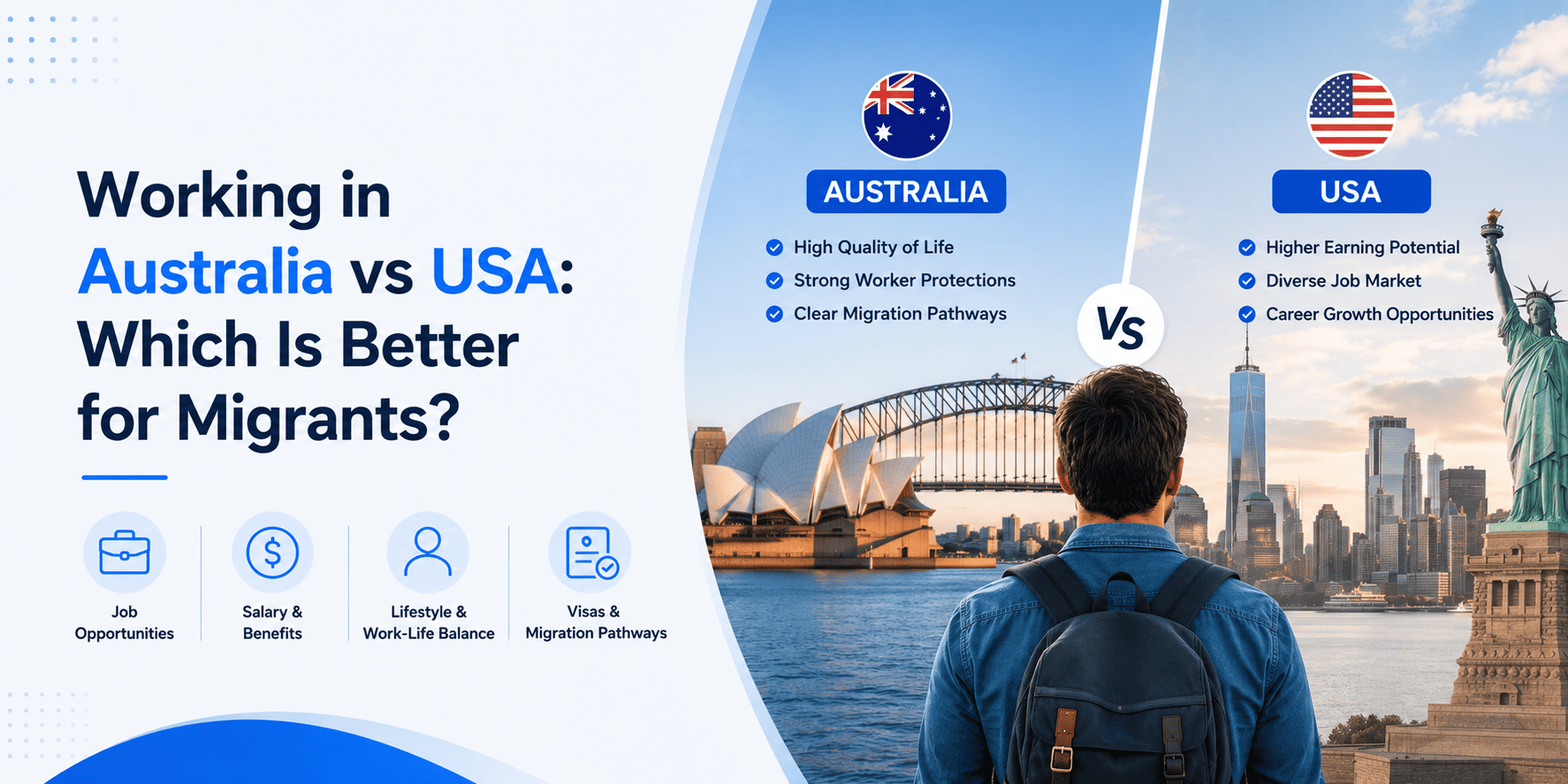
Here is the honest summary. The USA offers higher earning ceilings for top-tier professionals and a vastly larger job market. Australia offers higher earning floors, four weeks of guaranteed leave, universal healthcare, and 12% superannuation on top of every salary. Neither country wins universally. Your industry, ambitions, and family situation decide the winner.
Choose the USA if you sit in the top tier of tech, finance, or medicine. The ceiling there is simply higher, and the market rewards standout performers faster.
Choose Australia if you value guaranteed conditions, security, and a migration system you control. The floor is higher, the safety nets are real, and the visa process does not depend on winning a lottery.
The sections below unpack each factor with verified numbers. No cheerleading, just the trade-offs.
Salary Comparison: Australia vs USA in 2026
Start with the headline truth. Top American salaries beat top Australian salaries, sometimes dramatically. A senior engineer in San Francisco or New York can out-earn any Australian equivalent. Market scale drives it: more giant companies, more competition for stars.
Now the floor, where the story reverses completely. Australia’s minimum wage sits at $26.44 per hour from July 2026. The US federal minimum wage remains USD $7.25, though many states set higher rates. Australian penalty rates add loadings for weekends, nights, and public holidays. Superannuation adds 12% on top of every quoted salary. For ordinary workers, Australian total packages routinely win.
For the Australian side of the ledger, see our guide to the highest paying jobs in Australia for immigrants. It breaks down 20 roles with verified ranges.
Cost of living and what’s left over
Both countries charge painfully for housing in their famous cities. Sydney rivals New York, and Melbourne rivals Boston. Comparing countries misleads here, because city pairs decide everything. Adelaide versus Austin produces a different answer than Sydney versus San Francisco.
Run the comparison properly with four numbers. Rent for your household size, in the actual suburbs you would live in. Commuting costs, because American cities usually require a car per adult. Childcare, where both countries hurt but subsidies differ. And groceries, where the gap is smaller than people claim.
Then remember the invisible costs. American budgets need health premiums, deductibles, and college savings. Australian budgets absorb those through Medicare, super, and income-based university repayments. Compare your actual city options with all costs included. Our salary insights for Australia helps benchmark the Australian side.
Healthcare: the hidden salary difference
This single line item flips many comparisons. Australian Medicare covers residents without payroll deductions for basic care. American workers contribute around USD $1,440 yearly for single health coverage. Family coverage contributions average roughly USD $6,850, on top of deductibles. Subtract that from the American salary premium before comparing offers. For many families, the gap closes fast.
Taxes and Take-Home Pay: The Complicated Truth
Tax is where America claws back ground, so let us be fair about it.
US income tax rates often run lower than Australian rates at similar incomes. Several states charge no state income tax at all. Texas and Florida salaries stretch further than their headline numbers suggest. High earners frequently keep more of each extra dollar in America.
Australia taxes income harder at the top. In exchange, the system bundles what Americans buy separately. Medicare replaces health premiums that cost American families thousands yearly. Superannuation builds retirement savings automatically, without depending on employer generosity. University debts also work gentler here, repaying only above income thresholds.
The honest comparison method is simple. Never compare gross salaries between the two countries. Compare what lands in your account after tax, health costs, and retirement savings. Run that maths for your specific income and family size. Middle-income families usually land ahead in Australia. Top-percentile singles usually land ahead in America.
One more line item catches new arrivals. Tipping adds 15% to 25% to American service prices. Australian prices include service, and tipping stays genuinely optional. Small difference on paper, real difference across a year of living.
Work-Life Balance: Leave, Hours, and Job Security
The starkest verified differences live in this section.
Leave first. Australian law guarantees four weeks of paid annual leave from day one. Ten days of personal leave and around eleven public holidays sit on top. The USA mandates zero paid leave at federal level. The American average reaches about ten days after a full year of service. A first-day Australian worker out-holidays a ten-year American veteran.
Hours follow the same pattern. OECD figures show Americans work around 1,796 hours yearly against 1,627 in Australia. That gap equals roughly four extra 40-hour weeks every single year.
Job security might be the biggest cultural shock of all. In 49 US states, employment is “at-will”. Your employer can end your job any day, without reason, notice, or severance. Australia sets the opposite default under the Fair Work Act. Most employees hold unfair dismissal protection, requiring valid reasons, fair process, and minimum notice.
The honest American counterpoint deserves its space. Everything is more negotiable in the US, including pay, leave, and exit terms. High performers often progress faster, because the market moves faster. The ceiling is higher. The floor is lower. That sentence summarises the entire comparison.
Families should weight this section double. Parental leave, sick children, and school holidays test every workplace promise. Australia’s government-funded parental leave scheme covers eligible parents regardless of employer. American parental leave depends almost entirely on individual company policy. Ask any migrant parent which system they would rather raise kids under.
Visas and Migration: Which Country Lets You In?
For many migrants, this section makes the decision alone.
Australia runs points-tested visas that need no employer at all. You lodge an Expression of Interest through SkillSelect. Points come from age, English, skills, and experience, and invitations follow the scores. Employer-sponsored and state-nominated routes add more doors. You control your own application.
The American system hands control to employers. The main skilled route, the H-1B, requires an employer petition and a lottery. Demand exceeds supply most years, so qualified people simply miss out. Green card queues stretch years, and for some nationalities, decades. Family sponsorship dominates US permanent migration, leaving less room for skilled entrants.
One curiosity says plenty. Australian citizens get a dedicated US work visa, the E-3, with 10,500 places yearly. Americans receive no mirror arrangement in Australia. They queue through the standard skilled routes like everyone else.
The practical takeaway for migrants is simple. If you qualify on points, Australia lets you migrate on your own effort. America makes an employer decide your fate first. Our full guide on how to get a job in Australia from overseas walks the entire process, country by country.
Leaning towards Australia? Start earning from Australian businesses before you land. Sign up free on CloudColleague and build Australian client references from wherever you live now.
Work Culture: What Day-to-Day Actually Feels Like
Numbers aside, the two workplaces feel different to sit in.
Australian workplaces run flat and informal. First names apply to everyone, including executives. Egalitarian culture means good ideas outrank job titles in meetings. Finishing on time is normal, and weekends belong to you. One in four Australian workers was born overseas, so multicultural teams are the default.
American workplaces run hotter. Hierarchy is more visible, and individual performance gets measured constantly. Hustle culture is real, especially in tech and finance. Being reachable after hours is often the unspoken expectation. The reward is pace: promotions, pay rises, and big opportunities arrive faster for those who stand out.
Neither culture is objectively better. Ambitious sprinters often thrive in America and feel restless in Australia. People building long, balanced lives often flourish in Australia and burn out in the US. Know which one you are before you choose.
Read Next: Working in Australia vs New Zealand: Which Is Better for Migrants?
The Verdict: Working in Australia vs USA
Here is the decision framework, honestly stated.
Pick the USA when your earning ceiling matters most. Top-tier tech, finance, medicine, and law pay more there than anywhere. Pick it for market scale, speed, and the sheer volume of opportunity. Accept the trade: less leave, less security, and healthcare costs from your pocket.
Pick Australia when the whole package matters more than the peak. Guaranteed leave, universal healthcare, 12% super, and dismissal protection compound over a career. Pick it for family security and a lifestyle that ends at reasonable hours.
For migrants specifically, add the deciding factor. Australia’s points system puts your migration in your own hands. America’s employer-and-lottery system leaves brilliant people waiting on luck. A path you control usually beats a slightly shinier path you cannot access.
Third-country migrants feel this hardest. An engineer in India or the Philippines can score, apply, and move to Australia independently. The same engineer needs an American employer to win a lottery first. Plenty of people spend years chasing the US and land in Australia faster. Some of the happiest migrants planned it that way from the start.
Chose Australia? Move with momentum. Start as a seeker on CloudColleague and browse live tasks from any country today.
Make Australia the Easy Choice with CloudColleague
Working in Australia vs USA comes down to ceilings versus floors. America rewards the exceptional few spectacularly. Australia treats the everyday many far better, and lets migrants in on their own merits.
If Australia fits your life, remove the hardest part of the move early. Income and local references usually take months to build after landing. CloudColleague compresses that into weeks, starting before you fly. Build your free verified profile, let AI matching deliver suitable tasks, and interview by video across any time zone. Payment arrives the same day through Stripe. Join CloudColleague free today or browse open jobs, and land in Australia already working.
FAQ: Australia vs USA for Migrants
It depends on your priorities. The USA pays top-tier professionals more and offers a bigger market. Australia guarantees four weeks of leave, universal healthcare, 12% superannuation, and stronger job security. Migrants also find Australia’s points-based visas far more accessible than America’s employer-driven lottery system.
At the top, the USA wins clearly, especially in tech, finance, and medicine. At the middle and bottom, Australia often wins on total package. Australia’s minimum wage of $26.44 hourly dwarfs the US federal $7.25. Superannuation and penalty rates widen the everyday gap further.
Australia, by measurable margins. Australians work around 1,627 hours yearly against 1,796 in America, nearly four fewer working weeks. Australian law guarantees four weeks of paid leave from day one. The USA mandates none federally, and workers average about ten days.
Australia, for most skilled workers. Its points-tested visas require no employer sponsor and no lottery. The main US skilled route, the H-1B, is employer-bound and lottery-gated, with long green card queues. Australians even get a dedicated US visa, while Americans get no equivalent in return.
Build a free verified profile on CloudColleague from any country. AI matching connects you with Australian businesses posting tasks in admin, data, design, research, and more. Built-in video interviews handle time zones, and Stripe pays you same-day. Every completed task becomes an Australian reference for future applications.