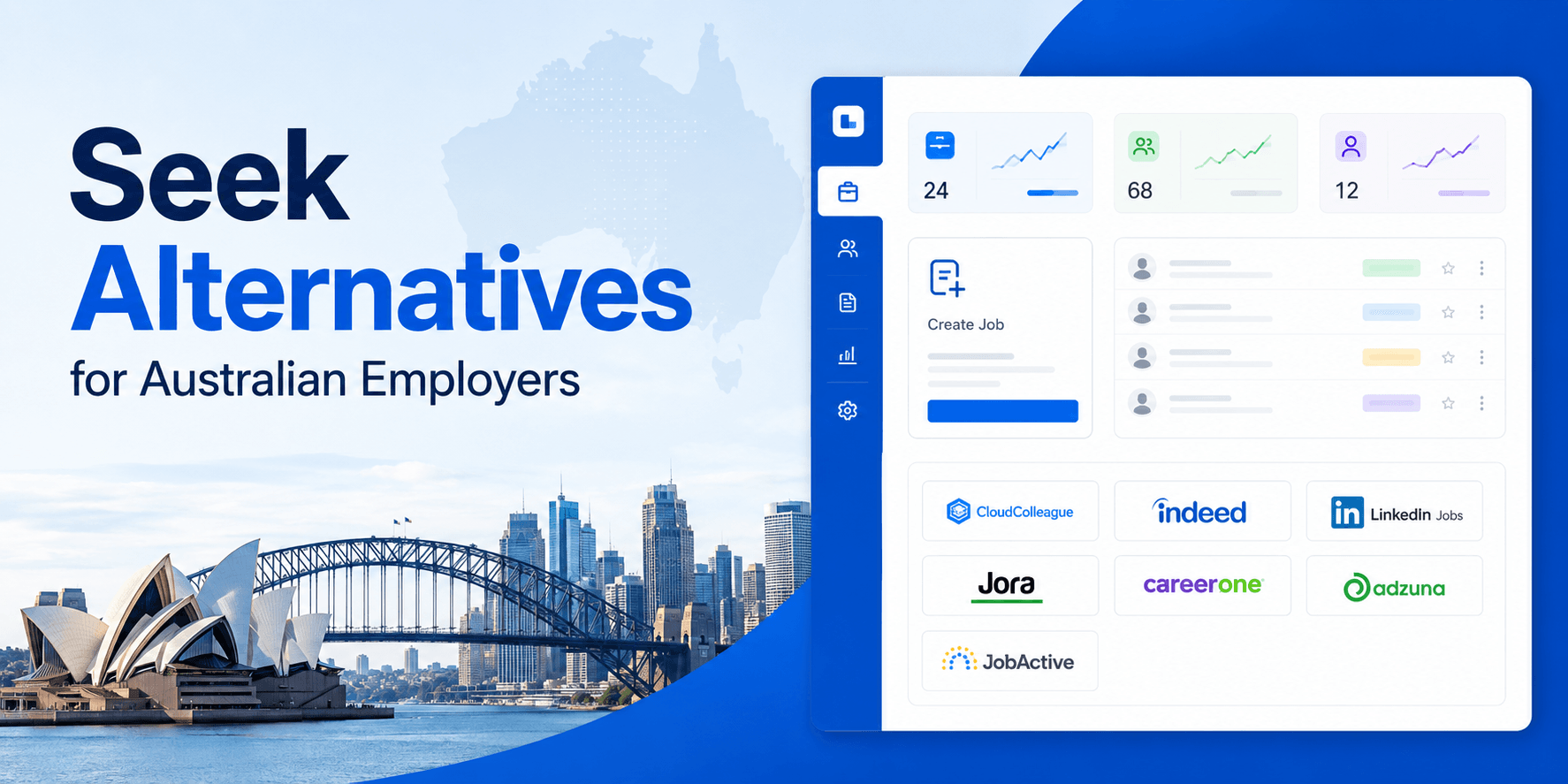
The strongest Seek alternatives for Australian employers in 2026 are Indeed for capped budgets, LinkedIn for passive professionals, Jora for free distribution, Workforce Australia for subsidised hiring, and industry specific boards for regulated roles. Most employers switch for cost control rather than dissatisfaction with candidate quality.
Employers searching for Seek alternatives in Australia are usually not unhappy with the candidates. They are unhappy with the invoice. Seek prices each advertisement individually, based on the job title, the vacancy location and how many relevant candidates are active nearby, which makes a multi role hiring plan difficult to budget in advance.
This guide covers the realistic replacements, what each one does well, and the specific circumstances where leaving Seek is the wrong call. We have included the last part deliberately, because a comparison that only argues one direction is not much use to anyone making a decision.
Why Australian employers look for Seek alternatives?
Three pressures drive the search, and they tend to arrive together.
First, cost visibility. Seek does not publish a flat rate card. Pricing surfaces through a lookup tool on the employer dashboard, which is fine for a single hire but awkward when you are planning a quarter of recruitment across several locations.
Second, market conditions. The Australian Bureau of Statistics recorded 329,500 vacancies in May 2026, down 2.1 per cent on the quarter and 30.3 per cent below the May 2022 peak. When hiring volumes shrink, finance teams scrutinise recruitment advertising more closely than they did during the shortage years.
Third, role mismatch. Seek is built around advertised employment. If you need someone for six hours of work next Tuesday, an employment marketplace is the wrong instrument regardless of price.
The main Seek alternatives compared
All pricing below was verified on 10 August 2026. Several platforms use auction pricing, so your figures will differ by role and location.
| Alternative | Cost model | Switch to it when | Do not switch when |
| Indeed | Three free posts per calendar month. Sponsored placement via live auction, charged per started application. | You need a hard ceiling on spend, or you want to test a role before committing. | You need guaranteed prominence. Free posts drop down results within about a day. |
| Free posting, paid promotion, separate recruiter licences | The role is professional, managerial or technical, and the best candidates are already employed. | You are hiring trades, hospitality or shift based staff. | |
| Jora | Free listings. Part of the Seek Group. | You want additional distribution at no cost alongside a paid ad. | You expect it to replace paid reach. It supplements, it does not substitute. |
| Workforce Australia | Free government platform | The role may attract wage subsidies or you are hiring from supported cohorts. | You need speed. Candidate flow is narrower than commercial boards. |
| Industry boards | Varies, commonly flat fee | The role is regulated or credentialled, such as aged care, health or licensed trades. | The role is general and would benefit from broad reach. |
| Airtasker and similar | Percentage service fee on completed tasks | The work is a defined one off task with a clear deliverable. | You are hiring an employee. These platforms are not employment marketplaces. |
Indeed: the closest direct replacement
For most employers leaving Seek, Indeed is the first stop, and the reason is structural rather than promotional. Indeed inverted the pricing model.
Employers posting directly can run up to three free listings per calendar month, each live for up to 30 days. Beyond that, sponsored placement runs through a live auction. Importantly, Indeed now charges per started application, meaning a candidate has actively begun applying rather than simply clicking through to view the role.
Independent 2026 analyses place typical effective cost per application somewhere around A$15 to A$50, varying by role competitiveness and metropolitan area. You set a daily or monthly cap and can stop at any point, which is precisely the control that Seek’s model does not offer.
However, be realistic about the free tier. A free Indeed post loses visibility quickly as newer listings arrive, often within a day. Treat the free allocation as a test, not a strategy.
LinkedIn: reaching people who are not looking
LinkedIn solves a problem no job board can. Roughly speaking, job boards reach active candidates, meaning people who have decided to look. LinkedIn reaches passive candidates, meaning people who are employed, reasonably content, and open to the right approach.
For professional, managerial and specialist technical roles, that distinction matters enormously. The strongest candidate for a senior finance position is rarely refreshing a job board at nine in the evening.
Conversely, LinkedIn performs poorly for trades, hospitality, retail and shift based work. The professional network simply is not where those candidates spend their time.
Free and government backed options
Jora
Jora is owned by the Seek Group, which produces a mild irony: one of the more useful Seek alternatives belongs to Seek. Listings are free and aggregate reasonably well. Use it as supplementary distribution rather than a primary channel.
Workforce Australia
The federal government platform costs nothing and connects employers to jobseekers in supported programs. Wage subsidies may apply depending on the candidate and the role. Candidate flow is narrower than commercial boards, so treat it as a valuable secondary channel rather than a replacement.
When you should stay with Seek?
This section matters more than the comparison table, because switching for the wrong reason costs more than staying.
Stay with Seek when candidate volume is the binding constraint. Seek reported revenue of A$1,097 million for 2025 and has spent nearly three decades building the largest Australian candidate pool. For high volume permanent recruitment, particularly outside capital cities, that depth is genuinely difficult to replicate elsewhere.
Stay with Seek when you hire regularly. Ad budgets purchased upfront attract volume discounts, and the effective per ad cost for a consistent recruiter looks very different from the single ad price.
Stay with Seek when the role is time critical and you cannot afford to test channels. Paid prominence on the largest local marketplace remains the fastest route to applicant volume.
A note on switching costs. Moving platforms means rebuilding your employer profile, re-training whoever manages applications, and losing whatever candidate history sits in your current dashboard. Factor that in before treating a lower ad price as a saving.
Where CloudColleague sits?
In the interest of disclosure, this guide is published by CloudColleague, an Australian platform where employers post both roles and one off tasks. That dual structure is genuinely uncommon, since most platforms handle employment or tasks but not both.
To state the trade off plainly: CloudColleague does not have Seek’s candidate volume, and for a high volume regional permanent hire, Seek will very likely outperform us. Where CloudColleague is worth considering is when your hiring mixes ongoing roles with short term work, because running two separate platforms for that creates administrative overhead most small businesses do not need.
How to switch without losing momentum?
- Run parallel first. Keep your Seek ad live and add a free Indeed post for the same role. Compare applicant quality, not just volume.
- Measure cost per qualified applicant. Not cost per application. An expensive channel that produces three interviewable candidates beats a cheap one that produces thirty unsuitable ones.
- Match the platform to the role type. Professional roles to LinkedIn, general roles to Indeed, regulated roles to industry boards.
- Keep one paid channel. Free distribution alone rarely fills a role on deadline.
For a direct comparison of the two largest platforms, see our guide to Seek versus Indeed in Australia. If you want the full landscape before narrowing down, start with our overview of the best job posting sites in Australia. Small businesses weighing whether a single premium ad is justified should read is a Seek job ad worth it for a small business.
Frequently asked questions
Indeed’s free allocation of three posts per calendar month is the strongest free option, followed by Jora and Workforce Australia. Free listings lose prominence quickly, so use them to test a role rather than to fill an urgent vacancy.
Usually, but not always. Indeed’s auction model gives you a spending cap, which makes it cheaper to control. In highly competitive categories the auction price can climb, and a heavily sponsored Indeed campaign can exceed a single Seek ad. Compare on cost per qualified applicant rather than headline price.
Quality varies by role type rather than by platform. LinkedIn produces stronger professional candidates. Seek produces greater volume. Industry boards produce better credentialled candidates for regulated roles. No single platform wins across every category.
Yes, and it is generally the better approach. Different platforms reach different candidate behaviours. Running one paid channel alongside two free ones covers substantially more of the market than concentrating spend in one place.
Jora operates as a separate free listing service with its own audience and aggregation reach. Ownership does not change its practical function for an employer, which is free supplementary distribution.