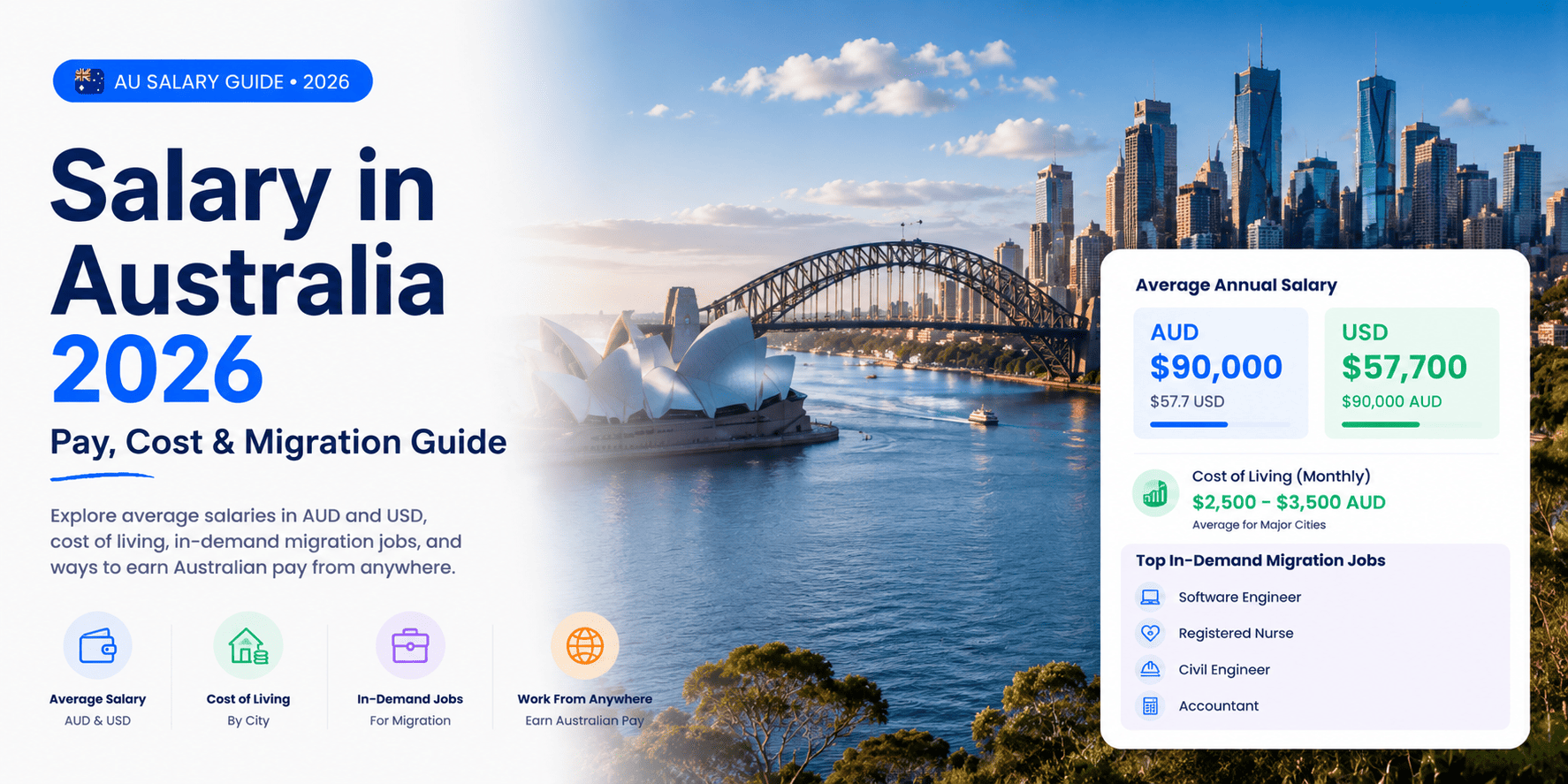
If you are weighing up Australia, the salary in Australia is a strong starting point. Full-time adults earn an average near $106,657 a year, according to the latest official figures. That places the country among the world’s better-paying economies. Yet the headline hides the role of tax, cost of living and currency. This guide views Australian pay from the outside, in global terms, and shows how to earn it even from abroad. For the full domestic breakdown by industry, state and role.
| Starting a new chapter in Australia? Start as a Seeker to learn how CloudColleague can help you get started. |
What is the average salary in Australia in 2026?
The Australian Bureau of Statistics reports clear, recent numbers. Full-time adult average weekly ordinary time earnings reached $2,051.10 in November 2025. Annualised, that is roughly $106,657, after rising 3.8% over the year. The ABS released these figures on 26 February 2026.
However, the average is pulled up by top earners. The ABS median tells a steadier story. Full-time workers sit near $90,500 a year, while all employees, including part-timers, sit near $74,100. So most newcomers should treat the median as their realistic guide.
Read Next: Average Salary in Nepal 2026
Salary in Australia in USD and how it compares globally
For an international view, convert the figure to US dollars. At mid-2026 exchange rates, the average lands near USD 69,000. On the OECD’s purchasing-power measure, Australia sits closer to USD 67,000.
That ranks Australia in the upper tier worldwide, though below the United States and much of Western Europe. It comfortably beats most of Asia and the OECD average. For scale, the average salary in Australia roughly doubles the OECD-wide figure near USD 58,000. For the full ranking, read our salary by country guide. You can also compare directly with the salary in Nepal, a common origin for skilled migrants.
Salary in Australia vs cost of living
A six-figure average sounds generous, but living costs eat into it. Sydney and Melbourne rank among the world’s pricier cities for housing. Rent and mortgages absorb a large share of take-home pay there. So the same salary stretches much further in Adelaide, Perth or a regional town.
This is why purchasing power matters more than the headline number. A salary that feels large can feel ordinary after rent. Always weigh pay against the local cost of living before you move. Smaller cities often leave more money in your pocket.
Plan before you move. Download our free 2026 Australia Pay and Cost-of-Living Guide. It pairs salary benchmarks with real living costs by city. See our guide to the average salary in Australia.
How much salary in Australia do you keep after tax?
Tax shapes your real income, so plan for it early. Residents pay no tax on the first $18,200 they earn, per the ATO. Above that, progressive rates apply, alongside a 2% Medicare levy. On a $90,000 salary, take-home pay lands near $70,000. Your 12% superannuation, by contrast, sits on top and grows separately.
| Wanna earn more the your basic salary in Australia? Explore our Guides on Tasks, understand How Bidding Works, and Explore Tasks to get started. |
Minimum wage and superannuation in Australia
Australia protects low-paid workers with a strong wage floor. The Fair Work Commission sets the national minimum wage each year. Since 1 July 2025, it has been $24.95 an hour, or $948 a week. Casual workers earn at least $31.19, including their 25% loading.
A further rise is already locked in for newcomers to note. From 1 July 2026, the lowest award rate climbs 4.75%, to at least $26.44 an hour. Employers must also pay 12% superannuation on top of wages. That super is a real, often overlooked, addition to your package.
Read Next: Average Salary for Freshers in Australia 2026
In-demand jobs and salaries for migrants in 2026
Australia ties much of its skilled migration to genuine shortages. Jobs and Skills Australia found 29% of assessed occupations in national shortage in 2025. It also flags 139 roles in shortage every year since 2021. Healthcare, trades, engineering, ICT and education dominate that list.
Several occupations stand out for both demand and pay. Registered nurses and general practitioners are persistently short. Software programmers, civil engineers and electricians are too. Secondary teachers in maths and science round out the picture. For pay by role and experience, see our guide to salary by job role.
The gender pay gap in Australia
Pay is not shared evenly across genders. The ABS puts the gender pay gap in full-time ordinary earnings at 11.5%. That is the equal lowest level in the series, but a gap remains. So women, on average, still earn less for full-time work. Employers and policymakers continue to target the difference.
How to earn an Australian salary, including from abroad?
You do not always have to migrate to earn Australian rates. There are two clear routes in 2026. The first is skilled migration, using an in-demand occupation. The second, and faster, is remote work for Australian clients.
Remote work removes the visa wait entirely. A skilled developer, designer or accountant can bill Australian businesses from anywhere. You earn strong rates while keeping your local cost of living low. To find that work, you can browse Australian and remote roles and apply in minutes.
Earn Australian rates without relocating. CloudColleague links skilled professionals with Australian and global businesses, then pays out the same day through Stripe. A verified profile is free, and AI matching surfaces roles that suit your skills.
Planning the move itself? Our first-time-in-Australia guide covers the practical steps. Meanwhile, our platform features keep payments and interviews in one place.
| Made the move from Nepal to Australia? Create your free account and join now to take the first step toward your next opportunity. |
Salary in Australia FAQ
Full-time workers earn an average just over $100,000 a year, based on ABS average weekly ordinary-time earnings, plus 12% super on top. The median is lower, closer to $76,000 to $90,000, and reflects what a typical worker earns.
The median is more accurate for most people. The average is pulled up by very high earners in sectors like mining and finance. Use the median as your main benchmark and the average to gauge the top end.
A good salary beats the median for your role and state, after cost of living and super. Beating the national average is a weaker signal, because that figure is skewed high.
Mining pays the most, near $150,000 to $171,000 for full-time work, helped by fly-in-fly-out roles. ICT, financial services and professional services follow. Accommodation and food services sit at the bottom.
Change roles, since job-changers tend to out-earn job-stayers. Or go independent and set your own rates. Freelancing lets you bill higher-paying domestic and overseas clients, which often pushes income above salaried averages.