A salary calculator tells you the number your employer will never put in the offer letter: what the salary actually delivers to your bank account after tax. On $100,000 gross in 2025-26, the ATO’s PAYG system and the 2% Medicare levy leave you with $77,212 in take-home pay. That is $22,788 less than the headline figure you signed for, before HECS repayments reduce it further. Most Australians discover this gap on their first payslip, not before their negotiation. This guide explains exactly how Australian salary calculations work in 2026, uses verified ATO figures to walk through the key scenarios, and shows you how CloudColleague’s salary insights turn the numbers into real market leverage.
| Use your salary insights to plan your next move. Start as a Seeker and discover new opportunities today. |
Australian salary calculator 2025-26
The most useful thing any salary calculator does is convert the gross figure on an offer letter into the net figure that lands in your account. In Australia that conversion depends on four variables: your income tax bracket, the Medicare levy, any HECS or HELP repayment, and whether super is included in or on top of your quoted salary.
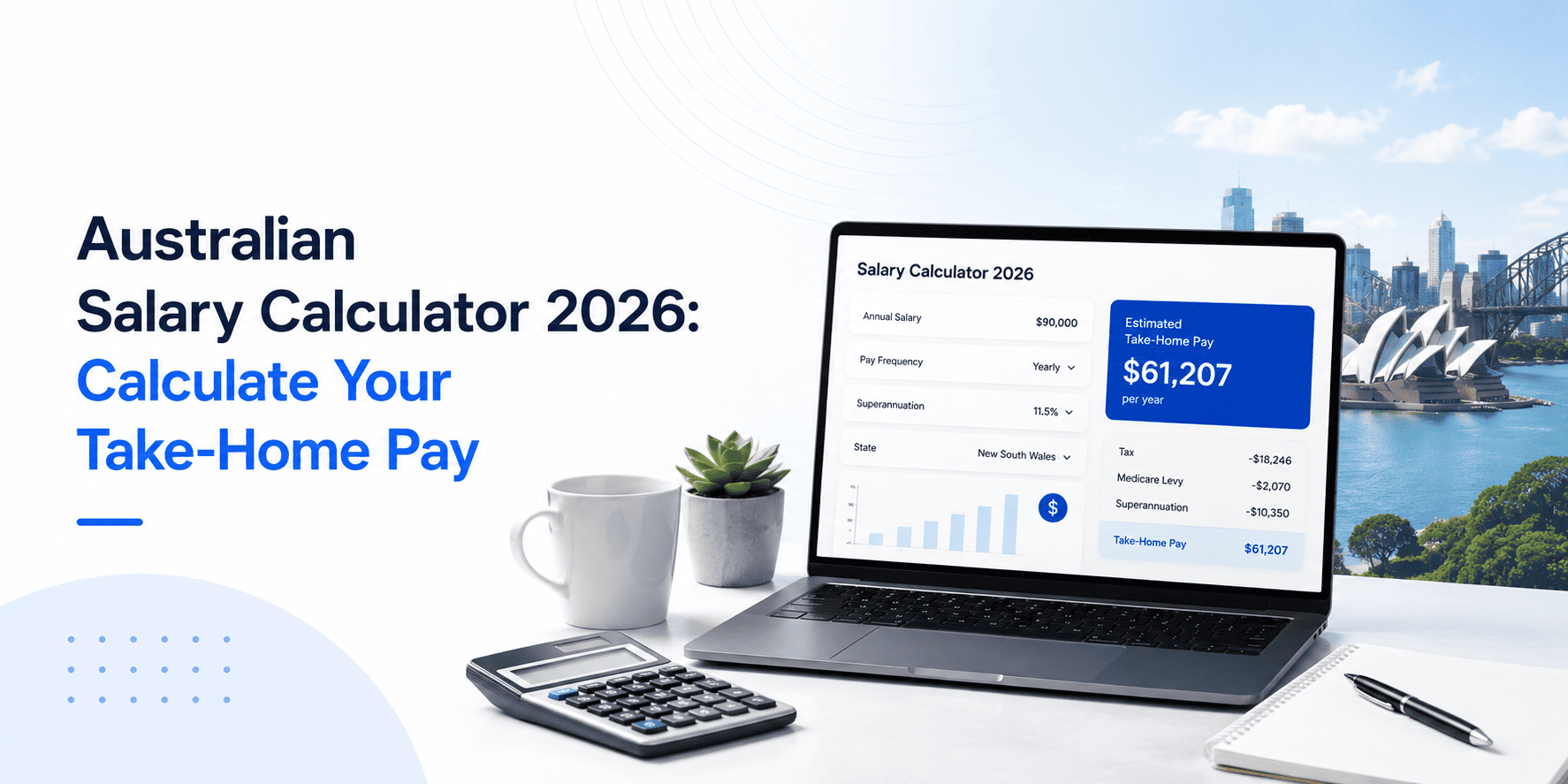
CloudColleague’s salary calculator uses verified ATO 2025-26 rates to give you an accurate take-home figure. Enter your annual gross salary, your residency status, whether you have a HECS debt, and your payroll period. The tool shows your income tax, Medicare levy, net take-home, and the employer super contribution sitting alongside your pay.
How Australian income tax works in 2025-26?
Understanding the mechanics behind your salary calculator result gives you the confidence to question any figure an employer or accountant gives you. Australian residents pay income tax on a progressive scale, meaning each bracket applies only to the portion of income that falls within it, not to the entire salary.
The 2025-26 resident tax brackets, confirmed by the ATO and incorporating the Stage 3 tax cuts that took effect from 1 July 2024, are as follows.
| Income range | Tax rate |
| $0 to $18,200 | 0% (tax-free threshold) |
| $18,201 to $45,000 | 16% |
| $45,001 to $135,000 | 30% |
| $135,001 to $190,000 | 37% |
| $190,001 and above | 45% |
The Stage 3 cuts reduced the rate on income between $18,201 and $45,000 from 19% to 16%, and the rate on income between $45,001 and $135,000 from 32.5% to 30%. Every Australian earning above $45,000 saves at least $268 per year compared to the pre-cut system. These are the rates confirmed by the ATO and unchanged for 2025-26.
On top of income tax, most Australians pay the Medicare levy at 2% of taxable income. This funds the public healthcare system. Higher-income earners without appropriate private hospital cover pay an additional Medicare Levy Surcharge of 1% to 1.5%, with the 2025-26 threshold sitting at $101,000 for singles and $202,000 for families, per ATO confirmed rates.
CloudColleague’s salary insights hub uses the same ATO-verified data to show what your role pays in your city. Knowing your gross benchmark and your take-home figure together is what makes any salary conversation productive.
How to calculate your take-home pay step by step?
The salary calculator result is only useful if you understand how it arrived there. The calculation follows the same four steps every time, regardless of the salary figure.
Step 1: Calculate your income tax. Apply each bracket rate to the portion of your salary that falls within it. A $90,000 salary produces $0 on the first $18,200, $4,288 on the $26,800 between $18,201 and $45,000, and $13,500 on the $45,000 between $45,001 and $90,000. Total income tax: $17,788.
Step 2: Add the Medicare levy. On $90,000, the Medicare levy is $90,000 multiplied by 2%, which equals $1,800.
Step 3: Subtract any offsets. The Low Income Tax Offset reduces tax payable for incomes below $66,667, but phases to zero above that. At $90,000 the LITO applies at $0.
Step 4: Deduct total tax from gross. On $90,000: $17,788 plus $1,800 equals $19,588 in total deductions. Take-home pay is $90,000 minus $19,588, which equals $70,412 per year, or approximately $5,868 per month.
The table below shows verified take-home pay at three common salary levels, using confirmed ATO 2025-26 rates.
| Gross salary | Income tax | Medicare levy | Take-home pay |
| $60,000 | $8,788 | $1,200 | ~$50,012 |
| $80,000 | $14,788 | $1,600 | $63,612 |
| $100,000 | $20,788 | $2,000 | $77,212 |
The $80,000 and $100,000 figures are verified against ATO 2025-26 bracket calculations confirmed by multiple independent tax calculators updated in May and June 2026. These are gross-to-net figures before HECS repayments or salary sacrifice.
| Interested in freelance and task-based work? Read our Guides on Tasks and learn How Bidding Works to get started. |
Annual salary to hourly rate calculator Australia
Converting an annual salary to an hourly rate is one of the most common salary calculator tasks, and one of the most frequently miscalculated. The standard formula for full-time employees in Australia uses the 38-hour standard working week across 52 weeks, giving 1,976 working hours per year.
Formula: annual salary divided by 1,976 equals gross hourly rate.
At $80,000: $80,000 divided by 1,976 equals $40.49 per hour gross. At $100,000: $100,000 divided by 1,976 equals $50.61 per hour gross. These are pre-tax figures. Your net hourly rate, after the same income tax and Medicare levy calculation, is lower.
Casual employees add a 25% loading to the base rate, which compensates for the absence of paid leave and other permanent entitlements. A $40.49 casual base rate becomes $50.61 per hour including the loading. This is why a casual position often looks better on the hourly figure but does not always deliver more income annually than the equivalent part-time permanent role. For a full comparison of how salary and hourly pay structures differ in Australian law and practice, see our salary vs hourly pay guide.
How superannuation affects your salary calculator result?
Super is the most frequently misread element in any Australian salary calculator. The confusion is almost always the same: does the quoted salary include super or does the employer pay it on top?
The answer in most Australian job offers is on top. Your employer pays the Super Guarantee, confirmed at its final scheduled rate of 12% from 1 July 2025, on top of your gross salary. A $90,000 salary with super on top costs the employer $90,000 plus $10,800 in super, totalling $100,800 in total employment cost. Your take-home pay is calculated on the $90,000 base, not the $100,800.
Some employers quote salary as a “total package” or “total remuneration” figure that includes super. A $100,000 total package with 12% super included means your base salary is $100,000 divided by 1.12, which equals $89,286. Your take-home is calculated on that base, not on $100,000. Always clarify whether super is included or excluded before comparing offers. From 1 July 2026, Payday Super comes into effect, requiring employers to pay super with every payslip rather than quarterly. For how super fits into the full salary structure, see our salary structure guide.
HECS and HELP: factoring your study debt into the salary calculator
HECS and HELP repayments are compulsory once your income crosses the minimum threshold, and they are one of the most significant factors in the gap between gross salary and actual take-home pay for graduates.
From 1 July 2025, the minimum repayment threshold increased to $67,000. In addition, a 20% reduction was applied to all outstanding HELP debts in June 2025, according to ATO-confirmed data. As a result, repayment amounts have decreased significantly for many borrowers.
However, if your income exceeds the threshold, your employer will withhold HELP repayments through PAYG. Consequently, your take-home pay is reduced on top of income tax and the Medicare levy.
The repayment rate increases with income and applies to your entire repayment income, not just the portion above the threshold. A salary of $80,000 with a HECS debt triggers a repayment that further reduces the $63,612 take-home figure. Your salary calculator should include the HECS toggle to show the real net figure. If it does not, your take-home estimate is overstated.
Salary calculator for contractors and freelancers
The salary calculator calculation changes significantly when you move from employment to contracting. Contractors receive no employer super, no paid annual leave, no sick leave and no other employment entitlements. To compare a contract rate to an employed salary fairly, you need to adjust for those absent benefits.
The standard adjustment for a fair comparison adds approximately 20 to 30% to the employed gross salary to find the equivalent contract rate. A $90,000 employed salary, accounting for 12% super and approximately 8% in leave entitlements, requires a contract rate of at least $108,000 to $117,000 gross annually to break even on total remuneration. At 1,976 working hours per year, that is $54.65 to $59.21 per hour. Experienced contractors with in-demand skills charge significantly above this floor.
CloudColleague handles contractor payments directly, with same-day Stripe payouts and built-in invoicing. The CloudColleague platform features remove the administrative overhead so contractors can focus on the rate and the work.
Read Next: How to Make a Salary Increase Request in Australia (2026 Guide)
Common salary calculator mistakes to avoid
A salary calculator is only accurate when the inputs are correct. These are the five mistakes that consistently produce misleading results.
The first is confusing gross and net. Gross is what the employer pays you. Net is what lands in your account. Every comparison between roles, rates and offers must use the same basis. Comparing a gross offer to a net payslip overstates the gap by thousands of dollars.
The second is including super inside the gross salary when the employer intends it as additional. If an offer says “$90,000 plus super,” the super is separate. A salary calculator that treats the $90,000 as inclusive of super will understate your base and understate your tax, producing a false take-home figure.
The third is forgetting HECS. A salary calculator without HECS toggled on overstates take-home for anyone with a study debt above $67,000 in income.
The fourth is using outdated tax brackets. The Stage 3 cuts changed the rates from 1 July 2024. Any calculator still using the old 19% bracket for $18,201 to $45,000 is producing incorrect results. The current rate is 16%.
The fifth is not checking the financial year. The ATO updates rates, thresholds and HECS repayment tables each July. Always verify your salary calculator is using current figures before making any financial decision.
| Create your free seeker account in minutes and connect with opportunities that fit your goals. |
Salary calculator FAQ
A salary calculator converts a gross salary into net take-home pay by applying income tax, Medicare levy and any applicable HECS repayments using current ATO rates.
Subtract your income tax (using the 2025-26 ATO brackets) and the 2% Medicare levy from your gross salary. Use the CloudColleague salary calculator for an accurate, ATO-verified result.
Divide your annual salary by 1,976 (38 hours per week multiplied by 52 weeks). For casual rates, multiply the result by 1.25 to include the 25% casual loading.
No, the 12% Super Guarantee is paid by your employer on top of your gross salary unless your contract specifies a total package that includes it.
HECS repayments are withheld automatically once your income exceeds $67,000, reducing your take-home pay on top of income tax and the Medicare levy.
The tax-free threshold is $18,200. You pay no income tax on income up to this amount if you are an Australian resident claiming the threshold with your employer.