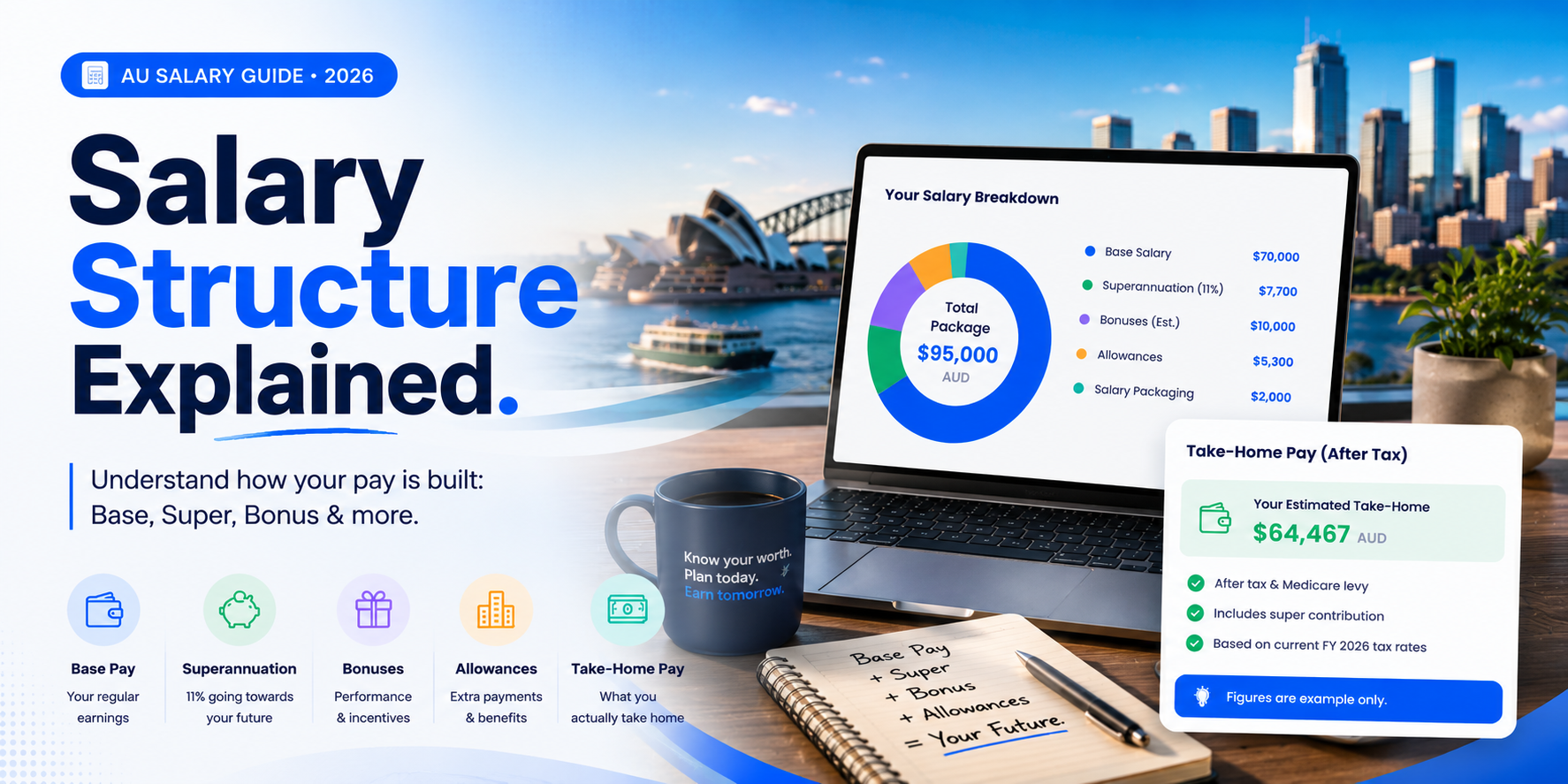
Your salary structure, not just the headline number, decides what actually lands in your bank account. Two people can earn the same salary yet take home very different amounts. The reason is how their pay is built: base salary, superannuation, allowances, bonuses and deductions all combine in different ways. This guide breaks down each part of an Australian salary structure, shows how it affects your take-home pay, and explains salary packaging. For pay benchmarks by role, see our salary insights.
| Find higher-paying work in your field. Professionals on CloudColleague set their own rates and keep more of what they earn. Start as a Seeker and explore new opportunities today. |
What is a salary structure?
A salary structure is the framework that defines how your pay is built and paid. In Australia, it usually separates four things: fixed pay, variable pay, statutory contributions and deductions.
Employers often describe pay across three layers. These are the total cost to employer, your gross salary, and your net or take-home pay. Because the mix of components differs, two people on the same salary can still receive different monthly amounts. See our guide on what Is Salary? Meaning, Types and Structure Explained.
So the structure matters as much as the number. Let us break it into parts.
The components of a salary structure in Australia
An Australian salary is built from several elements. You receive some directly, while others are paid on your behalf or taken out before you see them.
Base salary
Base salary is the fixed core of your pay. It anchors the whole structure, because employers use it to calculate super, leave and many other components. As a result, a higher base usually lifts everything else.
Superannuation: the 12% on top
Superannuation is money your employer pays into your retirement fund. The Super Guarantee rate is 12% for 2025 to 2026, calculated on your ordinary time earnings. Importantly, salary sacrifice cannot reduce the minimum earnings used to work out your super.
From 1 July 2026, employers must also pay super on payday rather than each quarter. So you should see it on your payslip more often.
Allowances (and is there an HRA in Australia?)
Allowances are extra payments for specific costs, such as travel, tools, meals or working in tough conditions. The ATO classes them as exempt, non-assessable or taxable, which changes how they are treated.
If you have moved from overseas, you may be looking for an HRA, or House Rent Allowance. However, Australia does not use HRA. Instead, it uses allowances and salary packaging, which we cover below. Newcomers can read our first-time-in-Australia guide for the full picture.
Bonuses, commissions and incentives
Bonuses reward performance or company results. Commissions are common in sales roles, while incentives often link to targets. These payments are variable, so they can rise or fall each period.
Overtime, penalty rates and loadings
Many roles add pay for extra or unsocial hours. Overtime is often paid at time-and-a-half or double-time. Penalty rates apply to weekends, public holidays and late shifts, and casual workers receive a 25% loading instead of paid leave.
| Your dream salary could be waiting. Create your professional profile and start exploring jobs now. |
Deductions
Deductions are amounts taken from your gross pay. The main ones are PAYG income tax, the 2% Medicare levy, and any HECS or HELP study loan repayments. For a full gross-versus-net walkthrough, see our guide to salary meaning.
Fixed pay vs variable pay
A useful way to read any structure is to split it in two. Fixed pay is guaranteed, like your base salary. Variable pay depends on performance or hours, like bonuses, commissions and overtime.
Generally, a higher fixed portion gives you more stability. By contrast, a higher variable portion offers more upside but less certainty.
Salary package vs base salary
Your base salary is only part of the story. Your total package, or total cost to employer, also includes super and any benefits.
This is why a role advertised as “plus super” can pay more than a higher-looking figure quoted “inclusive of super”. So always check whether the quoted figure includes super before you weigh one role against another.
Salary packaging and salary sacrifice
Salary packaging is where structure becomes a tool you can use. In short, you agree to receive part of your pay as approved benefits before tax.
How salary sacrifice works?
Salary sacrifice swaps pre-tax salary for benefits your employer approves. Because the money comes out before tax, it reduces your assessable income. As a result, you may pay less income tax overall.
Extra super contributions
You can also salary sacrifice into super. These pre-tax, or concessional, contributions are capped at $30,000 for 2025 to 2026. Many people use this to grow their retirement savings while lowering taxable income.
Novated leases and the EV exemption
A novated lease lets you pay for a car from pre-tax salary. Eligible electric vehicles below the luxury car tax threshold, around $91,387 for 2025 to 2026, remain exempt from Fringe Benefits Tax. Plug-in hybrids, however, lost that exemption from 1 April 2025. For other benefits, the FBT rate sits at 47% on the taxable value, so design matters.
How packaging affects tax, super and HELP
Packaging is powerful, but it has knock-on effects. Reportable fringe benefits can influence your HELP or HECS repayments, the Medicare Levy Surcharge, and some government payments. Therefore, always check the full picture before you commit.
Build your package with confidence. Download our free Salary Structure Template and Package Checklist. It maps every component and flags the tax and super traps.
A salary structure example
Numbers make this clearer. The table below shows a simple full-time structure. Figures are illustrative and exclude any salary packaging.
| Component | Amount (AUD/yr) | Notes |
| Base salary | $90,000 | The fixed core |
| Superannuation (12%) | $10,800 | Paid into your super fund |
| Allowances | $2,000 | For example, tools or travel |
| Bonus | $5,000 | Performance-based |
| Total package (TCE) | $107,800 | Base + super + allowances + bonus |
| Gross cash pay | $97,000 | Excludes super |
| Estimated take-home | ~$75,000 | After PAYG tax and 2% Medicare levy |
As the table shows, super sits on top and goes to your fund, not your bank account. Meanwhile, tax and the Medicare levy reduce the cash you actually receive.
Why salary structure matters for employees and freelancers
For employees, understanding structure helps you compare offers and use packaging wisely. It also helps you spot errors on your payslip.
For freelancers, the lesson runs deeper. When you work independently, you design your own structure. You set your rate, fund your own super, and invoice clients directly. To benchmark a fair rate first, read our guide to the average salary in Australia.
CloudColleague makes the freelance path simple. You can browse contract and freelance work, then let our platform features handle secure invoicing and payments.
| Looking for flexible ways to earn? CloudColleague lets professionals find freelance and task-based opportunities. Visit our Guides on Tasks and How Bidding Works to get started. |
Salary structure FAQ
A salary structure is the framework that defines how your pay is built. In Australia, it usually splits into fixed pay, variable pay, statutory contributions like super, and deductions.
The core parts are base salary, superannuation, allowances, bonuses, and any overtime or penalty rates. Deductions such as PAYG tax and the Medicare levy then reduce your take-home pay.
No. Australia does not use House Rent Allowance. Instead, employers offer allowances for specific costs and salary packaging arrangements that can reduce your taxable income.
Base salary is the fixed core of your pay. Your total package, or total cost to the employer, also adds superannuation and any benefits on top.
Salary packaging lets you receive part of your pay as approved benefits before tax. Because the money comes out pre-tax, it can lower your assessable income and reduce the tax you pay.
The mix of components decides it. Super is paid on top into your fund, while tax, the Medicare levy and study loans are deducted from your gross pay to leave your net amount.