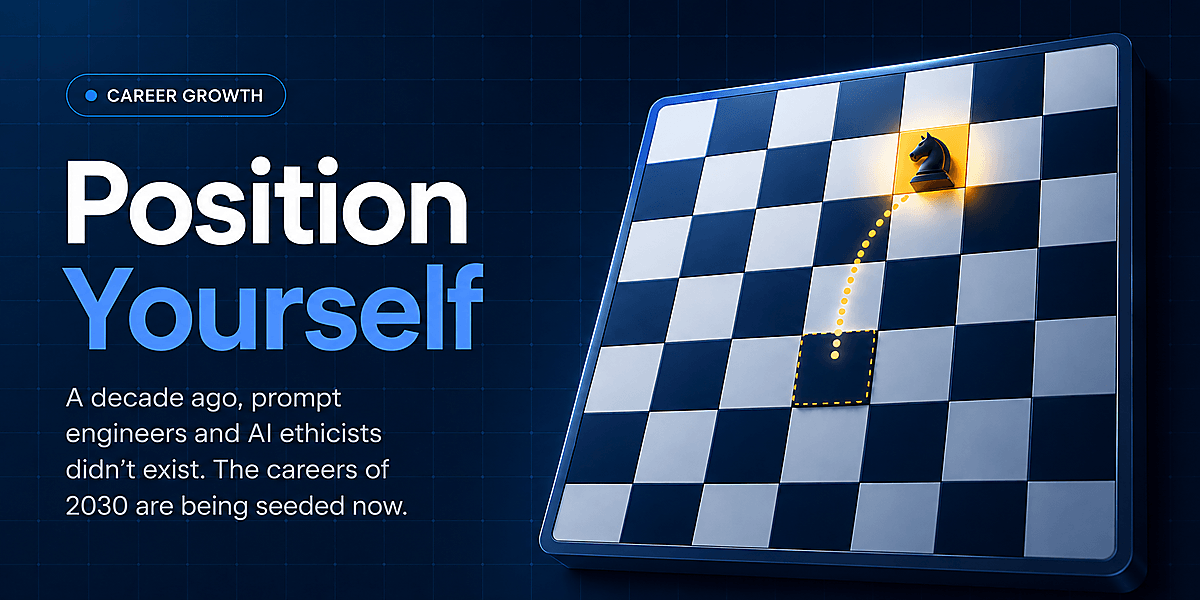
A decade ago, prompt engineers, sustainability analysts, cloud architects, and data ethicists did not exist as career categories. Today, they employ thousands of Australians, often at six-figure salaries. The reverse has also happened. Roles in traditional retail management, basic data entry, and routine print media have shrunk faster than most workforce planners predicted in 2015. Thinking about future careers is no longer optional. It is part of basic career planning.
This guide is for students, career changers, mid-career professionals, and parents helping young people decide what to study or train for. It covers the forces, frameworks, and positioning strategies that shape the next decade of work in Australia. For readers wanting specific occupations growing fastest right now or the 10-year occupation outlook, the linked cluster articles cover those directly.
Why Does the Future of Work Look Different This Time?
Every generation has worried about the future of work, and every generation has been partially right and partially wrong. Industrial weavers in the 1800s, telephone operators in the 1950s, and travel agents in the early 2000s all saw their work transformed. Many other roles people predicted would die are still thriving. Plumbers, teachers, and accountants are all still here, just doing the work differently. Cynicism about workforce predictions is reasonable, given the track record.
What is different now is the speed and breadth of change happening simultaneously. Artificial intelligence is reshaping cognitive work, demographic change is reshaping who does which work, climate transition is reshaping which industries grow, and globalisation is reshaping where work happens. These four forces are not independent. They compound on each other.
The World Economic Forum’s Future of Jobs Report projects that a significant share of work tasks will be transformed by automation and AI by 2030, with millions of new roles emerging and millions of existing roles shifting in shape. The same report finds that workers in advanced economies will need substantial reskilling over the coming decade.
Australia’s labour market sits inside these global forces but has its own characteristics. Jobs and Skills Australia consistently reports persistent shortages in healthcare, education, engineering, ICT, and skilled trades, which means the future of work in Australia is shaped as much by who is missing from the workforce as by what AI can do. Not all global trends apply equally here, which is why this guide focuses on the Australian context.
The Five Forces Reshaping Future Careers in Australia
Five forces will shape Australian careers over the next 10 to 15 years more than any other. Each one expands certain career categories and compresses others. Understanding them is the foundation for any sensible career planning.
Force 1: Artificial Intelligence and Automation
The most important distinction in any AI conversation is between augmentation and replacement. Most AI affects tasks, not entire occupations. A lawyer in 2030 will not be replaced by AI, but the way they research, draft, and review will be substantially changed. A radiologist in 2030 will not be replaced by AI, but the diagnostic workflow will involve AI assistance throughout.
Where AI is creating new careers: AI ethics, AI governance, prompt and workflow design, model operations, AI safety, and AI-augmented roles in nearly every industry. The Tech Council of Australia and CSIRO Data61 both identify AI-adjacent roles as one of the fastest-growing career categories in Australia.
Where AI is compressing demand: routine cognitive work, basic content production, entry-level data entry, simple bookkeeping, and routine translation. These categories are not disappearing overnight, but the entry routes are narrowing and the pay is flattening.
The honest framing for career planning: ask which parts of your work AI can do better, faster, or cheaper, and which parts only a human can do. That distinction tells you where to focus your career energy.
Force 2: Demographic Change and the Care Economy
Australia is ageing. The Australian Bureau of Statistics projects a substantial increase in the share of Australians over 65 across the coming two decades, with implications for every industry but especially for healthcare and social services.
The care economy is expanding faster than any other workforce category in absolute numbers. Aged care, disability support through the NDIS, allied health, mental health, and child care are all in long-term structural growth. The Productivity Commission identifies the care economy as the largest source of new jobs in Australia over the coming decade.
The other side of demographic change is just as important. A smaller working-age population means employers will compete harder for skilled workers, particularly in roles that cannot be done remotely or offshored. For workers, this is leverage. For employers, it is a planning challenge.
Force 3: The Climate Transition and Green Careers
Australia’s commitment to net zero is creating an entire category of work that did not exist at scale 10 years ago. Renewable energy technicians, grid engineers, battery storage specialists, sustainability analysts, climate adaptation specialists, and environmental engineers are all in expanding demand.
Adjacent shifts are happening in traditional industries. Mining is reshaping around critical minerals and lower-emissions practices. Agriculture is integrating regenerative methods and precision farming. Construction is moving toward sustainable building materials and energy-efficient design. None of these industries is going away. All of them are changing in shape.
Jobs and Skills Australia data points to green jobs as one of the strongest growth categories nationally, with shortage signals already appearing in renewable energy roles ahead of the broader deployment phase.
Force 4: Digital Transformation Across Every Industry
“Tech jobs” is becoming an outdated category. Almost every industry in Australia is becoming a tech-enabled industry. A nurse in 2030 will work with digital health platforms. A farmer will work with satellite-driven crop data. A teacher will work alongside AI tutoring systems. A small business owner will use AI accounting tools.
The implication is straightforward. Digital fluency is becoming a baseline expectation, not a specialty. You do not need to be a software engineer, but you do need to be comfortable with the digital tools that increasingly shape your industry.
Cybersecurity, data, cloud, and software-adjacent roles are expanding across every non-tech industry. McKinsey Global Institute research on skills shifts across the global economy confirms this pattern, and Australia is following the same curve.
Force 5: The Shift in How and Where Work Happens
Hybrid and remote work are not a temporary pandemic phenomenon. They are a permanent structural change to how Australian work is organised. The Australian Bureau of Statistics and LinkedIn workforce data both show that the share of Australians working in hybrid or remote arrangements has stabilised at substantially higher levels than pre-2020.
The growth of flexible work models matters more than the remote-versus-office debate. Freelancing, contracting, portfolio careers, and project-based work are becoming mainstream rather than fringe. ABS data shows around 1 in 4 Australian workers now does some form of contract, freelance, or gig work, either alongside a main role or as their primary income.
For future career planning, this matters in a specific way: a future career is increasingly a combination of work models, not a single job title. Platforms like CloudColleague reflect this shift by combining full-time roles, freelance tasks, and project work in one place, which is closer to how careers actually evolve over a decade than the traditional single-employer model.
Read Next: Freelancing or Full-Time Jobs? How Australian Professionals Can Choose the Right Path
Industries That Are Expanding (And Industries That Are Contracting)
Industry-level trends matter as much as occupation-level trends. A strong career in a contracting industry is harder to sustain than an average career in a growing one.
| Growing Industries (2026 to 2036) | Reshaping or Contracting Industries |
| Healthcare and social assistance | Traditional retail (in-store roles) |
| Professional, scientific, and technical services | Fossil fuel extraction |
| Education and training | Routine administration |
| Renewable energy and environmental services | Parts of manufacturing |
| Information media and telecommunications | Print media |
Industries Where Australian Workforce Demand Is Growing
Healthcare and social assistance is already Australia’s largest employing industry and continues to grow. Professional, scientific, and technical services covers consulting, engineering, scientific research, and specialist advisory work, and remains one of the fastest-growing sectors. Education and training continues to expand, particularly in early childhood and STEM secondary teaching. Renewable energy and environmental services is in its deployment decade. Information media and telecommunications keeps growing as the digital infrastructure of every other industry.
Industries That Are Reshaping or Contracting
Traditional retail, fossil fuel extraction, routine administration, and parts of manufacturing are reshaping rather than disappearing. “Contracting” rarely means “disappearing”. It means changing in shape, requiring different skills, or shifting employment patterns.
What this means for workers currently in these industries: the transferable skills bridge matters more than the industry label. A retail manager who has built strong people skills, operational discipline, and customer insight has a much shorter bridge to adjacent industries than a generic resume suggests.
The Concept of a Future-Proof Career (And Why It Does Not Actually Exist)
The phrase “future-proof career” is comforting but misleading. No career is fully future-proof. The goal is career resilience, not career immortality.
Three properties make a career relatively durable across the next 10 to 15 years:
- A hard-to-automate core, often involving complex human judgment, physical presence in unstructured environments, or genuine creativity
- Anchoring in a growing rather than shrinking industry
- A transferable skill base that allows lateral movement when the specific role evolves
“AI-proof” is the wrong question. “AI-augmented” is the right one. A career that combines a hard-to-automate human core with the ability to use AI tools well is far more durable than one that tries to compete with AI on AI’s own ground.
The mindset shift matters: stop hunting for the perfect future-proof career. Start building a career that can adapt to whatever 2036 actually looks like.
The Skills That Matter Most for Future Careers
Skills are more durable than job titles. A skill that matters in 2026 usually still matters in 2036, even if the role you apply it in changes shape. The World Economic Forum, the OECD, and the Australian HR Institute all converge on a similar shortlist.
Durable Human Skills That AI Cannot Replicate
The skills least vulnerable to automation are the ones that depend on uniquely human capacities:
- Complex judgment and ethical decision-making, particularly in high-stakes or ambiguous situations
- Cross-domain communication, which is the ability to translate between technical, commercial, and human languages
- Genuine creativity, defined as generating problems worth solving, not just solutions to known problems
- Emotional intelligence and relationship building
- Adaptive learning ability, which is the meta-skill of being able to acquire new skills quickly
These are the skills that compound over a career. Investing in them at any stage pays dividends.
Technical and Digital Fluency as a New Baseline
Technical fluency is becoming a floor, not a ceiling. The minimum bar:
- Data literacy: understanding what data is, what it can and cannot tell you, and how to read basic visualisations
- AI literacy: knowing how to use AI tools effectively for your specific work, and where their judgment cannot be trusted
- Functional understanding of how digital systems work in your industry
This is not “everyone must learn to code”. It is functional digital fluency, in the same way that everyone in 1990 needed to be comfortable with a phone and a fax machine.
Meta-Skills That Compound Over a Career
Three meta-skills outperform every specific technical skill over a 10 to 15 year horizon: learning how to learn, knowing how to position and reposition yourself, and network building. For a deeper treatment of ongoing skill development, see the dedicated career development guide.
How to Position Yourself for the Future Workforce?
Positioning is different from planning. A plan assumes you know the destination. Positioning assumes the destination will move, and prepares you to move with it.
The Three Horizons of Career Planning
A useful framework for thinking across time:
- Horizon 1: The next 12 months. Your current role, immediate skill needs, and short-term goals
- Horizon 2: The next 3 to 5 years. The role you are positioning for, the qualifications you might need, the relationships you are building
- Horizon 3: The next 10 to 15 years. The broader career category you want to be relevant in, the durable skills you are building, the trends you are watching
Most career planning fails because it only operates in Horizon 1. People know what they are doing this quarter but have no view of where they are heading by 2036. Spending even an hour a year thinking in Horizon 3 changes the quality of every Horizon 1 decision.
The Reskilling and Upskilling Reality in Australia
TAFE and Universities Australia both report rising adult learning participation, driven by professionals reskilling mid-career rather than school leavers entering for the first time. The realistic time and cost commitment for a meaningful skills shift in Australia is usually 6 to 24 months, depending on the depth required.
The micro-credential trend is real but uneven. A well-chosen micro-credential from a credible provider builds genuine capability. A poorly chosen one is a certificate without substance. The signal employers look for is competence, not paperwork.
Reading the Signals Early
Monitoring your industry is a skill in itself. The annual career check-in practice takes one hour per year and pays compounding returns:
- Read the latest Jobs and Skills Australia outlook for your occupation
- Skim one CSIRO foresight report or Deloitte Access Economics workforce study
- Note which roles in your network have grown or disappeared in the last 12 months
- Ask yourself: is my skill set appreciating or depreciating?
This is not anxiety-driven monitoring. It is informed, low-volume awareness that keeps you ahead of changes that would otherwise surprise you.
Common Myths About the Future of Work
Future-of-work conversations attract strong opinions and weak evidence. Five myths get repeated often enough that they distort how people plan.
Myth 1: AI is coming for all the jobs. The reality is augmentation, not wholesale replacement. AI changes tasks within most occupations far more than it eliminates the occupations themselves.
Myth 2: All future careers require coding. They do not. They require digital fluency, which is closer to spreadsheet literacy than to software engineering. Most careers in 2036 will require comfort with AI tools, not the ability to build them.
Myth 3: University is becoming useless. Universities Australia data shows that tertiary qualifications continue to correlate with higher lifetime earnings and lower unemployment risk in Australia. University is changing in role, not collapsing in value. For some career paths it is essential. For others, TAFE qualifications, apprenticeships, or short courses are better fits.
Myth 4: Trades and physical work are dying. The opposite is true in Australia. Jobs and Skills Australia data shows skilled trades sit at the most severe end of the national shortage spectrum, and the green transition is driving sustained demand for electricians, plumbers, and renewable energy technicians through to the late 2030s.
Myth 5: You need to predict the perfect career path. No, you need to build a career that can adapt. Resilience beats prediction every time. People who tried to “future-proof” in 2010 by picking a specific job title often guessed wrong. People who built durable skills and stayed curious almost always landed well.
How Different Career Stages Should Think About Future Careers?
Career stage changes which questions matter most. The forces above apply to everyone, but the right response depends on where you are in your working life.
For Students and School Leavers
Choose a field over a specific job. The job titles available at age 25 will be partly different by the time you are 35, but the field you choose (healthcare, engineering, education, design, science) will still exist in a recognisable form. Depth in one area plus breadth in adjacent ones beats narrow specialisation in a single role.
The starting point is honest self-reflection. The choosing a career path guide walks through the practical method.
For Career Changers
The transferable skills audit is the starting point. Most career changers underestimate how much of their existing experience translates into new fields. A retail manager moving into healthcare administration brings stakeholder management, scheduling under pressure, and customer service. None of that disappears with the industry change.
Mid-career changers often have a structural advantage in emerging fields, because emerging fields value experience and judgment as much as technical credentials. The career change process covers the practical steps.
For Mid-Career Professionals
“Staying current” is a different challenge from “starting fresh”. The risk is not unemployment. The risk is gradual irrelevance.
The 20% rule helps. Dedicate roughly 20% of your annual professional development time to skills outside your current role’s immediate needs. A bookkeeper learning data analysis. A marketing manager learning AI tools. A senior lawyer learning negotiation theory. The 20% is what keeps the 80% relevant.
Where to Find Reliable Information About Future Careers in Australia?
The future-of-work conversation is full of opinions. These are the sources worth trusting:
Jobs and Skills Australia is the most authoritative source for Australian workforce planning, publishing the Occupation Shortage Report, the Skills Priority List, and annual workforce outlooks.
Australian Bureau of Statistics Labour Force data provides the underlying employment trends across industries, regions, and demographics.
Department of Employment and Workplace Relations publishes occupation outlooks and labour market analysis tied to government workforce planning.
CSIRO foresight reports, including Our Future World, provide longer-horizon scenario planning for Australia’s industries.
Deloitte Access Economics, McKinsey Global Institute, and World Economic Forum offer the global context, useful for comparison but always to be filtered through the Australian-specific data above.
Read Next: High Demand Careers in 2026-27: Top Jobs in Australia.
Bringing It All Together
The future of work is not one future. It is a set of forces you can read, prepare for, and position yourself within. Trade the search for the “perfect future career” for the practice of staying genuinely employable as the world changes. The first skill of the next decade is the willingness to keep learning. Everything else builds on it.
Whatever direction your future career takes, CloudColleague brings together full-time roles, freelance tasks, and project work in one place, which makes it easier to explore opportunities as the world of work keeps shifting.
Frequently Asked Questions About Future Careers in Australia
Healthcare, aged care, renewable energy, cybersecurity, AI and data, defence and engineering, construction, and education are all projected to grow strongly through to 2036. For specific occupation-level detail, see the10-year occupation outlook.
AI is most likely to compress demand in routine cognitive roles such as basic data entry, simple bookkeeping, entry-level legal research, and routine content production. Most occupations will change in shape rather than disappear, with AI taking over specific tasks while humans focus on judgment, relationships, and complex work.
No career is fully future-proof. The most resilient careers share three properties: a hard-to-automate core (judgment, physical presence, creativity), anchoring in a growing industry, and a transferable skill base. Trades, healthcare, education, engineering, and skilled creative direction all score well on these criteria.
Yes. Jobs and Skills Australia data consistently identifies skilled trades as one of the most severely undersupplied workforce categories nationally. The renewable energy transition is driving sustained demand for electricians, plumbers, and HVAC technicians, and the infrastructure pipeline continues to keep construction trades in shortage.
Build durable human skills (complex judgment, communication, emotional intelligence, adaptive learning), reach a baseline of digital and AI literacy, and commit to ongoing reskilling. The full method is covered in the career development guide.
For some career paths, yes. Universities Australia data shows tertiary qualifications continue to correlate with stronger employment outcomes and higher lifetime earnings in many fields. For other paths, TAFE qualifications, apprenticeships, or industry certifications are better fits. The question is not “university or not” but “which qualification fits which career”.