You show up to work every day, put in the hours, and do what’s expected of you. But deep down, you wonder – “Am I actually going anywhere?”
If that sounds familiar, you’re not alone. A lot of Australians who live inside Australia or are moving to Australia, whether they’re just starting out or a few years into their career, feel like they’re working hard but not really moving forward.
The truth is, career growth doesn’t just happen. It’s not something your employer hands you. It’s something you build intentionally, step by step.
This guide explains exactly what career growth means, why it matters, what it looks like in real life, and how you can start growing right now no matter where you are in your career.
What is Career Growth?
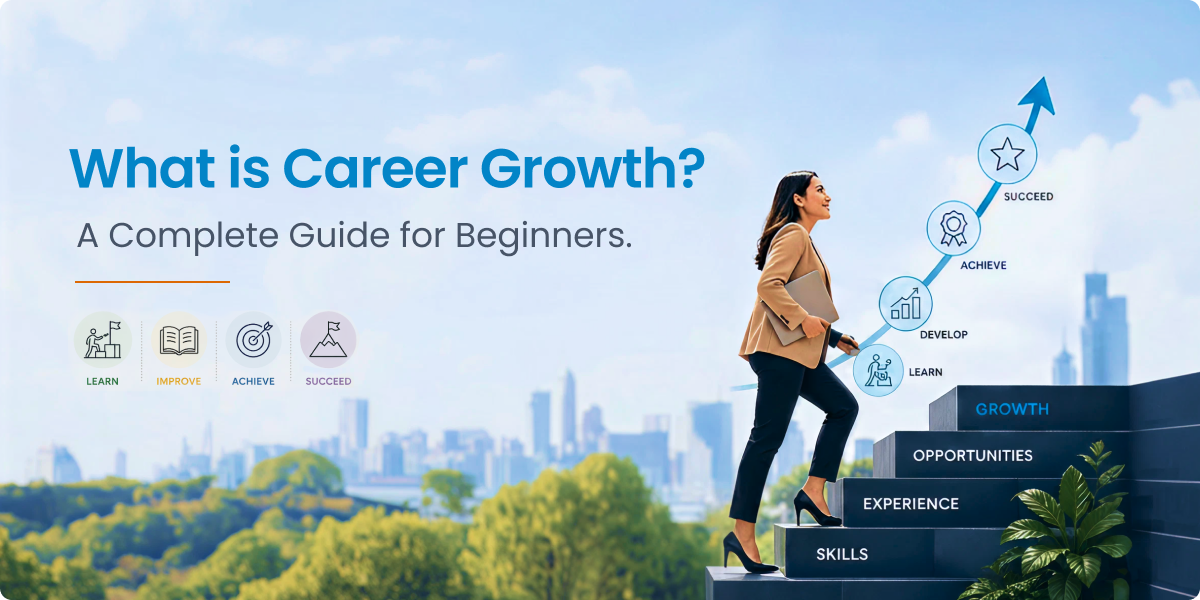
Career growth is the ongoing process of advancing your skills, experience, responsibilities, and value as a professional over time. It’s not just about getting a promotion, it’s about becoming better at what you do and opening up more opportunities for yourself.
Career growth looks different for everyone. For one person, it might mean moving from a junior role to a senior position. For another, it might mean developing a new skill set, earning more, or finding work that’s more meaningful.
The key idea is this: career growth is intentional. It doesn’t happen by accident; it happens when you decide to invest in yourself and take action.
Career Growth vs Career Development vs Career Progression
These three terms are often used interchangeably, but they mean slightly different things:
| Term | What It Means | Example |
| Career Growth | The big picture, advancing your overall value, skills, and opportunities. | Going from entry-level to respected expert in your field. |
| Career Development | The learning side, training, courses, and skills building. | Completing a digital marketing certification. |
| Career Progression | The title side, moving up the hierarchy. | Getting promoted from Coordinator to Manager. |
Think of career growth as the destination, and career development and progression as two of the roads that get you there.
Why Does Career Growth Matter?
According to the Australian Bureau of Statistics, workers who proactively upskill and change roles earn up to 20-30% more over a 10-year period than those who stay in the same role without development. It’s easy to get comfortable in a role, especially when things are going okay. But staying still while the world keeps moving is actually a form of going backwards. Here’s why career growth matters:
For You Personally,
- Higher earning potential: professionals who grow consistently earn significantly more over time.
- Greater job satisfaction: growing means doing more meaningful, challenging work.
- Confidence and self-belief: the more you grow, the more you trust your own abilities.
- Career resilience: a growing professional is far less vulnerable to redundancy or industry shifts.
Also For Your Professional Life,
- Better opportunities come to you, employers and clients seek out people with strong track records.
- You build a reputation in your industry.
- You gain influence and leadership, even without a formal management title.
And, For Your Long-Term Future too,
- Financial security: consistent growth compounds over a career, just like interest in a bank account.
- Flexibility: a strong career gives you more choices about where, how, and for whom you work
- A sense of legacy: most people want to feel like their work has mattered.
Types of Career Growth
One of the most important things to understand especially as a beginner is that career growth doesn’t always mean going “up.” There are actually four different directions your career can grow:
1. Vertical Growth
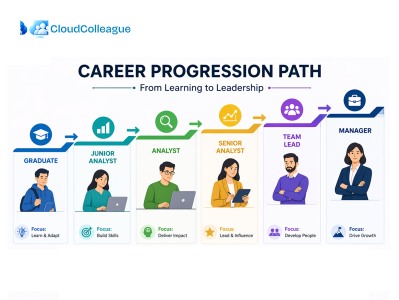
This is the traditional idea of career growth, climbing the ladder. You move into more senior roles, take on management responsibilities, and earn a higher salary along the way.
Example: Graduate → Junior Analyst → Analyst → Senior Analyst → Team Lead → Manager
Vertical growth suits people who enjoy leadership, decision-making, and building teams. In Australia, this path is common in industries like finance, government, healthcare administration, and corporate business.
2. Horizontal Growth
Instead of moving up, you move across, expanding your skills, experience, and knowledge into different areas at a similar level.
Example: A content writer who grows into content + SEO + social media + email marketing — becoming a well-rounded digital marketer.
Horizontal growth is fantastic for people who love variety, don’t want to manage others, or who want to become more valuable by combining multiple skill sets.
3. Skills-Based Growth
Think of it this way, would you rather be someone who knows a little about everything, or the person in the room who knows more about one thing than anyone else? Skills-based growth is about choosing depth over breadth.
Example: A developer who becomes the company’s leading expert in cloud security, or an accountant who specialises in tax law for small businesses.
This type of growth is powerful in Australia’s growing tech, trades, and professional services sectors, where deep specialists are highly sought after and well paid.
4. Personal Growth
Two people can have identical job titles, identical qualifications, and completely different careers, because one of them is invested in how they think, communicate, and lead. Personal growth is the invisible differentiator that most people overlook until it’s too late.
- Learning to give and receive feedback constructively.
- Getting better at managing stress and uncertainty.
- Building stronger working relationships.
- Becoming someone people trust and want to work with.
The best careers usually combine all four types of growth at different stages of life.
What Does Career Growth Look Like in Real Life?
Every person you admire professionally, every expert, every leader, every successful freelancer- started exactly where you are now. What changed wasn’t luck. It was a pattern of choices. Here’s what that pattern looks like up close.

A Real-World Example
Priyanka Karki moved to Melbourne in 2021 and took a junior customer service role at a mid-sized tech company. She was grateful for the job, but knew she wanted more. Rather than waiting to be noticed, she proactively asked to shadow the marketing team, completed a free Google Analytics course on weekends, and volunteered to help with their social media content. Within 18 months, she was offered a full-time marketing coordinator role. By 2025, she was a digital marketing lead managing a team of three. Priyanka didn’t wait for someone to hand her growth-she built it herself.
Growth Looks Different Across Industries
| Industry | Example of Growth | How It Looks |
| Tech | Junior Dev → Senior Dev → Tech Lead | Vertical + skills-based |
| Healthcare | Nurse → Specialist → Clinical Lead | Vertical + deep expertise |
| Trades | Apprentice → Qualified → Business Owner | Vertical + entrepreneurial |
| Freelancing | Generalist → Niche specialist → Premium rates | Skills-based + horizontal |
| Education | Teacher → Coordinator → Deputy Principal | Vertical + leadership |
If you’re looking for roles that match your current growth stage, CloudColleague is a great place to start. It connects Australian professionals and freelancers with jobs, tasks, and services; so you can find the right opportunity no matter where you are in your career.
Fewer Signs, You Are Growing in Your Career
It is easy to focus on what is not working and completely miss what is. If you have been heads down and working hard, you might be growing more than you realise. Here are some genuine signs that your career is heading in the right direction. Here are some positive signs to look for:
- You are regularly taking on new responsibilities, not just doing the same tasks on repeat.
- Your salary, title, or role has changed in the past 12–18 months.
- You are being asked to guide, mentor, or train others.
- You feel genuinely challenged, not just busy.
- Your professional network has grown, new connections, mentors, or collaborators.
- You are being approached with opportunities, rather than always having to seek them out.
- You feel proud of the work you’re producing.
Few Signs, Your Career Growth Has Stalled
Most people do not wake up one day and decide to stop growing. It happens gradually. A comfortable role becomes a comfortable habit. Months turn into years. And before long, you look back and realise you are in almost exactly the same place you were two or three years ago. That is not failure. It is just a signal that something needs to change. Here are some warning signs that your career may have plateaued:
- You have been doing the same tasks, at the same level, for 2+ years.
- There has been no salary increase or promotion conversation in a long time.
- You feel disengaged, bored, or like the work doesn’t matter.
- You haven’t learned anything genuinely new in the past 12 months.
- You dread going to work most days, not just occasionally.
- Your manager or colleagues don’t see you as someone who is going places.
If several of these resonate with you, it doesn’t mean you’ve failed, it just means it’s time for a reset.
The Career Growth Roadmap for Beginners
Here’s a simple five-step overview to help you get started. Think of this as the map, each step has its own full guide to dive into.
Step 1: Understand Where You Stand
Before you can grow, you need an honest picture of where you are right now. What are your strongest skills? Where are the gaps? What kind of work energises you versus drains you?
A simple self-assessment even just writing it down gives you a starting point that most people never bother creating.
Step 2: Set a Direction with Goals
Without a destination, any road will do and that’s exactly how careers drift. Setting clear, specific goals for where you want to be in 1 year, 3 years, and 5 years transforms growth from a vague idea into something you can actually work towards.
Step 3: Build a Plan to Get There
A goal without a plan is just a wish. A career plan maps out the specific actions, milestones, and timelines that will take you from where you are to where you want to be. It doesn’t have to be complicated, it just has to exist.
Step 4: Keep Learning Consistently
The professionals who grow the fastest are the ones who never stop learning. Courses, certifications, mentors, books, podcasts every investment in your skills compounds over time. Even 30 minutes a day adds up to over 180 hours a year.
Step 5: Take Action and Find Opportunities
Growth without action is just theory. At some point, you have to apply for the job, pitch the project, send the message, or raise your hand. Opportunity doesn’t knock, it rewards the people who go looking for it.
Looking for your next opportunity right now? Browse jobs, tasks, and freelance work on CloudColleague, a platform built for Australian professionals at every career stage.
Career Growth vs Job Hopping: What’s the Difference?
There’s a big difference between moving jobs strategically and simply bouncing around because you’re restless.
Job Hopping
Job hopping means changing employers frequently, often every 6–12 months without a clear reason tied to growth. While it can sometimes signal ambition, it can also raise red flags for Australian employers who value reliability and commitment.
Strategic Job Changing
Changing jobs for the right reasons, a significant step up in responsibility, a much better cultural fit, entry into a new industry, or a genuinely better career opportunity is completely different. Many of Australia’s most successful professionals have changed jobs 3–5 times in their first decade of working.
The Rule of Thumb: Stay long enough to deliver results and build a track record. Move when there’s a clear, meaningful reason not just because you’re bored or the pay could be slightly better. Generally, aim for at least 18–24 months in a role before considering a move.
Career Growth at Every Stage of Life
Comparing your career to someone else’s is one of the fastest ways to feel like you are falling behind. The truth is, career growth at 22 looks nothing like career growth at 45. Different stages, different goals, different definitions of progress. Here is a simple breakdown of what growth typically looks like at each point in your working life. Here’s a quick guide:
| Life Stage | Career Focus | What to Prioritise |
| Early Career (20s) | Explore and build foundations | Try different roles, say yes to learning, build your network, don’t be afraid to make mistakes |
| Mid Career (30s) | Specialise and lead | Develop deep expertise or leadership skills, ask for promotions, build your professional reputation |
| Senior Career (40s) | Leverage and scale | Mentor others, expand your influence, focus on high-value work, consider consulting or leadership roles |
| Late Career (50s+) | Legacy and flexibility | Share your knowledge, consider portfolio careers, protect your wellbeing, transition on your own terms |
Common Mistakes That Hold Career Growth Back
Picture two people with the same qualifications, starting salary, and job title. Five years later, one has been promoted twice and leads a team. The other is in almost exactly the same spot. That gap is rarely about talent. Instead, it is almost always about habits and choices.
Waiting to be noticed. Your manager is busy. If you want a promotion or new opportunity, ask for it clearly. Sitting quietly and hoping someone will eventually recognise your effort is one of the most common ways careers stall.
Avoiding difficult conversations. Feedback sessions, performance reviews, and salary negotiations feel uncomfortable. However, every time you avoid them, you hand control of your career to someone else. The people who grow fastest learn to have these conversations early and often.
Choosing comfort over challenge. A role that feels easy is not a safe place. Rather, it is a slow stop. The most meaningful growth happens when you take on work that stretches you, even when it feels uncomfortable at first.
Not investing in learning. Saying you do not have time to upskill is how professionals get left behind. Even 30 minutes a day, whether a podcast on your commute or a short online course on weekends, adds up to more than 180 hours of learning a year.
Neglecting your network. In Australia, a significant number of jobs are filled through referrals and personal connections rather than job listings. Consequently, the relationships you build now with colleagues, mentors, and industry peers are one of your most valuable long-term career assets.
Staying too long in a role with no ceiling. Loyalty is a good quality. However, if there is genuinely no room to grow, no new responsibilities, and no pathway forward, staying out of habit is not loyalty. It is simply standing still.
The Best Time to Start Growing Your Career is Right Now
Not next Monday. Not after the next performance review. And, Not when things settle down at work. Right now, with whatever you have, wherever you are.
Every professional you admire started with the same thing you have today: a job, a skill, and a choice about how seriously to take their own growth.
The difference between a career that goes somewhere and one that stays still is not luck. It is my intention. Set yours today.
Ready to find your next opportunity? CloudColleague is where Australian professionals find jobs, freelance work, and career opportunities that actually match their skills and ambitions.
Frequently Asked Questions
Career growth is the ongoing process of advancing your skills, responsibilities, earning potential, and professional value over time. It’s not just about getting a promotion, it’s about becoming a more capable, confident, and valuable professional in your chosen field.
Career development refers specifically to the learning side courses, training, mentoring, and skill-building. Career growth is the bigger picture: the overall advancement of your career, which includes development, but also includes promotions, salary increases, new responsibilities, and expanded opportunities.
There’s no fixed timeline, it depends on your industry, your goals, and the effort you put in. That said, most meaningful career jumps happen in 2–5 year cycles. The professionals who grow fastest are the ones who are consistently learning, taking initiative, and proactively seeking opportunities rather than waiting for things to happen.
Absolutely. Australia has a strong and growing recognition of skills-based hiring, especially in tech, trades, creative industries, and business. Many of the fastest-growing careers from cybersecurity to UX design to digital marketing, value demonstrated skills and portfolio work over formal qualifications. Certifications, micro-credentials, bootcamps, and real-world experience can all drive genuine career growth.
A few reliable signs: you’re regularly taking on new challenges, your income has increased in the past 18 months, people are coming to you for advice or guidance, you feel energised rather than just busy, and you can clearly see how your current role is building towards your larger goals. If none of those feel true, it’s a signal to take stock and make a plan.