
Most Australians have some version of a career in their head. A role they are working toward, a salary they want to reach, a type of work they would rather be doing. A long-term career plan is the document that turns your professional ambitions into a structured sequence of actions with timelines, milestones, and a clear direction attached to them. Without it, even the most talented and hardworking professionals can find themselves a decade into their career wondering why they are not further along.
This guide walks you through exactly how to build one, step by step, with a template you can start filling in today and examples drawn from the realities of working life in Australia in 2026.
What Is a Career Plan and Why It Matters for Australians?

A career plan is a structured, written document that maps out where you want your career to go and the specific steps you will take to get there. It captures your long-term professional vision, identifies the milestones between where you are now and where you want to be, outlines the skills and qualifications you need to develop, and commits you to a set of concrete actions within a defined timeframe.
It is not a wish list and it is not a CV. A CV records where you have already been. A career plan directs where you are going next.
Research from Gallup on Australian workplace engagement consistently shows that professionals who have a clear sense of their professional development trajectory report higher levels of job satisfaction, stronger motivation, and lower rates of career stagnation than those who are working without one. The act of planning does not guarantee outcomes, but it dramatically increases the probability that your career will move in a direction you actually chose.
Stephen Covey, in his foundational work on personal effectiveness, described the principle of beginning with the end in mind. Applied to career planning, this means starting not with what you can do today but with what you want your professional life to look like in 5 or 10 years, and then working backwards to understand what needs to happen between now and then.
Most Australians do not have a written career plan. Not because they are not ambitious, but because nobody teaches this skill explicitly, and because the process of writing one requires a level of honest self-reflection that is easier to defer indefinitely. The cost of that deferral shows up slowly, in stalled progression, missed opportunities, and the persistent feeling that your career is happening to you rather than being built by you.
Difference Between a Career Plan and a Career Goal
Career goals and career plans are related but they are not the same thing, and confusing them leads to planning that is either too narrow or too abstract to be useful.
A career goal is a specific, time-bound target you are working toward. It has a clear outcome and a deadline. A career plan is the broader framework that holds your goals together, connects them to a long-term vision, and maps out the sequence of steps, milestones, and development activities that will take you from where you are to where you want to be.
Put simply: a goal tells you what you are aiming for right now. A career plan tells you why it matters and what comes before and after it.
| Career Goal | Career Plan | |
| What it is | A specific target to reach | A structured roadmap to get there |
| Time focus | One outcome at a time | Multiple steps across months and years |
| Format | A sentence or two | A document with several sections |
| Review cycle | Monthly or quarterly | Every 6 to 12 months |
| Purpose | Keeps you focused | Keeps you on course across the long term |
You need both. Goals without a plan lack context and direction. A plan without goals lacks traction and momentum. The career goal setting guide covers how to write effective goals in detail. This article covers the bigger framework that gives those goals their meaning.
Read next: How to Set Career Goals (Step-by-Step) full guide on writing effective goals
What Should a Long-Term Career Plan Include?
A career plan is not a rigid document with a single correct format. It is a living framework that you build, use, and update over time. That said, every effective career plan contains the same six core components. Without all six, the plan tends to be either too vague to follow or too short-term to provide real direction.
Your Long-Term Career Vision: Where Do You Want to Be in 5 to 10 Years?
The vision is the anchor point of your entire career plan. Everything else in the document exists to serve it. A long-term career vision describes the professional life you are working toward in concrete terms: the kind of role or position you want to hold, the type of work you want to be doing, the organisation or context you want to be working in, the income you want to be earning, and the lifestyle your career should support.
A vision that is too vague, something like I want to be successful or I want to do work that matters, provides no useful direction. A vision that is too narrowly focused on a specific job title is brittle and fails to account for how industries and opportunities evolve.
The best career visions sit in between: clear enough to point you somewhere specific, broad enough to accommodate the uncertainty that comes with planning 5 to 10 years ahead.
Example vision for a technology professional: In 7 years, I want to be leading a small engineering team at a mid-sized Australian tech company, working on products in the fintech or healthtech space, earning above the industry median for team lead roles, with enough flexibility to manage my own schedule at least two days per week.
Example vision for a healthcare professional: In 5 years, I want to be a registered nurse working in aged care or community health in regional Queensland, contributing to a team that delivers genuine patient outcomes, and building toward a nurse practitioner qualification within 10 years.
Your Current Position: Where Are You Right Now?
You cannot plot a route without knowing your starting point. The current position section of your career plan is an honest audit of where you stand right now: your skills, qualifications, experience, professional network, and reputation in your field.
The most useful way to approach this section is as a gap analysis. Compare your current state against what your long-term vision requires, and identify clearly what is missing. That gap becomes the content of your development plan.
The challenge in this section is honesty. Most people either undersell themselves, dismissing genuine strengths as ordinary, or avoid examining their gaps directly because the distance between now and the vision feels uncomfortable. Both tendencies produce career plans that fail in practice, either by being too conservative or by skipping necessary development steps.
Read next: How to Choose the Right Career Path in 2026 if your direction is still unclear
Your Career Milestones: The Checkpoints Between Now and Your Vision
Milestones are the measurable waypoints that sit between your current position and your long-term vision. They make a 5 or 10 year goal navigable by breaking it into stages you can actually see and work toward.
A useful career plan sets milestones at three points: 12 months out, 3 years out, and 5 years out. Each milestone should describe a specific state you will have reached by that point, a role, a qualification, a capability, an income level, or a professional situation.
Milestones need to be ambitious enough to require genuine effort but realistic enough to remain motivating when progress feels slow. A milestone that requires no real change produces no growth. A milestone that feels completely out of reach produces discouragement rather than drive.
What Skills Do You Need to Reach Your Goals?
For each milestone in your career plan, there is a set of skills, qualifications, or experiences you need in order to reach it. The skills and development plan maps those out and identifies the most practical pathway to acquiring them in the Australian context.
Skills fall into two broad categories. Hard skills are technical, teachable, and usually certifiable: a TAFE qualification, a professional certification through CPA Australia or Engineers Australia, a coding language, a project management methodology. Soft skills are interpersonal and behavioural: leadership, communication, conflict resolution, stakeholder management. Both matter, and most roles at a senior level require a combination of both.
When prioritising development activities, the question worth asking is not what skills would be good to have but which skills will have the most impact on reaching my next milestone. That focus prevents the common trap of accumulating qualifications that feel productive but do not move the needle in any specific direction.
Australian pathways worth knowing: TAFE qualifications, LinkedIn Learning, professional association programmes through CPA Australia, Engineers Australia, and the Australian HR Institute, Skills Road for trades and vocational pathways, and MYFUTURE for broad career exploration all provide structured development options for working Australians at every career stage.
90-Day Action Plan: What Will You Do?
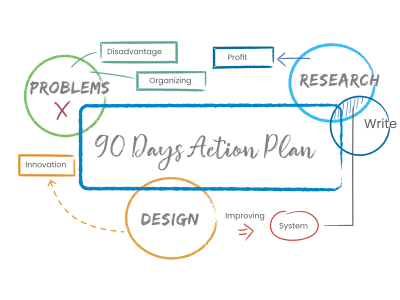
The 90-day action plan is where a career plan transitions from a document about the future into something that changes what you do this week. Without it, even a beautifully written career plan remains theoretical.
A 90-day action plan contains three to five specific, calendar-ready steps that connect directly to your 12-month milestone. They should be concrete enough that you could tell someone exactly what you did and when, and realistic enough that they fit into your current life without requiring a complete overhaul of your schedule.
Examples of well-written 90-day action steps: enrol in the TAFE Certificate IV programme by the end of this month, update LinkedIn profile with a professional summary and two recent achievements this week, apply for three roles per week on SEEK and CloudColleague starting Monday, attend one industry networking event in the next eight weeks.
Your Review Plan: When and How to Revisit?
A career plan without a review schedule becomes a historical document within six months. Life changes, the job market shifts, you learn things about yourself and your industry that were not visible when you wrote the plan. Without a regular process for revisiting it, the plan stops reflecting your reality and stops being useful.
A sustainable review schedule works on three levels. A monthly 15-minute check-in asks one question: are my 90-day actions on track? A quarterly 60-minute deeper review asks: are my milestones still the right ones, and does anything need to be adjusted? An annual full revision asks: does my long-term vision still reflect what I actually want, and does the whole plan need to be rewritten?
The monthly check-in is the most important. It is the habit that keeps everything else alive. Block it in your calendar now, before you finish reading this guide.
How to Write a Career Plan Step by Step?

The following six steps walk you through building a career plan from scratch. Work through them in order. Each step builds on the one before it, and skipping ahead tends to produce a plan that lacks internal coherence.
Step 1. Write Your Long-Term Vision Statement
Open a document and write a paragraph that describes your professional life 5 to 10 years from now. Do not worry about whether it sounds realistic or impressive. Write what you actually want, not what you think you should want.
Use this template as a starting point:
Vision Template: In [X] years, I want to be [role or position] doing [type of work] for [type of organisation or clients], earning [income target], with [lifestyle element that matters to you].
Once you have a draft, read it back and ask two questions. Is this specific enough to point me somewhere? And is this genuinely what I want, or is it what I think I should want? If the answer to the second question is no, rewrite it until it is honest.
Step 2. Audit Where You Are Right Now
Fill in the following table as honestly as you can. The goal is not to be harsh or deflating but to see your starting position clearly. Gaps are not failures. They are the raw material of your development plan.
| Area | Current State | Target State | Gap |
| Core technical skills | |||
| Qualifications | |||
| Industry experience | |||
| Leadership and soft skills | |||
| Professional network | |||
| Reputation and visibility |
The gaps column becomes the direct input into Step 4, your skills and development plan. The current state column gives you an honest baseline to measure progress against at future review points.
Step 3. Set Your Career Milestones
Using your long-term vision and your gap analysis, set three milestones: where you want to be at 12 months, at 3 years, and at 5 years. Each milestone should describe a specific state, not just an action you will take but a situation you will have reached.
| Timepoint | Milestone Description |
| 12 months | Write the specific role, qualification, skill level, or professional situation you want to have reached by this point. |
| 3 years | Write the next stage of your career trajectory, more advanced than the 12-month milestone and pointing toward the 5-year vision. |
| 5 years | Write the state that sits just before or at the point described in your long-term vision. |
A milestone is not a task list. It describes a state of being, not a sequence of actions. The actions that will get you to each milestone come in the next step.
Step 4. Build Your Skills and Development Plan
For each milestone you have set, ask: what skills, qualifications, or experiences do I need in order to reach this point? Then identify the most practical Australian pathway to acquiring each one.
| Milestone | Skills or Quals Needed | Development Pathway | Timeline |
| 12 months | |||
| 3 years | |||
| 5 years |
Prioritise development activities by asking which ones will have the most direct impact on reaching your next milestone. A TAFE qualification that is directly relevant to your 12-month milestone is worth pursuing before an online course that would be nice to have but is not connected to anything specific in your plan.
Step 5. Write Your 90-Day Action Plan
Based on everything you have written above, identify three to five specific actions you will take in the next 90 days. Each action should connect directly to your 12-month milestone and be specific enough to schedule.
| Action | Deadline | Connected to Milestone |
One concrete action worth adding for almost every career plan: browse current job listings on CloudColleague, or SEEK in your target field this week. Understanding what employers are actually asking for right now keeps your plan grounded in market reality rather than assumptions.
Step 6. Schedule Your Reviews
Before you close the document, add three recurring calendar events: a 15-minute monthly check-in, a 60-minute quarterly review, and a half-day annual revision. Treat these as non-negotiable appointments with your own career.
Share your plan with at least one person you trust, a mentor, a colleague, a career counsellor, or a friend who is equally serious about their own professional development. Accountability to someone else increases follow-through significantly, and a second perspective often surfaces blind spots you cannot see from inside your own situation.
Career Plan Examples for Different Stages of Australian Working Life
The following three examples show what a career plan looks like in practice at different stages. Use them as reference points, not prescriptions. Your plan needs to reflect your specific situation, values, and goals.
Career Plan Example for Someone Just Starting Out in Australia
Someone in their early career, perhaps one to three years into their first professional role, is typically building foundational skills and trying to work out what direction they want to move in. The plan at this stage does not need to be highly specific 10 years out. It needs to create forward momentum and build the skills and network that open doors over the next few years.
| Component | Content |
| Long-term vision | In 5 years, working as a team lead or specialist in my field, with a clear area of expertise and a professional network I actively contribute to. |
| Current position | Entry-level role, limited formal qualifications beyond base degree or TAFE cert, small professional network, no leadership experience. |
| 12-month milestone | Complete one relevant certification through TAFE or an online provider and take on at least one project with visible cross-team impact. |
| 3-year milestone | Move into a mid-level or specialist role with a salary increase and a broader professional network including at least two mentors. |
| 5-year milestone | Hold a team lead or senior specialist position and be recognised within the organisation or industry as someone with genuine expertise. |
| 90-day actions | Enrol in relevant TAFE or online course, update LinkedIn profile, apply for three roles per week on SEEK and CloudColleague to build interview experience and market knowledge. |
Career Plan Example for Mid-Career Professionals
A mid-career professional who has been in the same role or at the same level for two or more years often needs a plan that creates momentum from a standing start. The foundations are there. What is missing is the direction and the deliberate investment in development that progression requires.
| Component | Content |
| Long-term vision | In 5 years, working in a senior management or specialist consulting role, financially independent enough to have genuine flexibility about where and how I work. |
| Current position | Experienced professional, solid technical skills, no formal development in two years, not actively building toward anything specific. |
| 12-month milestone | Complete a leadership or management development programme and have a formal progression conversation with my manager. |
| 3-year milestone | Move into a senior role with direct reports or a consulting arrangement with at least two retained clients. |
| 5-year milestone | Operating independently or at senior management level with a strong industry reputation and multiple income streams. |
| 90-day actions | Research leadership programmes at TAFE or through a relevant professional association, approach manager to discuss a development plan, update LinkedIn and reconnect with three former colleagues. |
Career Plan Example for Someone Changing Careers in Australia
Career changers face a unique planning challenge. They need to build credibility in a new field while managing the transition practically and financially. The career plan for a changer is typically shorter in its initial horizon, focused on making the transition successfully in 18 to 24 months, with a longer-term view that builds from there.
| Component | Content |
| Long-term vision | In 4 years, established and recognised in my new field, earning at least the median salary for mid-level roles in that area, with the wrong career fully behind me. |
| Current position | Several years of experience in a different field, transferable skills identified, motivated to change but not yet qualified for target roles. |
| 12-month milestone | Complete an entry-level qualification in the new field through TAFE or an online programme and build a small portfolio of relevant work. |
| 2-year milestone | Secure first paid role in the new field, even at an entry level, and begin building industry-specific experience and contacts. |
| 4-year milestone | Hold a mid-level role in the new field with a salary that meets or exceeds what was earned in the previous career. |
| 90-day actions | Enrol in introductory course, conduct three informational interviews with people working in the target field, pick up one short-term freelance project through CloudColleague to build real-world experience. |
Stuck in Your Career? Build a Clear Plan

Not everyone who needs a career plan knows where to point it. If you are reading this from a place of genuine uncertainty, where the long-term vision section feels blank not because you have not thought about it but because you genuinely do not know what you want, trying to write a 5-year career plan will produce something that feels hollow and that you will not use.
The more honest starting point for someone in that position is not a long-term directional plan but a short-term exploratory one. An exploratory career plan covers the next 90 to 180 days and has one purpose: to generate the self-knowledge and real-world information that makes a proper directional plan possible.
Exploratory plans contain a different kind of action step. Instead of enrol in the qualification for the career you have chosen, they contain conduct one informational interview per month for three months, take one introductory TAFE or online course in a field you are drawn to and see whether the interest holds, pick up one short-term task in a target area through CloudColleague to get a feel for the actual work.
These are not detours from career planning. They are the necessary foundation for people who are starting from genuine uncertainty rather than from existing clarity. A well-run exploratory phase of three to six months typically produces enough self-knowledge and market understanding to make a real directional plan possible.
If the uncertainty runs deep or has persisted for a long time, a session or two with a professional career counsellor is a worthwhile investment. A good career counsellor does not tell you what to do. They ask the questions that help you figure out what you already know but have not yet articulated clearly.
Review Your Career Plan Without Starting from Scratch
A career plan is a living document, not a fixed one. The most useful plans are the ones that change as you change, not because the writer was undisciplined but because the writer was paying attention.
Updating a career plan and abandoning one are not the same thing. Abandoning a plan is what happens when you stop looking at it and let inertia carry you. Updating a plan is what happens when you return to it regularly, notice what has changed, and make deliberate adjustments that keep it relevant to your actual situation.
What to Review at Each Cadence?
At the monthly check-in, the only question worth asking is whether your 90-day actions are on track. If they are, note it and move on. If they are not, identify specifically what got in the way and whether the action needs to be adjusted, deferred, or replaced with something more realistic.
At the quarterly review, step back and look at the 12-month milestone. Is it still the right target? Has anything changed in your industry, your personal circumstances, or your understanding of what you want that would change what you are aiming for? Adjust the milestone if needed and rewrite the 90-day action plan for the next quarter.
At the annual revision, return to the long-term vision. Is it still honest? Does it still reflect what you actually want from your professional life, or have you learned things in the past year that would change it? This is the time to rewrite sections rather than just adjust them.
Minor Adjustments vs Full Career Plan Revision
Minor adjustments are appropriate when your underlying vision and milestones are still sound but specific actions or timelines need to be updated. A certification takes longer than expected. A job market shift changes which roles are realistic to target in the short term. A personal circumstance changes how much time you have available for development activities.
A full revision is appropriate when the long-term vision itself no longer resonates. When you return to the vision statement and feel nothing, or when you read it back and it describes a professional life that belongs to an earlier version of you rather than the one you are now, the plan needs to be rebuilt from the foundation up, not just patched.
James Clear writes that you do not rise to the level of your goals, you fall to the level of your systems. Applied to career planning, the system is the review schedule. The plan is only as useful as the habit of returning to it.
Career Planning Tools Australians Can Use in 2026
The following tools are specifically useful for Australians building or updating a career plan. Each one serves a different purpose in the planning process.
Government and Research Tools
MY FUTURE is the Australian Government’s career exploration platform. It allows you to explore career options by interest area, skill set, or industry and provides information on pathways, qualifications, and typical earnings. It is particularly useful for the vision-setting and gap analysis stages of your career plan.
Job Outlook provides detailed labour market data for every major occupation in Australia including employment size, projected growth over five years, typical weekly earnings, and entry pathway information. Using Job Outlook during your career planning process ensures your milestones are grounded in realistic market conditions rather than assumptions.
Skills Road covers trades and vocational pathways specifically. If your career plan points toward a trade or apprenticeship route, Skills Road provides the clearest picture of what that pathway looks like and what it requires.
Professional and Networking Tools
LinkedIn serves multiple functions in a career plan. It is a research tool for understanding what employers value in your target field, a networking platform for building the professional connections that support career progression, and a public record of your milestones and achievements as you reach them. Keeping your LinkedIn profile updated as your career plan progresses is a low-effort way to build professional visibility over time.
Professional associations including CPA Australia for accounting and finance professionals, Engineers Australia for engineering professionals, and the Australian HR Institute for human resources practitioners all offer structured professional development programmes, industry events, and mentoring opportunities that can directly support the skills development component of your career plan.
Practical Opportunity Platforms
SEEK remains the largest job board in Australia and is useful both for researching what employers currently value in your target field and for applying to roles as your career plan progresses.
CloudColleague is particularly useful for the testing and action stages of career planning. Whether you are exploring a new field through short-term project work, building your portfolio before applying for full-time roles, or actively seeking your next opportunity, CloudColleague connects Australian professionals with jobs, tasks, and freelance work that match where their career plans are taking them.
Career counsellors are worth mentioning as a resource for anyone whose planning process is stuck, particularly if the uncertainty is significant or longstanding. A good career counsellor does not prescribe a direction. They help you develop the self-clarity that makes planning possible.
A Career Plan Is Not a Promise. It Is a Tool.
The most common misconception about career planning is that the plan has to be right. That you need certainty before you can write anything down. That committing to a direction means being stuck with it forever.
None of that is true. A career plan is a working document, not a contract. It will be wrong in some ways. It will need to be updated as you learn more about yourself and the world. That is not a flaw in the process. That is the process working as it should.
What a career plan gives you is not certainty. It gives you direction. And direction, even imperfect direction, is infinitely more useful than drifting through your working life hoping the right opportunities will eventually appear.
The most important thing you can do after reading this guide is open a document and write the first sentence of your long-term vision. Not the whole plan. Just the first sentence. Everything else can be built from there.When you are ready to put your plan into action and find real opportunities that match where you are heading, CloudColleague is a practical starting point. Browse jobs, freelance work, and career opportunities built for Australian professionals who are serious about where their careers are going.
Frequently Asked Questions About Career Planning in Australia
A career plan is a structured, written document that maps out where you want your professional life to go and the specific steps, milestones, and development activities that will take you from where you are now to where you want to be.
Start by writing an honest long-term vision statement describing where you want your career to be in 5 to 10 years. Then audit your current position and identify the gaps between where you are and where you want to be. Set milestones at 12 months, 3 years, and 5 years.
A career goal is a specific, time-bound target you are working toward right now. A career plan is the broader framework that connects your goals to a long-term vision and maps out the sequence of milestones and development activities between your current position and where you want to end up.
A light monthly check-in of around 15 minutes is enough to ensure your 90-day actions are on track. A deeper quarterly review of around 60 minutes allows you to adjust your milestones and refresh your action plan.
Yes, and in some ways it matters more early on than later. A simple career plan at the start of your working life, even if the long-term vision is not fully clear yet, gives you enough direction to make better decisions about the roles you pursue, the skills you develop, and the opportunities you prioritise.