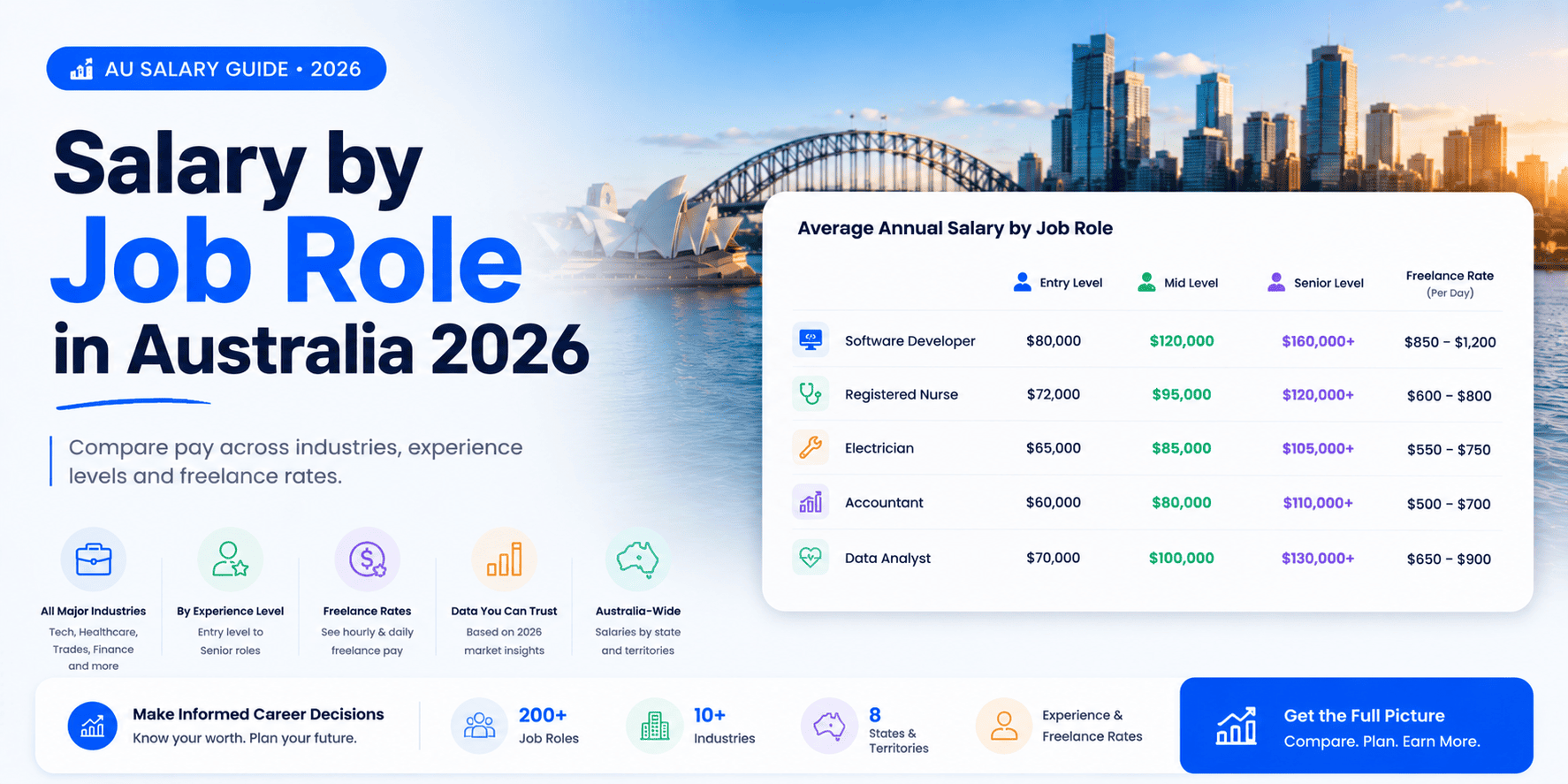
Salary by job role tells you far more than any national average ever could. In 2026, full-time workers in Australia earn an average near $107,000 a year, or about $8,900 a month, according to ABS data. Yet a registered nurse, an electrician and a software engineer all sit at very different points on that scale. So this guide breaks pay down role by role, across every major field. Use it to see what your job pays now, and how to earn more. For the national picture, see our salary insights hub.
| Ready to turn salary insights into action? Begin your journey Starting as a Seeker. |
Salary by job role in 2026: the quick overview
This guide covers pay across technology, healthcare, trades, finance, marketing, admin and education. For each field, you will find typical salary ranges plus freelance rates where they apply.
Pay still varies by experience, location and demand, so treat these figures as benchmarks. For the by-industry and by-state view, read our guide to the average salary in Australia.
How we built this salary by job guide
We combined advertised pay with median data, then cross-checked it. Our sources include SEEK, the ABS, Jobs and Skills Australia and Robert Half’s 2026 guide.
Because advertised salaries often sit above the median, we report ranges rather than single figures. This shows salary by job title more honestly, and reflects the real spread you will see in offers.
Salary by job role: the full 2026 directory
Below is the role directory, grouped by field. Figures are 2026 Australian benchmarks in AUD, and freelance rates appear where the work suits contracting.
Technology and data salaries
Technology and data roles sit well above the national average, driven by ongoing skills shortages.
| Role | Typical salary (AUD/yr) | Freelance / contract rate |
| Software engineer / developer | $75,000 – $155,000 | $42 – $85/hr |
| Data analyst / scientist | $95,000 – $160,000 | specialist premium |
| IT project manager | $120,000 – $150,000 | day rates vary |
| Cybersecurity analyst | $100,000 – $150,000 | high demand |
| Web developer | $70,000 – $155,000 | $40 – $180/hr |
Healthcare salaries
Healthcare spans a wide range, from entry-level care to highly paid medical practitioners.
| Role | Typical salary (AUD/yr) | Freelance / contract rate |
| Registered nurse | $75,000 – $95,000 | agency shift rates |
| GP / medical practitioner | $200,000 – $350,000 (FTE) | billing-based |
| Physiotherapist / occupational therapist | $75,000 – $100,000 | private session rates |
| Aged care / personal care worker | $55,000 – $70,000 | varies |
Trades and construction salaries
Trades remain in strong demand, and many tradespeople earn more by contracting.
| Role | Typical salary (AUD/yr) | Freelance / contract rate |
| Electrician | $75,000 – $110,000 | $60 – $100+/hr |
| Plumber | $75,000 – $110,000 | $60 – $100+/hr |
| Carpenter | $65,000 – $95,000 | varies |
| Construction project manager | $120,000 – $180,000 | day rates |
Business and finance salaries
Finance roles scale sharply with qualifications such as a CPA or CA.
| Role | Typical salary (AUD/yr) | Freelance / contract rate |
| Accountant | $70,000 – $90,000 | varies with CPA |
| Finance manager | $120,000 – $160,000 | n/a |
| Bookkeeper | $60,000 – $80,000 | $35 – $60/hr |
| Business analyst | $90,000 – $130,000 | day rates |
Marketing and creative salaries
Creative pay depends heavily on niche, portfolio and client mix.
| Role | Typical salary (AUD/yr) | Freelance / contract rate |
| Marketing manager | $90,000 – $130,000 | n/a |
| Marketing specialist | $70,000 – $95,000 | project rates |
| Graphic designer | $60,000 – $90,000 | $30 – $37/hr |
| Content writer | $65,000 – $90,000 | $40 – $80/hr |
Administration and customer service salaries
These roles anchor most organisations, with pay rising into management.
| Role | Typical salary (AUD/yr) |
| Executive assistant | $75,000 – $95,000 |
| Administrative officer | $60,000 – $75,000 |
| Customer service representative | $55,000 – $65,000 |
Education salaries
Teaching pay follows set scales, while tutoring offers a flexible side income.
| Role | Typical salary (AUD/yr) |
| Secondary school teacher | $80,000 – $110,000 |
| Early childhood educator | $60,000 – $75,000 |
| Want more control over your income? Visit our Guides on Tasks, discover How Bidding Works, and Explore Tasks that match your skills. |
Highest paying jobs in Australia in 2026
Some roles sit far above the rest. Medical specialists and surgeons top the list, often well beyond $300,000 a year. General practitioners follow, with full-time equivalent pay around $200,000 to $350,000.
Outside medicine, IT project managers, engineering managers, finance directors and mining specialists round out the highest paying jobs in Australia. In short, deep expertise and scarce skills drive the biggest pay.
Read Next: Salary by Country Guide 2026 (Global Comparison)
Most in-demand jobs and salaries in 2026
Demand also shapes pay, and 2026 favours a few clear fields. Registered nursing remains Australia’s largest employed occupation outside retail, with more than 340,000 people in the role.
Alongside nursing, the most in-demand jobs in 2026 include software engineering, cybersecurity, aged care, allied health and skilled trades. With unemployment near 4.1% in early 2026, employers in these fields compete hard for talent. As a result, skilled candidates can often negotiate above the advertised range.
What affects your salary by job role?
Four factors move your pay within any role.
- Experience. Senior workers often earn 50% to 60% more than entry-level peers.
- Location. Capital cities and mining regions usually pay more than regional areas.
- Skills and certifications. Credentials like a CPA, or cloud and AI skills, lift pay quickly.
- Demand. Shortage roles command a premium, especially in health, tech and trades.
See exactly where you stand. Download our free 2026 Salary by Role Report. It includes the full directory, experience tiers and a know-your-worth checklist.
Salary by occupation vs freelance rate
Many roles pay more as a contractor than as an employee. Developers, designers, writers and tradespeople often charge premium hourly or day rates.
However, freelancers fund their own super and leave, so compare the full picture, not just the headline rate. To weigh both paths properly, read our guide to salary vs hourly pay. For how super and benefits sit inside an offer, see our salary structure guide.
How to earn above the average salary for your role?
If your pay sits below your role’s range, you have three clear moves. You can upskill, switch employers, or work independently and set your own rate.
Independent work often unlocks the fastest gains. You can bill higher-paying clients, stack projects, and control your income ceiling. To find that work, you can browse roles hiring now and apply in minutes.
Turn these numbers into a higher income. Join the 18,000-plus Australian businesses and professionals on CloudColleague, rated 4.7 out of 5. You get a free verified profile, AI-matched job recommendations, and same-day payouts via Stripe.
Once you join, AI matching and built-in interviews through our platform features connect you with the right work fast. Planning to negotiate a higher offer instead? Our interview and negotiation tips cover the conversation itself.
| Take the next step in your career. Create your free seeker account on CloudColleague in minutes. |
Salary by job role FAQ
It varies widely by role. The national full-time average sits near $107,000, but customer service roles start around $55,000, while medical specialists can exceed $300,000.
Medical specialists and surgeons earn the most, often well above $300,000 a year. General practitioners, IT project managers and engineering managers also rank among the highest paid.
Registered nursing leads on sheer numbers, followed by software engineering, cybersecurity, aged care, allied health and skilled trades. These fields face ongoing shortages.
Yes, significantly. Senior professionals often earn 50% to 60% more than entry-level workers in the same job, before bonuses and overtime.
Often, yes. Freelancers charge higher gross rates, but they fund their own super and leave, so compare the total package rather than the rate alone.
Use the lookup tool above, then check the directory for your field. For the national and state view, see our average salary guide.