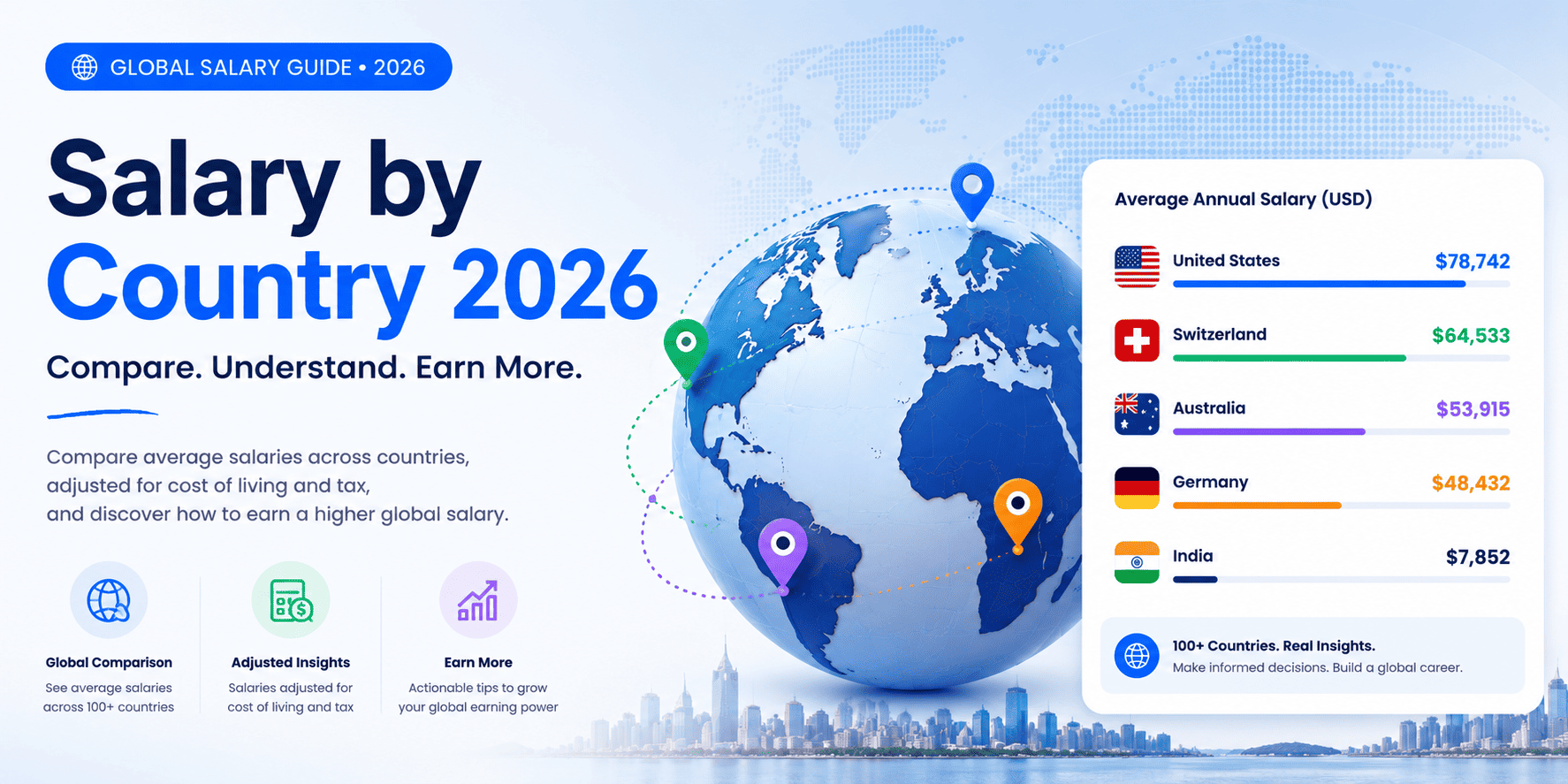
Salary by country varies more than most people expect, with the richest economies paying four times what others do for similar work. In 2026, a worker in Luxembourg or Switzerland can earn double the global average, while the same role pays far less elsewhere. Yet the headline number only tells part of the story. Tax, cost of living and currency all change what your pay is really worth. So this guide compares average wages across the world, adjusts for purchasing power, and shows how remote work lets you earn a higher global salary. For local benchmarks, start with our salary insights hub.
| Ready to turn salary insights into action? Start as a Seeker and begin exploring opportunities today. |
How we built this salary by country guide?
We based this comparison on OECD average annual wages, the most consistent global measure available. These figures convert each country’s pay into US dollars using purchasing power parity, or PPP, which adjusts for cost-of-living differences.
The OECD calculates the average by dividing a country’s total wage bill by its full-time-equivalent workforce. We use the latest published data, then add 2026 figures from reputable sources where available. As a result, you get a fair, like-for-like view rather than raw exchange-rate noise.
Throughout, we read every salary in three layers. First the nominal figure, then take-home pay after tax, and finally purchasing power. We also flag where figures reflect 2026 estimates rather than the latest confirmed data. That framework matters, and we return to it below.
Average salary by country in 2026
The table below shows average annual wages, adjusted for purchasing power, in US dollars. It gives the clearest like-for-like view of salary by country.
| Country | Average annual wage (USD, PPP) |
| Luxembourg | ~$90,000 |
| Iceland | ~$87,000 |
| Switzerland | ~$83,000 |
| United States | ~$80,000 – $83,000 |
| Germany | ~$69,400 |
| Canada | ~$69,400 |
| Australia | ~$67,000 |
| United Kingdom | ~$63,700 |
| France | ~$60,600 |
| Italy | ~$51,000 |
| Japan | ~$49,400 |
| OECD average | ~$58,000 |
As the table shows, Luxembourg leads at about $90,000, followed by Iceland and Switzerland. The United States sits near the top of the non-European pack, while Australia lands around $67,000. Meanwhile, the OECD average is roughly $58,000.
Notably, eight of the ten highest-paying economies are in Europe, with the United States and Australia the main non-European standouts. The spread is huge, too. The best-paying OECD countries pay roughly four times what the lowest-paying members do for similar work. So geography and economic productivity drive much of the gap.
Read Next: Average Salary for Freshers in Australia 2026.
Highest paying countries in 2026
When you look at monthly take-home income, a slightly different picture appears. Switzerland tops the list, with average monthly income near $7,958. Norway follows closely at around $7,878, thanks to high productivity and strong worker protections.
Luxembourg also ranks highly, with average monthly pay above $6,000. The United States does not top the global charts on average, yet it offers some of the best-paying individual roles in tech, healthcare and finance. Ireland deserves a mention too, with Dublin tech and pharmaceutical salaries starting near $55,000 and most employers planning further wage rises. In short, the highest paying countries reward both strong economies and scarce, specialised skills.
Salary growth by country in 2026
Pay is not static, and 2026 is reshaping the global map. Most developed economies are seeing modest rises of 3 to 4%, but a few regions are moving faster.
Eastern Europe leads the charge. Hungary, Poland, Czechia and Bulgaria are projected to record the strongest real salary growth this year, as their economies converge with Western Europe. So a developer in Warsaw or Prague may see far faster raises than a peer in Paris or London.
Elsewhere, growth is steadier. The Nordics and Western Europe rise slowly from an already high base, while the United States keeps rewarding scarce tech and healthcare skills even as broad wage growth cools. In short, where you sit on the salary by country map can shift quickly, so it pays to track the trend, not just the snapshot.
Salary by country: nominal pay vs purchasing power
Here is the single most important idea in this guide. A big salary in an expensive country can buy less than a smaller salary somewhere cheaper.
That is why you should always compare pay in three layers. The nominal salary is the headline figure. Take-home pay is what remains after tax. Purchasing power is what that money actually buys locally.
The difference is stark. A $150,000 salary feels comfortable in San Francisco, wealthy in Dubai, and genuinely transformational in Bengaluru. So the same number means very different lives in different places. For instance, a modest salary in a low-cost country can fund a lifestyle that a far larger pay packet cannot match in London or Sydney. Currency strength adds another layer, since a salary paid in US dollars often stretches much further than the same figure in a weaker currency.
Salary by country: best value for cost of living
The best-paid country is rarely the best-value country. Once you adjust for rent, tax and daily costs, the ranking shifts noticeably.
High-cost nations like Switzerland and Norway still deliver excellent living standards, because their services and infrastructure are world-class. Yet some lower-cost economies leave more disposable income from the same nominal pay. That gap is exactly why purchasing power matters more than the headline number.
For remote workers, the sweet spot is clear. You want income from a high-paying market and expenses in a lower-cost one. That pairing, rather than any single location, delivers the strongest real salary by country outcome. Cost-of-living indexes make it easy to test this before you commit to a move or a contract.
Salary by country by region
Patterns become clearer when you group countries by region. Each region has its own pay story.
North America salaries
The United States pays among the highest wages in the world, near $80,000 to $83,000 on average. However, it also shows the widest spread, with very high earners and lower floors. Canada sits lower and more even, at about $69,400. Mexico pays far less in nominal terms, though its lower living costs soften the difference for local workers.
Western Europe salaries
Western Europe dominates the top of the global table. Luxembourg and Switzerland lead, while Germany, France and the United Kingdom all post strong averages. The Netherlands and Belgium pay well too, supported by high productivity. Southern Europe pays less, with Italy near $51,000 and Spain lower again.
Nordic salaries
The Nordic countries combine high pay with high tax and strong benefits. Norway, Denmark, Sweden and Iceland all rank among the best for living standards. Workers there accept higher taxes in return for free healthcare, education and generous leave. Pay is also more compressed, so the gap between junior and senior roles is narrower than in the United States.
Eastern Europe salaries
Eastern Europe pays lower base salaries, but it is catching up fast. Hungary, Poland, Czechia and Bulgaria are projected to see the strongest real salary growth in 2026. Skilled-migration routes such as the EU Blue Card also draw talent in. As a result, the region is increasingly attractive for skilled and remote workers.
Oceania salaries
Australia sits around $67,000 on the PPP measure, with 12% superannuation paid on top. New Zealand offers competitive pay too, though usually a little below Australia. Both countries carry high living costs, especially for housing in their major cities. For the full Australian breakdown by industry, state and role, see our guide to the average salary in Australia.
Asia salaries
Asia spans the widest range of any region. Japan averages about $49,400, while Singapore pays among the world’s highest in finance and tech. Many other Asian economies pay less in nominal terms, yet local purchasing power can be strong. India and much of Southeast Asia, for example, offer lower headline pay but very low living costs, which makes them magnets for remote work and global outsourcing.
| Want to earn beyond your average pay? Visit our Guides on Tasks, discover How Bidding Works, and Explore Tasks that match your skills. |
Salary by country through a role lens
Averages hide a lot, so it helps to compare a single role. Software engineers make a clear example.
In 2026, Danish software engineers earn about $87,000 on average. Norwegian developers earn between $64,320 and $90,000, while the United States again shows the widest variance. The same role in Eastern Europe or much of Asia pays less in nominal terms, yet often delivers strong local purchasing power. To see how one role breaks down in detail, read our guides to salary by job role and the software engineer salary.
So the country sets the baseline, but the role and your skills decide where you land within it.
How tax and benefits change your salary by country?
Two identical salaries can leave very different amounts in your pocket. Tax is the main reason.
The Nordic countries, for instance, apply effective tax rates of roughly 35 to 45%. In return, residents receive free healthcare, world-class education and generous parental leave. So a lower take-home figure still buys a high quality of life.
The United States works differently, with lower average tax but fewer universal benefits, so workers fund more of their own healthcare and retirement. Australia sits in between, pairing moderate tax with compulsory superannuation that quietly builds long-term wealth. So two equal salaries in different countries can leave very different real outcomes. To understand how base pay, tax, super and benefits fit together, read our salary structure guide.
Australia vs the world
Australia ranks comfortably in the upper tier of global pay. Its PPP-adjusted average near $67,000 places it among the OECD’s stronger performers, though below the United States and much of Western Europe.
However, Australia adds 12% superannuation on top of most salaries, which lifts the true value of a package. Strong minimum wages and conditions also narrow the gap between low and high earners. New to the country and comparing offers? Our first-time-in-Australia guide walks through the essentials.
Remote work and the global salary advantage
Here is where salary by country becomes an opportunity rather than a limit. Remote work breaks the link between where you live and what you can earn.
Increasingly, skilled professionals bill clients in higher-paying markets while living in lower-cost ones. A designer or developer in a cheaper city can charge United States or Australian rates, then enjoy strong local purchasing power. This is the single biggest lever most people overlook.
Consider a simple example. A developer earning $35,000 locally might bill global clients at rates worth two or three times that, without moving home. The salary by country gap, which usually works against lower-cost regions, suddenly works in their favour. That is the quiet revolution remote work has created.
Freelancing makes that lever easy to pull. You set your own rate, work with global clients, and keep more of each invoice. To weigh freelance income against a salaried role, read our guide to salary vs hourly pay.
See where you stand globally. Download our free 2026 Global Salary Comparison Report. It maps average pay, cost of living and remote-work potential across key markets.
What affects salary differences between countries?
Six forces explain most of the gaps you see above.
- Productivity. Wealthier, more productive economies pay more for the same work.
- Cost of living. High-cost countries pay more, but the money buys less.
- Currency strength. A salary in a strong currency stretches much further abroad.
- Tax and benefits. High-tax nations often return value through services.
- Labour regulation. Stronger protections raise the floor and narrow the top.
- Demand. Scarce, in-demand skills command a premium everywhere.
In short, no single number captures the whole picture. You have to read pay through all six lenses at once. That is also why benchmarking your own role, in your own city, beats relying on a national headline. The averages set the scene, but your skills and your market set your actual pay.
How to use this salary by country guide?
Data only helps if you act on it. Start by finding your country’s average above, then adjust it for your role and experience.
Next, apply the three-layer test. Check the nominal figure, estimate take-home after tax, and weigh local cost of living. This tells you what an offer is really worth, not just how big it looks. Finally, compare that against what you could earn from clients in higher-paying markets.
If the gap is large, remote and freelance work may be your fastest path to a better real income. The rest of this guide shows you how.
How to earn a higher global salary?
If your local market pays below your worth, you have real options in 2026. You can work remotely, target global clients, or specialise in scarce skills.
Remote freelance work is often the fastest route. It lets you bill higher-paying markets from anywhere, regardless of your local average. To find that work, you can browse remote and global roles and apply in minutes.
Turn global pay gaps into your advantage. Join the 18,000-plus Australian businesses and professionals on CloudColleague, rated 4.7 out of 5. You get a free verified profile, AI-matched job recommendations, and same-day payouts via Stripe, wherever your clients are.
Once you join, our platform features handle secure, same-day payments from clients anywhere in the world. So you can focus on the work, not the logistics.
Hiring across borders: salary by country for employers
This data helps businesses as much as professionals. If you hire across markets, salary by country tells you what a fair offer looks like in each one.
Smart employers use these benchmarks to set competitive rates without overpaying. They also tap lower-cost markets for specialist skills, then pay fairly for the local context. Remote hiring makes this straightforward, since talent no longer has to sit in your city.
On CloudColleague, businesses post a role and match with verified professionals, then pay securely through built-in tools. If you are hiring, you can start as an employer and benchmark fair pay before you post.
| Your next opportunity starts here. Create your free seeker account on CloudColleague today. |
Salary by country FAQ
Average wages vary widely. The OECD average sits near $58,000 in PPP terms, with Luxembourg highest at about $90,000 and many economies far below that.
Luxembourg leads OECD average wages at around $90,000, followed by Iceland and Switzerland. On monthly take-home income, Switzerland and Norway top the list in 2026.
Productivity, cost of living, currency strength, tax, labour laws and demand all play a part. Together, these forces can make one country pay several times more than another. Even within the wealthy OECD group, the highest payers offer around four times the lowest.
Use purchasing power parity, which adjusts for cost of living. Then read each salary in three layers: nominal pay, take-home after tax, and what it actually buys locally.
Often, yes. Remote and freelance work lets you bill higher-paying markets while living in a lower-cost one, which can dramatically lift your real income.
Not necessarily. A large salary in an expensive country can buy less than a smaller one in a cheaper place. Always compare purchasing power, not just the headline figure.
Australia ranks in the upper tier, with a PPP-adjusted average near $67,000 plus superannuation. It sits below the United States and much of Western Europe, but above the OECD average.