The average salary in Australia in 2026 sits just above $100,000 a year for full-time workers. Yet most Australians earn well below that headline number. A small group of very high earners pulls the average up. So before you decide whether you are underpaid, you need the right benchmark for your industry, state, role and experience. This guide gives you all four, and a fast way to compare your own pay.
| Want to earn from day one? CloudColleague also provides professionals with an option for freelance tasks. Go through guides on tasksand how bidding worksto learn more about online and freelance tasks. |
How we built this 2026 salary guide?
We anchored every figure to official Australian sources, then cross-checked them. Our main references include the ABS Average Weekly Earnings survey, Jobs and Skills Australia, AHRI and Mercer wage forecasts, and SEEK role data.
Surveys often disagree, so we report ranges instead of false-precise single numbers. We also separate the average (mean) from the median, because the two tell very different stories. For more benchmarks, explore our ongoing salary insights.
What is the average salary in Australia in 2026?
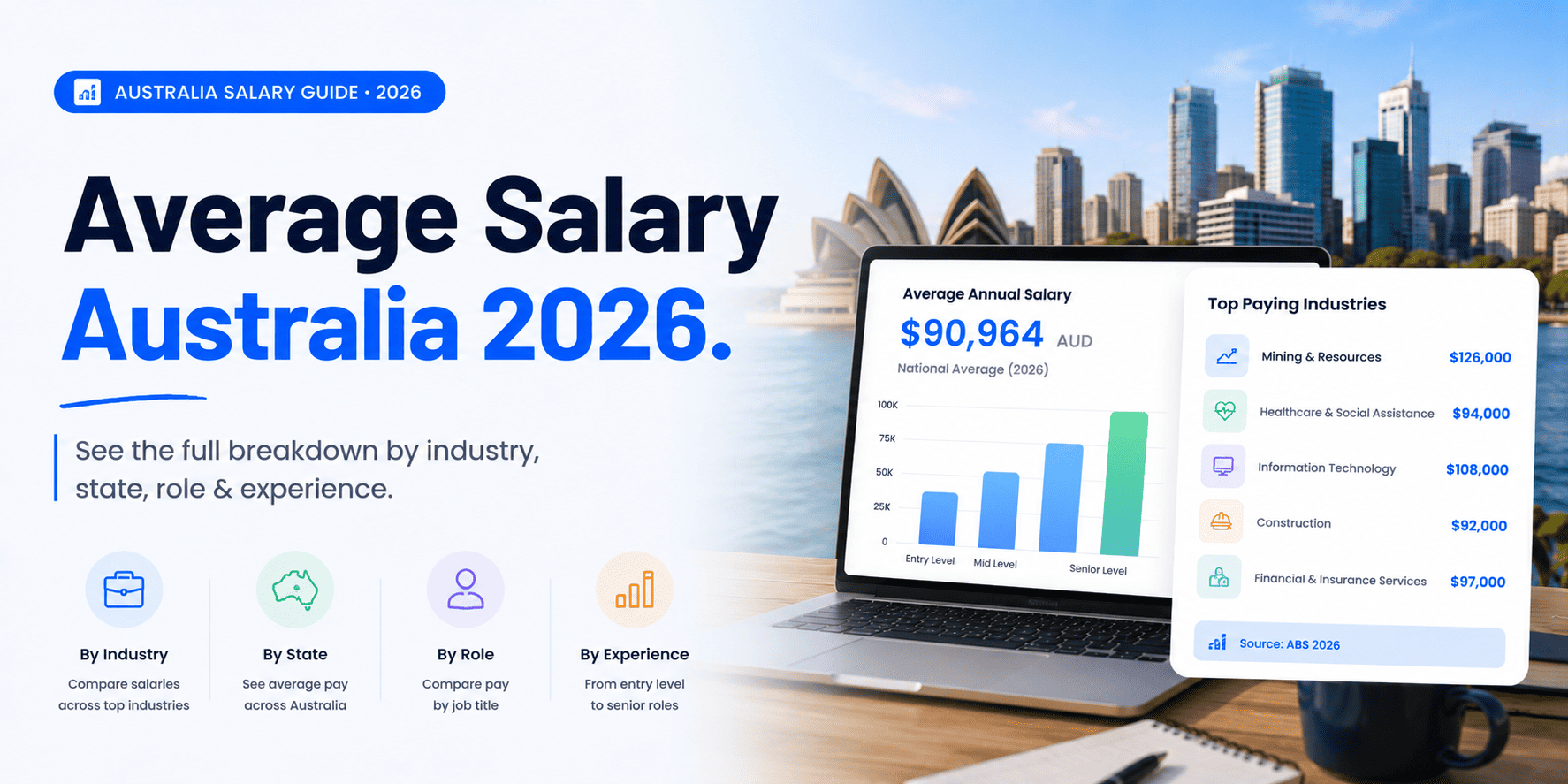
According to the ABS, full-time adult average weekly ordinary-time earnings reached roughly $1,920 to $2,050 per week in late 2025. That works out to about $100,000 to $106,000 a year. Employers must also pay 12% superannuation on top, so your total package is higher.
However, that average misleads most people. A typical worker earns less, because mining and senior professional salaries stretch the mean upward. Therefore the median matters more, and we break it down next.
Average salary vs median salary in Australia
The difference is simple. The average is inflated by top earners. The median marks the exact middle of the pay scale. As a result, the median is the more honest benchmark for most Australians.
In 2026, the median full-time salary sits around $76,000 to $90,000. That is well below the $100,000-plus average. Meanwhile, the ABS median weekly figure lands near $1,440 to $1,480.
In short, compare yourself to the median first. Use the average only to see how large the top end has grown.
Read Next: Salary vs Hourly Pay: What’s Better in Australia?
Average salary by industry in 2026
Industry is the single biggest driver of pay in Australia. The top sectors earn more than double the lowest. Skill scarcity, capital intensity and bonuses explain most of the gap.
| Industry | Approx. full-time salary (AUD/yr) |
| Mining | $150,000 – $171,000 |
| Financial & insurance services | $110,000 – $130,000 |
| Information media & telecommunications (ICT) | $100,000 – $135,000 |
| Professional, scientific & technical services | $100,000 – $120,000 |
| Electricity, gas & water | $100,000 – $115,000 |
| Public administration & safety | $95,000 – $110,000 |
| Construction | $85,000 – $100,000 |
| Education & training | $85,000 – $100,000 |
| Healthcare & social assistance | $80,000 – $100,000 |
| Retail trade | $55,000 – $70,000 |
| Accommodation & food services | $55,000 – $65,000 |
Mining stays well ahead, with ABS data placing full-time earnings near $150,000 to $171,000. Fly-in-fly-out roles lift that figure. By contrast, accommodation and food services sit at the bottom, because the sector leans on award rates and casual labour.
Average salary by state and territory
Geography moves pay too. Industry mix and cost of living drive most of the difference.
| State / Territory | Versus national average |
| Australian Capital Territory | Highest, public-sector heavy |
| Western Australia | High, mining premium |
| New South Wales | Above average (about $111,700) |
| Northern Territory | Around average |
| Victoria | Around average |
| Queensland | Slightly below average |
| South Australia | Below average |
| Tasmania | Lowest |
The ACT tops the table, because federal public-service roles dominate its workforce. Western Australia follows on the back of mining. In fact, the gap between WA and Tasmania exceeds $21,000 a year for a full-time worker. New to the country and comparing offers? Read our first-time-in-Australia guide.
Average salary by age
Age tracks experience, so pay climbs and then plateaus. According to the ABS, earnings peak between 45 and 54. Full-time workers in that band reach a median near $99,800 a year. Younger workers earn less, because many combine study with casual work early on.
Average salary by experience level
Experience remains the clearest lever on pay. Here is the typical full-time path in Australia.
| Experience level | Typical range (AUD/yr) | What changes |
| Entry-level (0-2 yrs) | $60,000 – $80,000 | Foundational skills, growth potential |
| Mid-career (3-9 yrs) | $85,000 – $120,000 | Specialisation, team leadership |
| Senior / expert (10+ yrs) | $120,000 – $180,000+ | Niche expertise, management |
For example, web developers often start near $70,000 to $95,000. They then climb past $150,000 at senior level, according to Glassdoor AU and ERI SalaryExpert. In most fields, the jump from entry to senior exceeds 60%.
Average salary by job role
CloudColleague connects professionals across many fields. So the table below focuses on in-demand roles you can monetise on the platform. Figures show 2026 Australian benchmarks, with freelance hourly rates in AUD.
| Role | Salaried (AUD/yr) | Freelance hourly (AUD) |
| Web developer | $70,000 – $155,000 | $40 – $180 (full-stack $80–$150+) |
| Software engineer (contract) | $90,000 – $160,000 | $42 – $85 (senior median ~$63) |
| Data / AI specialist | $120,000 – $160,000+ | Specialist premium |
| Web designer | $55,000 – $90,000 | ~$31 average |
| Graphic / freelance designer | $51,000 – $85,000 | $30 – $37 |
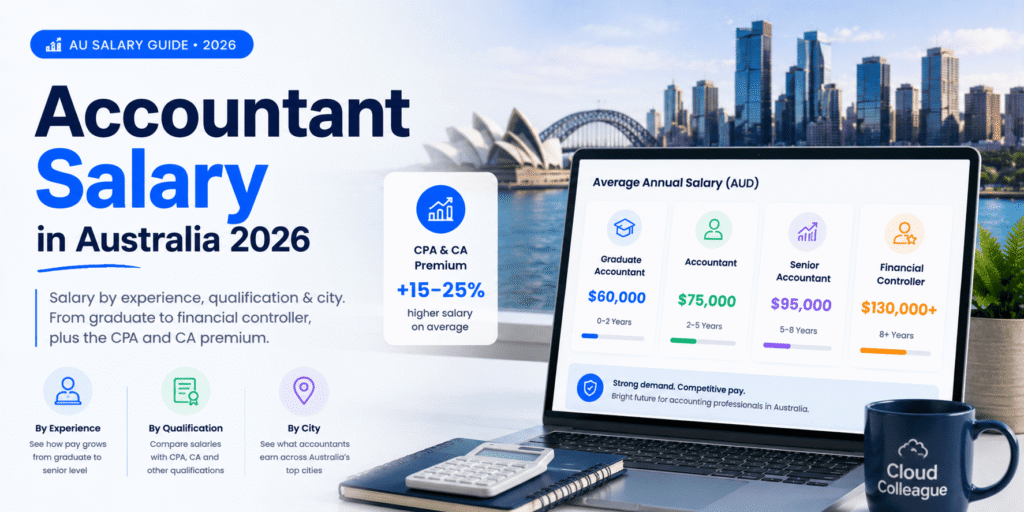
| Accountant | $60,000 – $110,000 | Varies with CPA |
Technical and AI-adjacent skills sit at the top. Creative roles depend more on niche and client mix. Front-end web developers usually charge $70 to $120 an hour. Full-stack specialists push past $150.
| Looking to increase your earnings? Professionals on CloudColleague set their own rates and keep more of what they earn. Start as a Seeker to get started. |
Average wage increase in 2026: the latest pay trends
Australian pay growth has cooled after several strong years. The ABS Wage Price Index rose about 3.4% over the year to the September 2025 quarter. That is only marginally above inflation. Mercer forecasts 2026 salary budgets near 3.5%. AHRI members expect rises closer to 2.7%, and about 3.3% in the private sector.
Meanwhile, the labour market stays relatively tight. Unemployment sits near 4.3% and is forecast to soften only slightly. Even so, two patterns stand out.
- The job-changer premium. Workers who switch roles usually gain more than those who stay, because new employers pay a market rate to win them.
- The specialisation premium. Scarce skills in data, AI, cloud and modern web stacks still attract above-average increases.
The takeaway is clear. A standard annual review rarely beats the market. Changing roles or going independent often does. Go through our guide on Salary and Job market trends to be informed all the time.
What is a good salary in Australia in 2026?
A good salary beats the median for your role and state, after cost of living and super. That target beats the national mean, which top earners inflate.
For instance, earning slightly below $100,000 does not mean you are underpaid. Often it just means the average is skewed high. So benchmark against the median for your specific role and city.
Are you paid below the average salary? How to check
Most Australians only discover they are underpaid by accident. You do not have to. Follow three quick steps.
- Find your role’s median, not the national average, for your state and city.
- Adjust for experience and industry using the tables above.
- Compare your current package, including super and bonuses, against that median.
| Ready to earn? Create your professional profile to set your rate, switch on job-match alerts and start browsing matched jobs. |
How to earn above the average salary?
If your pay sits below the median, you have two realistic levers in 2026.
First, change roles. Job-changers consistently out-earn job-stayers. So moving to a new employer or client is often the fastest pay rise available.
Second, go independent. Freelance and contract work lets you set your own rates and stack multiple clients. You can even bill overseas clients in higher-paying markets, wherever you live in Australia. Specialists in data, AI and development routinely charge above salaried equivalents.
Here is the simplest way to price your time as a freelancer.
Target rate = (desired annual income ÷ ~1,500 billable hours) + 30 to 40% loading. The loading covers tax, insurance, downtime and your own super, which you fund yourself as a freelancer. Example: a $100,000 target ÷ 1,500 hours is about $67/hr, plus ~35% is about $90/hr.
On CloudColleague, professionals do exactly this. They set rates, build a review history and win higher-value work over time. See how matching and secure payments work on our platform features page.
| Want the full career roadmap behind these numbers? See our Career Advice guides. Polishing your application first? Read our resume guide and interview preparation tips. |
Average salary Australia FAQ
Full-time workers earn an average just over $100,000 a year, based on ABS average weekly ordinary-time earnings, plus 12% super on top. The median is lower, closer to $76,000 to $90,000, and reflects what a typical worker earns.
The median is more accurate for most people. The average is pulled up by very high earners in sectors like mining and finance. Use the median as your main benchmark and the average to gauge the top end.
A good salary beats the median for your role and state, after cost of living and super. Beating the national average is a weaker signal, because that figure is skewed high.
Mining pays the most, near $150,000 to $171,000 for full-time work, helped by fly-in-fly-out roles. ICT, financial services and professional services follow. Accommodation and food services sit at the bottom.
Change roles, since job-changers tend to out-earn job-stayers. Or go independent and set your own rates. Freelancing lets you bill higher-paying domestic and overseas clients, which often pushes income above salaried averages.