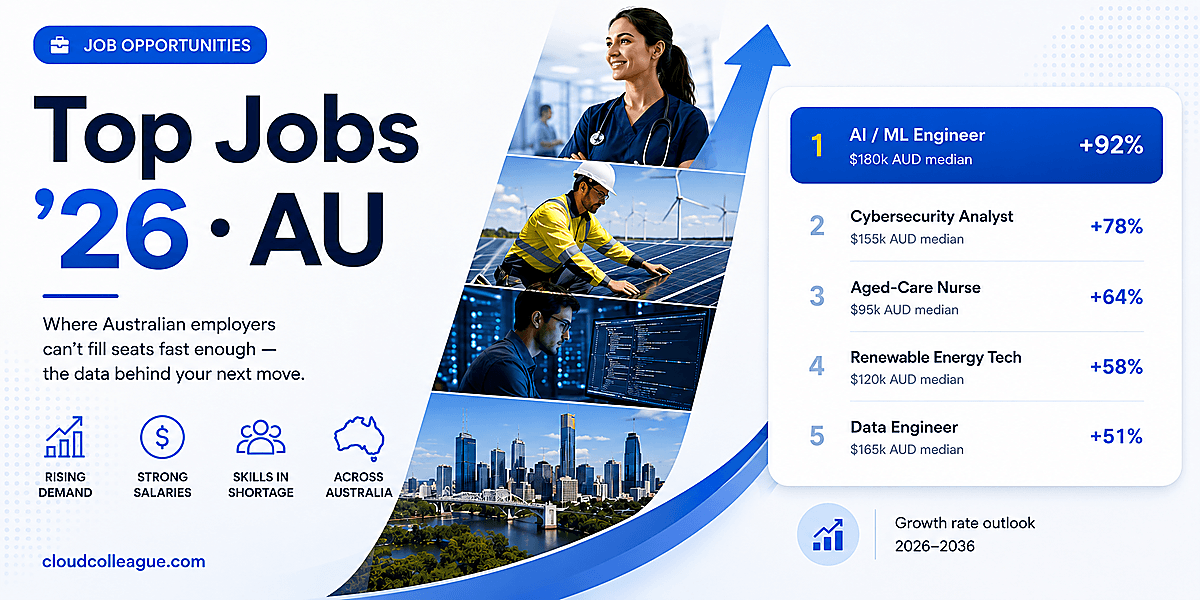
In a tight Australian labour market, some careers have more open roles than qualified people to fill them. That is a rare position of leverage for job seekers, and it is exactly the situation Australia is in heading into 2026-27. Jobs and Skills Australia’s September 2025 Occupation Shortage Report identifies 139 occupations in persistent shortage every year from 2021 to 2025, with a national vacancy fill rate of 70.2% and Skill Level 3 trades at just 54.3%.
This guide is for job seekers actively looking, career changers, students choosing a field, and professionals weighing their next move. It covers the top jobs by current demand and salary, what each pays, what each requires, and the realistic path into each one.
Want a head start? Start as a seeker on CloudColleague, create your free profile, and start your journey on high demand careers.
Built on Real Data: Shortage Reports, Job Ads, and Salary Guides
Methodology matters in a list like this, and readers (along with Google) reward transparency.
Three signals went into ranking the careers below. First, Jobs and Skills Australia’s Skills Priority List and September 2025 Occupation Shortage Report, which combines the Survey of Employers who have Recently Advertised with vacancy fill rates as the official measure of Australian workforce shortages. Second, current vacancy data from SEEK and Indeed Hiring Lab Australia, which reflects what employers are actually advertising in 2026. Third, recruiter salary guides from Hays Australia, Robert Half, and Talent International, which set the benchmarks the Australian market actually pays.
One caveat. National demand varies by state and capital city. A registered nurse in regional Queensland faces a different market than one in inner Sydney. The list reflects national patterns, and the state-by-state section later in the article covers the regional variation. For the broader long-term workforce trends shaping these shortages, the pillar guide goes into the forces behind them.
Read Next: Careers That Will Grow in the Next 10 Years: The 2026–2036 Outlook for Australian Workers
The Top High Demand Careers in Australia for 2026-27
Each career below uses the same six-point structure: what the role does, why it is in demand right now, salary range, qualifications and time to job-ready, who it suits, and where the jobs are.
Registered Nurse
A registered nurse provides clinical care across hospitals, aged care, mental health, community health, and primary care settings.
Registered nurses have sat at the top of the Jobs and Skills Australia Occupation Shortage List for the fifth consecutive year, driven by Australia’s ageing population and the expansion of healthcare and social assistance.
- Salary range (Hays Australia 2026): $75,000 to $95,000 for early career, $95,000 to $115,000 for experienced and specialist nurses
- Qualifications: Bachelor of Nursing and AHPRA registration, around 3 years to job-ready
- Who it suits: People comfortable with shift work, physical and emotional demands, and direct patient contact. Career changers from caring or service backgrounds often adapt well.
- Where the jobs are: Every state, with severe shortages in regional Australia. Northern Territory, regional NSW, and regional Queensland offer the strongest relocation incentives.
Aged Care and Disability Support Worker
These workers provide personal care, social support, and daily living assistance to older Australians and people with disability.
The Productivity Commission identifies the care economy as the single largest source of new jobs in Australia over the coming decade, and aged care and NDIS-funded disability support are the two largest categories within it. ABS workforce data confirms this is the fastest-growing employment area by absolute numbers.
- Salary range (ABS and Hays Australia data): $55,000 to $65,000 entry-level, $65,000 to $80,000 with experience and specialisations
- Qualifications: Certificate III in Individual Support, around 6 months through TAFE or a registered training organisation
- Who it suits: People with strong empathy, patience, and physical stamina. One of the most accessible entry points for career changers and returning workers.
- Where the jobs are: Nationwide, with particular shortages in regional Australia and outer metropolitan areas
Software Developer and Software Engineer
Software developers and engineers build, test, and maintain software systems, applications, and digital products.
The Australian Computer Society and Tech Council of Australia both identify software development as a persistent shortage across every state on the Jobs and Skills Australia Skills Priority List, with demand outpacing supply since 2020. AI integration has expanded rather than reduced demand for skilled developers.
- Salary range (Hays Australia and Robert Half Salary Guide 2026): $85,000 to $120,000 for junior to mid-level, $130,000 to $180,000 for senior engineers
- Qualifications: Bachelor’s degree in Computer Science, coding bootcamp, or self-taught with a strong portfolio. 1 to 3 years to job-ready depending on pathway.
- Who it suits: Logical thinkers with strong problem-solving skills. Career changers from maths, science, finance, and engineering backgrounds often transition successfully.
- Where the jobs are: NSW, Victoria, and Queensland have the highest concentration. Many roles are fully remote within Australia.
Cyber Security Specialist
Cyber security specialists protect organisational systems, data, and infrastructure from digital threats.
Robert Half Salary Guide 2026 identifies cyber security as a critical shortage area in Australia, driven by the rise in high-profile data breaches and the migration of business workloads to the cloud. The Australian Signals Directorate has flagged the cyber workforce gap as a national priority.
- Salary range (Robert Half Salary Guide 2026): $110,000 to $150,000 for mid-level, $150,000 to $200,000 for senior specialists
- Qualifications: Industry certifications such as CISSP, AWS Security, CompTIA Security+, or equivalent, plus 2 to 4 years of relevant experience. Computer Science degrees common but not always required.
- Who it suits: Detail-oriented professionals with strong analytical skills. IT professionals, ex-defence personnel, and computer science graduates form the typical entry pool.
- Where the jobs are: All capital cities, with strong concentration in Canberra (defence and government), Sydney, and Melbourne. Many roles are hybrid or remote.
Data Analyst and Data Scientist
Data analysts and scientists collect, interpret, and visualise data to inform business decisions.
The National Skills Commission ranks data analysts and ICT business analysts on the annual skills priority list, and Morgan McKinley’s 2026 in-demand roles list names Data Engineer among the top five fastest-growing roles, citing the central importance of data for AI readiness and cloud optimisation.
- Salary range (Hays Australia 2026): $80,000 to $110,000 for analysts, $110,000 to $170,000 for data scientists and senior engineers
- Qualifications: Bachelor’s in Computer Science, Mathematics, Statistics, or related field, plus practical experience with SQL, Python, Tableau, and Power BI. 2 to 4 years to job-ready.
- Who it suits: Analytical thinkers comfortable with both numbers and storytelling. Strong career conversion path from finance, science, and engineering.
- Where the jobs are: Sydney, Melbourne, and Brisbane have the largest concentrations. Hybrid and remote arrangements common.
Construction Manager
Construction managers plan, coordinate, budget, and supervise construction projects from concept through completion.
The Australian Industry Group and Jobs and Skills Australia both identify construction management as one of the most acute shortages nationally, driven by the federal and state infrastructure pipeline plus housing supply pressure.
- Salary range (Hays Australia 2026): $130,000 to $170,000 mid-career, $180,000 to $220,000 for senior managers on major projects
- Qualifications: Bachelor’s in Construction Management, Engineering, or trade plus management experience. 4 to 8 years to senior roles.
- Who it suits: Experienced tradespeople moving up, civil engineers moving across, or graduates of construction management programs. Strong leadership skills essential.
- Where the jobs are: Sydney, Melbourne, Brisbane, and Perth have the strongest demand. Regional Australia offers strong opportunities tied to renewable energy and infrastructure projects.
Electrician
Electricians install, maintain, and repair electrical systems in residential, commercial, and industrial settings.
Jobs and Skills Australia’s September 2025 Occupation Shortage Report shows Skill Level 3 trades sitting at just 54.3% vacancy fill rate, the most severe shortage band tracked nationally. The renewable energy transition is amplifying demand further as Australia builds solar, battery, and grid infrastructure.
- Salary range (Hays Australia 2026 and industry data): $85,000 to $110,000 average, with experienced electricians in Western Australia and the Northern Territory reaching $130,000 or more
- Qualifications: Electrical apprenticeship through TAFE, 4 years combining paid work and study
- Who it suits: School leavers, career changers comfortable with physical work, and people who prefer practical hands-on roles. Apprenticeships pay from day one.
- Where the jobs are: WA, NSW, and Queensland have the strongest demand. Regional Australia offers chronic shortages and good wages.
Civil Engineer
Civil engineers design, develop, and oversee construction of infrastructure including roads, bridges, water systems, and buildings.
Engineers Australia and Jobs and Skills Australia both identify civil engineering as one of Australia’s most persistent shortages, driven by the long-term infrastructure pipeline across federal and state governments.
- Salary range (Hays Australia 2026): $90,000 to $130,000 mid-career, $130,000 to $170,000 for senior engineers
- Qualifications: Bachelor of Engineering (Civil), Engineers Australia accreditation, 4 years to job-ready
- Who it suits: Strong mathematical and analytical thinkers. STEM graduates and overseas-trained engineers seeking Australian recognition both fit well.
- Where the jobs are: All capital cities. Regional Australia offers strong opportunities on major infrastructure and renewable projects.
Early Childhood Educator
Early childhood educators provide care, education, and developmental support to children aged 0 to 5 years.
The Australian Children’s Education and Care Quality Authority (ACECQA) and Jobs and Skills Australia both report long-term structural shortages in early childhood education, with demand growing under expanded government subsidy programs.
- Salary range (ABS and Hays Australia 2026): $55,000 to $70,000 for Cert III and Diploma qualified, $75,000 to $95,000 for ECT qualified educators
- Qualifications: Certificate III in Early Childhood Education and Care (around 12 to 18 months through TAFE) or Diploma (2 years). Early Childhood Teacher (ECT) requires a Bachelor’s degree.
- Who it suits: People with patience, energy, and a genuine interest in child development. Strong entry point for career changers and returning parents.
- Where the jobs are: Nationwide demand, with particular shortages in regional areas and outer metropolitan suburbs
Secondary School Teacher (STEM Specialisations)
Secondary STEM teachers educate students in mathematics, sciences, and technology subjects, typically across Years 7 to 12.
Jobs and Skills Australia data shows secondary STEM teaching as one of the longest-running shortage categories in Australia, with the gap concentrated in maths, sciences, and technology. The Australian Institute for Teaching and School Leadership (AITSL) oversees the registration framework.
- Salary range (Hays Australia 2026 and state department data): $80,000 to $100,000 early career, $100,000 to $130,000 for experienced teachers and leadership roles
- Qualifications: Bachelor of Education or postgraduate teaching qualification (Master of Teaching), 4 years (or 2 years with a prior STEM degree)
- Who it suits: STEM graduates seeking purpose-driven work, mid-career career changers from science, engineering, or finance backgrounds
- Where the jobs are: Regional Australia has the strongest demand and most generous relocation incentives. Outer metropolitan schools also face shortages.
Mental Health Professional (Psychologist, Counsellor, Social Worker)
Mental health professionals provide assessment, therapy, counselling, and support across clinical, community, and private practice settings.
Jobs and Skills Australia identifies the mental health workforce as one of Australia’s most pressing shortage categories, with demand outpacing supply across both metropolitan and regional areas. AHPRA oversees psychologist registration, and the Australian Association of Social Workers (AASW) accredits social workers.
- Salary range (Hays Australia 2026): $80,000 to $110,000 for early-career psychologists and social workers, $110,000 to $160,000 for experienced clinical psychologists and private practitioners
- Qualifications: Master’s level qualification for psychology (5 to 6 years total), Bachelor of Social Work (4 years), Counselling qualifications vary by registration body
- Who it suits: People with strong empathy, communication skills, and emotional resilience. Career changers from teaching, nursing, and HR backgrounds often transition well.
- Where the jobs are: Nationwide, with regional shortages most severe
Cloud Engineer and DevOps Engineer
Cloud and DevOps engineers design, deploy, and maintain cloud infrastructure and automate software delivery pipelines.
Robert Half Salary Guide 2026 lists cloud engineering as one of the fastest-growing tech specialisations in Australia, driven by the migration of business workloads to AWS, Microsoft Azure, and Google Cloud. The Australian Computer Society confirms the persistent shortage.
- Salary range (Robert Half Salary Guide 2026): $120,000 to $160,000 mid-level, $160,000 to $210,000 for senior engineers
- Qualifications: Bachelor’s in Computer Science or equivalent, plus AWS, Azure, or Google Cloud certifications. 3 to 5 years to mid-level.
- Who it suits: Software engineers moving into infrastructure, IT professionals transitioning out of traditional system administration
- Where the jobs are: Sydney, Melbourne, Brisbane. Highly remote-friendly within Australia.
Sustainability and ESG Analyst
Sustainability and ESG analysts assess environmental, social, and governance performance, manage climate reporting, and advise on sustainability strategy.
Jobs and Skills Australia identifies sustainability roles as one of the fastest-growing categories nationally, driven by mandatory climate reporting requirements and Australia’s net zero transition.
- Salary range (Hays Australia 2026): $90,000 to $130,000 mid-career, $130,000 to $180,000 for senior ESG specialists
- Qualifications: Bachelor’s degree in environmental science, finance, business, or related field. Strong career conversion path with postgraduate certificates in sustainability or ESG.
- Who it suits: Analytical professionals with an interest in climate, policy, or corporate strategy. Strong fit for finance, audit, and policy career changers.
- Where the jobs are: Sydney, Melbourne, and Canberra have the strongest demand
Registered Chef and Cook
Chefs and cooks plan, prepare, and serve food in cafes, restaurants, hotels, and institutional settings.
Hays Australia’s 2026 Jobs Report notes hospitality as one of the strongest shortage categories, particularly chefs and commercial cooks. The Jobs and Skills Australia Skills Priority List confirms the chronic gap.
- Salary range (Hays Australia 2026): $60,000 to $80,000 for qualified cooks, $80,000 to $120,000 for chefs and head chefs
- Qualifications: Certificate III in Commercial Cookery (2 to 3 years apprenticeship through TAFE)
- Who it suits: People comfortable with shift work, physical demands, and team coordination under pressure. Strong entry point for career changers willing to start in apprenticeship.
- Where the jobs are: All capital cities, with severe regional shortages. Tourism regions offer year-round and seasonal demand.
Truck Driver and Heavy Vehicle Operator
Truck drivers and heavy vehicle operators transport goods across local, interstate, and regional routes.
The Australian Trucking Association and Jobs and Skills Australia both identify heavy vehicle drivers as a persistent shortage, driven by an ageing workforce and the continued growth of e-commerce and logistics.
- Salary range (Hays Australia 2026): $70,000 to $90,000 for HC licence drivers, $90,000 to $130,000 for MC licence and specialised haulage
- Qualifications: HC (Heavy Combination) or MC (Multi-Combination) licence, achievable within 6 to 12 months through accredited training providers
- Who it suits: People who prefer autonomy, comfortable with long hours and travel, often appealing to career changers seeking strong wages without university requirements
- Where the jobs are: Western Australia, Queensland, and regional Australia have the strongest demand and highest pay, particularly in mining and agricultural haulage
Read Next: High Demand & Future Careers Guide: How to Position Yourself for the Future of Work
High Demand Careers by Salary Band
| Salary Band | Example Roles from the List |
| Entry-level high demand ($55k to $80k) | Aged care worker, early childhood educator (Cert III), electrician apprentice, registered cook |
| Mid-range ($80k to $130k) | Registered nurse, secondary STEM teacher, civil engineer, data analyst, mental health professional, sustainability analyst |
| High earning ($130k to $200k+) | Cyber security specialist, cloud engineer, construction manager, senior software engineer, senior data scientist |
The salary signal tells a clear story. The high-earning bands are concentrated in specialist tech and senior engineering roles, where supply is most constrained and the skills take years to develop. The mid-range covers the largest volume of regulated professional shortages: nurses, teachers, engineers, and mental health workers.
The lower bands still represent strong opportunity. Aged care and early childhood roles dominate the entry band because they are the largest workforce categories in absolute numbers, with the most accessible entry routes. For career changers and returning workers, the lower bands are often the fastest route to stable, growing demand.
High Demand Careers by Entry Speed
| Time to Job-Ready | Example Pathways |
| Under 6 months | Aged care Cert III, NDIS support worker, heavy vehicle licensing (HC), basic warehousing and logistics |
| 1 to 2 years | Early childhood Cert III and Diploma, IT bootcamp to junior developer, data analyst certification path, commercial cookery apprenticeship (starts immediately) |
| 3 to 4 years | Nursing, teaching, engineering, social work, allied health |
| Career conversion routes | Tech bootcamps, postgraduate certificates in sustainability or ESG, employer-sponsored cadetships, AI and cloud certifications |
Speed of entry matters because demand is now. A four-year degree captures the demand of 2030, not 2026. For job seekers with short runways, the under-6-months and 1-to-2-year pathways are the practical route into shortage occupations.
The career conversion routes deserve attention. Tech bootcamps, postgraduate certificates, and employer-sponsored cadetships compress what used to be 3 to 4 year pathways into 6 to 18 month transitions for candidates with prior degrees or relevant experience.
High Demand Careers by State and Region
Geographic patterns matter, and competitors often miss this section entirely.
New South Wales and Victoria have the highest concentration of tech, finance, professional services, and white-collar shortages. Sydney and Melbourne lead the country in software, cyber security, and data demand.
Queensland has the strongest demand in construction, mining-adjacent trades, healthcare, and tourism-driven hospitality. Brisbane, the Gold Coast, and regional centres all face skilled labour shortages.
Western Australia continues to lead in mining, energy, and engineering. The state’s resource sector pays premium rates for skilled trades and engineers, and the renewable energy transition is creating new demand alongside traditional mining roles.
South Australia has growing demand in defence industries (Adelaide’s submarine and AUKUS-related projects), aged care, and renewable energy. Education and healthcare also face persistent gaps.
Tasmania, Northern Territory, and the Australian Capital Territory have strong demand in public sector, healthcare, and education roles. The NT in particular offers expanded skilled migration pathways and strong incentives for regional workers.
Regional Australia has the most severe shortages overall. Trades, healthcare, agriculture, and education all face critical gaps, and relocation incentives are real. Many regional roles offer housing assistance, signing bonuses, or accelerated permanent residency pathways for skilled migrants.
How to Land One of These High Demand Roles?
A high-demand job market rewards action, not preparation theatre. The route into one of these roles depends on where you are starting from.
If You Have the Right Qualifications Already
Move fast. In a shortage market, employers often have competing candidates, and the candidates who apply within 48 hours of a listing typically land in the first review batch. Set up alerts on SEEK, Indeed Australia, LinkedIn, and CloudColleague.
Tailor every application, even when demand is high. A generic resume is the fastest way to lose a strong role to a candidate who did 10 minutes of customisation. See the resume guide for the full method to tailor your resume.
Negotiate the salary. High demand is the time to do it, and Hays and Robert Half salary data both give you benchmark numbers to work from.
If You Need to Reskill
Match the time-to-job-ready table to your runway. If you can train for 6 months, aged care, NDIS support, or heavy vehicle licensing are the fastest paths. If you have 1 to 2 years, early childhood, IT bootcamps, or data certifications open up. And If you have 3 to 4 years, the regulated professions (nursing, teaching, engineering) become available.
TAFE pathways, micro-credentials, and employer-sponsored cadetships have all expanded substantially in 2026. Many large Australian employers now sponsor training in shortage occupations, particularly in trades, healthcare, and tech. Universities Australia data shows adult learning participation continues to climb.
For a structured approach to the move, the career change process covers the full method.
If You Are Switching from an Adjacent Field
Start with a transferable skills audit. Most career changers underestimate how much of their existing experience translates into a new field. A retail manager moving into healthcare administration brings scheduling, stakeholder management, and customer service. A finance analyst moving into ESG brings modelling, reporting, and regulatory familiarity.
Build a credibility bridge with short certifications that signal commitment. A 3 to 6 month course is often enough to convince an employer that you are serious about the switch, particularly when paired with relevant transferable skills.
For the specifics of switching from an adjacent field, the dedicated guide covers the practical steps.
Where to Apply for High Demand Jobs in Australia?
The major Australian job platforms cover most of the listings: SEEK has the largest volume, Indeed Australia aggregates broadly, and LinkedIn is strongest for white-collar and senior roles. Workforce Australia, the Australian Government platform, lists government-verified roles alongside training support.
Industry-specific niche boards often surface roles that miss the major platforms. Engineers Australia maintains a jobs board for engineering roles. Health Times and AHPRA’s career pages cover nursing and allied health. CPA Australia lists accounting roles. EthicalJobs covers not-for-profit and social-impact roles.
For job seekers who want full-time roles plus freelance and contract work in the same place, CloudColleague is a useful platform to include in the rotation. It is particularly valuable for professionals testing a new direction through short projects before committing to a full career change.
Direct employer career pages remain the fastest route for many high-demand roles, particularly at senior levels where employers prefer to skip third-party recruiters.
Are you actively searching for skilled professionals? Start your hiring journey on CloudColleague.
Your Next Career Move Starts With Understanding the Market
The careers listed above represent the strongest hiring demand in Australia right now, with verified salary data and clear entry pathways for each one. Demand is only useful if you act on it. High demand is a window, not a permanent state. Move while the window is open.
Ready to apply? Browse open roles across full-time jobs, contracts, and freelance work on CloudColleague. Many of the high-demand careers above are actively hiring right now.
Common Mistakes Job Seekers Make in a High Demand Market
- Assuming high demand means low effort. Employers still reject poor applications, and the bar on resume quality, cover note clarity, and interview preparation has not dropped.
- Applying broadly instead of strategically. High demand rewards targeted applications. 10 tailored applications outperform 50 generic ones, every time.
- Skipping the salary conversation. High demand is the moment to negotiate. Walking in with Hays and Robert Half benchmarks in hand consistently improves outcomes.
- Underestimating regional opportunities. Relocation incentives are real. Many regional employers offer housing assistance, signing bonuses, and accelerated career progression.
- Ignoring credentialing requirements. A registered nurse role requires AHPRA registration, not enthusiasm. A construction manager role requires real qualifications. Demand does not waive the rules.
Frequently Asked Questions About High Demand Careers in 2026
The careers with the highest demand in Australia in 2026 are registered nurses, software developers, electricians, aged care workers, cyber security specialists, civil engineers, accountants, and construction managers.
Senior cyber security specialists, senior software engineers, senior construction managers, and senior cloud engineers earn the highest salaries among in-demand roles, reaching $180,000 to $220,000 according to the Hays 2026 Jobs Report and Robert Half Salary Guide 2026.
According to the Jobs and Skills Australia September 2025 Occupation Shortage Report, shortages concentrate in healthcare, engineering, education, ICT, and skilled trades, with Skill Level 3 trades hitting a 54.3% vacancy fill rate.
Aged care support, NDIS disability support, heavy vehicle driving, early childhood education (Cert III), and entry-level hospitality roles can all be entered within 6 to 12 months.
Yes. Skill Level 3 trades occupations have a vacancy fill rate of just 54.3%, the most severe shortage band tracked by Jobs and Skills Australia. Electricians, plumbers, carpenters, and HVAC technicians remain among the most in-demand roles, particularly in Western Australia and regional areas.
It depends on the industry. NSW and Victoria lead in tech, finance, and professional services. Queensland and Western Australia lead in trades and engineering. South Australia leads in defence-linked roles. Regional Australia has the most severe shortages overall, often paired with strong relocation incentives.