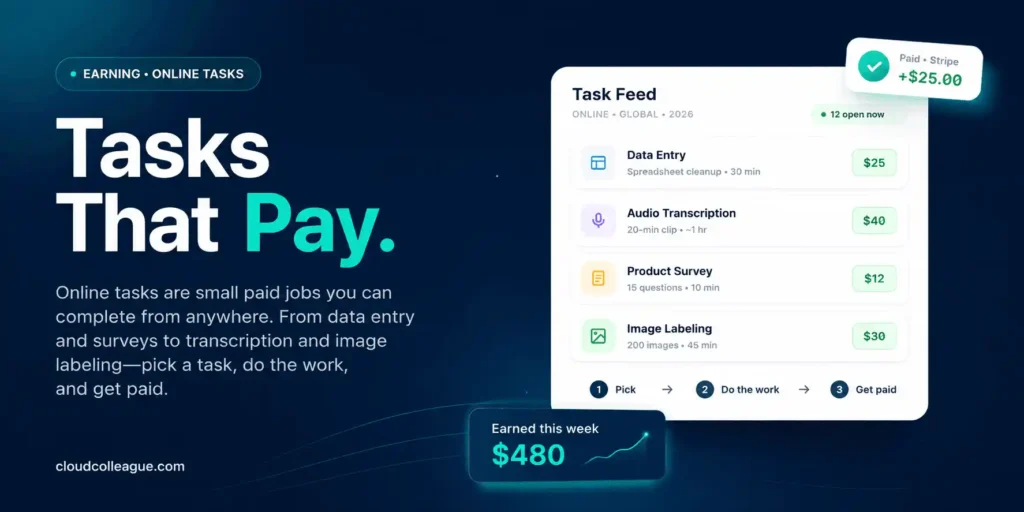
There are dozens of types of online tasks you can do to earn money in Australia, from quick data entry to skilled removals and design. This guide sorts them into a clear, skimmable catalogue, so you can match tasks to your skills, your available time, and your target income. Every category includes indicative AUD pay so you can see where the real money sits.
We focus on genuine, market-priced tasks rather than low-value survey work. To keep it practical, the tasks are grouped into four families. Use the overview table first to scan the whole landscape, then dive into the family that fits you best. By the end, you will know which task types to start with and which to grow into.
| QUICK ANSWER: You can do dozens of types of online tasks to earn money in Australia, grouped into four families: admin and data tasks, creative and digital tasks, home and trade tasks, and errand and delivery tasks. Entry tasks like cleaning and assembly are easiest to start, while skilled tasks like design, web work, and licensed trades pay the most per hour. |
Types of Online Tasks (Quick Overview Table)
The master table below lists the most in-demand task types in Australia, with skill level, indicative pay, and demand. Australian marketplace data consistently ranks handywork, removals, assembly, cleaning, gardening, data entry, and delivery among the most posted tasks, so those carry the steadiest demand and the fastest path to your first reviews.
| Task type | Skill level | Indicative AUD pay | Demand |
| End-of-lease cleaning | Entry | $120 to $350 | Very high |
| Furniture assembly | Entry | $40 to $120 | High |
| Removals and delivery | Entry to mid | $150 to $450 | High |
| Gardening and lawns | Entry | $60 to $200 | High |
| Handyman and repairs | Mid | $80 to $250 | High |
| Painting | Mid | $200 to $800 | Medium |
| Data entry | Entry | $25 to $45 / hr | Medium |
| Virtual assistant | Mid | $30 to $55 / hr | Medium |
| Bookkeeping support | Skilled | $40 to $70 / hr | Medium |
| Writing and editing | Skilled | $50 to $120 / hr | Medium |
| Graphic design | Skilled | $80 to $400 | Medium |
| Basic video editing | Skilled | $100 to $500 | Growing |
| Web and tech fixes | Skilled | $60 to $150 / hr | Growing |
| Pick-ups and errands | Entry | $20 to $80 | Medium |
| Shopping and queueing | Entry | $25 to $90 | Medium |
Figures are indicative ranges for taskers in Australia. Pay rises with skill, ratings, location, and urgency, so treat these as starting points rather than ceilings. Notice that the highest hourly rates sit with scarce skills, while the highest volume sits with everyday home tasks.
Admin and Data Tasks
Screen-based tasks let you earn from home with just a laptop. They reward accuracy and clear communication, and they carry a hidden advantage: they convert to repeat work more often than one-off physical jobs. A business that trusts your output this month tends to send more next month.
Data entry tasks
Data entry covers spreadsheet clean-ups, form processing, and transcription. It needs care and speed rather than formal qualifications, which makes it a popular entry point. Typical pay runs $25 to $45 an hour depending on volume and complexity.
Accuracy is everything here, because one trusted job often leads to a steady stream. A simple habit of double-checking totals and flagging anything unclear marks you as reliable, and reliability is what turns a one-off client into a regular.
Research and lead lists
Businesses pay for contact lists, market research, and competitor scans. These tasks suit detail-focused workers who can verify sources properly. Clear, well-organised output wins repeat clients fast.
Adding a short summary at the top of your deliverable sets you apart from taskers who simply hand over raw data. That small extra step often justifies a higher rate and earns the next job without rebidding.
Virtual assistant tasks
Virtual assistants handle inboxes, scheduling, and light admin in blocks of hours. Reliability is everything, so strong communication lifts both your ratings and your rate, often to $30 to $55 an hour.
VA work is one of the most dependable routes to ongoing, repeat income, because a business that hands over its inbox rarely wants to retrain someone new. Once you are trusted, the work tends to recur week after week.
Creative and Digital Tasks
Skilled digital tasks pay the most per hour, because fewer people can deliver them well. If you have a creative skill, this is where your effective rate climbs fastest, and where a sharp portfolio matters more than any certificate.
Writing and editing
Articles, product descriptions, and proofreading are in steady demand. Niche expertise, such as finance, legal, or trades writing, commands premium rates. A clear portfolio shortens the path to higher-paying clients.
A quick, relevant writing sample often wins the work outright, because clients can judge quality instantly. Specialising in one or two industries lets you charge more and write faster, since you already know the language.
Design and basic video
Logos, social packs, and short video edits sell well to small businesses. These tasks reward a tight turnaround and a strong portfolio.
Packaged offers, such as a five-asset social bundle or a logo plus brand colours, raise your value per task and make you easier to hire than a per-hour designer. Clear deliverables also reduce revisions, which protects your effective rate.
Simple web and tech tasks
Small website fixes, plugin setups, and landing-page tweaks suit anyone with light technical skills. Demand is growing as more local businesses move online, and trust-based repeat work is common.
A single reliable fix often turns into an ongoing maintenance arrangement, because business owners would rather keep a trusted helper than search for a new one each time something breaks.
| Wondering which tasks are available right now? Explore live tasks across Australia to see what employers are posting, compare different categories, and find the work that best matches your skills and schedule. |
Home, Trade and Local Tasks
These in-person tasks form the backbone of the Australian task economy, because every household generates them. They suit practical, reliable taskers, and licensed trades earn well above entry rates. This family is also the fastest route to your first reviews.
Cleaning and gardening
End-of-lease cleans, regular tidies, lawns, and hedges are posted constantly. They need stamina and attention to detail rather than certificates. End-of-lease cleans pay strongly because the stakes for renters are high.
A spotless result often earns a glowing review and a referral, which matters because cleaning has strong repeat potential. Many clients want a fortnightly or monthly tidy, turning a single job into steady income.
Furniture assembly and removals
Flat-pack assembly and small moves are high-volume, entry-friendly tasks. A trailer or van and a second pair of hands open up the better-paid removal jobs.
Assembly in particular is ideal for beginners, since the work is quick, the demand never stops, and the tools required are minimal. Building speed on common flat-pack ranges lets you raise your effective hourly rate fast.
Handyman and repairs
Mounting, patching, and minor repairs reward practical skill and the right tools. Holding relevant licences lets you take on higher-value, regulated work safely and legally.
Reliable handymen build repeat clients quickly, because most households keep a running list of small jobs. One good visit often leads to a call-back for the next three things on that list.
Errand and Delivery Tasks
Errand tasks fill the gap between delivery apps and personal favours. They pay modestly each, but they stack well when you batch several into one efficient trip.
Pick-ups and drop-offs
Collecting parcels, marketplace items, or documents suits anyone with a vehicle and spare time. Plan an efficient route to lift your earnings per hour, and group nearby jobs to cut dead travel time between them.
Shopping and queueing
Grocery runs, click-and-collect, and queueing for releases are simple, flexible tasks. They are ideal first jobs while you build ratings, and they require almost no setup beyond reliability and good communication.
How to Choose Your First Task Type
With so many options, the trick is to start narrow. Choose one task type that matches a skill or tool you already have, then expand once your reviews build. Use this simple test to decide.
- What can I already do well today, with no training?
- What tools, vehicle, or software do I already own?
- Which of those tasks post often in my city?
- Which one could become repeat work, not just one-off?
The task type that scores well on all four is your best starting lane. Win a few, earn five-star reviews, then layer in a higher-value skill to lift your average rate.
Read Next: How to Earn Money Doing Tasks in Australia
Seasonal and Local Demand in Australia
Demand shifts through the year, and knowing the pattern helps you plan. Gardening and outdoor tasks peak in spring and early summer. Cleaning and removals rise around lease turnover periods and the new year. Admin and digital tasks stay steadier across the calendar, which makes them a useful counterbalance to seasonal physical work.
Location matters too. Sydney and Melbourne offer the deepest task pools and higher rates, Brisbane is growing with less competition, and regional areas have fewer postings but often less rivalry for each one. Pairing a seasonal physical category with a year-round digital skill smooths your income.
Which Task Type Pays the Most?
Skilled digital and trade tasks pay the most per hour, while entry tasks pay the most per attempt early on, because they are easy to win. The shortlist below splits the two so you can choose a lane that matches your goal.
| Goal | Best task types | Why |
| Highest hourly pay | Design, writing, web, licensed trades | Scarce skills, premium rates |
| Fastest to start | Cleaning, assembly, errands, data entry | Low barrier, high volume |
| Best repeat income | Virtual assistant, bookkeeping, regular cleans | Ongoing client relationships |
| Most flexible | Errands, delivery, shopping | Fit around any schedule |
Skill vs speed vs demand
Three levers set your income: how scarce your skill is, how fast you complete tasks, and how much demand exists for the work. The sweet spot pairs a skill you can deliver quickly with a category that posts often. That combination keeps your calendar full and your rate high at the same time.
How to pick your lane
Start with what you can already do well, then add one higher-value skill over time. Specializing lifts ratings and rates faster than spreading yourself thin across every category. Pick one or two lanes, own them, and let your reviews compound.
| Found the task type that’s right for you? Start as a Seeker for free, create your profile, apply for real tasks and projects, and begin building the reviews that lead to higher-paying opportunities. |
Frequently Asked Questions
You can do admin and data tasks, creative and digital work, home and trade jobs, and errands. Popular options include cleaning, furniture assembly, data entry, virtual assistance, design, and delivery. The best fit depends on your skills, your tools, and how much you want to earn per hour.
Data entry tasks involve typing, organizing, or cleaning information, such as spreadsheets, forms, or transcriptions. They need accuracy and speed rather than formal qualifications, which makes them a popular entry point. In Australia, data entry typically pays $25 to $45 an hour depending on volume and complexity.
Skilled digital and licensed trade tasks pay the most per hour, including design, writing, web work, and regulated repairs. Larger in-person tasks like painting and removals also pay well per job. Scarcity and accountability drive these higher rates, so building a niche skill lifts your income fastest.
Beginners can start with cleaning, furniture assembly, gardening, errands, and basic data entry. These tasks have a low barrier to entry and post frequently, so they are easy to win without experience. Completing them reliably builds the ratings that unlock higher-paying work over time.
Yes, and many taskers do. A common strategy pairs one steady physical category, such as cleaning or assembly, with one growing digital skill, such as design or web fixes. This mix protects your income across seasons and reduces your exposure to competition in any single category.
Digital micro-projects are rising fastest, including short-form video editing, basic web fixes, and content clean-up, as small businesses move more activity online. Home and trade tasks stay resilient too, because households increasingly outsource one-off jobs rather than buy tools they will use once. Pairing both is a smart hedge.