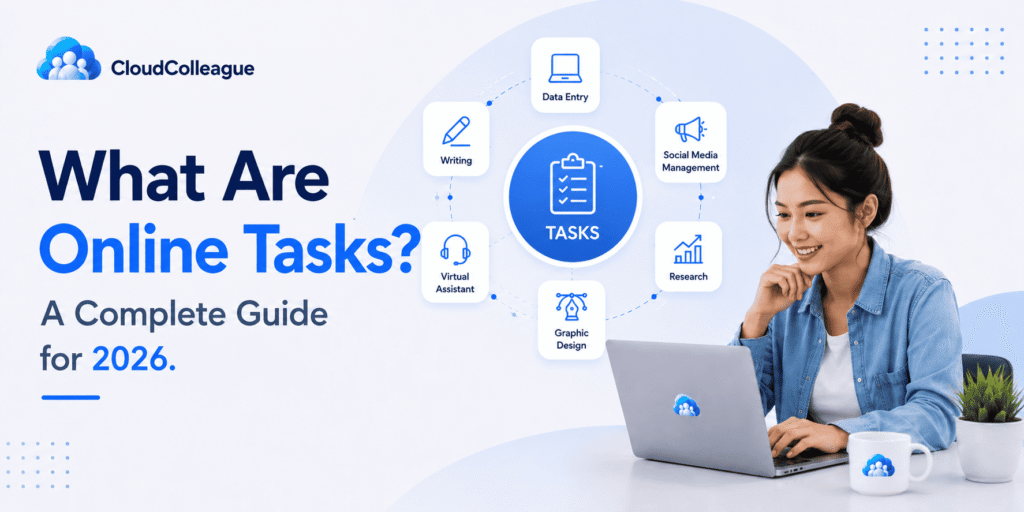
Online tasks sound like one of those internet trends that’s too good to be true. Every day, people see ads promising flexible income, work-from-home opportunities, and quick cash from a laptop or phone. Most of it gets ignored. But behind the hype, a growing number of Australians are genuinely making money through small remote jobs and digital gig work without committing to a second traditional job.
Rather than sitting through interviews or locking into fixed schedules, people are signing up to task platforms, picking up short-term work, and getting paid to complete simple online jobs. These can include admin support, research, writing, customer service, data entry, and other freelance-style tasks businesses need help with.
The issue is that almost no one explains how tasks actually works. Most articles either dump a list of websites at you or repeat the same vague “earn from home” pitch. This guide does neither. It walks you through what online tasks really are, who pays for them, what you can realistically earn, and whether the work is worth your time. By the end, you’ll know enough to decide for yourself, which is the whole point.
| Ready to take on online tasks? Create a free profile on CloudColleague and browse tasks to start your journey. |
So, What Is an Online Task, Exactly?
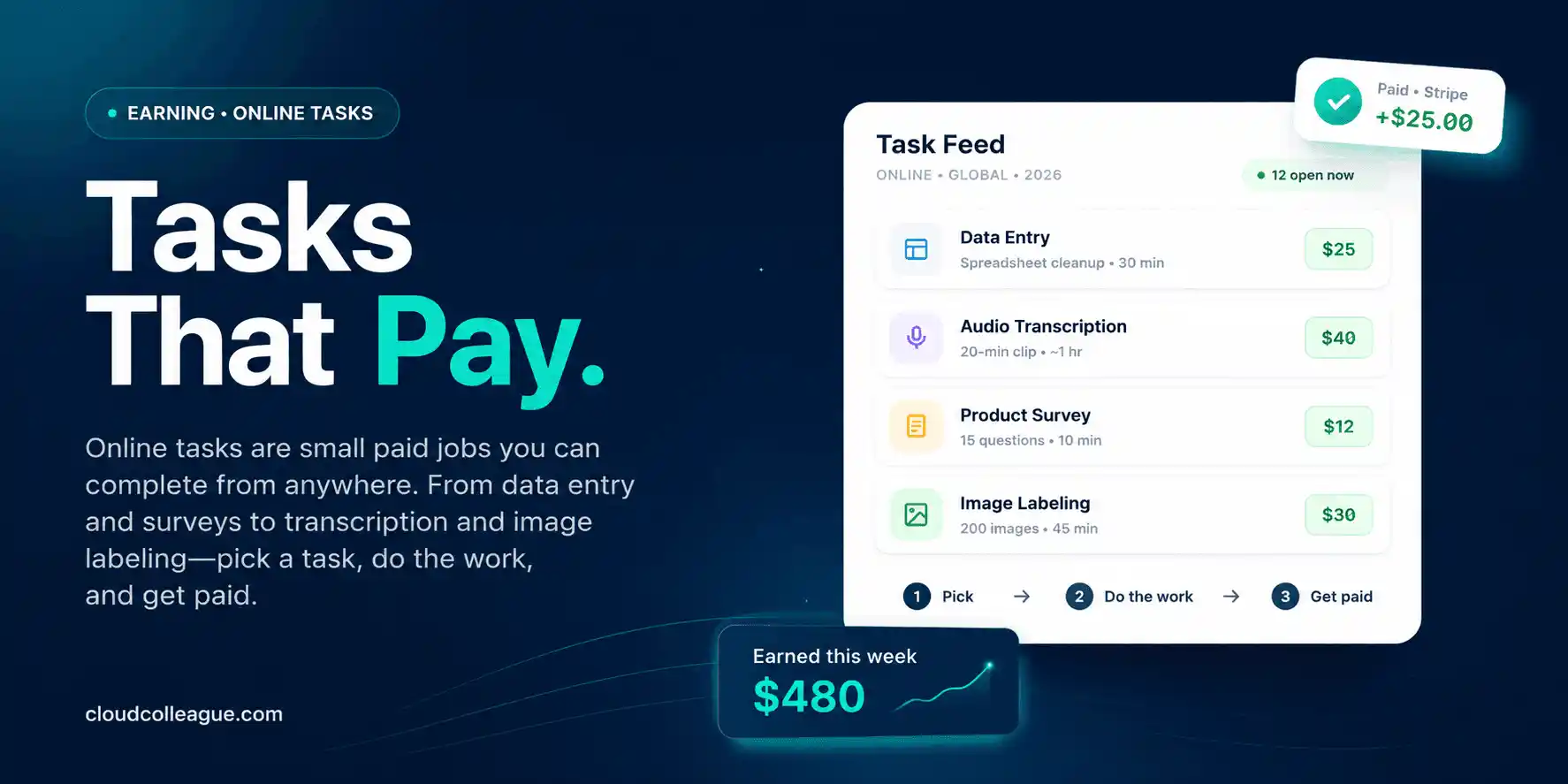
An online task is a small, clearly defined piece of digital work that you finish remotely in exchange for a fixed reward. The job is broken into the smallest practical unit, usually completed in seconds, minutes, or at most an hour. The pay is shown before you start. There’s no negotiating, no scope creep, no client emails to chase.
You’ll hear them called by a few different names depending on where you’re reading. Microtasks are the most common. Microjobs turn up a lot too. The label changes; the idea doesn’t. It’s a unit of work too small to advertise as a freelance gig but too nuanced to leave to a machine.
Here’s where people often get tangled up. An online task is not the same as a freelance project, where you negotiate scope and deliver custom work over weeks. It’s not the same as a survey, where you’re paid for your opinion rather than completed work. And it’s not a traditional remote job with set hours and a manager. Online tasks sit deliberately below all three. That’s the appeal, and also the limitation.
Read Next: How to Bid on Tasks and Actually Win? A Guide for Australian Freelancers in 2026.
How the System Actually Works Behind the Scenes?
To understand whether online tasks are worth your time, it helps to see the four moving parts that make the whole thing run. Most guides skip this bit, which is why so many people end up confused or burned.
The requester is the company that needs the work done. This might be Google needing search results rated, Meta moderating flagged content, a Sydney startup needing product images sorted into categories, or a research lab needing audio transcribed to train a machine learning model.
The platform is the middleman. It’s the website or app that connects requesters to workers, distributes the tasks, manages quality control, and handles payments. Names you’ll come across include CloudColleague for both job and tasks, Amazon Mechanical Turk, Clickworker, Toloka, Appen, Remotasks, and Airtasker for the more local, in-person side of things.
The worker is you. You sign up, fill in a profile, sometimes pass a short qualification test, and gain access to a feed of available work.
The payout is the agreed reward, almost always shown upfront. It might be a few cents for tagging an image, a couple of dollars for testing an app, or significantly more for skilled work like medical transcription or multilingual evaluation.
That four-part system is the entire model. Whether the platform is based in Brisbane, Berlin, or Bangalore, it runs on some version of this structure. When something feels off about a site, it’s almost always because one of these four pieces is missing or out of place.
Why Do Companies Even Pay for This Work?
You might be wondering why any business would split work into tiny pieces and pay strangers around the world to do it. The answer matters, because it tells you whether the work is actually legitimate or just a clever way to extract free labour.
The biggest driver right now is artificial intelligence training. Every large language model, every image recognition system, every self-driving car algorithm needs huge volumes of human-labelled data to learn from. A model can’t tell a kangaroo from a wallaby until thousands of humans have looked at thousands of photos and confirmed which is which. According to Mordor Intelligence, the global micro-tasking market was worth around USD 5.66 billion in 2024, and demand keeps climbing as AI keeps growing.
Beyond AI, requesters use online tasks for content moderation, search quality evaluation, localisation and translation, app testing, product listing checks, and market research. The thread running through all of it is the same. These tasks need human judgement, and they need it at a scale no in-house team could handle alone. That’s the gap online task workers fill. You’re not doing busywork. You’re doing the parts of the modern internet that machines genuinely can’t do on their own yet.
The Main Types of Online Tasks You’ll Run Into
Rather than listing every platform under the sun, it’s more useful to think about online tasks by what the work actually involves. Most of what you’ll come across falls into five broad buckets.
Data labelling and annotation is the largest category by volume. You might draw boxes around pedestrians in dashcam footage, tag objects in product photos, classify the sentiment of a tweet, or transcribe a snippet of audio. This work feeds straight into AI training pipelines.
Content tasks involve creating or editing short pieces of written, audio, or video content. Writing product descriptions, transcribing interviews, translating short paragraphs, and proofreading machine-generated text all sit in this category.
Evaluation tasks ask you to judge the quality of something. Search engine raters, app testers, and user-experience reviewers all do evaluation work. These tasks usually pay better than pure data labelling because they need more context and judgement.
Engagement tasks include surveys, product reviews, polls, and short user-research interviews. The pay is modest, but the work is genuinely simple and the entry barrier is almost nothing.
Capture tasks are a newer category. You use your phone to record short videos or photos of real-world activities, like folding laundry, walking through a Coles aisle, or recording specific phrases in your accent. AI companies use this footage to train models on real human behaviour, and Australian accents are actually in steady demand.
You don’t need to specialise. Most workers drift between categories depending on what’s available and what pays well that week.
| Online tasks can be started from anywhere. Start as a Seeker on CloudColleague, learn how bidding works and start earning rom day 1. |
What You Can Realistically Earn?
This is where I’ll be straight with you, because too many articles aren’t.
Online tasks pay in three common ways. Per-task pricing is the most familiar. You see the reward, finish the task, the money lands in your balance. Hourly pricing shows up on more skilled platforms where the work is harder to break into discrete units, like long-form transcription or app testing sessions. Tiered pricing rewards workers who maintain accuracy, hit volume thresholds, or qualify for premium task pools.
Most platforms have a payout threshold, the minimum balance you need to reach before withdrawing. This might be $5, $10, or $50 depending on the platform and how you’re getting paid. PayPal, Payoneer, and direct bank transfer are the common options for Australian workers. A few newer platforms also pay in cryptocurrency.
So what do people actually earn? Realistic hourly earnings on most platforms sit somewhere between $0.50 and $15 per hour, with the wide gap explained by skill level, task availability, and how selective you are. Specialised work, especially AI training tasks for workers who pass advanced qualification tests, can pay considerably more.
For broader context, Australia has one of the fastest-growing gig economies in the world, with a CAGR of 18.9% according to data compiled by DemandSage. The global gig economy is now valued at roughly USD 674 billion in 2026 and projected to keep climbing. Online tasks are a small but rapidly expanding slice of all of that.
The honest takeaway is this. Online tasks are great for supplemental income, building digital work habits, or earning during life stages where flexibility matters more than maximum pay. They’re not a path to replacing a full-time salary unless you commit serious hours and qualify for the higher-paying task pools.
What You Need to Get Started?
You don’t need a degree, a portfolio, or any prior experience. You do need a small handful of practical things in place.
A stable internet connection matters more than people realise. Plenty of tasks time out if your connection drops mid-submission, and lost work usually means lost pay. A reliable device is next. A laptop or desktop works best for most platforms, though some run smoothly on mobile. A working microphone helps if you’re keen on app testing or audio tasks.
You’ll also need a payment method that the platform supports. PayPal is the most common globally. Payoneer is widely used for cross-border payments and is popular with Australian workers earning in USD. Some local platforms also support direct bank transfer.
Two soft skills quietly separate the workers who earn consistently from those who don’t. The first is strong reading comprehension, because online tasks live and die by the brief. Misread one line of instructions and your work gets rejected, no pay. The second is English at a comfortable working level, since most high-paying tasks are in English, though Mandarin, Spanish, French, Arabic, and several Indic languages also have steady demand.
That’s the whole setup. No course. No subscription. And No upfront payment to anyone. If a platform asks for one, that’s your cue to walk away.
Online Tasks Versus Freelancing Versus Surveys
A lot of people show up expecting one thing and finding another. Here’s how the three categories actually differ.
Freelancing is project-based. Think Upwork, Fiverr, or any platform where you market yourself, negotiate scope, build client relationships, and handle larger sums per engagement. The earning ceiling is much higher, but so is the effort to get started.
Online tasks are task-based. The platform finds the work for you. The trade-off is lower per-unit pay in exchange for zero client management, instant availability, and no need to specialise.
Paid surveys are opinion-for-pay. You’re not producing work, you’re providing data points. The pay is generally lowest, but so is the cognitive load.
A useful way to think about it: freelancing rewards expertise, online tasks reward consistency and speed, and surveys reward time spent. Pick the one that matches what you actually have spare to give.
Red Flags Worth Spotting Before You Sign Up
The online task space has more legitimate platforms than scams, but the scams are aggressive enough that you should know what to watch for.
Upfront fees are the clearest red flag. No legitimate platform charges you to access tasks. If a site asks for a registration fee, training payment, or membership unlock, close the tab.
Earnings claims that don’t add up. Anyone promising hundreds of dollars a day for unskilled task work is either lying or selling a course. The realistic ranges are public information.
Vague or shifting task instructions paired with high rejection rates. Legitimate platforms write clear briefs because clear briefs get clean data. Confusing instructions and a pattern of rejected work usually means the platform is harvesting free labour.
Withheld payouts. Look for transparent thresholds, predictable processing times, and verifiable user reviews. Reddit’s r/beermoney community and Trustpilot are useful starting points.
Excessive personal data requests. A payment email is normal. Bank login details, government ID before you’ve earned a cent, or social media passwords are not.
Mirror sites. “Amazon Mechanical Turk Pro” and “Clickworker Premium” are not real. Always go to the platform via its official URL.
This is also part of why dedicated Australian job and task marketplaces, including platforms like CloudColleague, exist in the first place. A trusted local marketplace cuts down the noise and gives you a verified place to start, rather than gambling on whichever site ranks first on Google.
Who This Actually Suits?
Online tasks aren’t for everyone, and pretending otherwise wastes your time. They tend to suit:
Students looking for flexible income that fits around classes and exam periods. Low commitment means you can step away for a fortnight without consequence.
Stay-at-home parents who need work that fits into unpredictable five and ten-minute windows during the day.
Australians on working holiday visas or new arrivals who want a low-risk way to start earning while they sort out longer-term work and get familiar with the local job market.
People exploring digital work for the first time who want to build confidence with online platforms before committing to bigger paths like freelancing or remote employment.
Workers with disabilities or chronic health conditions for whom traditional schedules don’t suit, and who benefit from full control over hours and intensity.
Online tasks are not well-suited for anyone hoping to replace a full-time salary quickly, build a long-term career path, or earn predictable monthly income. The work is real, but the ceiling is real too.
Where Online Tasks Sit in the Bigger Picture?
Step back, and online tasks are one branch of a much bigger shift. The global gig economy is on track to reach USD 2.5 trillion by 2035 according to forecasts from Business Research Insights. Around 435 million people now do some form of gig work worldwide. The World Bank has documented that demand for online gig work grew by roughly 41% between 2016 and early 2023, and the rise of generative AI has accelerated that even further, since every new model needs human-labelled data to learn from.
What this means for you is simple. Online tasks aren’t a fad, and the work isn’t going to disappear. The categories will keep shifting. Simpler tasks will increasingly be automated, while AI validation, multimodal annotation, and culturally specific evaluation work will keep growing. Workers who treat task platforms as a stepping stone, using them to build digital fluency before moving into adjacent work like freelance annotation, remote QA, or specialised AI training contracts, tend to get the most lasting value out of them.
Where to Go From Here?
Before you sign up to anything, sit with three questions.
How much spare time do you genuinely have each week, and is it in chunks or scattered minutes? Online tasks reward the second pattern. Freelancing rewards the first.
Are you looking for supplemental income, skill-building, or something closer to a primary earning path? Tasks suit the first two well, and the third only with serious commitment.
What’s your tolerance for inconsistency? Task availability fluctuates. Some weeks are flush, some are quiet. If you need predictable income to cover essentials, factor that in.
If your answers point you toward online tasks, the next step is choosing where to start, and that part matters more than people give it credit for. Australian-focused marketplaces like CloudColleague are built specifically to connect local workers with verified task and job opportunities, which removes a lot of the guesswork that comes with global platforms. With only 7% commission on tasks, the task performers get more money than on any other platform. Wherever you start, take your time. Sign up to one or two platforms, not ten in an afternoon. Read the briefs carefully. Build a track record. The workers who do well at this aren’t the ones who rush in. They’re the ones who treat it like real work, because that’s exactly what it is.
Online tasks won’t make you rich. But if you take them seriously, they’ll give you a flexible, legitimate way to earn alongside everything else in your life, and a quiet front-row seat to the human labour that keeps the modern internet running.
Frequently Asked Questions
An online task is a small piece of digital work you complete remotely for a fixed reward, like tagging images, transcribing audio, or rating search results. Most take seconds to an hour, and the pay is shown upfront.
Most workers earn between $0.50 and $15 per hour, depending on the platform and task type. Specialised AI training work pays more; basic surveys pay less.
Yes, when done through verified platforms like Amazon Mechanical Turk, Clickworker, Appen, and Toloka. Avoid any site that charges an upfront fee or promises unrealistic earnings.
No experience or degree is needed. You just need stable internet, a device, a payment method like PayPal or Payoneer, and the ability to follow instructions carefully.
Online tasks are small, pre-assigned jobs with fixed pay. Freelancing is project-based work where you find clients, negotiate scope, and earn more per job but with greater effort.