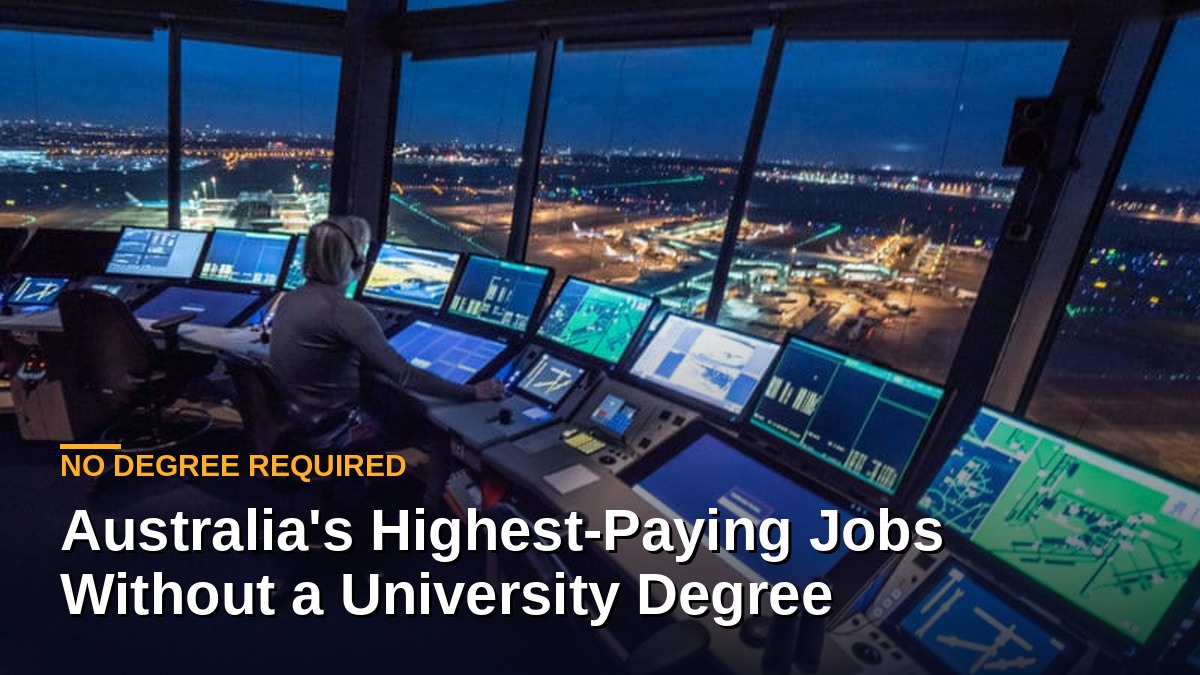
Air traffic control is the highest paying career in Australia open without a university degree. Airservices Australia requires only Year 12 or a diploma-level qualification, pays trainees throughout training, and endorsed controllers earn well above the national full-time average of $106,700 a year (ABS, November 2025).
This guide sets out the highest paying jobs in Australia without a degree, what each one actually requires, what the government shortage data says about how long the demand will last, and where to start depending on whether you are leaving school, changing careers in your thirties or forties, or newly arrived in Australia. For the wider national picture across every category, our Australian salary guide hub is the best starting point.
Why every “highest paying job without a degree” list gives a different answer
There is no official table published by the Australian Bureau of Statistics or the Australian Taxation Office called “highest paying job without a degree”. Every ranking you read online invents its own definition. Most do not say so. Here are the three defensible definitions, and the different winner each one produces.
| How you measure it | The winner | Why |
| Highest realistic ceiling in a structured career you can enter from Year 12. | Air traffic controller | Entry needs Year 12 or a diploma. Training is paid. Senior controllers sit at the top of the non-degree pay range. |
| Highest average salary on live job advertisements. | Shotfirer (drill and blast) | SEEK advertised averages sit between $135,000 and $155,000 in 2026, above most other non-degree roles. |
| Highest total package once rosters and allowances are counted. | FIFO mining specialists and supervisors | Mining is the highest paid industry in Australia on ABS earnings data, before overtime and site allowances. |
So, the honest position is this. Air traffic control has the highest structured ceiling. Shot firing currently has the highest advertised average. Mining has the highest total package once you add rosters. All three are correct answers to slightly different questions, and knowing which question you are asking is what turns a list into a decision. If you want the ranking that includes degree-required professions alongside these, see our guide to the highest salary jobs in Australia.
One data warning worth knowing. If you look up air traffic controller salaries on job boards, you will often see a figure in the $50,000 to $70,000 range. That number is not wrong, but it is misleading. Airservices Australia recruit trainees in intakes, so the pool of live advertisements is dominated by trainee roles rather than endorsed controllers. The advertised average reflects who is being hired right now, not what the job pays once you are licensed.
Air traffic controller: the highest ceiling you can reach without a degree
Air traffic controllers’ separate aircraft in Australian airspace and at airports. It is one of the most cognitively demanding jobs in the country, and the entry requirements have nothing to do with university.
What Airservices Australia actually requires
- Residency eligibility, plus an educational minimum of a Year 12 certificate or equivalent, or a tertiary qualification at diploma level
- Strong spatial awareness and solid mathematical ability, tested through psychometric assessment
- Medical clearance and security checks
There is no requirement for a bachelor degree at any stage. That is unusual for a role at this pay level, and it is why the job keeps appearing at the top of these lists.
How the pathway works?
Successful applicants become trainees and are paid while they train. Training runs for approximately 12 months at Airservices facilities in Melbourne, delivered face to face across theory and simulator work, and leads to the AVI50115 Diploma of Aviation (Air Traffic Control). On-the-job training follows and its length varies. The Civil Aviation Safety Authority issues the licence at the end.
Two things make this financially unusual. You are not paying tuition, so you finish with no HECS-HELP debt attached to the qualification. And you are earning throughout, rather than deferring income for three or four years. Over a decade, that gap compounds in a way that a headline salary comparison does not show.
The honest trade-offs
- Selection is genuinely competitive, and a meaningful share of applicants do not pass the aptitude testing
- Postings are assigned by operational need, so your first location may not be your preference
- The work is shift-based, including nights and weekends, which is where the shift loadings come from
- There is no partial credit. If you do not complete training, the qualification does not transfer easily to another industry
Mining and drill and blast: where the advertised averages actually peak
If you rank purely by what employers are advertising today, mining specialists come out on top. Mining is also the highest paid industry in Australia on ABS average weekly earnings, ahead of every other sector.
| Role | SEEK advertised average (2026) | Typical entry route |
| Shotfirer (drill and blast) | $135,000 to $155,000 | Shotfirer licence, explosives handling tickets, site experience first |
| Driller | $115,000 to $135,000 | Start as a driller’s offsider, often through advertised traineeships |
| Excavator and heavy plant operator | $115,000 to $135,000 | High risk work licence and machine tickets, plus verified site hours |
| Train driver (including rail freight and mine rail) | $115,000 to $135,000 | Employer-run training programs, medical and safeworking certification |
A shotfirer designs, loads and detonates production blasts. It is a licensed role, the licensing is state-based, and nobody walks into it from outside the industry. The realistic path is to start in a general mining or drilling role, build verified site hours, then move into drill and blast. Driller’s offsider traineeships that advertise “no prior experience needed” are the most common genuine entry point, and they appear regularly on job boards in Western Australia, Queensland and increasingly in Victoria and New South Wales.
Pay in mining also varies sharply by the specific job title rather than by the industry as a whole, which is why an industry average is a poor planning tool. Our breakdown of salary by job role in Australia shows how far apart two roles on the same site can sit.
What the salary figures do not tell you?
- Rosters are the reason the pay is high. Fly-in fly-out patterns such as 8 days on and 6 off, or 2 weeks on and 1 off, are standard
- Time away from family is the real cost, and it is the most common reason people leave the sector rather than the work itself
- Commodity cycles affect hiring. Mining pay is strong now, but it is not a flat line across decades
- Advertised salaries sometimes include superannuation and sometimes do not, so always confirm before comparing offers
Licensed trades: the most durable high income without a degree
Licensed trades rarely top a single-number ranking, but across a working life they are arguably the strongest option on this list, for one reason: the shortage is structural rather than cyclical.
Jobs and Skills Australia found in its 2025 Occupation Shortage List that nearly half of all trade roles remain in national shortage. Electrical, plumbing, refrigeration and mechanical trades sit in that group. Lift and escalator mechanics, a smaller and heavily licensed trade, consistently sit near the top of trade pay because the licensing barrier is high and the workforce is small.
The trade pathway also has something none of the other options on this page offer, which is the ability to become the employer. A licensed tradesperson can contract independently, take on apprentices and build a business. That step, rather than the wage itself, is where trade income moves well past the six-figure mark.
The trade-off is time. An apprenticeship typically runs three to four years on a reduced wage before you reach the full licensed rate. The income curve starts lower and ends higher, which is the opposite shape to mining. Our entry level salary guide sets out what the apprenticeship years actually pay before you qualify, which is the number most people underestimate.
Commission and sales roles: uncapped income, but not guaranteed income
Real estate sales, medical device sales, recruitment and business-to-business software sales are all open without a degree, and all appear on high earner lists. They belong in a separate category, because the structure is different.
These roles usually pay a modest base plus uncapped commission. The published figures for top performers are real, and so is the fact that they describe top performers. Median earnings in commission-heavy fields sit far below the headline numbers, and income varies sharply year to year with market conditions. Real estate agent registration is a short state-based course, so entry is fast, but the first 12 months are commonly the hardest financially.
If you have savings to absorb a slow start and you genuinely enjoy selling, the ceiling is high. If you need predictable income from month one, this is the wrong category, whatever the advertised numbers say.
Which of these jobs will still be in demand? What the shortage data says?
A high salary today matters less than whether the role still exists and still pays well in ten years. Australia publishes the data that answers this, and it is worth more than any salary table.
The Jobs and Skills Australia 2025 Occupation Shortage List found that 29 per cent of assessed occupations were in national shortage, or 293 out of 1,022. That figure is down from 33 per cent in 2024 and 36 per cent in 2023, so the labour market has loosened overall. Shortages have not eased evenly, though.
- Nearly half of all trade roles remain in shortage, alongside two in five professional occupations
- Twenty-one occupations are in shortage in regional Australia only, which is where willingness to relocate becomes worth real money
- The national vacancy fill rate reached 70.7 per cent in December 2025, but for Skill Level 3 occupations, the band that covers most trade and technical roles, it sat at just 54.5 per cent
That last figure is the most useful number in this entire article. It means employers are still failing to fill roughly one in two trade-level vacancies. Pay pressure follows unfilled vacancies. If you want a single indicator of where non-degree income holds up, that is it.
One technical note for anyone tracking this data over time: Jobs and Skills Australia is moving from the ANZSCO classification to OSCA, with new occupation profiles due from mid-2026, so older occupation pages will not be updated.
What “no degree” actually means in Australia?
This is where a lot of advice quietly misleads people. None of the jobs above require a university degree. Almost all of them require a qualification of some kind.
| What it is | What it involves | Examples on this page |
| Licence or ticket | Short course plus assessment, often days or weeks | White Card, high risk work licence, real estate registration |
| Certificate III or IV | One to four years, often as a paid apprenticeship | Electrical, plumbing, carpentry, refrigeration |
| Diploma | Around 12 to 18 months, sometimes employer-funded | AVI50115 Diploma of Aviation (Air Traffic Control) |
| Verified site experience | Logged hours under supervision, no classroom | Shotfirer, driller, heavy plant operator |
So the accurate framing is not “no study”. It is “no university degree, no tuition debt, and you earn while you qualify”. That is a genuinely different proposition, and a better one for many people, but it is not the same as skipping training.
Why a university or college degree still matters for higher salaries?
The roles above prove you do not need a degree to earn well in Australia. What a degree changes is which ceilings exist at all, and that is worth understanding before you rule it out.
The very top of the income distribution is degree-gated. ATO Taxation Statistics for 2023 to 2024 place surgeons at the top of the occupation table with an average taxable income of $519,998, a position they have held for 15 consecutive years. Medicine, dentistry, law and specialist engineering sit in a band that no licensed trade pathway reaches. That is not employer preference, it is regulation. Those professions legally require registered qualifications.
Graduate salaries also start near the national average and climb from there. The 2025 Graduate Outcomes Survey, released in June 2026, put the median full-time salary for recent undergraduates at $76,700 for non-Indigenous graduates and $80,600 for First Nations graduates, within four to six months of finishing. The starting figure is not the point. The trajectory is. The Graduate Outcomes Survey Longitudinal followed the 2022 cohort from 79.5 per cent in full-time work at graduation to 91.7 per cent three years later, a rise of 12.2 percentage points. Note that QILT changed how the labour force is defined in 2025, so year-on-year comparisons need care.
That compounding effect is not unique to graduates, though. Earnings rise steeply with experience across almost every field in Australia, and our guide to salary by experience shows where the biggest jumps happen on both the degree and the non-degree path.
Employers keep rating graduates well, too. The Employer Satisfaction Survey found 85.5 per cent of employers would hire another graduate from the same course and institution, the highest result since the survey began in 2016.
The most important development, though, is that the two pathways are converging. Since 2021, the proportion of students finishing an undergraduate degree and then moving into a certificate-level or advanced diploma course has doubled to 10 per cent. The Australian Tertiary Education Commission has been tasked with developing a Tertiary Roadmap to make movement between vocational education and university easier in both directions.
The practical question in 2026 is not degree or no degree. It is which qualification your target role actually requires, and in what order you acquire it.
Where to start, based on where you are right now?
If you are leaving school or under 21
You have the one advantage nobody else on this page has, which is time. Both the air traffic control intake and a four-year apprenticeship are realistic, and both put you at full earning rate before most of your peers finish university. Apply for the Airservices intake when it opens, because there is no cost to trying and the aptitude testing is the only real gate. In parallel, apply for apprenticeships. Do not wait for one outcome before pursuing the other. Before you compare offers, check what a realistic starting salary looks like in each field.
If you are changing careers in your thirties or forties
Your constraint is usually income continuity rather than ability. That makes the mining and heavy plant pathway more practical than a four-year apprenticeship, because operator roles pay reasonably from early on and traineeships are advertised openly. Start with a White Card and the relevant machine tickets, take a site role, then move toward licensed specialisations like drill and blast once you have verified hours. Also check what your existing experience already qualifies you for, since recognition of prior learning can shorten a certificate significantly. Our guide to how salary moves with experience is useful for working out how long a pay dip would realistically last.
If you have recently arrived in Australia
Three points matter more than the salary tables. First, check the residency conditions attached to any role before investing time, because some employers, including Airservices Australia, apply residency and security requirements at the eligibility stage. Second, if you hold an overseas degree, have it assessed rather than assumed. Many people who believe they need to requalify from scratch do not. Third, look closely at the 21 occupations that are in shortage in regional Australia only. Willingness to work outside a capital city is one of the few genuine advantages available to a new arrival, and it is reflected in both pay and hiring speed.
If you are already working but underpaid
Compare your current role against the shortage list before you change industries entirely. If your occupation sits in shortage, the faster route to higher pay is often a licence or endorsement within the field you already know, not a full restart. A sideways step into a licensed specialisation usually pays better than a fresh start at the bottom of a different ladder. Benchmark yourself first against our salary by job role guide, because plenty of people who feel underpaid turn out to be mid-range and simply need to ask.
Read next
20 highest paying jobs in Australia (2026 salary guide) for the full ranking across degree and non-degree roles.
Salary by experience in Australia for how pay moves from entry level to senior in each field.
Australian salary guide hub for pay benchmarks across every category on Cloud Colleague.
Once you have picked a direction, you can browse live roles and tasks across Australia on Cloud Colleague and see what employers are actually paying for the skills you are building.
Frequently asked questions
Air traffic control is the highest paying career in Australia that does not require a university degree. Air services Australia requires only a Year 12 certificate or a diploma-level qualification, pays trainees during training, and endorsed controllers earn well above the national full-time average of $106,700 a year (ABS, November 2025). On advertised job listings alone, mining shotfirers currently show a higher average, at $135,000 to $155,000.
Yes. Airservices Australia lists the educational eligibility requirement as a completed Year 12 certificate or equivalent, or a tertiary qualification at diploma level or above. Selected applicants are paid while they train toward the AVI50115 Diploma of Aviation (Air Traffic Control), which takes approximately 12 months, followed by on-the-job training and a CASA licence.
Almost always. A university degree is not required, but licensed trades require a Certificate III or IV completed through an apprenticeship, and site roles require licences such as a White Card or a high risk work licence. The difference from university is that apprentices are paid throughout and finish without tuition debt.
Mining. On ABS Average Weekly Earnings data for November 2025, mining recorded the highest full-time average weekly earnings of any industry, well ahead of the all-industries average of $2,051.10 per week, or roughly $106,700 a year.
It depends on the role. Advertised averages on SEEK in 2026 run from about $115,000 for drillers and heavy plant operators to $135,000 to $155,000 for shotfirers. These figures reflect roster loadings and site allowances, and entry-level offsider and traineeship roles start lower.
Overall shortages have eased, but trades have not. The Jobs and Skills Australia 2025 Occupation Shortage List found 29 per cent of assessed occupations in national shortage, down from 36 per cent in 2023. Nearly half of all trade roles remain in shortage, and the vacancy fill rate for Skill Level 3 occupations sat at just 54.5 per cent in December 2025.
For the highest paid occupations, it is required rather than optional. ATO data for 2023 to 2024 shows surgeons at the top of the occupation table with an average taxable income of $519,998, and regulated professions legally require registered qualifications. Recent undergraduates reported a median full-time salary of $76,700 within four to six months of finishing, and full-time employment for the 2022 cohort rose to 91.7 per cent three years after graduation.
Yes, and movement now runs in both directions. Since 2021 the proportion of students completing an undergraduate degree and then entering a certificate-level or advanced diploma course has doubled to 10 per cent. The Australian Tertiary Education Commission is developing a Tertiary Roadmap intended to make transfers between vocational education and university easier.