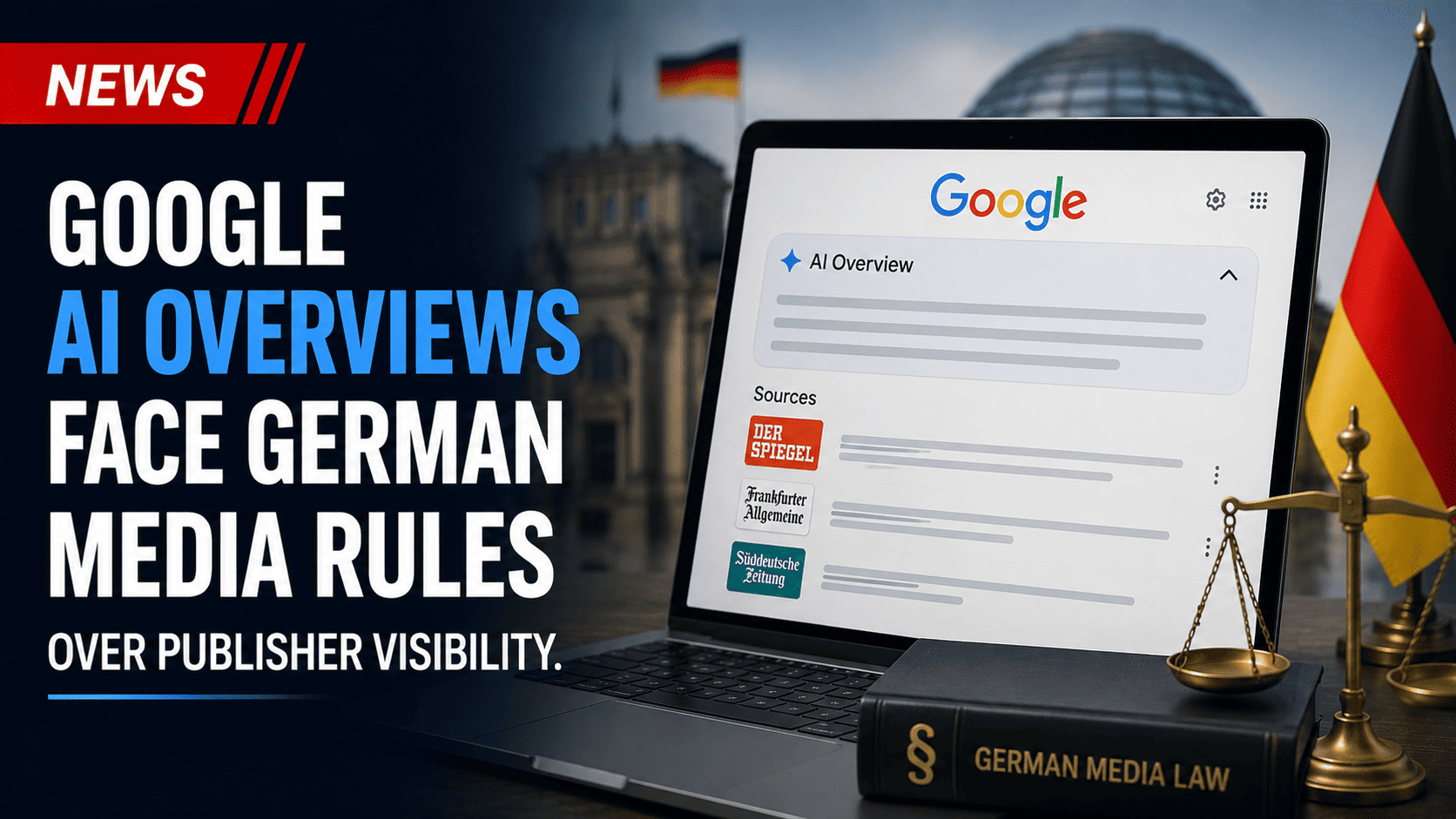
Germany’s Commission for Licensing and Supervision (ZAK), the body that coordinates the country’s 14 state media authorities, announced on 14 July 2026 that Google’s AI Overviews and the AI search engine Perplexity fall under German media law.
The regulator found that AI-generated summaries and chatbot answers count as content created by the providers themselves, not neutral displays of third-party material. It also found that services which select and position links can qualify as media intermediaries. Both companies can appeal. Google confirmed to Reuters it will challenge the decision, arguing the regulator misunderstands how people now search for information.
The finding matters well beyond Germany’s borders. It is one of the first times a national regulator has formally classified AI search output as the provider’s own content, rather than a pass-through of other people’s material. For publishers, website owners, SEO professionals and content teams, it adds a legal dimension to a problem they have felt commercially for two years: AI summaries sitting above search results and reducing the need to click through to the original source.
Search users and AI companies now have a clearer, if still contested, answer to who is responsible when an AI-generated answer is wrong, unfair or drowns out the sites it draws from. For more on how AI regulation is reshaping technology work in 2026, see CloudColleague News.
What Did Germany Decide About Google AI Overviews?
ZAK decided that AI-generated search summaries and chatbot responses are content created by the provider, and that this removes certain liability protections these services previously relied on. The decisions followed investigations by two regional media authorities, Hamburg/Schleswig-Holstein and Berlin-Brandenburg, that began earlier in 2026.
ZAK is the joint supervisory commission of Germany’s state media authorities. It licenses and oversees private broadcasters and online media operating nationally, and its decisions are grounded in the Interstate Media Treaty (Medienstaatsvertrag).
Its reasoning rests on a distinction between simply linking to other websites and generating a new, self-contained answer. According to the regulator, an AI Overview does not just point to sources. It evaluates, compresses and rewrites them into a fresh statement, which makes it the provider’s own expression rather than a reflection of someone else’s page.
Because Google’s AI Overviews are shown prominently above the traditional list of links, and because Perplexity chooses and presents which sources accompany its answers, ZAK concluded both services can influence which media content people actually find. That meets the threshold for a media intermediary under German law. ZAK chairman Thorsten Schmiege said the regulator will now consistently apply German media law to these services. Both Google and Perplexity have the right to challenge the decisions through formal legal channels.
Did Germany Ban Google AI Overviews?
No, Germany has not banned Google AI Overviews. The ZAK decision applies existing media-law obligations, such as transparency and non-discrimination requirements, to AI Overviews and Perplexity. It does not order either product removed from the German market.
Several outcomes are being conflated in early coverage of this story, and it is worth separating them clearly:
- Applying media-law obligations means a service now has to meet rules around transparency and fair treatment of journalistic content.
- Finding a service legally responsible is a separate question that depends on individual cases, such as the Munich lawsuit discussed below.
- Restricting a specific practice would mean ordering a company to stop doing one particular thing, which has not happened here at the regulatory level.
- Issuing a fine requires a further enforcement step that has not been confirmed in this announcement.
- Banning a product is the most serious outcome of all, and nothing in ZAK’s decision does that.
AI Overviews and Perplexity continue to operate in Germany while the companies pursue their appeals.
Why Does Germany Consider AI Answers the Platform’s Own Content?
The regulator’s reasoning centres on what an AI system actually does with the material it draws on. A traditional search result is a list of links to other websites; the search engine does not claim authorship of what is on those pages.
An AI Overview or chatbot answer is different. It produces new sentences that did not exist on any single source page, combining and interpreting information from multiple places into one statement.
ZAK’s position, informed by a legal opinion from Professors Jan Oster and Christoph Busch, is that this act of generation and control puts editorial responsibility back on the provider. The company decides what the summary says, how it is worded, and where it appears on the page.
That level of control is what separates an AI answer from a conventional index of links, in the regulator’s view. It is also the reason AI Overviews sit at the top of search results. It is ahead of the traditional list, rather than as one link among many. The practical legal effect is that when a summary is inaccurate or unfair to a named business or publisher. The provider cannot treat the output as if it were simply reflecting someone else’s words.
Ready to build a career around this shift? CloudColleague connects Australian technical SEO, content and AI governance professionals with employers hiring for exactly these skills. Browse technology and digital marketing roles on CloudColleague.
What Does the Decision Say About the Digital Services Act?
The EU’s Digital Services Act generally shields online platforms from liability for illegal content posted by their users. On the basis that the platform is only hosting or transmitting material it did not create. ZAK found that this liability exemption does not apply to AI Overviews or Perplexity’s AI-generated answers, because the content in question is not user-generated at all. It is generated by the provider’s own system.
This is not a finding that the Digital Services Act no longer applies to Google or Perplexity in general. It is a narrower conclusion about one specific protection within the DSA, the exemption for hosting third-party user content, and why the regulator believes it does not extend to AI-authored summaries.
This is not legal advice, and the interpretation itself is one that Google is expected to contest as part of its appeal.
Why Is Link Placement Important for Publishers?
ZAK’s central concern is prominence. Because AI Overviews appear at the top of the results page, above the conventional list of website links, the regulator argues that publishers and other third-party sources become harder to find, even when their content underpins the AI-generated answer.
This connects to a wider, well-documented shift toward zero-click search behaviour, where users get an answer without visiting the source site. The regulator’s finding does not put a number on how much traffic any individual publisher has lost, and no credible independent study was cited in ZAK’s announcement to quantify that figure precisely.
What the decision does establish is a principle: a service that controls which sources are surfaced. And how visible they are, may have obligations to be transparent about that selection process. To avoid discriminating against journalistic content without good reason. Industry data and publisher complaints about declining referral traffic and rising zero-click search form the broader backdrop against which this regulatory action was taken. That wider context is analysis rather than part of ZAK’s legal findings.
What Did Google and Perplexity Say?
Google confirmed it plans to appeal the ZAK decision. A company spokesperson said the regulator’s approach fails to reflect how people’s search preferences and the broader information ecosystem are changing. Google has separately argued that AI summaries help users discover new websites rather than simply replacing them, a position it has raised before in response to earlier publisher criticism.
Perplexity did not comment directly on the ZAK decision. According to PYMNTS’ report on the ruling, the company said it complies with the EU’s General Data Protection Regulation and holds SOC 2 Type II certification covering its security and privacy controls. These are statements about its general compliance posture rather than a direct response to the media-law classification itself.
How Is This Different From the Munich Google AI Overviews Case?
The Munich case is a separate civil lawsuit, not part of ZAK’s regulatory action. On 28 May 2026, the Regional Court of Munich I issued a preliminary injunction against Google (case number 26 O 869/26) after AI Overviews falsely linked two Munich-based publishing companies to scams and dubious business practices. The court found those connections did not appear in any of the sources the summaries cited.
The court held that Google could be treated as a direct infringer because the AI Overview text was Google’s own statement, not merely a display of someone else’s page. It rejected the argument that a general disclaimer about possible AI errors was enough to avoid responsibility. Google said at the time it was reviewing the decision, which was not yet final, and has indicated it intends to appeal.
The Munich ruling and ZAK’s decision reach a similar conclusion, that AI-generated answers are the provider’s own content, but they came from different institutions using different legal tools. One is a court resolving a specific defamation-style dispute between two named publishers and Google. The other is a regulator applying general media-law obligations across an entire product category. Neither is the other, and neither has produced a final, binding ruling that has exhausted all appeals.
What Could This Mean for SEO?
The decision does not create a new Google ranking factor, and nothing in ZAK’s findings changes how organic search results are ordered. What it does is add legal weight to an accountability conversation that SEO, answer engine optimisation (AEO) and generative engine optimisation (GEO) professionals have been having informally for months.
Practically, this raises the profile of a few disciplines:
- Source credibility and structured data help AI systems understand a page correctly, though adding schema markup does not by itself guarantee an AI Overview citation.
- Clear authorship and editorial policies matter more directly now that AI-generated claims can be traced back to a provider under media law.
- Entity optimisation and digital PR that build a recognisable, consistent brand presence across the web remain relevant to how confidently an AI system cites a source.
Teams should monitor a broader set of signals than traditional rankings alone: how and whether their brand is cited in AI answers, whether those citations are accurate, changes in branded search demand, referral traffic from AI-driven surfaces, and any incorrect claims that appear about their organisation.
Does This Mean Traditional SEO Is Coming Back?
Traditional search rankings still matter, and this decision does not suggest AI-generated answers will disappear. What it may influence over time is attribution, transparency and where legal responsibility sits when an AI answer gets something wrong.
A balanced reading is that search strategy now needs to address two channels at once. Conventional organic rankings still drive meaningful traffic. AI-generated answer surfaces are growing but operate under different rules.
Publishers should not abandon strong content fundamentals, accuracy, depth, clear sourcing, in favour of tactics aimed purely at winning an AI citation. The regulatory direction of travel is toward more scrutiny of how AI systems use and represent content, not less.
What Could the Decision Mean for Publishers?
Potential benefits include greater transparency about how sources are selected, a clearer path to challenge inaccurate AI summaries, and closer regulatory scrutiny of how prominently AI answers are displayed relative to traditional links. Corint Media, which represents dozens of German broadcasters and publishers, welcomed the decisions as an important signal that global platforms are not operating outside existing media law.
The limitations are real too. Google has already signalled it will appeal, which means the practical effect on how search results actually look in Germany will not change immediately. Enforcement mechanisms and timelines have not been detailed.
Any approach adopted in Germany applies within German jurisdiction and does not automatically extend to other countries. Publishers should also be realistic that proving a direct link between an AI Overview’s prominence and a specific drop in their own traffic remains difficult. This decision does not guarantee that traffic will recover even if Google loses its appeal.
Could Other European Countries Follow Germany?
Germany’s move sits within a wider pattern of European scrutiny of AI-powered search. In the UK, the Competition and Markets Authority imposed a conduct giving publishers the ability to opt content out of Google’s AI Overviews. AI Mode and AI features in Discover, while requiring clearer attribution when AI summaries do draw on publisher material. That is a competition-law mechanism rather than a media-law classification. But it addresses a similar underlying concern about publisher bargaining power.
At the EU level, questions about how the Digital Services Act interacts with AI-generated content. And ongoing publisher complaints about the use of their material in AI features, mean Germany’s approach is likely to be studied closely by regulators elsewhere. It is analysis, not a confirmed outcome. To say Germany’s decision could influence policy debates in France, the Netherlands or at the European Commission. National media law differs by country, and nothing in the ZAK decision automatically becomes EU-wide law.
Could Australia Introduce Similar Rules?
Australia has direct experience regulating platform power over news content through its News Media Bargaining Code. It pushed Google and Meta into commercial agreements with local publishers. The Australian Competition and Consumer Commission has also flagged ongoing concerns about digital platform market power more broadly. This includes how AI features affect the visibility of Australian news and content.
Whether Australia adopts rules resembling Germany’s media-law classification or the UK’s opt-out mechanism is not yet confirmed. No Australian regulator has announced identical measures at this stage. Given Australia’s history of proactive platform regulation, the interest Australian news publishers have shown in AI search issues. It is a reasonable area to watch. The difference between a German regulatory decision grounded in the Interstate Media Treaty and any future Australian law is significant. One should not be assumed to predict the other.
What Could This Mean for Digital and Technology Jobs?
Regulatory scrutiny of AI search tends to expand, not shrink, the range of specialist roles businesses need. Demand is likely to keep growing for:
- Technical SEO and AEO/GEO specialists who understand both traditional ranking factors and how AI systems select and cite sources.
- Content verification and fact-checking roles that reduce legal exposure to AI-generated inaccuracies.
- Technology policy and AI governance professionals who can translate developments like this one into practical compliance steps.
- Data analysts who track AI citation performance alongside traditional analytics.
- Brand reputation, trust and safety, and compliance specialists familiar with media law and platform regulation.
No company has announced hiring specifically because of the ZAK decision. This is a directional read on where skills demand is likely to grow rather than a confirmed recruitment trend. Some traditional content-production roles focused purely on volume will need to adapt toward higher-accuracy, more clearly attributed work. AI-generated summaries take on a larger share of how people first encounter information.
Employers building out these capabilities can find pre-vetted technology and compliance talent through CloudColleague, from one-off content audits to permanent SEO and governance hires. For related coverage of how AI is reshaping the Australian job market, see CloudColleague’s ongoing AI and employment news.
What Should Website Owners Do Now?
- Monitor how AI answers, including Google AI Overviews and Perplexity, describe your organisation.
- Document any harmful or factually incorrect AI-generated summaries you find.
- Strengthen clear, factual, and attributable content with named authors where possible.
- Maintain visible editorial policies and correction processes.
- Use structured data where it genuinely helps machines understand your content, not as a citation shortcut.
- Track AI citations separately from traditional keyword rankings.
- Build branded search demand so users look for you directly rather than only through generic queries.
- Diversify traffic sources beyond Google search alone.
- Review legal options with qualified counsel before lodging a formal complaint against an AI provider.
- Keep investing in genuinely useful content rather than chasing AI-only shortcuts.
None of these actions guarantees an AI citation or a traffic increase. They reduce risk and improve your position as the rules around AI search continue to develop. For teams that want structured support building these skills, CloudColleague’s guide to in-demand digital skills for 2026 covers where SEO, AEO and AI governance roles are heading.
What Happens Next?
Google has confirmed it will challenge the ZAK decision, and Perplexity retains the same right of appeal. Here is what is likely, though none of it is confirmed:
- German courts will likely be asked to examine how the regulator’s interpretation of media law. And the Digital Services Act holds up.
- German media authorities may issue further guidance clarifying what compliance actually requires in practice.
- Platforms could adjust how prominently AI answers are displayed. Or how transparently they explain source selection, independent of what any court ultimately decides.
- Other European regulators are likely to study the German approach as they consider their own responses.
- Further complaints from German and other European publishers are plausible given existing frustration over AI-driven traffic declines.
The legal position will keep evolving as appeals proceed. CloudColleague News will continue tracking how this and related AI regulation stories affect Australian employers and job seekers.