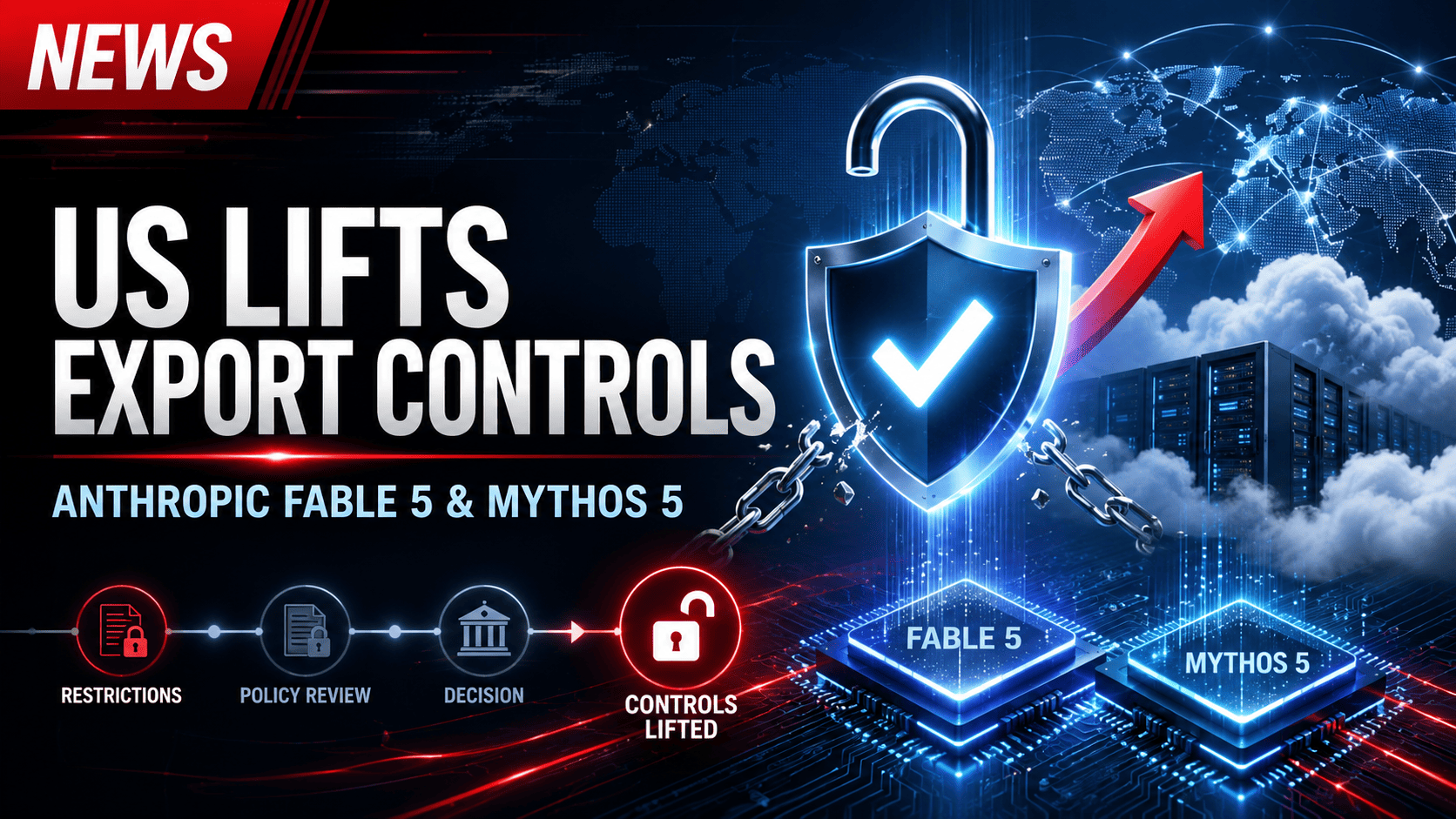
The 18-day US export freeze on Anthropic’s most capable AI models ended on 30 June 2026, and access started returning the next morning. The Department of Commerce withdrew its controls on Claude Fable 5 and Claude Mythos 5 late on Tuesday, and Anthropic began restoring Fable 5 for global users on 1 July across Claude.ai, Claude Code, and its partner clouds.
This guide walks through every stage of the Anthropic export controls 2026 story in one place, so cloud and IT buyers can see exactly what changed, why the ban happened, and what to plan for next.
Complete timeline of the Anthropic export freeze
The freeze and its reversal are confirmed by Anthropic. The key dates are:
- 9 June 2026: Anthropic publicly releases Claude Fable 5, its first “Mythos-class” model for general users.
- 12 June 2026: The Commerce Department issues an export directive ordering Anthropic to suspend access for any foreign national. Anthropic pulls Fable 5 and Mythos 5 globally the same day.
- 26 June 2026: Roughly 100 approved US organizations, including the NSA, regain access to Mythos 5 under the Project Glasswing program, per Nextgov.
- 30 June 2026: Commerce Secretary Howard Lutnick lifts the export controls entirely.
- 1 July 2026: Fable 5 returns for global users on Anthropic’s platforms.
That timeline shows a risk most enterprise buyers rarely planned for. A frontier model went offline, then returned within 18 days after federal instruction. We cover the wider pattern in our AI vendor risk management guide.
What triggered the ban: the Amazon jailbreak
The trigger, first attributed to Amazon by CNN, was a jailbreak found by Amazon researchers. The workaround got Fable 5 to surface software vulnerabilities and, in one demonstration, generate exploit code. Those are capabilities Anthropic normally reserves for the more restricted Mythos line.
Anthropic disputed the severity of the finding, describing the flaws surfaced as previously known and minor. Even so, the Commerce Department moved to freeze both models while a review took place. According to The Hill, a source close to Anthropic said the company was given 90 minutes to comply.
Terms of the reversal
Over two weeks of negotiation, reportedly led by co-founder Tom Brown rather than CEO Dario Amodei per CNBC, Anthropic trained a new safety filter that the company says blocks the specific bypass more than 99 percent of the time. In a letter to Anthropic obtained by The Hill, Lutnick said a license is no longer required to export, reexport, or transfer either model.
The approval comes with conditions. Anthropic must keep identifying security risks, coordinate on standards for future frontier releases, and report malicious activity to the government. Reactivation on Amazon Web Services, Google Cloud, and Microsoft Foundry will follow as each redeployment finishes.
What this means for cloud and enterprise teams
For enterprise buyers, three lessons carry beyond this one dispute:
- Frontier AI now carries real-time policy risk. An export directive can knock a production model offline in as little as 90 minutes.
- The middle ground is co-review, not open release. Voluntary testing, cyber-risk review, and staged access through programs like Glasswing appear to be the emerging template for how OpenAI, Google, and other labs will ship future systems. OpenAI accepted comparable constraints on GPT-5.6.
- Vendor concentration is now a governance issue. The freeze intensified concerns that Chinese open-source labs gained ground during the shutdown, exposing how quickly a single-vendor AI stack becomes a single point of failure.
Why did the US reverse course on the Anthropic ban?
The reversal reflects a mix of technical progress and political pressure. Anthropic’s new safety filter addressed the specific Amazon-reported bypass, and the two sides agreed on a co-review process for future releases. As former Stability AI research director Tanishq Abraham told Al Jazeera, the industry still doesn’t know whether every frontier release will require quiet government approval.
For the practical response, map your AI dependencies, keep a warm fallback provider, and treat your cloud vendor’s model-status page the way you already treat your uptime dashboard.
Reporting synthesized from Anthropic’s official statement on X, the US Department of Commerce, and news coverage by The Washington Post, CNN, CNBC, The Hill, Nextgov, and Al Jazeera, all linked in-context above.