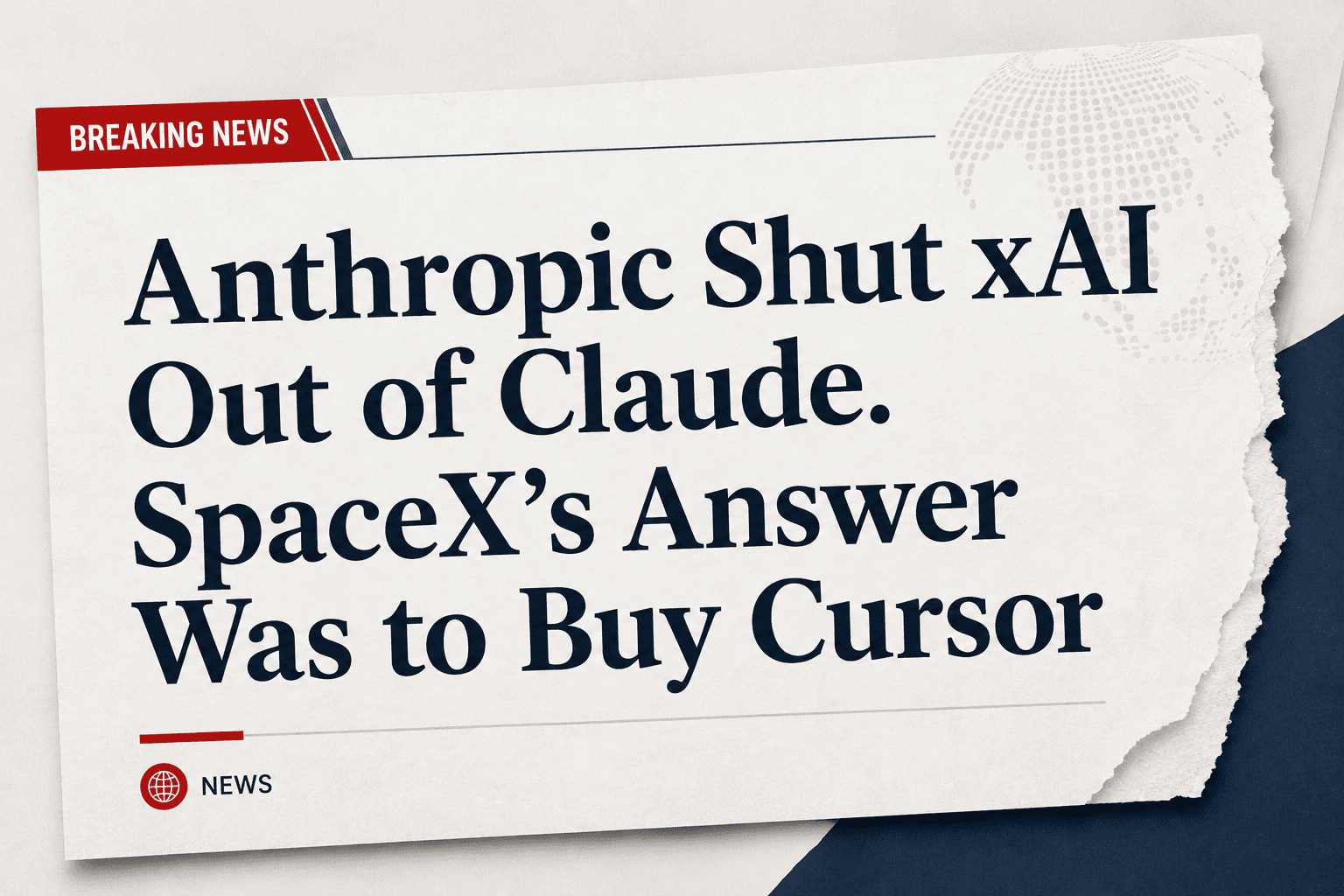
The SpaceX Cursor acquisition reads like payback as much as strategy. Months after Anthropic shut Elon Musk’s xAI out of its Claude models, SpaceX has agreed to buy Cursor, the AI coding tool at the centre of that dispute, for $60 billion. The timing is no coincidence, and the deal reveals how access to top AI models has become a weapon across the industry. Here is what happened, why it happened, and what it means for everyone building with AI.
What Happened: The SpaceX Cursor Acquisition, Explained?
Start with the deal itself. On 16 June 2026, SpaceX announced it would buy Anysphere, the startup behind the AI coding agent Cursor, for $60 billion in an all-stock transaction. Both Reuters and CBS News confirmed the figures.
The purchase is agreed, but not yet closed. SpaceX said Cursor would become a wholly owned subsidiary once the deal completes, which is expected in the third quarter of 2026. Regulators could still review it before it finalises.
The price is staggering for a company barely three years old. Cursor CEO Michael Truell framed the move as a chance to build more capable AI models alongside SpaceX, and the two firms had reportedly already begun training a model together.
Context matters here too. The deal landed just days after SpaceX went public, raising roughly $75 billion in what was described as the largest IPO on record and lifting its valuation above $2 trillion. That surging stock handed Musk the currency to fund a $60 billion acquisition almost overnight.
The Backstory: How Anthropic Shut xAI Out of Claude
To understand the purchase, rewind to January 2026. Anthropic cut off xAI’s access to its Claude models, after xAI engineers were found using Cursor as a route to tap Claude for competitive work. In short, Anthropic refused to power a direct rival.
This fit a wider pattern. Anthropic had already revoked OpenAI’s Claude API access in August 2025, and it cut off the coding tool Windsurf earlier that year. The company has repeatedly walled off competitors who lean on its models.
The same enforcement reshaped Cursor for everyday users as well. Claude’s built-in integration through consumer Claude Max subscriptions stopped working in January 2026, which pushed developers toward paid API keys instead. Access that once felt casual became metered and policed.
For xAI, the message was blunt. Its engineers lost a high-performing tool mid-race, even as the company poured money into its Colossus data centre in Memphis and promoted its own Grok coding models. Losing Claude stung, and it exposed a strategic weakness, namely dependence on a rival.
Why SpaceX Bought Cursor: The Real Motive?
Now the purchase makes sense. By owning Cursor, SpaceX removes its exposure to a competitor’s goodwill. It no longer needs Anthropic’s permission to put a leading coding tool in front of developers.
The acquisition also feeds xAI, which SpaceX absorbed in February 2026. Cursor hands xAI a popular distribution channel, millions of developer users, and a product to pair with its Grok models and Memphis compute. That combination targets enterprise AI coding, one of the few areas already generating real business revenue.
There is a defensive logic too. According to CBS News, Cursor gave SpaceX a choice: buy the company for $60 billion, or pay $10 billion simply to work together. Musk chose ownership, which locks out rivals such as OpenAI and secures the tool for his own stack.
So the honest answer to why a rocket company paid $60 billion for a code editor is simple. SpaceX is not really buying an editor. It is buying independence from the model providers that can switch off access at will.
From Staying Independent to $60 Billion: Cursor’s Reversal
The sale marks a sharp U-turn. Cursor spent 2025 as the poster child for independence. It walked away from earlier acquisition talks with OpenAI specifically because it wanted to stay its own company.
The numbers behind that confidence were real. Anysphere raised about $900 million at a valuation near $10 billion, with backing from Thrive Capital, Andreessen Horowitz, and others. Its annual recurring revenue reportedly crossed $500 million, making it one of the fastest growing software startups on record.
Yet $60 billion changed the calculation. That figure values Cursor at roughly six times its private valuation from only months earlier. For founders and investors, an all-stock deal inside a $2 trillion company proved hard to refuse.
The irony is sharp. The tool xAI got banned from using is now the tool xAI’s parent company owns outright.
What the SpaceX Cursor Acquisition Signals for AI Coding?
This deal is part of a bigger consolidation wave. OpenAI moved to buy the coding tool Windsurf for about $3 billion in 2025, and now SpaceX has claimed Cursor. The independent AI coding startup is fast becoming an endangered species.
The pattern reveals a hard truth. Model access is now a competitive weapon, not a neutral utility. When a provider can cut off a rival overnight, owning your own model and tooling stops being optional.
Expect more closed ecosystems as a result. Large players will keep buying or building their own coding tools, while smaller teams scramble for portable setups that can switch between models. Vendor lock-in, once a background worry, now sits at the centre of every buying decision.
What It Means for Developers and the Teams Hiring Them?
For working developers, the lesson is to stay portable. Tools that support multiple models, such as Claude, Grok, and Gemini, protect you when one provider changes the rules. Betting an entire workflow on a single model now carries real risk.
For businesses, the shift raises the value of AI-literate talent. Teams need developers who adapt across tools as ownership and access keep shifting. That flexibility, rather than loyalty to one platform, is what keeps projects moving.
This is also why flexible hiring matters more than ever. Marketplaces such as CloudColleague connect businesses with vetted freelance developers who already work fluently across AI coding tools, which lets teams adjust quickly without long-term hiring risk. In a market where the tools keep changing hands, adaptable talent is the safer bet.
The SpaceX Cursor acquisition is, at its core, a story about control. Anthropic proved it could shut a rival out of Claude, and SpaceX answered by buying the very tool it could no longer freely use. For $60 billion, Musk turned a vulnerability into ownership. For the rest of the industry, the message is clear. In the AI race, whoever controls the models and the tools controls the game.