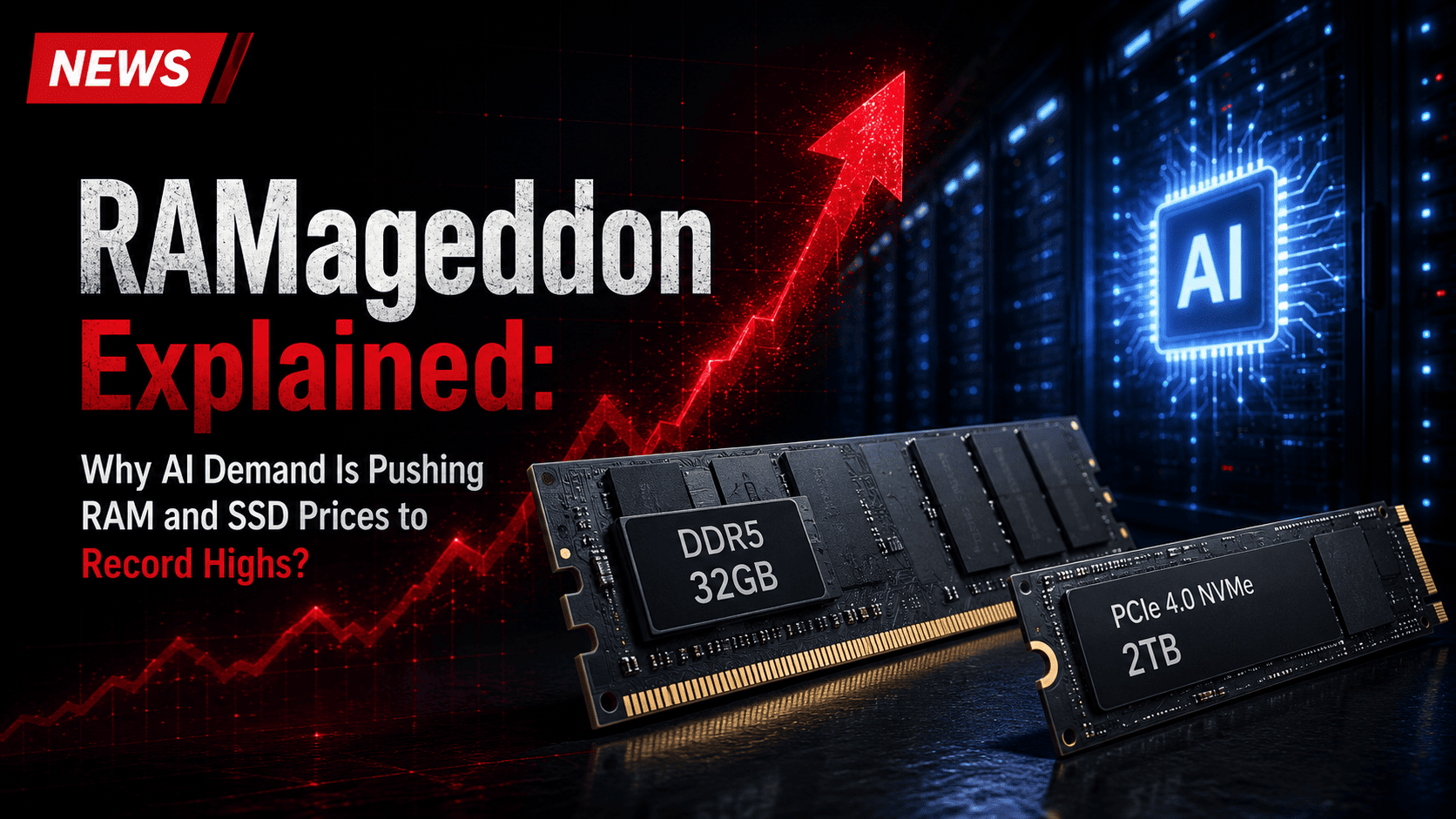
AI memory and SSD prices have entered record territory in 2026, and the surge now shapes the cost of almost every device on sale. Tech media has given the crisis a name, RAMageddon, and the data behind the nickname is sobering.
TrendForce said conventional DRAM contract prices jumped roughly 90 to 95 percent in the first quarter of 2026. It was the largest quarterly increase on record. Prices then rose another 58 to 63 percent in the second quarter. NAND flash, which powers SSDs and phone storage, climbed even faster. It rose 70 to 75 percent in the second quarter. “The speed at which the memory pricing has increased has shocked everybody,” Gartner research director Ranjit Atwal told reporters.
What the AI boom actually demands?
The AI boom refers to the global rush to build data centres that train and run large language models. Companies are committing hundreds of billions of dollars to this infrastructure, and each facility needs vast pools of fast memory sitting beside its processors.
That need centres on high bandwidth memory, or HBM, the stacked chips that supply the throughput AI accelerators require. Demand has outrun supply so sharply that HBM has become the most prized product in the entire memory industry, and chipmakers have reorganised their factories around it.
Why AI memory and SSD prices keep climbing?
Here lies the structural problem. Samsung, SK Hynix and Micron control the overwhelming majority of memory output, and all three are reallocating wafer capacity toward HBM because it pays far better. HBM commands gross margins near 60 percent, against roughly 40 percent for commodity memory, and it consumes several times more wafer capacity per bit than standard DRAM.
The result is a self reinforcing squeeze. As makers pour capacity into HBM, the supply of conventional memory for PCs, phones and consoles shrinks, and prices spike. Deutsche Bank analysts captured the dynamic bluntly, calling memory production “a zero-sum game” in which AI demand crowds out everyone else.
| “For every wafer devoted to HBM stacks for AI servers, others are unavailable for smartphones, PCs, or vehicles.” Deutsche Bank research note (via Fortune) |
How AI data centers consume RAM and SSDs?
Inside a data centre, RAM and SSDs do different jobs. RAM holds active data for instant access, while enterprise SSDs store the massive datasets, model checkpoints and vector databases that training depends on. As generative AI moves from training to large scale inference, both needs multiply.
Demand for enterprise SSDs has therefore shown no sign of slowing, and suppliers have deprioritised consumer storage to protect their margins. For the broader picture, see how AI data centres are reshaping consumer electronics.
A strange price inversion signals deep stress
One detail reveals just how distorted the market has become. Counterpoint Research found that older DDR4 spot prices climbed to about $2.10 per gigabit, overtaking advanced HBM3e at roughly $1.70 per gigabit. In other words, legacy memory now costs more than the cutting edge product, a clear inversion that signals acute scarcity at the low end.
The scramble for supply has changed how the industry trades. Suppliers now limit price quotes to short windows, sometimes finalising figures only at shipment, while smaller electronics firms struggle to secure parts at all. Micron even exited its consumer facing Crucial brand entirely to focus on AI and enterprise customers.
Companies competing for memory
The buyers’ list reads like a who’s who of technology. Apple, Nvidia, Qualcomm and AMD now compete directly for limited output, and cloud providers are locking up supply through multi quarter agreements. Micron alone reported roughly $22 billion in long term commitments, while Lenovo’s chief financial officer Winston Cheng described the surge as “unprecedented” and said the firm was holding inventory about 50 percent above normal.
Will AI memory and SSD prices keep rising?
Most analysts expect elevated prices through 2026 and beyond. A new memory fab takes two to three years to build, so meaningful fresh supply is unlikely before late 2027. TrendForce has projected the global memory market will swell to roughly $889 billion in 2026 and surpass $1.28 trillion in 2027, growth driven by price rather than volume, since the chips going to consumers are actually shrinking.
Intel chief executive Lip-Bu Tan put it plainly, saying there is “no relief until 2028.” We compile every recovery forecast in will Apple prices return to normal.
What it means for laptop and PC buyers?
For shoppers, the advice is practical. Memory and storage upgrades now carry a steep premium, so configure carefully and buy only what your workload needs. Compare value across brands with our best MacBook alternatives roundup, and settle the timing question using our buy now or wait framework.
The same forces fuelled the Apple price increase 2026.