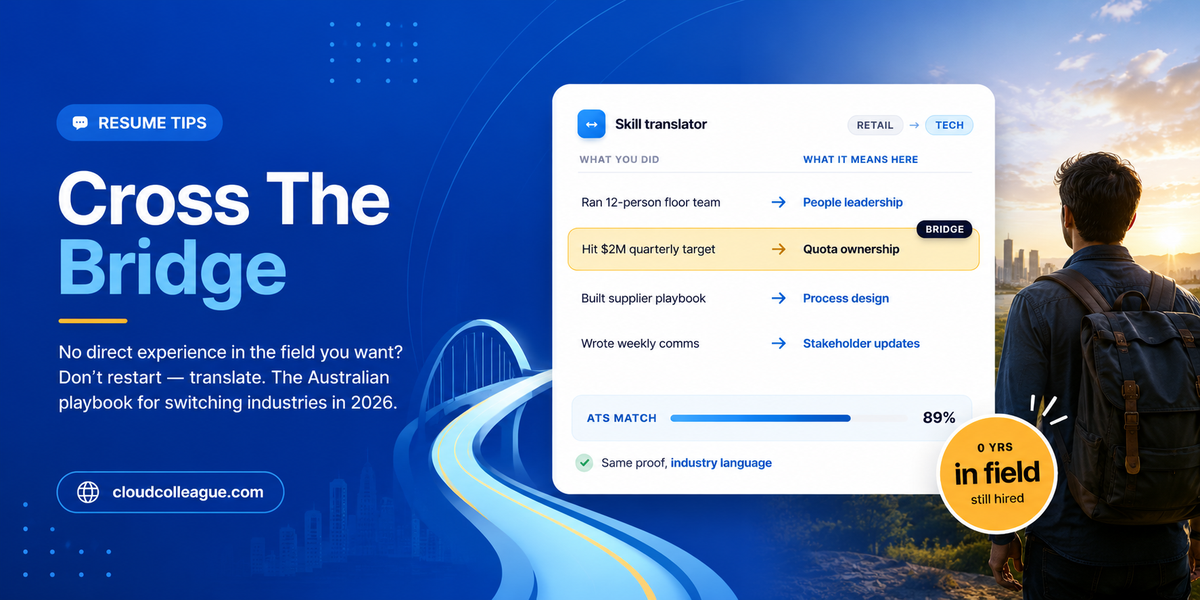
Writing a resume for someone switching industries with no direct experience is not about hiding your background. It is about translating it.
Every industry has its own vocabulary for the same underlying capabilities. What finance calls financial modelling, data analytics calls quantitative analysis? What teaching calls differentiated instruction, corporate training calls adaptive learning design? And what nursing calls clinical assessment, health administration calls needs analysis?
The gap between your background and your target field is almost always smaller than it appears. It is a vocabulary gap more than a capability gap. In this guide, we show you exactly how to identify and close that gap on paper, using an approach calibrated for the Australian job market in 2026.
Switching industries? Find Australian employers who value transferable skills. CloudColleague’s AI matching considers your full skill profile, not just your most recent job title. Browse AI-matched roles in your target field right now. Browse roles on CloudColleague
The Core Insight: It Is a Vocabulary Gap, Not a Capability Gap
Before any practical resume advice, the most useful reframe is this: most industry switchers overestimate how different their new field is from their current one, and underestimate how much of their capability is genuinely transferable.
The primary barrier is almost never experience. It is language.
Every industry uses specific vocabulary to describe roles, capabilities, and achievements. ATS systems are trained on this vocabulary. Recruiters pattern-match against it in the first six seconds of reading your resume. A document that describes genuine capability in the wrong vocabulary is nearly invisible to both automated screening and human review.
The solution is not to claim experience you do not have. It is to describe the experience you do have using the language the target industry already uses. This is what we call the vocabulary crossover technique, and it is the most important skill a career-switching candidate can develop before touching their resume.
Read Next: How to Write a Resume After Maternity Leave in 2026: The Australian Guide
The Vocabulary Crossover Technique
The vocabulary crossover technique has three steps. First, identify the skills you genuinely have. Second, identify the language your target industry uses for those exact skills. Third, rewrite your resume using the target vocabulary, with your existing evidence intact. The evidence does not change. The words do.
How to Find the Target Vocabulary?
The fastest and most reliable way to identify the exact vocabulary your target industry uses is to paste three to five target job descriptions into an ATS keyword tool such as Teal or Resumeworded.
These tools surface the most frequently appearing terms across your target job descriptions. These are the terms ATS systems are scanning for and the terms recruiters have been trained to recognise as signals of competence. They represent the language of the industry at the hiring level you are targeting.
Make a list of the twenty most common terms from your target job descriptions. Then map each term against your actual experience: where have you done that, even if you called it something different? That mapping is your vocabulary crossover.
Australian Industry Switch Vocabulary Crossovers
These are the most common industry switch vocabulary crossovers for Australian professionals in 2026.
Resources and mining to project management consulting:
- “Site operations management” becomes “project delivery and site coordination”.
- “Contractor management” becomes “stakeholder coordination and vendor management”.
- “FIFO roster and logistics management” becomes “resource planning and workforce scheduling”.
- “Safety management systems” becomes “risk and compliance frameworks”.
Financial services to fintech or data analytics roles:
- “Financial modelling” becomes “quantitative analysis and data-driven decision-making”.
- “Regulatory compliance” becomes “risk and governance frameworks”.
- “Portfolio management” becomes “data analysis and performance optimisation”.
- “Client reporting” becomes “data visualisation and stakeholder communication”.
Teaching to L&D and corporate training:
- “Lesson planning” becomes “instructional design”.
- “Differentiated instruction” becomes “adaptive learning design and personalised learning pathways”.
- “Student assessment and reporting” becomes “learning outcomes evaluation and performance tracking”.
- “Classroom management” becomes “group facilitation for diverse audiences”.
- “Curriculum development” becomes “training program design and content development”.
Nursing and allied health to health technology or health administration:
- “Clinical assessment” becomes “needs analysis and clinical requirements gathering”.
- “Care coordination” becomes “case management and cross-functional coordination”.
- “Patient documentation” becomes “clinical data management and health records administration”.
- “Multidisciplinary team collaboration” becomes “cross-functional stakeholder management”.
- “Patient education” becomes “health communication and behaviour change design”.
Construction and property to property development or project management:
- “Site supervision” becomes “project oversight and delivery management”.
- “Subcontractor management” becomes “vendor and supplier management”.
- “Compliance with building codes and standards” becomes “regulatory compliance management”.
- “Cost management and variation control” becomes “budget management and change control”.
The Right Resume Format for an Industry Switcher
The hybrid (combination) resume format is the correct choice for industry switchers in every scenario.
The hybrid format leads with a professional summary and a skills section using the target industry’s vocabulary, then presents your chronological work history below. This structure ensures the recruiter reads your cross-industry relevance before they process the job titles from your old field.
Do not use a functional resume format. Functional resumes push employment history to the bottom and lead with grouped skill categories. Recruiters associate this format with candidates hiding something, and ATS systems struggle to parse it correctly. The hybrid format achieves the same goal as a functional resume (leading with skills and capability) without the red flags or the ATS problems.
Need help with building your resume? Read our guide : Best Resume Builder for Career Changers
Professional Summary for an Industry Switcher
Your professional summary must do two things. First, name your target role or industry clearly so the recruiter immediately understands the direction of the application. Second, establish your most relevant transferable credentials using the vocabulary of the target field.
Strong example for a teacher transitioning to L&D:
“Learning and Development professional transitioning from eight years of secondary education into corporate training and instructional design. Experienced in curriculum development, adult learning theory, and facilitation of large and diverse groups. Currently completing Certificate IV in Training and Assessment (TAE40122).”
This summary names the target field specifically, translates the education experience into L&D vocabulary, and adds the Australian credential that closes the formal qualification gap.
Strong example for a nurse transitioning to health administration:
“Health administration professional transitioning from seven years of clinical nursing into health systems and health service management. Experienced in clinical workflow optimisation, multidisciplinary team coordination, and healthcare data documentation across acute care settings. Completed Health Services Management Foundations course through the Australian Institute of Management.”
The summary uses health administration vocabulary throughout, even though every credential listed was earned in a clinical setting.
Skills Section for an Industry Switcher
Lead your skills section with hard skills in the vocabulary of the target industry. List the tools, platforms, methodologies, and technical competencies that appear in your target job descriptions and that you can genuinely claim having used, even in a different context.
For industry switchers, this section is particularly important because it bridges the vocabulary gap before the recruiter reaches the work history. A skills section that correctly uses target industry vocabulary signals competence before a single work history bullet is read.
Follow hard skills with transferable soft skills. Only list soft skills that have specific evidence elsewhere in your resume. “Strong communicator” with no supporting bullet is ignored. “Group facilitation for audiences of up to 80” with a supporting bullet in your work history is credible.
Work History for an Industry Switcher
Keep your chronological work history intact. Do not remove roles, manipulate dates, or restructure your history. The evidence stays the same. The language changes.
Rewrite each bullet point using the target industry’s vocabulary for the capabilities you applied. The outcome, the scale, and the context remain accurate. The terminology shifts to match the new field.
Before (teacher applying for L&D role): “Managed a classroom of 28 students and delivered the Year 10 English curriculum across Terms 1 and 2.”
After: “Facilitated learning programs for groups of 28 participants and designed a 20-week instructional program covering literacy and analytical writing skills for a diverse cohort with varied prior learning levels.”
The same facts. Entirely different vocabulary. The second version passes ATS keyword scanning for L&D roles. The first does not.
Vocabulary updated and resume taking shape. Now find Australian employers actively hiring career changers. Browse AI-matched roles on CloudColleague. Many employers actively seek transferable skills from adjacent industries. Start as a Seeker on CloudColleague.
How to Fill the Experience Gap? Four Strategies
Beyond vocabulary, most industry switchers benefit from at least one piece of evidence that demonstrates genuine engagement with the target field. Here are four strategies that work for Australian career changers.
Strategy 1: Get a Relevant Australian Certification
A single relevant certification signals serious intent, provides target-field vocabulary already verified by an external body, and gives recruiters a data point outside your old industry. For Australian career changers, the most recognised options depend on the target field.
L&D and corporate training: Certificate IV in Training and Assessment (TAE40122) from a TAFE or registered training organisation (RTO). This is the baseline qualification for many corporate training roles in Australia and is specifically recognised by Australian employers in the sector.
Project management: CAPM or PMP from the Project Management Institute, or PRINCE2 Foundation. Both are recognised across Australian industries and government.
Data analytics and business intelligence: Google Data Analytics Certificate, Microsoft Power BI certification, or the Tableau Desktop Specialist. All are recognised in Australian tech and data roles.
Human resources: AHRI Practising Certification (APC) from the Australian HR Institute. The most recognised HR credential in Australia and specifically respected by Australian employers over US-based alternatives.
Health administration: Health Services Management programs through the Australian Institute of Management or equivalent Australian RTO.
Australian credentials from TAFE, industry associations, and Australian-registered RTOs carry more weight with Australian employers than equivalent US-based certifications in regulated or professionally recognised fields. When a choice exists between an Australian credential and an international equivalent, the Australian credential is generally the stronger signal for Australian hiring managers.
Strategy 2: Complete a Bridge Project
A bridge project is any piece of real work you complete in the target field that produces an output you can reference on your resume. The output does not need to be extensive. It needs to be genuine and documentable.
For a teacher transitioning to L&D: design and facilitate a professional development session for colleagues and write up the outcomes. The design document, the session itself, and the participant feedback are all legitimate evidence.
For a nurse transitioning to health technology: complete a health informatics course capstone project analysing a clinical data set. Document your methodology, tools used, and findings.
For a financial services professional transitioning to data analytics: complete a Kaggle data analysis competition and document your approach, tools, and result. Many Australian tech employers recognise Kaggle as evidence of applied data skills.
For a construction professional transitioning to property development: prepare a property analysis report for a hypothetical development site using publicly available planning and market data. The report itself is the output.
One substantive bridge project, honestly described on your resume, often does more to close the experience gap than a list of soft skills and claimed capabilities.
Strategy 3: Use CloudColleague Tasks to Build Immediate History
CloudColleague’s task marketplace lists short-term, output-based tasks from Australian businesses. For an industry switcher, completing one to three relevant tasks provides documented, paid work history in or adjacent to the target field.
A teacher transitioning to corporate training can take a task to design an onboarding module or deliver a facilitation session. A nurse transitioning to health administration can take a task in medical documentation review or patient database management. A finance professional transitioning to data can take a data analysis or reporting task.
The completed CloudColleague task with positive client feedback becomes a credible, dated, paid work history entry in your target field. It appears on your resume as a genuine professional engagement, not as a personal project or a hypothetical.
Strategy 4: Consider a Bridge Role
For some industry switches, the most effective path is not a direct pivot but a bridge role: a position that sits between both industries and builds genuine credibility in the target field over 12 to 18 months.
A teacher moving to corporate L&D might take a training coordinator or learning administrator role first. This provides exposure to corporate L&D workflows, team structures, and vocabulary, and produces a much stronger second resume than the direct pivot attempt.
A nurse moving to health technology might take a clinical informatics coordinator or health data coordinator role first. This bridges the clinical knowledge and the technology context without requiring a full pivot on the first application.
A finance professional moving to data analytics might take a business analyst or financial analyst role at a data-forward company first, building the data vocabulary and toolset in a context where their finance background is still valued.
The bridge role strategy is slower than a direct pivot. It typically produces significantly better outcomes on the second application because the resume now contains genuine target-field job titles alongside transferable experience from the original field.
Australian Credentialling Paths for Career Changers
These Australian-specific pathways for building formal credibility in a new field are completely absent from every US-focused competitor article on this topic.
TAFE qualifications: TAFE courses are Australian government-accredited and widely recognised by Australian employers across trades, healthcare, community services, business, and technology. A Certificate III, IV, or Diploma from TAFE provides Australian accreditation that many employers specifically require or prefer over equivalent international credentials.
Recognition of Prior Learning (RPL): Australian registered training organisations can assess your existing experience and knowledge against the requirements of a formal qualification and formally recognise it without requiring you to complete the full course. RPL can significantly reduce the time and cost of obtaining a credential if you have substantial relevant practical experience in the target field, even if acquired in a different context.
Industry association membership and credentialling: Many Australian industries have professional associations that offer membership, accreditation, and credential pathways specifically designed for career changers. AHRI for HR professionals, CPA Australia and CA ANZ for accounting, Engineers Australia for engineering, the Australian Institute of Training and Development (AITD) for L&D professionals, and the Project Management Institute (PMI) Australia chapter all provide industry recognition that carries genuine weight with Australian employers.
Micro-credentials from Australian universities: Many Australian universities now offer short, stackable micro-credentials that can be completed online in eight to twelve weeks. These carry Australian university branding alongside practical upskilling and are increasingly recognised by Australian employers as evidence of targeted learning. The University of Melbourne, UNSW, Monash, QUT, and others have published micro-credential libraries covering data science, AI, business analytics, digital marketing, and project management.
Want guide on changing career without experience? Go through Switch Careers Without Experience.
What Australian Industry Switchers Specifically Need to Know
CloudColleague’s AI matching considers your full skills profile rather than just your most recent job title. A teacher with curriculum design and group facilitation skills will surface in L&D searches even if their title says Secondary School Teacher.
Creating a complete, skills-based CloudColleague profile using target industry vocabulary maximises your discoverability to Australian employers in your target field before you have even submitted a single application. This passive discoverability is particularly valuable for career changers who are not yet known in the new industry.
SEEK allows you to search by skill keywords rather than just job title. Searching your target skills (for example, “instructional design”, “data analysis”, or “project coordination”) rather than your target job titles will surface roles you qualify for based on capability, even when your current title would not have appeared in the search.
Australian industry associations often run job boards, mentoring programs, and networking events specifically designed for career changers. AHRI, AITD, the PMI Australia chapter, these communities provide both job leads and the professional vocabulary you need to navigate interviews in the new industry.
Resume updated with target industry vocabulary. Now find Australian employers hiring in your target field. Create a free verified profile on CloudColleague and get AI-matched to roles that fit your actual skill profile, not just your previous job title.Get started free on CloudColleague
Hiring and open to candidates from adjacent industries? Post a role on CloudColleague in under five minutes. Smart matching surfaces candidates with transferable skills across every Australian industry.Start hiring on CloudColleague
Frequently Asked Questions on Resume for Someone Switching Industries
Yes, this is common in Australia. A strong Resume for someone switching industries focuses on translating existing experience into the language of the target field. The most effective approach is to highlight transferable skills, add one or two relevant signals (certification, project, or short course), and apply where your core capabilities match even if your job title does not.
The hybrid (combination) format works best. It leads with a targeted summary and skills section using the new industry’s vocabulary, followed by your chronological work history. This ensures recruiters see relevance before job titles. Avoid functional resumes, which can raise red flags, and avoid purely chronological formats without a strong summary at the top.
State the transition directly in the first line. Be clear and confident, for example: “Marketing professional transitioning from five years in retail operations.” Then highlight transferable skills aligned to the new industry. Keep it to 3–4 sentences and use industry-specific keywords throughout.
Yes. Keep your full work history. Do not remove roles. Instead, rewrite bullet points using the vocabulary of the target industry while keeping the same achievements. This builds credibility and avoids gaps or confusion in your career timeline.
It usually takes 3–9 months for an entry into a new field, depending on skills and credentials. More structured transitions may take 6–18 months. Candidates who build experience through projects, certifications, or platforms like CloudColleague often transition faster by creating relevant evidence before formal job entry.