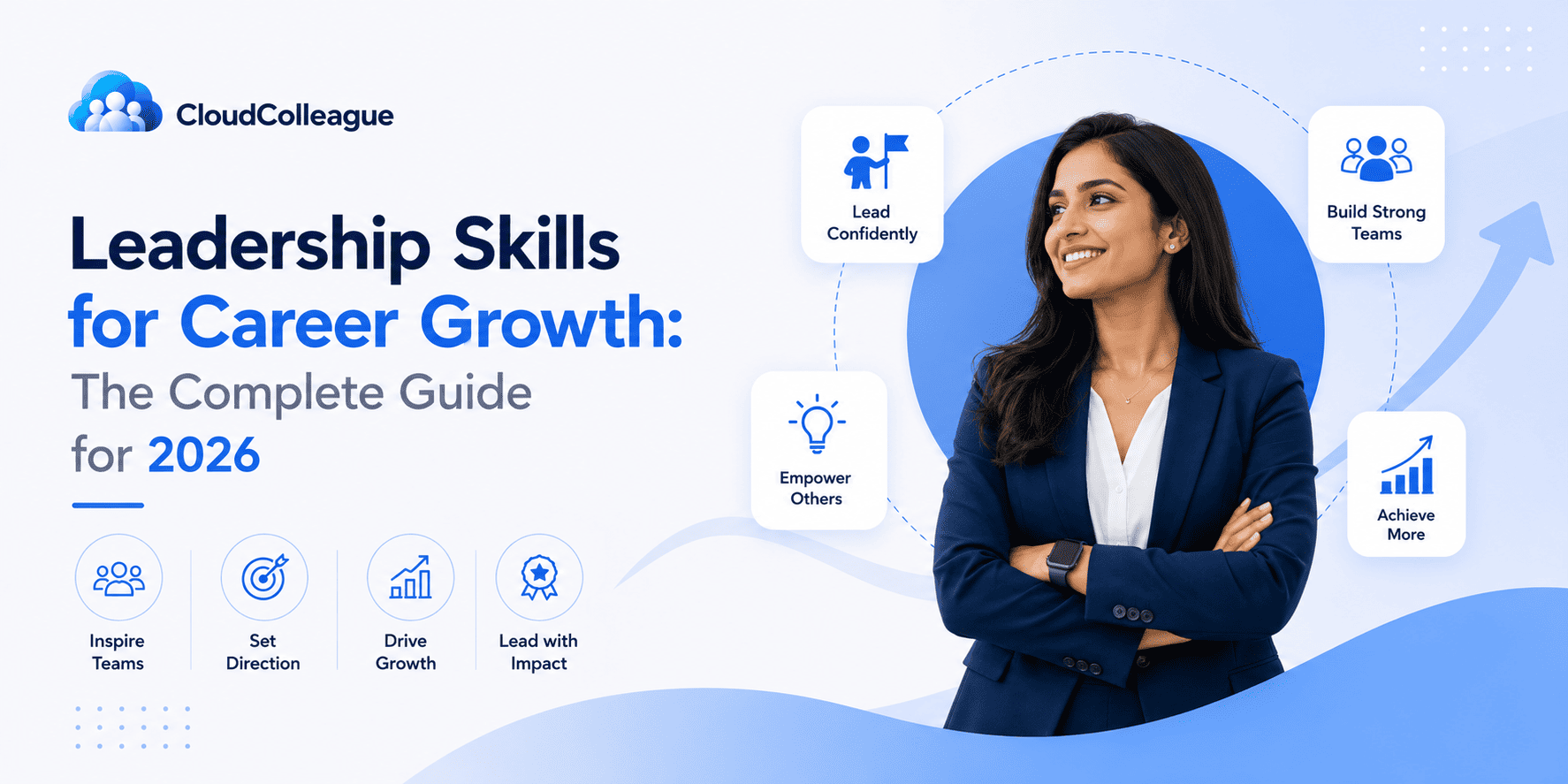
Leadership skills are the abilities that let you guide, influence, and develop other people toward a shared goal. They include communicating a clear direction, influencing without authority, making sound decisions, reading and managing emotions, and developing the people around you. Crucially, leadership is not a job title, it is a way of working that anyone can start practising today.
Here is why this matters for your career and your income. Leadership skills are among the strongest predictors of advancement, because organisations promote the people who multiply a team’s results, not just their own output. When you can lift the performance of those around you, you become far more valuable than a strong individual contributor, and pay and responsibility follow. Building leadership is one of the most direct routes to career growth.
This guide is the pillar for the topic. It defines leadership, breaks down the specific skills that drive growth, separates leadership from management, shows how to lead without a title, and lays out how to develop the skill. It connects to our guides on management, becoming a leader, and decision making, linked where they apply.
| QUICK ANSWERLeadership skills are the abilities that let you guide, influence, and develop people toward a shared goal, including communication, influence, decision-making, emotional intelligence, and delegation. You do not need a title to use them. They are among the strongest drivers of promotion and pay, because employers advance the people who can lift a team’s results, not just their own. |
What Are Leadership Skills?
Leadership skills are the behaviours that let you take a group of people somewhere they would not have reached alone. They include setting and communicating a clear direction, building trust, influencing others to act, making decisions under uncertainty, and growing the people you work with. They are less about commanding and more about enabling.
The most freeing thing to understand is that leadership is learnable and title-independent. The myth that leaders are born, or that you can only lead once you have a manager’s badge, holds many capable people back. In reality, the person who takes initiative, helps others, and moves a goal forward is already leading, and that behaviour is exactly what earns the title later.
For example, picture a team where a project is drifting and morale is low. One member, without any formal authority, quietly clarifies the goal, helps a struggling colleague, and keeps the team focused on the next step. People naturally start to follow their lead. That person is demonstrating leadership in its purest form, and they are doing it from an ordinary seat. Leadership is action, not position.
| A common misconception: Leadership is not about being the loudest or most dominant person. The best leaders often listen more than they speak, build others up, and lead through trust and clarity rather than force. Quiet, steady leadership is frequently the most effective kind. |
The Leadership Skills That Drive Career Growth
Leadership is a bundle of specific, learnable skills. The table summarises the ones that most drive career growth, and the highest-leverage ones are developed below.
| Leadership skill | What it looks like | Why it drives growth |
| Communication | Setting a clear direction | Aligns and motivates people |
| Influence | Getting buy-in without authority | Moves work forward across teams |
| Decision-making | Choosing well under uncertainty | Earns trust with bigger calls |
| Emotional intelligence | Reading and managing emotions | Builds strong relationships |
| Delegation | Trusting others with real work | Multiplies what you can achieve |
| Developing others | Coaching and lifting people | Creates lasting team value |
Communication and influence
Leadership starts with communication, because you cannot lead people toward a goal they do not understand. Strong leaders make the direction clear, explain the why, and tell a story people want to be part of. Influence builds on this: the ability to get buy-in without relying on authority, by appealing to shared goals and listening genuinely to concerns. For example, a team lead who frames a tough change in terms of what the team gains, and addresses worries openly, gets cooperation that orders alone could never produce.
Decision-making and judgement
Leaders are trusted to make the calls others cannot, so sound judgement is central. This means deciding well under uncertainty, owning the outcome, and staying steady when the path is unclear. It builds directly on structured decision-making, and the better your judgement, the bigger the decisions you are trusted with. For example, a leader who calmly weighs the options and commits during a crisis earns the confidence that leads to greater responsibility.
Because so much of leadership is judgement, it pays to strengthen the underlying skill directly through our guide to decision-making skills.
Emotional intelligence and developing others
The human side of leadership often matters most. Emotional intelligence, reading the room, managing your own reactions, and understanding what motivates people, is what lets you build trust and navigate tension. Developing others, through coaching and creating opportunities, multiplies your impact far beyond what you could do alone. For example, a leader who notices a quiet team member’s potential and gives them a stretch task builds both loyalty and capability. These relational skills are what turn a competent boss into someone people genuinely want to follow.
Leadership vs Management
Leadership and management are often confused, but they are different and complementary. It is about direction, influence, and people, setting where to go and inspiring others to follow. Management is about execution, organising, planning, and controlling the work so the direction is delivered. The strongest professionals do both, but they are distinct skills.
| Leadership | Management |
| Sets the direction and vision | Plans and organises the work |
| Influences and inspires | Coordinates and controls |
| Focuses on people and change | Focuses on process and delivery |
| Asks what and why | Asks how and when |
| Builds trust and motivation | Builds systems and accountability |
For the execution side in depth, see our guide to essential management skills, which complements the leadership skills covered here.
How to Lead Without a Title
You do not need authority to lead, and learning to lead without a title is the surest way to earn one. It comes down to a few behaviours that any team member can practise. Take initiative on problems others avoid. Help colleagues succeed without being asked. Communicate clearly and keep the team focused on the goal. Own your commitments completely.
For example, a junior team member who notices the team keeps missing information, and quietly starts a short shared status update, is leading. They saw a problem, took initiative, and made the whole team more effective, with no authority at all. Managers notice exactly this kind of behaviour, because it is what they need more of. Leading without a title is not just possible, it is the audition for the next role.
How to Develop Leadership Skills
Leadership develops through deliberate practice, feedback, and gradually taking on more responsibility. You build it in the role you already have, not only once you are promoted.
You can start by practising one leadership behaviour at a time: volunteer to coordinate a small project, mentor a newer colleague, or speak up with a clear direction when the team is stuck. Seek feedback from people you respect, since blind spots are the main thing that holds leaders back. And reflect on what worked after each opportunity, which turns experience into judgement. A simple 90-day approach, choosing one leadership skill to build each month, produces visible growth that managers notice when promotion decisions are made.
For a step-by-step path from contributor to leader, see how to become a leader at work.
Put Leadership to Work on CloudColleague
Strong leadership opens doors on both sides of the marketplace, whether you want to step into a bigger role or lead work as an employer. Here is how to turn the skill into opportunity on CloudColleague.
Find leadership and team-lead roles on CloudColleague
Employers pay a premium for people who can lead and decide well. Browse the jobs marketplace for team-lead and senior roles that reward leadership, and put a clear example of leading or owning an outcome on your profile. You can also apply for short-term tasks that reward leadership. That proof separates you from candidates who only list the skill.
Hire and manage taskers as an employer
Already leading work? Use CloudColleague for employers to post tasks, hire taskers, and manage delivery. Strong leadership and management make you a better client, which gets your work done faster and builds reliable working relationships.
Create a profile and start applying
Set up a free profile on the sign-up page, evidence your leadership with a short example, and start applying. A specific, results-focused profile wins far more interest than a list of qualities.
Frequently Asked Questions
Leadership skills are the abilities to guide, influence, and develop people toward a shared goal, including communication, influence, decision-making, emotional intelligence, and delegation. They do not require a title and are learnable through practice. They are among the strongest drivers of career growth, because employers promote people who lift a team’s results.
Leadership is about direction, influence, and people, setting where to go and inspiring others to follow. Management is about execution, planning and organising the work to deliver that direction. Leadership asks what and why, while management asks how and when.
Develop leadership by practising one behaviour at a time, such as coordinating a small project or mentoring a colleague, then seeking feedback and reflecting on what worked. Build the skill in your current role rather than waiting for a promotion.
Yes, leadership is learnable rather than innate. The idea that leaders are born holds capable people back. In reality, leadership is a set of behaviours, taking initiative, communicating clearly, developing others, that anyone can practise and improve. Deliberate practice, feedback, and gradually taking on responsibility build strong leadership skills over time.
A good leader sets a clear direction, builds trust, communicates well, decides soundly, and develops the people around them. The best leaders often listen more than they speak and lead through clarity and trust rather than force.
Yes, leadership and the judgement behind it are highly valued in Australia, particularly in management, engineering, and professional roles. Jobs and Skills Australia notes that employers often seek the higher-order employability skills that distinguish strong candidates.