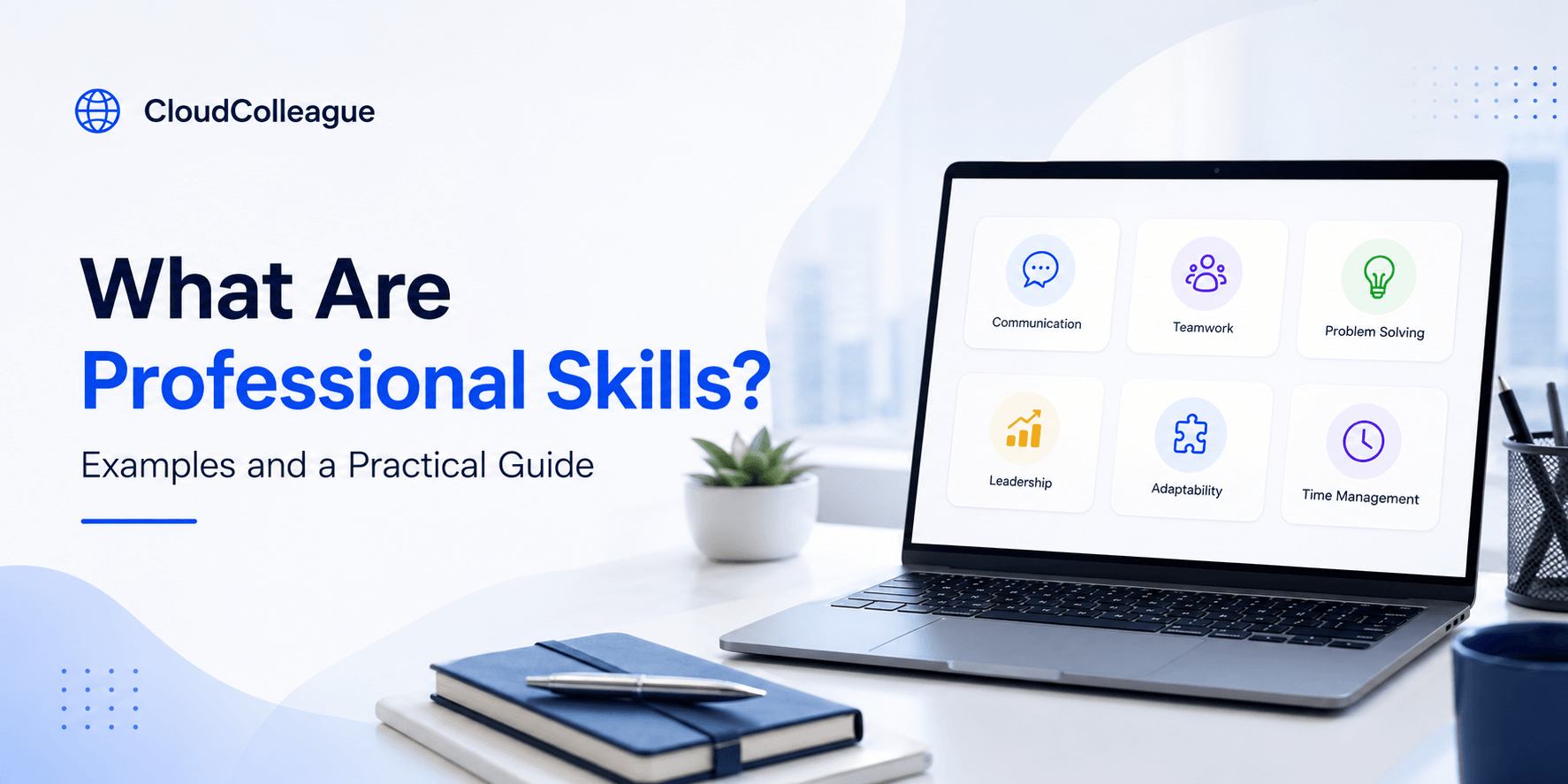
Professional skills are the workplace abilities that make you effective at your job and attractive to employers. They cover people skills like communication, thinking skills like problem solving, and digital skills like using key software. This page is the examples-and-evidence guide: each skill comes with a clear way to prove it on your profile or application.
Listing a skill is easy, but proving it is what wins work. Below, you get 20 professional skills examples sorted by category, each with how to evidence it, plus profile snippet templates you can adapt. The goal is a profile that turns skills into interviews and tasks.
| QUICK ANSWER: Professional skills are the workplace abilities that make you effective and employable, spanning people skills, thinking skills, and digital skills. The 20 examples below each pair a skill with how to prove it on your profile or application. Employers in Australia increasingly hire on demonstrated skills, so evidence matters as much as the skill itself. |
What Are Professional Skills?
Professional skills are the competencies that help you perform, collaborate, and grow in a work setting. Some are technical and role-specific, while many are transferable across jobs. Employers treat them as evidence that you can deliver, which is why showing them well matters as much as having them.
20 Professional Skills Examples (By Category)
The table below lists 20 in-demand professional skills, why each matters, and how to evidence it on a profile or application. Use it as a checklist for your own profile.
| Professional skill | Why it matters | How to evidence it |
| Communication | Core to every role | Writing samples, references |
| Teamwork | Drives group results | Project outcomes you contributed to |
| Problem solving | Solves real issues | A worked example with the result |
| Adaptability | Handles change | A time you adjusted fast |
| Time management | Hits deadlines | Consistent on-time delivery |
| Critical thinking | Better decisions | A decision you reasoned through |
| Leadership | Lifts others | Initiative you took |
| Customer service | Keeps clients happy | Ratings and feedback |
| Attention to detail | Quality output | Error-free work examples |
| Collaboration | Cross-team work | A cross-functional project |
| Digital literacy | Baseline today | Tools you use confidently |
| Data analysis | Informs decisions | A dashboard or report |
| Project coordination | Keeps work on track | A project you ran |
| Conflict resolution | Smooths teams | A situation you defused |
| Negotiation | Wins agreements | A deal or outcome reached |
| Organisation | Reduces chaos | Systems you set up |
| Initiative | Self-starting | Something you improved unasked |
| Creativity | Fresh solutions | An idea you delivered |
| Emotional intelligence | Reads people | Feedback on how you work |
| Continuous learning | Stays current | Courses or skills added |
Read Next: Essential Workplace Skills You Need in 2026 (Complete Guide)
People skills
People skills like communication, teamwork, customer service, and conflict resolution shape how you work with others. They are hard to fake and easy to evidence through outcomes and references. Lead with these, because employers consistently rank them at the top.
Thinking skills
Thinking skills like problem solving, critical thinking, and decision making show you can handle complexity. Prove them with a short, concrete example: the problem, what you did, and the result. A single strong story beats a list of adjectives.
Digital skills
Digital skills like data analysis, key software, and AI tool fluency are now baseline in most roles. Name the specific tools you use and what you achieve with them. Specificity here reads as competence, while vague claims read as filler.
How to Show Professional Skills on Your Profile?
A profile that proves skills wins more interest than one that just lists them. The trick is to pair each skill with evidence and a result.
Wording, proof, results
Replace generic claims with proof. Instead of stating you have strong communication, show it: name what you did, for whom, and the outcome. Numbers and specifics make a skill believable, which is exactly what an employer or task poster is scanning for.
| Profile snippet template: Strong [skill]: [what you did] for [who], achieving [result]. For example, clear communication: wrote weekly client updates that cut follow-up questions by half. |
Which Professional Skills Are in Demand?
Australian employers consistently prize communication, teamwork, problem solving, and digital literacy. Jobs and Skills Australia’s shortage analysis notes that employers often pass over qualified candidates for gaps in exactly these employability skills, particularly in engineering, science, and management. Demonstrating them clearly is a real advantage in a competitive market.
Put These Skills to Work on CloudColleague
Knowing about professional skills is only useful when it earns you something. CloudColleague turns that knowledge into income two ways: roles that need the skill, and tasks you can complete for pay. Here is how to bridge from learning to earning.
| Ready to showcase your skills to employers? Create your free seeker profile to discover jobs and tasks that match your skills. |
Frequently Asked Questions
Professional skills are the workplace abilities that make you effective and employable, including people skills, thinking skills, and digital skills. They can be technical or transferable, depending on the role. More importantly, employers treat these skills as evidence that you can deliver in real work situations. Therefore, proving them clearly matters just as much as having them.
Examples include communication, teamwork, problem solving, adaptability, time management, leadership, data analysis, and digital literacy. People skills and thinking skills tend to rank highest with employers. The strongest profiles pair each skill with a concrete result that proves it, rather than just listing it.
List each skill with evidence and a result rather than as a bare word. For example, instead of stating teamwork, describe a project you contributed to and its outcome. Specific, outcome-focused wording makes your skills believable to employers and task posters scanning your profile.
Employers most want communication, teamwork, problem solving, adaptability, and digital literacy, alongside role-specific technical skills. Jobs and Skills Australia notes that gaps in these employability skills often cost qualified candidates the job. Demonstrating them clearly gives you a real edge in Australia’s competitive market.
Focus on your strongest six to ten professional skills, and make sure each one is backed by clear evidence. Instead of adding a long unproven list, choose fewer skills that show real experience. This works better because well-evidenced skills feel more credible to employers. Finally, tailor your selection to the roles or tasks you want, so your most relevant strengths stand out first.