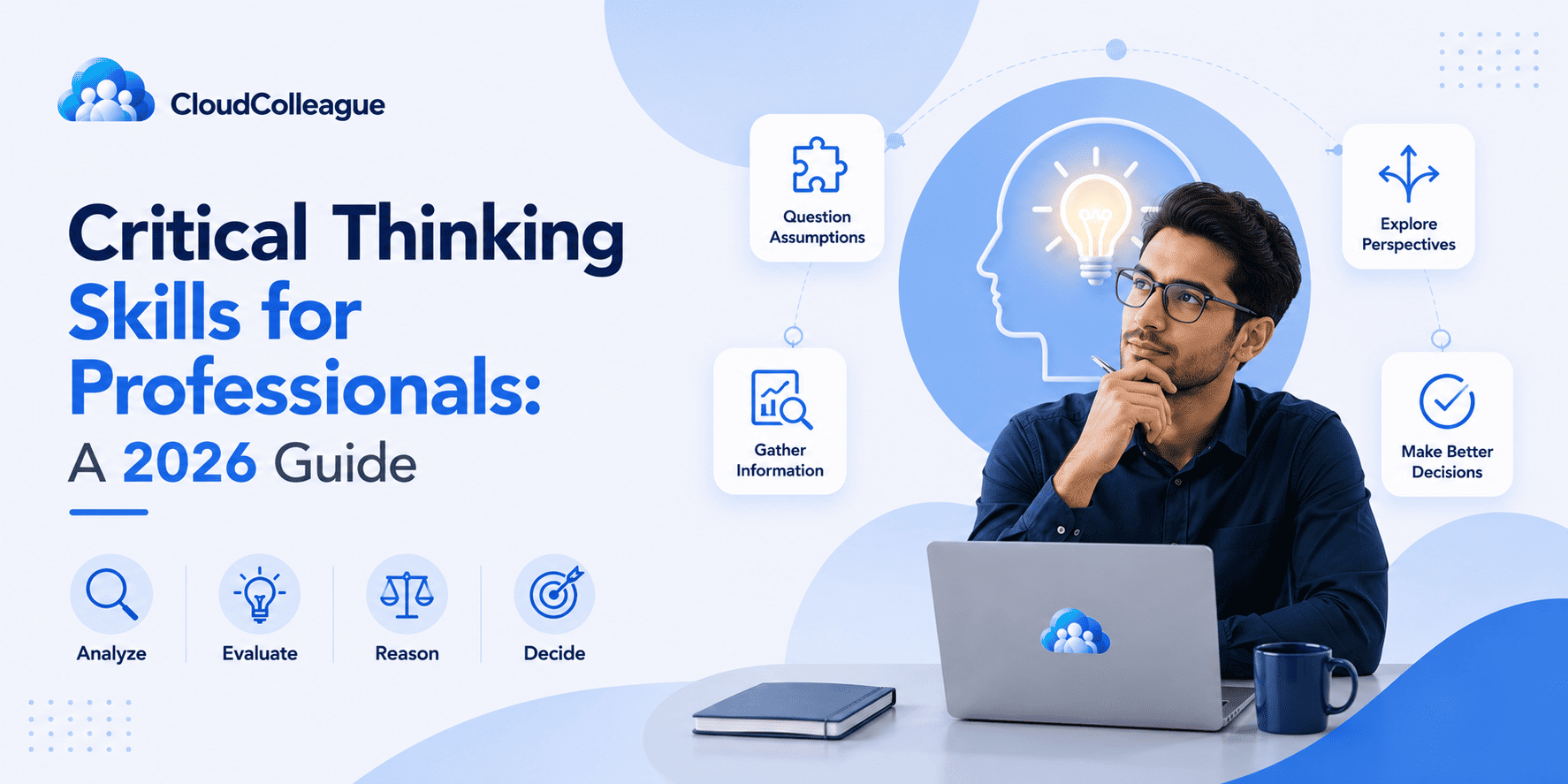
Critical thinking skills are the abilities you use to analyse information objectively, question assumptions, weigh evidence, and reach conclusions you can defend. Where problem solving fixes an issue, critical thinking is the clear reasoning that sits underneath it. It is how you tell a strong argument from a weak one and a reliable claim from a convincing-sounding guess.
This skill has never been more commercially valuable. Workplaces are flooded with data, opinions, and AI-generated content, and the people who can cut through that noise to judge what is actually true are in serious demand. Employers do not just want someone who can find information, they want someone who can evaluate it, which is exactly what critical thinking provides.
This guide distinguishes critical thinking from problem solving, shows why it matters at work, teaches the core reasoning skills with examples, and gives you a practical way to think more critically. It pairs naturally with our guides to problem solving and decision making, linked where they apply.
| QUICK ANSWER: Critical thinking skills are the abilities to analyse information objectively, question assumptions, weigh evidence, and reach sound conclusions. They are the reasoning layer behind good decisions and problem solving, and they are increasingly valuable as workplaces flood with information and AI-generated content. Employers pay for people who can separate signal from noise and judge what is actually true. |
What Is Critical Thinking?
Critical thinking is the disciplined process of evaluating information before you accept or act on it. It means asking where a claim comes from, what evidence supports it, what assumptions it rests on, and whether the conclusion actually follows. It is less about being sceptical of everything and more about being appropriately rigorous before you commit.
The key distinction from problem solving is layer. Problem solving is the whole process of fixing an issue, while critical thinking is the reasoning quality within it. When you analyse a root cause or weigh options, you are applying critical thinking inside the larger problem solving process. Strong critical thinking makes every other thinking skill more reliable.
For example, suppose a colleague proposes a new tool because a competitor uses it. A weak thinker accepts the reasoning at face value. A critical thinker asks what problem the tool actually solves for your team, whether the competitor comparison is even relevant, and what evidence exists that it would help. That habit of questioning before agreeing is critical thinking in action, and it prevents a great deal of wasted effort.
Why Critical Thinking Matters at Work
Critical thinking is the skill that protects an organisation from expensive mistakes. Poor reasoning leads to decisions based on bias, hype, or incomplete information, and those decisions cost money and time. The critical thinker who asks the right questions before a commitment is made saves far more than they appear to, because they prevent failures that never happen.
It is also increasingly a hiring differentiator. As routine tasks get automated and information becomes infinite, the human skill that stays valuable is judgement: knowing which information to trust and what it really means. Jobs and Skills Australia points to gaps in exactly these higher-order employability skills among otherwise qualified candidates, which means demonstrating strong reasoning gives you a genuine edge in the market.
Roles that reward this kind of judgement, from analysis to strategy, tend to pay well. You can see the demand for yourself on the CloudColleague jobs marketplace, where analytical roles consistently sit among the better-paid listings.
Critical Thinking Skills That Matter at Work
Critical thinking is made of a few specific, learnable habits. The two below carry the most weight, and each is developed with an example so you can practise it directly.
Question assumptions
Most flawed reasoning rests on an unexamined assumption. Questioning assumptions means asking what this argument takes for granted, and whether that is actually true. It is the fastest way to catch a weak plan before it costs anything. For example, a proposal to cut prices assumes customers are leaving over price. A critical thinker checks that assumption first, and may find customers are actually leaving over slow service, which would make a price cut both costly and useless. Surfacing the hidden assumption changes everything.
Weigh evidence objectively
Weighing evidence means judging information on its quality, not on whether it confirms what you already believe. It involves checking the source, looking for data rather than anecdote, and noticing what evidence is missing. For example, if one loud customer complains, that is an anecdote, not a trend, and acting on it alone would be poor reasoning. A critical thinker asks how many customers feel this way and what the data shows before drawing a conclusion. This habit guards against overreacting to noise.
Reason logically and spot weak arguments
Logical reasoning means checking that a conclusion actually follows from its premises, rather than just sounding persuasive. Many workplace arguments contain a hidden leap, where the conclusion does not really follow from the evidence given. Spotting that leap is a core critical thinking skill. For example, a claim that a campaign worked because sales rose ignores that sales might have risen for other reasons, such as seasonality or a competitor’s stumble. A critical thinker asks whether the cause and effect actually hold, which prevents the team from repeating a tactic that never truly worked.
| Looking for practical ways to sharpen your critical thinking skills? Explore our Guides on Tasks and learn How Bidding Works to start solving real challenges. |
How to Think More Critically
Critical thinking improves through deliberate practice of a few questions you ask before accepting any important claim or making any significant decision. Over time, asking them becomes automatic.
1. Ask where the information comes from and how reliable the source is.
2. Identify the assumptions the argument depends on, and test them.
3. Look for evidence, and notice what evidence is missing.
4. Consider alternative explanations before settling on one.
5. Separate what you know from what you are guessing.
For example, faced with a confident claim that a new approach will boost results, run the checklist: where did this come from, what is it assuming, what evidence backs it, what else could explain the expected gain, and what is genuinely known versus hoped. A few minutes of this questioning routinely prevents costly missteps, which is precisely why it is so valued.
| Watch for these traps: Confirmation bias, accepting evidence that fits your view and dismissing what does not. Anecdote over data, treating one story as proof. And overconfidence, mistaking a strong feeling for a strong reason. Naming these traps makes them far easier to catch in yourself. |
Critical Thinking Examples at Work
Concrete examples show how the skill changes outcomes. In each, the critical thinker asks a question that others skip.
- Evaluating a vendor pitch: instead of accepting the claimed results, ask for the data behind them and what conditions they assume.
- Reviewing a report: check whether the conclusion actually follows from the numbers, or whether a leap has been made.
- Assessing AI-generated content: verify the facts against a reliable source rather than trusting confident phrasing.
- In every case, the value comes from pausing to evaluate rather than accept. That pause is short, but it consistently prevents expensive errors, which is why critical thinkers are trusted with higher-stakes work.
Read Next: Problem Solving Skills at Work: The Complete Guide for 2026
How to Build Critical Thinking Over Time
Critical thinking is a habit that deepens with deliberate practice, so the goal is to make rigorous questioning part of how you work rather than an occasional effort you remember to apply.
Read widely and seek out views that challenge your own, since exposure to opposing arguments sharpens your reasoning. Practise explaining your conclusions and the evidence behind them, because having to justify a view exposes weak logic quickly. And after important decisions, review whether your reasoning actually held up, which builds the judgement that makes you faster and more accurate next time. For example, a professional who routinely asks a colleague to poke holes in their plan before committing develops far stronger reasoning than one who never tests their thinking. Over months, these habits compound into the kind of sharp judgement that employers notice and reward.
Put Critical thinking skills to Work on CloudColleague
Strong critical thinking skills is only valuable when it earns you something. CloudColleague turns the skill into income two ways: roles that need it, and paid tasks you can start today. Here is how to bridge from building the skill to getting paid for it.
When you create a free CloudColleague profile, you get matched to live Australian roles that fit your strengths. You then build real critical thinking experience by analyzing and solving genuine tasks, which turns reasoning into proof. Meanwhile, job-match alerts bring relevant roles straight to you. First explore how the platform works.
| Ready to turn critical thinking into career opportunities? Create your free profile, build experience through exploring real job and live tasks, and show employers how you think, analyze, and solve problems. |
Frequently Asked Questions
Critical thinking skills are the abilities to analyse information objectively, question assumptions, weigh evidence, and reach sound conclusions. They are the reasoning layer behind good decisions and problem solving. As workplaces flood with data and AI-generated content, the ability to judge what is actually true is increasingly valuable and well rewarded.
Critical thinking is the reasoning and evaluation layer, while problem solving is the full process of fixing an issue. When you analyse a cause or weigh options during problem solving, you are applying critical thinking. The two work closely together, and strong critical thinking makes your problem solving and decisions far more reliable.
Think more critically by asking where information comes from, identifying and testing the assumptions an argument depends on, looking for evidence and what is missing, and considering alternative explanations. Separate what you know from what you are guessing. Running this short checklist before important decisions becomes automatic and prevents many costly mistakes.
Critical thinking is important because it prevents expensive mistakes driven by bias, hype, or incomplete information. As routine work gets automated, judgement becomes the human skill that stays valuable. Employers increasingly seek people who can evaluate information rather than just gather it, which makes strong reasoning a real career advantage.
Common traps include confirmation bias, accepting only evidence that fits your view, treating a single anecdote as proof instead of data, and overconfidence, mistaking a strong feeling for a strong reason. Naming these traps helps you catch them in your own thinking, which is a core part of reasoning well at work.
Yes, critical thinking is a learnable habit, not a fixed trait. It improves through deliberately questioning assumptions, weighing evidence, and considering alternatives before accepting claims. Practising a short reasoning checklist on real decisions gradually makes rigorous thinking automatic, which steadily strengthens the judgement that employers value so highly.