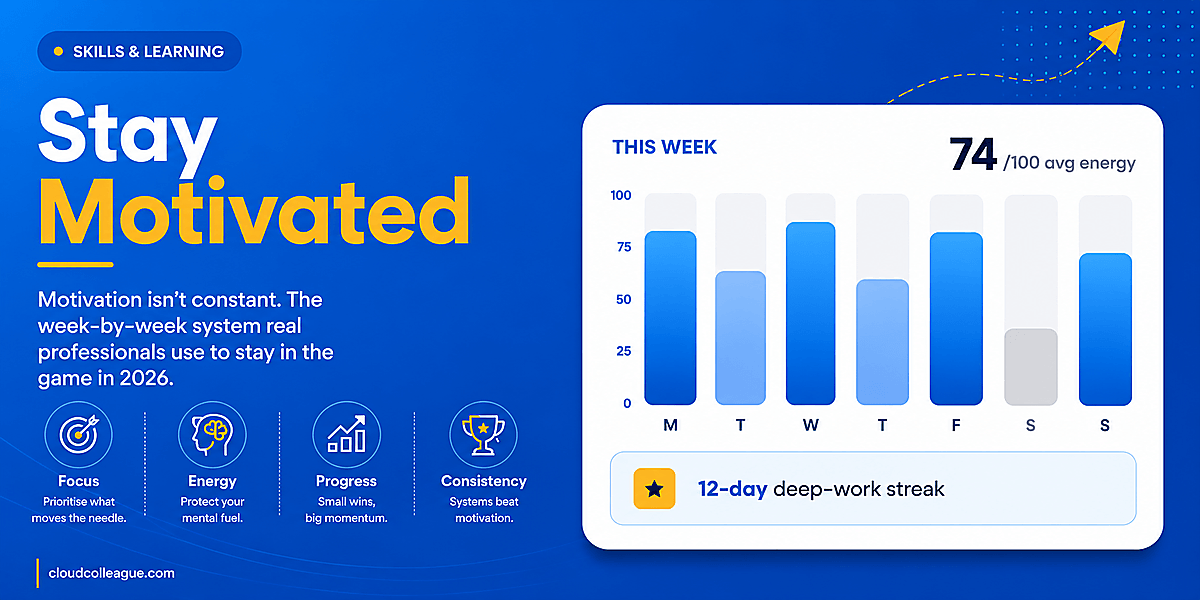
Motivation at work is not a constant state. It is something professionals actively manage, day by day and week by week. Even people who genuinely like their jobs experience motivation dips, and the data confirms it is universal rather than personal. This guide is for working professionals who want to stay motivated at work and engaged in their current role, not for those considering leaving or recovering from burnout. If you are experiencing chronic exhaustion or depersonalisation, How to Recover From Job Burnout is the better starting point. Everything below focuses on practical, daily strategies grounded in research and tested by Australian professionals.
Want to land your dream job? Create your free profile on CloudColleague, and start applying now.
Why Motivation at Work Is Hard to Sustain (And Why That Is Normal)
Motivation is harder to sustain than most career advice admits. Gallup’s State of the Global Workplace research consistently shows that the majority of workers experience engagement dips multiple times per year, and Australian Bureau of Statistics workforce data points to similar patterns across most industries. You are not broken if you lose motivation regularly. You are normal.
The biological reality is simple. Dopamine systems are not designed for sustained engagement with repetitive tasks. Your brain rewards novelty, progress, and meaning. When work becomes routine, those signals quiet down. This is why “just push through” advice fails almost everyone. White-knuckling your way through motivation dips burns energy without solving the underlying problem.
The reframe that changes everything: motivation is an output, not an input. You do not wait for it to arrive. You create the conditions that produce it. The rest of this guide is about those conditions.
The Difference Between Motivation, Discipline, and Habit (And Why It Matters)
Three concepts get confused constantly. Sorting them changes how you approach your workday.
| Concept | What It Is | When You Rely On It |
|---|---|---|
| Motivation | The feeling that makes action easy | Early stage, novelty, fresh project |
| Discipline | Action despite the absence of feeling | Mid stage, when motivation fades |
| Habit | Action without needing feeling or willpower | Long term, after enough repetition |
Relying on motivation alone is a losing strategy. James Clear’s Atomic Habits and BJ Fogg’s Tiny Habits both argue the same point: feelings are unreliable fuel, but systems are not. This article focuses on building structures that produce motivation rather than chasing the feeling itself.
Read Next: Career Challenges and Growth Guide: How to Overcome Issues at Work in Australia?
Proven Tip 1: Master Your First 90 Minutes
Why the First 90 Minutes Set the Tone for the Entire Day?
The cognitive science is clear. Decision quality, focus, and mental energy peak in the first 90 to 120 minutes after waking, then decline through the day. The trap most professionals fall into is spending those peak minutes on email and Slack, which are reactive tasks dressed up as productive ones.
The Practical First-90-Minutes Framework
Identify the one task that matters most for that day before opening any communication tool. Protect this block with a calendar entry treated as a real meeting, not a soft suggestion. Cal Newport’s Deep Work calls this the single highest-leverage habit in modern knowledge work.
The “two-screen rule” helps when working from a laptop: one screen for the work, one for nothing. No browser tabs, no Slack, no email. The discipline lasts 90 minutes, then the rest of the day can be reactive if it needs to be.
Proven Tip 2: Use Micro-Wins to Build Daily Momentum
The Progress Principle research from Harvard Business Review found that small, visible progress on meaningful work is the single strongest predictor of daily motivation. Not promotions, not raises, not recognition events. Progress, made small enough to feel.
Break large projects into wins you can actually see. A “draft the report” task is too big. “Write the opening paragraph” is a win. “Send the draft for review” is another win. Each one releases a small dopamine signal, and those signals stack across the day.
The “done list” practice is simple and underused. At the end of each day, write down 3 to 5 things you completed, not 3 to 5 things still on the to-do list. A done list builds evidence of momentum. A to-do list reminds you of debt.
Proven Tip 3: Engineer Flow States Into Your Schedule
What Flow Actually Is? (And What It Is Not)
Mihaly Csikszentmihalyi defined flow as the state of complete absorption in an activity, where time disappears and effort feels effortless. It is not a vague feeling of being “in the zone”. It has three specific conditions: a clear goal, immediate feedback, and a challenge matched to your skill level.
How to Build Flow-Friendly Time Blocks?
Schedule the type of work to the type of energy you have. Creative work belongs in high-energy windows, usually morning. Administrative work belongs in low-energy windows, usually after lunch. Reversing this is one of the most common motivation drains.
Eliminate the three flow-killers: notifications, meetings without agendas, and unclear tasks. The 90-minute flow block experiment works as a two-week test. Schedule one 90-minute block per day, protect it like a meeting, and track how your motivation changes by the end of week two.
Proven Tip 4: Reconnect With the “Why” Behind Your Role
Daniel Pink’s Drive identifies three intrinsic motivators that outperform external rewards: autonomy, mastery, and purpose. When motivation dips, one of these three is usually depleted.
The “two layers” exercise helps reconnect with purpose. Layer one is the surface task. Layer two is the underlying impact. A bookkeeper’s surface task is reconciling accounts. The underlying impact is that a small business owner sleeps better at night because someone they trust is watching the numbers.
When the “why” feels weak, build it through who you serve, what you learn, or what you build. This is not about deciding whether the role is meaningful enough to keep, which is a different question entirely. This is about reconnecting with meaning inside the role you already have.
Proven Tip 5: Manage Energy, Not Just Time
The Four Types of Energy
Tony Schwartz’s research in Harvard Business Review identified four types of energy professionals draw on: physical, emotional, mental, and spiritual. Most motivation dips come from depletion in one of these, not from time pressure.
Physical energy comes from sleep, food, and movement. Emotional energy comes from positive relationships and meaningful interaction. Mental energy comes from focused attention and clear thinking. Spiritual energy comes from doing work aligned with your values.
When motivation dips, identify which type is depleted before reaching for productivity tools.
Daily Energy Rituals That Australian Professionals Can Realistically Use
The 90/20 rhythm works for most office workers: 90 minutes of focused work, 20 minutes of recovery. Recovery means stepping away from the desk, not switching to a different screen.
Lunch outside the desk matters more than people assume. ABS data shows a meaningful share of Australian workers eat lunch at their desk, and this single habit reliably flattens afternoon energy. A 25-minute lunch in a different physical space resets the rest of the day.
Add a two-minute walk between back-to-back meetings, drink water before reaching for coffee, and treat the afternoon slump as a recovery signal rather than a willpower test.
Proven Tip 6: Curate Your Environment for Motivation
Physical Environment
Desk setup principles that reduce friction matter more than they look. Tools you need within reach, distractions out of sight, and one visible cue that signals “work mode”. For hybrid and remote workers, designing a workspace that physically signals work is the difference between a productive day and one that bleeds into the kitchen.
Digital Environment
Run a notification audit once a quarter. Most professionals have 3 to 5 apps producing daily interruptions that produce zero value in return. The single open tab rule is uncomfortable for a week and liberating after that.
Be honest about what each app on your dock actually does. Some are tools (a calendar, a writing app). Some are toys disguised as tools (a news app, a social platform). The toys are not the problem. Pretending they are tools is.
Proven Tip 7: Build a Personal Recognition System
Gallup’s engagement research consistently finds that employees who receive regular recognition are significantly more engaged than those who do not. The reality is that most workplaces do not provide recognition consistently, and waiting for it is a slow path to disengagement.
The self-recognition practice is simple and effective. At the end of each week, write down three things you did well. Not three things you completed, three things you did well. The distinction matters.
The peer recognition exchange works alongside this. Pair with one colleague for mutual acknowledgement on a fortnightly check-in. Each person names one thing the other did well. This is different from a performance review or a feedback loop. It is a small, deliberate motivation supply.
Proven Tip 8: Use the 1% Better Principle for Skill Growth
Learning at work is one of the most reliable motivation generators. The brain rewards progress on skill development the same way it rewards progress on projects.
The 1% better approach focuses on one specific skill in your current role. Not five skills, not a full career development plan, just one micro-skill you can improve this week. Better email writing. Faster spreadsheet work. Clearer meeting facilitation. Each one compounds, and each one reconnects you with the mastery driver Daniel Pink describes in Drive.
This is about staying motivated through small daily learning. For a longer-term career development plan, see the Career Development Guide for Professionals.
Proven Tip 9: Reset Your Relationship With Meetings
McKinsey research on meeting overload found that knowledge workers spend an average of 23 hours a week in meetings, up sharply from previous decades. The same research links meeting overload directly to motivation loss.
Before accepting any meeting invite, ask three questions. Is there a clear agenda? Am I needed, or just included by default? Could this be an async update instead? Two out of three “no” answers means the meeting probably should not happen.
Convert two meetings per week to async updates as a starting experiment. Most teams welcome it after the first month.
Proven Tip 10: Manage the Monday Reset and the Friday Drift
The Sunday Evening Setup
A 15-minute Sunday practice prevents Monday inertia. Review the week ahead, pick the one task that matters most for Monday morning, and write it down. The work brain registers the decision overnight, and Monday starts with momentum instead of confusion.
The Friday Close-Out
The way you finish the week determines how you start the next one. The five-minute Friday review takes stock of what got done, what carries over, and what one thing matters most on Monday. Closing the week deliberately produces a real sense of completion, and that sense compounds across months.
Proven Tip 11: Have Honest Conversations With Your Manager
The motivation conversations most professionals avoid having are the ones that change everything when they finally happen. Ask for a more interesting project. Request a stretch assignment. Propose a workload adjustment. Most managers are quietly relieved when team members raise these conversations directly.
The language matters. Frame the conversation as growth, not complaint. “I would do my best work on X” lands better than “I am bored with Y”. The Australian HR Institute consistently identifies open growth conversations as one of the strongest motivation predictors in Australian workplaces, and Fair Work Australia guidelines protect reasonable conversations about workload and conditions.
This is normal motivation maintenance, not a workplace crisis conversation.
Proven Tip 12: Use Side Projects to Refill Creative Energy
Professionals who maintain one creative or learning project outside the main job often report higher motivation inside the job. The pattern is consistent across industries: the side project gives a sense of autonomy and mastery that some full-time roles cannot fully provide.
The kind of side project that helps is energising and low pressure. Writing a blog, learning a new tool, mentoring someone, building a small portfolio of freelance work. The kind that hurts is a second job in disguise, with deadlines and stress that drain the energy you were trying to refill.For professionals exploring freelance side projects or short tasks alongside a full-time role, platforms like CloudColleague offer flexible opportunities. Picking up a single small freelance task can reconnect you with the parts of work you find most energising, without the commitment of a second job.
Proven Tip 13: Build a Peer Accountability Circle
Solo motivation is the hardest motivation. Even highly self-directed professionals get more done when other people are quietly watching the work.
The three-person accountability circle works well for most professionals. Each person shares what they are working on, what they got done last fortnight, and what they need help with. The format takes 30 minutes every two weeks. The accountability is light, the support is real, and the social signal does more for motivation than any productivity app.
Proven Tip 14: Track What Drains You and What Fuels You
The two-week motivation audit is one of the simplest tools in this guide and one of the most useful. At the end of each workday, write down one thing that drained you and one thing that fuelled you. Two sentences. Two weeks.
By the end of week two, a pattern appears. Certain meetings keep showing up on the drain list. Certain types of work keep showing up on the fuel list. Once the pattern is visible, you can renegotiate, redesign, or simply do more of what already works.
Proven Tip 14: Track What Drains You and What Fuels You
The two-week motivation audit is one of the simplest tools in this guide and one of the most useful. At the end of each workday, write down one thing that drained you and one thing that fuelled you. Two sentences. Two weeks.
By the end of week two, a pattern appears. Certain meetings keep showing up on the drain list. Certain types of work keep showing up on the fuel list. Once the pattern is visible, you can renegotiate, redesign, or simply do more of what already works.
Proven Tip 15: Protect Recovery Time Like a Professional Athlete Would
Professional athletes do not treat recovery as the absence of work. They treat it as part of the work. Sleep, rest days, and downtime are performance strategies, not weaknesses.
Apply the same logic to your evenings and weekends. Guilt-free recovery is what allows the workday to be productive in the first place. Boundary practices help: a clean shutdown ritual at the end of the day, no email after a certain time, and one day per week that is fully off-limits to work thinking.This is preventive recovery for engaged professionals, not the deep recovery protocol that follows burnout. If you are already past the point of needing rest and into chronic exhaustion, the burnout recovery guide is the right resource.
When Low Motivation Is Telling You Something Bigger
Sometimes motivation tactics are not enough, and the issue is structural rather than daily. Three signals that the problem is bigger: persistent dread before work most mornings, chronic exhaustion that rest does not fix, or a fundamental mismatch with the role that no tactic can solve. If two of these three apply, the next step is not another motivation strategy.
Bringing It All Together
Motivation at work is not a feeling you wait for. It is a set of conditions you create. The 15 tips above are a menu, not a checklist. Pick the two or three that fit your week and try them for the next fortnight.
If your motivation has dipped because the role itself has stopped fitting, it may be worth exploring what else is out there. Browse jobs, tasks, and freelance opportunities on CloudColleague to see what aligns with where you want to grow next.
Frequently Asked Questions About Staying Motivated at Work
Master your first 90 minutes on the one task that matters most, build micro-wins into your day, and reconnect with the underlying purpose of your role. Boredom usually signals depleted novelty, not a broken career, and small changes to your daily structure often restore engagement within two weeks.
Sudden motivation loss usually has one of three causes: physical energy depletion, an unrecognised emotional drain (a difficult colleague, a conflict at home), or a change in your work environment. If it persists for more than 4 to 6 weeks alongside exhaustion, it may be early burnout.
Lower the bar to the first 2 minutes of the task. Open the document, write one sentence, send one email. BJ Fogg’s Tiny Habits research and James Clear’s Atomic Habits both show that starting is the friction point, not continuing. The motivation often appears once the action has begun.
The 2-minute rule, popularised by James Clear and informed by BJ Fogg’s behavioural research, says that any task you are resisting should be reduced to a 2-minute starting version. Write for 2 minutes, plan for 2 minutes, reply to one email. The starting friction breaks, and momentum usually follows.
Yes. Gallup’s State of the Global Workplace research consistently shows that most workers experience engagement dips multiple times per year. Motivation loss is normal, not a personal failing. What matters is having a set of tactics ready before the dip arrives.
A typical motivation dip lasts 1 to 3 weeks for engaged professionals and resolves with small changes to daily structure. A slump that persists past 6 weeks, especially alongside exhaustion or persistent dread, signals something deeper and may benefit from the burnout recovery or career change resources linked above.