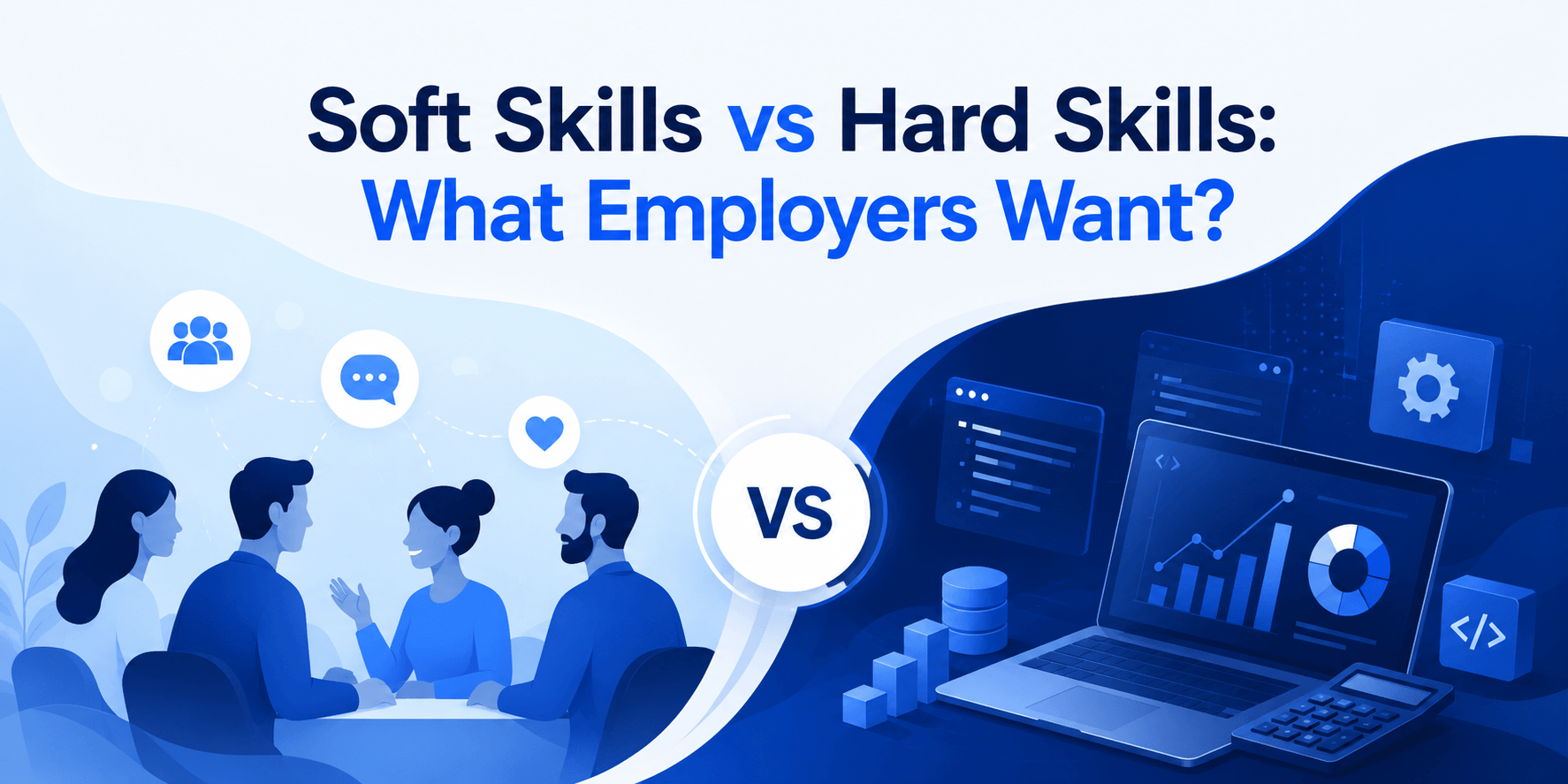
Soft skills vs hard skills is one of the most useful distinctions in your career. Soft skills are the human abilities like communication, teamwork, and adaptability. Hard skills are the teachable, measurable abilities like coding, accounting, or operating equipment. Knowing the difference helps you build the right mix and present both well to employers.
This guide gives you the quick answer, then defines each type with clear examples, weighs which matters more to Australian employers, and shows how to balance both on your profile. The short version: you need both, but soft skills are often the tiebreaker.
| QUICK ANSWERSoft skills are human abilities like communication, teamwork, and adaptability, while hard skills are teachable, measurable abilities like coding, data analysis, or a trade. Employers want both, but increasingly weigh soft skills, because qualifications prove hard skills while soft skills decide how well you actually work with others and deliver. |
Soft Skills vs Hard Skills: Quick Answer
The fastest way to see the difference is side by side. Hard skills get you shortlisted, while soft skills get you hired and promoted.
| Aspect | Hard skills | Soft skills |
| What they are | Teachable, technical abilities | Human, interpersonal abilities |
| How you prove them | Certificates, tests, portfolios | Behaviour, references, outcomes |
| Examples | Coding, data, a trade | Communication, teamwork |
| How you learn them | Courses and practice | Experience and feedback |
| How they transfer | Often role-specific | Transfer across most jobs |
Read Next: How to Make Money From Your Skills in Australia?
What Are Hard Skills?
Hard skills are specific, teachable abilities you can measure and certify. They are usually tied to a role or industry, and you build them through study and practice. They get you through the first filter, because they prove you can do the technical part of the job.
Examples of hard skills
Common hard skills include data analysis, spreadsheet modelling, coding, graphic design, accounting, a licensed trade, and using specific software or AI tools. Each can be tested or shown in a portfolio. Naming the exact tools and showing real output is the best way to evidence them.
What Are Soft Skills?
Soft skills are the human abilities that shape how you work with others and handle yourself. They are harder to measure but easier to spot in action, and they transfer across almost every job. They decide whether your hard skills actually translate into results in a real team.
Examples of soft skills
Common soft skills include communication, teamwork, adaptability, problem solving, time management, emotional intelligence, and conflict resolution. You prove them through behaviour, references, and outcomes rather than certificates. A short story showing the skill in action is far more convincing than the label.
Which Matters More to Employers?
Both matter, but soft skills increasingly tip the decision. Jobs and Skills Australia’s shortage analysis found that employers often pass over qualified candidates for gaps in employability skills like communication and teamwork, even when the hard skills are present. So hard skills open the door, and soft skills win the room.
| The practical takeaway: Lead with the hard skills that match the role to clear the first filter, then prove the soft skills that show you will thrive in the team. Candidates who evidence both consistently out-compete those who rely on qualifications alone. |
How to Balance Both on Your Profile?
A strong profile shows the technical fit and the human fit together. Pair each hard skill with proof, and weave soft skills into your achievements rather than listing them separately.
For example, do not just claim communication and Excel. Instead, write that you built a budget model in Excel and presented it clearly enough that the team adopted it the same week. That single line proves a hard skill and a soft skill at once, which is exactly what an employer is looking for.
How to Build Each Type of Skill?
Hard and soft skills grow in different ways, so build them with different methods. Knowing which approach fits each type saves you time and effort.
Building hard skills
Hard skills respond well to structured learning: courses, certifications, tutorials, and deliberate practice on real projects. Set a clear target, follow a course or guide, then apply the skill on a live task to lock it in. A portfolio of real output is the proof employers trust most.
Building soft skills
Soft skills grow through real interaction and honest feedback rather than courses alone. Put yourself in situations that stretch them, such as leading a small project or handling a tricky conversation, then reflect on what worked. Asking a trusted colleague for specific feedback accelerates progress more than any single course.
Show Both on CloudColleague
The best way to prove your skill mix is to use it. CloudColleague lets you put both hard and soft skills to work, through roles that need them and tasks you can complete for pay.
Find jobs that need your skills on CloudColleague
Browse the jobs marketplace for roles that reward your skills, then filter by category and location to find a strong match. Listing the skill clearly on your profile helps the right roles find you.
Earn doing tasks that use your skills
Prefer flexible, paid work? Browse live tasks and pick up jobs that put your skills to work straight away. Tasks let you earn while you build experience and reviews.
Create a profile and apply
Set up a free profile on the sign-up page, add your skills, and start applying. A complete profile wins more interest from both employers and task posters.
Frequently Asked Questions
Hard skills are teachable, measurable abilities like coding or a trade, proven with certificates or portfolios. Soft skills are human abilities like communication and teamwork, proven through behaviour and outcomes. Hard skills get you shortlisted, while soft skills often decide who gets hired and promoted.
Examples of soft skills include communication, teamwork, adaptability, problem solving, time management, emotional intelligence, and conflict resolution. They transfer across almost every job and are best proven through real examples and references. Employers in Australia consistently rank these among the most valuable workplace skills.
Examples of hard skills include data analysis, coding, spreadsheet modelling, graphic design, accounting, a licensed trade, and using specific software or AI tools. They are role-specific and measurable, so you prove them with certificates, tests, or a portfolio showing real output.
Employers want both, but soft skills increasingly tip the decision. Hard skills clear the first filter by proving technical ability, while soft skills like communication and teamwork decide who actually thrives in the role. Jobs and Skills Australia notes that soft-skill gaps often cost qualified candidates the job.
Yes, soft skills are learnable through experience, feedback, and deliberate practice, even though they are harder to certify than hard skills. Working in teams, seeking honest feedback, and reflecting on real situations all build them. Many people improve their communication and collaboration markedly over a single year of focused effort.
Lead with the hard skills that directly match the role to clear the first filter, then evidence the soft skills that show you will thrive in the team. The strongest approach weaves both together in your achievements, proving technical fit and human fit in the same line