
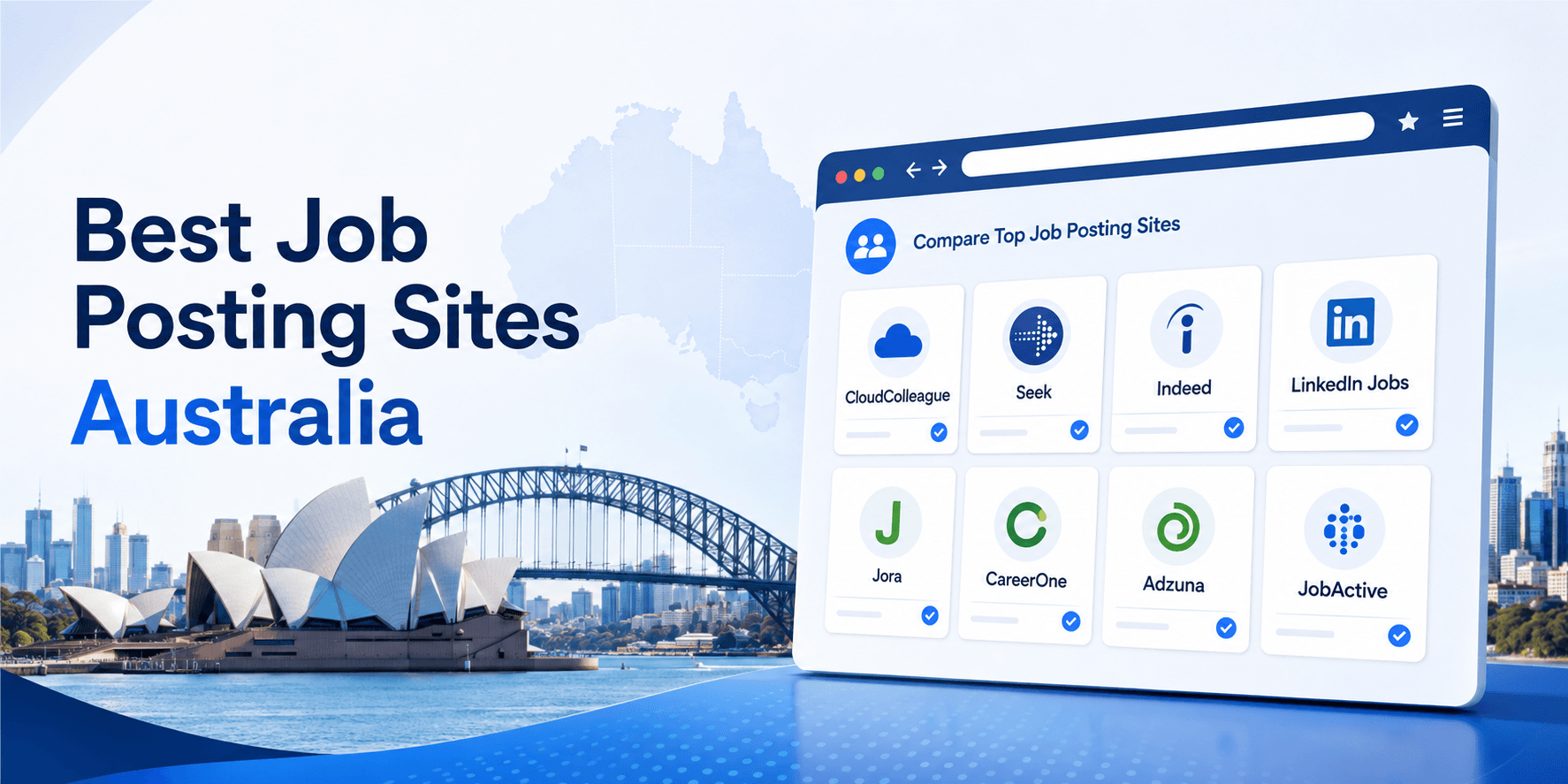
The best job posting sites in Australia for employers in 2026 are Seek for reach, Indeed for budget control, LinkedIn for professional and passive candidates, Jora for free distribution, and Airtasker for short tasks rather than roles. Most employers get better results from two platforms than from one.
Choosing the best job posting sites in Australia has become harder, not easier, because the market itself has tightened. The Australian Bureau of Statistics recorded 329,500 job vacancies in May 2026, a fall of 2.1 per cent over the quarter and the first decline since August 2025. Fewer vacancies means more employers competing for attention on fewer listings, and it means your advertising spend now buys less visibility than it did two years ago.
This guide compares the major Australian job boards on what actually matters to an employer: how you are charged, what you get for it, and which kinds of roles each platform genuinely suits. We have deliberately avoided ranking them one to ten, because the honest answer depends on the role you are filling.
How the Australian job board market breaks down in 2026?
Australia has an unusual employment market. Unlike the United States or the United Kingdom, one domestic incumbent still holds the dominant position. Seek, listed on the ASX and headquartered in Melbourne, reported revenue of A$1,097 million in 2025 and remains the default starting point for most Australian hiring managers.
However, the landscape underneath Seek has fragmented considerably. Indeed operates a dedicated Australian portal and competes on pricing model rather than reach. LinkedIn owns the professional and passive candidate segment. Jora, itself part of the Seek Group, distributes listings at no cost. Meanwhile Airtasker, Hipages and Oneflare serve a completely different need, which is short tasks rather than employment.
Consequently, the question is rarely which platform is best overall. Instead, it is which platform matches the role, the budget and the urgency in front of you right now.
Comparing the best job posting sites in Australia
The table below sets out how each platform charges and where it performs strongest. All pricing was verified on 10 August 2026. Because several platforms use auction based models, your actual cost will vary by role and location.
| Platform | How you are charged | Genuine strength | Where it falls short | Best for |
| Seek | Variable per ad, priced by role title, location and local candidate depth. Discounted ad budgets available on contract. | Largest volume of Australian listings and the deepest local candidate pool | No published flat rate, so budgeting requires the price lookup tool. Cost per ad is the highest of the major boards. | Permanent roles where candidate volume matters |
| Indeed | Up to three free posts per calendar month. Sponsored listings run on a live auction, charged per started application. | Budget control. You set a cap and stop whenever you want. | Free posts sink down results within about a day. Auction costs rise sharply in competitive categories. | Employers testing a role before committing spend |
| Free posting with paid promotion, plus separate recruiter licences | Passive candidates already in work, and strong professional filtering | Weak for trades, hospitality and shift based roles | Professional, managerial and technical hires | |
| Jora | Free listings, part of the Seek Group | Zero cost distribution and useful aggregation reach | Lower intent traffic, and limited employer tooling | Supplementing a paid ad elsewhere |
| Airtasker | Percentage service fee on completed tasks | Fast turnaround on defined one off jobs | Not an employment platform. Unsuitable for ongoing roles. | Discrete tasks with a clear deliverable |
Best for: at a glance
- Seek is best for permanent roles where you need genuine candidate depth and can absorb a higher cost per ad.
- Indeed is best for employers who want to control spend precisely and are comfortable managing an auction.
- LinkedIn is best for reaching people who are not actively searching.
- Jora is best for free supplementary reach alongside a paid listing.
- Airtasker is best for tasks, not jobs.
Understanding what you are actually paying for
Job board pricing in Australia now splits into two distinct philosophies, and understanding the difference will save you money.
Fixed price advertising
Seek uses a variable but committed price. You pay a set amount for a set period, and that amount is determined by the job title, the vacancy location and how many relevant candidates are active in that area. The price is visible through the lookup tool on the employer dashboard before you commit. Larger employers can purchase an ad budget upfront, which functions like a line of credit and attracts a volume discount.
The advantage is predictability. You know your exposure before you spend. The disadvantage is that you pay regardless of outcome. A poorly written ad costs the same as an excellent one.
Performance based advertising
Indeed moved away from flat fees entirely. Employers posting directly can run up to three free listings per calendar month, each live for up to 30 days. Beyond that, sponsored placement runs through a live auction, and Indeed now charges per started application rather than per click. A started application means a candidate has actively begun applying, not merely clicked through.
Furthermore, Indeed retired its earlier pay per application model in December 2023 after billing complaints, which is worth knowing if you last used the platform under those rules. Third party analyses in 2026 place typical effective cost per application in the range of roughly A$15 to A$50, though this varies substantially by role and metropolitan area.
Verify before you budget. Auction based pricing changes constantly. Every figure in this guide carries a verification date, and we re-check the whole comparison quarterly. Confirm current rates on each platform before committing spend.
Why running one platform is usually a mistake?
Most Australian employers default to a single board, and this is where budgets quietly leak. Each platform attracts a different candidate behaviour.
Seek attracts active searchers who deliberately visit an employment marketplace. Indeed attracts a broader mix, including people browsing casually across aggregated listings. LinkedIn reaches people who are employed and not looking, which is exactly the group you cannot reach anywhere else. These are three genuinely different audiences.
Therefore, a sensible approach for most small and medium employers looks like this. Run one paid listing on the platform that best matches the role type. Add free distribution through Jora and Indeed’s free allocation. Then, if the role is professional or senior, promote it once through LinkedIn to reach passive candidates. This structure costs little more than a single premium ad while covering three distinct audiences.
Where recruitment agencies fit, and where they do not?
Agencies remain relevant for genuinely hard to fill roles, but the cost gap is significant. The Australian HR Institute reported the average cost to hire in Australia rising from about A$10,500 in 2020 to A$23,860 in 2021, with agency fees a major contributor. Against that, direct job board advertising typically sits in the low hundreds to low thousands of dollars per role.
Accordingly, agencies make sense when the role is senior, confidential, or in a skills category where active candidates barely exist. For everything else, direct advertising through the platforms above will usually deliver a comparable outcome at a fraction of the cost.
A third option worth knowing about
Alongside the established boards, CloudColleague operates as an Australian platform where employers can post roles and, separately, post tasks. That dual structure is unusual, because most platforms handle one or the other. It sits closest in purpose to Seek and Indeed on the employment side, and closest to Airtasker on the task side.
To be direct about the trade off: CloudColleague does not match Seek’s candidate volume, and no newer platform realistically could. Seek has spent nearly three decades building that pool. If sheer applicant numbers are your priority, Seek remains the stronger choice, and we would say so to any employer who asked.
How to choose, in four questions
- Is this a role or a task? Ongoing work with direction and set hours is employment. A defined deliverable is a task. This single distinction rules out half the platforms immediately.
- Are the right candidates actively looking? If yes, use Seek or Indeed. If no, you need LinkedIn or direct outreach.
- Can you absorb a fixed cost, or do you need a cap? Fixed cost points to Seek. A hard cap points to Indeed.
- How urgent is the hire? Urgency justifies paid placement. Flexibility allows you to start with free listings and escalate only if needed.
For a direct head to head on the two largest platforms, read our comparison of Seek versus Indeed in Australia. If you have already decided Seek is not right for you, our guide to Seek alternatives for Australian employers covers the replacement options in detail.
Frequently asked questions
Indeed’s free allocation of three posts per calendar month is the strongest starting point for a small business, because it carries no cost and no commitment. Add Jora for free supplementary distribution. Move to a paid Seek listing only when a role has proven difficult to fill through free channels.
Costs vary widely by platform and model. Seek prices each ad individually based on role, location and candidate depth. Indeed charges through an auction, with effective cost per application commonly landing between roughly A$15 and A$50 in 2026. Free options exist on Indeed, Jora and LinkedIn.
Yes. Seek holds the largest volume of Australian job listings and remains the dominant local employment marketplace, with revenue of A$1,097 million reported for 2025.
Yes, and most employers should. Posting across two or three platforms reaches genuinely different candidate audiences. Keep the role description consistent so applicants encounter the same information wherever they find you.
Vacancies fell 2.1 per cent in the three months to May 2026 to 329,500, which is 30.3 per cent below the May 2022 peak. Fewer open roles generally means more employers competing for candidate attention, so advertising quality matters more than it did during the post pandemic shortage.