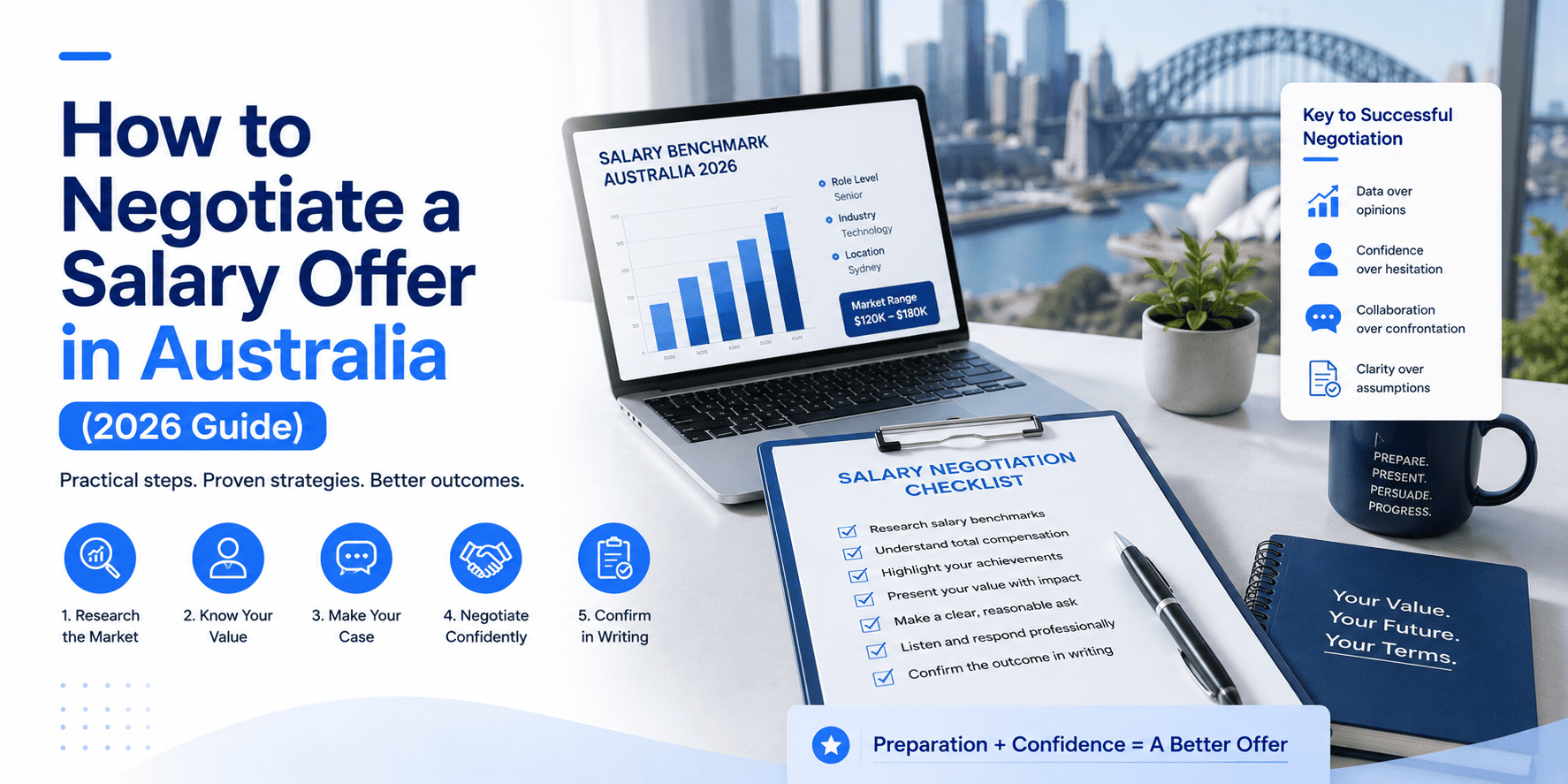
When you negotiate salary offer terms before you sign, you set the baseline for every raise, bonus and super contribution that follows. Research from Pew Research Centre shows two-thirds of people who negotiate a salary offer get what they ask for, with an average gain of 18.8%. Yet most candidates accept the first number out of relief or fear of losing the role. That single decision compounds against them for the rest of their time at that employer. This guide shows you exactly how to negotiate salary offer packages in Australia in 2026, step by step. Before you respond to your next offer, CloudColleague’s salary insights hub gives you live benchmarks so you know your number before you open your mouth.
| Want a head start? Start as a seeker on CloudColleague, go through our guide on salary insights. |
Why most people fail to negotiate salary offer packages?
Most professionals know they should negotiate salary offer terms. Most do not. The gap between knowing and doing costs the average Australian worker tens of thousands of dollars over their career, and it starts at the very first offer.
The reason is almost always one of three things. First, they fear that attempting to negotiate salary offer terms will cause the employer to withdraw the role. This has not happened to a professional who made a data-backed, respectful counter-offer. Employers expect negotiation. They build room for it. Walking away from a qualified candidate because they asked professionally would cost the employer more in time and re-hiring than the small difference they are negotiating over. Second, they do not know their market rate, so they have no basis to negotiate salary offer amounts. This is fixable in under five minutes. Third, they confuse gratitude for the offer with an obligation to accept it unchanged. The two have nothing to do with each other.
The professionals who consistently negotiate salary offer packages and win share one trait: they arrive prepared. They know their benchmark. They know the employer headroom. They know what they want, and they ask for it calmly.
What the data says about salary offer negotiation success?
Before you decide whether to negotiate salary offer terms on your next role, look at what the research says actually happens when people do.
According to Pew Research Centre data reviewed in 2025 and 2026, around 66% of workers who attempt to negotiate salary offer packages get the outcome they asked for. The average gain from a successful negotiation is 18.8%. Only 10% of people who negotiate salary offer terms come away with less than 10% above the original figure, or with no increase at all. The math is clear. The cost of not negotiating is permanent. The cost of negotiating and not getting everything is minimal.
The Australian market supports this approach specifically in 2026. A 2025 salary guide cited by learningpeople.com/au in April 2026 reports that 84% of employers across Australia and New Zealand plan to offer pay rises, averaging around 4.5%. In technology roles especially, employers build room to negotiate salary offer packages and expect candidates to use it. Robert Half’s 2026 Australia Salary Guide confirms that hiring managers in technology and finance are prepared to offer 6 to 10% above their initial proposal for the right candidate. The room exists. Most people just never ask for it.
Step 1: Ask for time before you respond
When a job offer arrives, the right response is never an immediate yes. Thank the hiring manager warmly and ask for 24 to 48 hours to review the offer in full. This is professional, widely expected, and gives you time to negotiate salary offer terms from a position of preparation rather than emotion.
Use those 24 hours to benchmark the offer against the market. Check the role against SEEK advertised salaries, Robert Half 2026 data and the CloudColleague salary benchmark tool. Compare the base to the 25th, 50th and 75th percentile for your specific role and city. If the offer sits below the 50th percentile, you have a clear, verified case to negotiate salary offer amounts upward. If it sits at the 75th percentile, shift your negotiation to other package elements. For the national context, see our guide to the average salary in Australia.
The pause is also a signal. Candidates who ask for time are perceived as considered and deliberate. Candidates who accept in the room are often perceived as having accepted before the conversation. Take the time.
Step 2: Research your market rate to negotiate salary offer amounts
You cannot negotiate salary offer packages effectively without a number. The number has to come from the market, not from your feelings or your previous salary.
Your market rate is the 50th to 75th percentile of verified salary data for your specific role, at your specific experience level, in your city. The 25th percentile is what someone new to the role earns. The 50th is the market average. The 75th is what experienced, in-demand professionals command. Your goal when you negotiate salary offer terms is to land at or above the 50th percentile, targeting the 75th if your experience justifies it.
Use three sources to build this number: SEEK advertised salaries for your role in your city, the Robert Half 2026 salary guide for your field, and CloudColleague’s salary insights benchmarks. Cross-check them. If all three point to a range of $110,000 to $130,000 and the offer is at $95,000, you have a verified, multi-source case to negotiate salary offer amounts upward by $15,000 to $20,000. For experience-level pay ranges across your field, see our salary by experience guide.
When you present this research, attribute it by source. Do not say “I think I am worth more.” Say: “Based on SEEK, Robert Half 2026 and CloudColleague’s benchmarks for this role at my level in this city, the range sits at $X to $Y. I would like to discuss moving the offer to $X.” That is a business conversation, not an opinion.
| Wanna have some side income? CloudColleague also provides professionals with an option for freelance tasks. Go through guides on tasks and how bidding works to learn more about online and freelance tasks. |
Step 3: Know what to negotiate beyond base salary
Base pay is one line in a package. When you negotiate salary offer terms, look at the full picture. Employers who cannot move on base can often move on other elements, and each one has real financial value.
The elements worth raising when you negotiate salary offer packages in Australia include the superannuation contribution (above the 12% minimum), a performance bonus or profit-share structure, a signing bonus to compensate for any leave forfeited at your current role, extra annual leave, the number of remote-work days per week, a professional development or training budget, an equipment allowance, and the job title where it affects future earning potential. These are standard negotiation points in 2026. Asking about them is expected.
Rank your priorities before the conversation. Lead with base salary. If base is fixed, move systematically through your list. A candidate who can negotiate salary offer terms flexibly across multiple elements will almost always get more total value than one who focuses on a single number and walks away when it does not move.
Get the free CloudColleague Job Offer Negotiation Toolkit. It maps every package element worth negotiating, with a benchmarking worksheet and counter-offer template.
Step 4: Make a specific, anchored counter-offer
When you negotiate salary offer amounts, the first number you name anchors the entire negotiation. Research on anchoring shows that candidates who start higher, but credibly, consistently achieve better outcomes. A University of Idaho study reviewed across 2024 and 2025 salary negotiation research found that candidates who anchored at a higher figure received offers that were meaningfully better than those who did not anchor at all.
The practical rule: when you negotiate salary offer packages, open 10 to 15% above your target, anchored to the 75th-percentile benchmark. If your target is $115,000 and the 75th percentile is $120,000, counter at $120,000 and justify it with your three-source market data. This is not greed. It is giving yourself room to land where you want to be.
Phrase the counter as a question where possible. “Based on the market benchmarks I have reviewed, and my experience in this field, would the business be open to moving the base to $120,000?” This frames it as a conversation rather than a demand, reduces defensiveness and keeps the dialogue open. After you ask, stop talking. The silence is working for you.
Step 5: Handle the response and close
Employers almost never accept a first counter when you negotiate salary offer terms. The response you receive is the real negotiation beginning. Do not mistake a counter-counter for a rejection.
If the employer comes back between their opening and your counter, you are in a successful negotiation. Decide in advance what your minimum acceptable number is, so you can respond clearly rather than emotionally in the moment. If they meet your target, accept in writing and confirm all agreed changes in an updated offer letter. If they fall short, you can either accept on the condition of a written six-month review date, propose splitting the difference, or stand firm on the 75th-percentile benchmark and let them decide.
Never agree verbally and assume the offer is final. Every change must appear in writing before you sign. Hiring managers move on. What they promised can be forgotten without documentation.
Read Next: How to Negotiate Salary in Australia (Step-by-Step Guide 2026)
What to do when you cannot negotiate salary offer higher?
An employer who refuses to move at all when you negotiate salary offer packages is giving you important information. Either the role sits in a rigid pay band, or they do not value you at market rate. Both are worth knowing before you commit.
If base is fixed, complete the package negotiation across every other element. Bonuses, super, leave, remote work, equipment and development budgets are all potentially moveable. If nothing moves at all, you have a decision to make. Does the role, team and career trajectory justify accepting below market rate short-term? Only you can answer that. But the answer should be made with full information, not under pressure.
The most powerful thing you can do at this point is know your real alternatives. CloudColleague shows you what employers are actively paying for your role and experience right now. Setting up a profile costs nothing. Turning on job-match alerts takes a minute. And seeing that three similar roles are advertising $25,000 more than this offer is information you need before you sign.
Your market rate may be higher than this offer. CloudColleague connects professionals with Australian and global employers that pay competitively, settle payments the same day through Stripe, and match you to roles by experience and skills.
For the highest-paying roles actively hiring in 2026, see our guide to high paying jobs in Australia. For how CloudColleague’s matching and payment tools work end to end, visit CloudColleague platform features.
| Want a head start? Create your free account on CloudColleague and start exploring job that fits you. |
Negotiate salary offer FAQ
Yes. Employers expect it, build room for it, and two-thirds of candidates who negotiate salary offer terms get what they ask for.
The average gain is 18.8%, according to research reviewing Pew data. In Australian tech and finance, employer headroom is 6 to 10% above the initial offer.
No professional who made a respectful, data-backed counter-offer to negotiate salary offer terms has had an offer withdrawn. If that happened, the employer was not someone you wanted to work for.
Ask for 24 to 48 hours to review. Most Australian employers allow up to five business days before requiring an answer.
Negotiate salary offer elements beyond base: super, bonus, leave, remote work and professional development budget are all on the table.
CloudColleague’s salary insights hub gives you live benchmarks by role, city and experience level so you walk into every negotiation with verified market data.