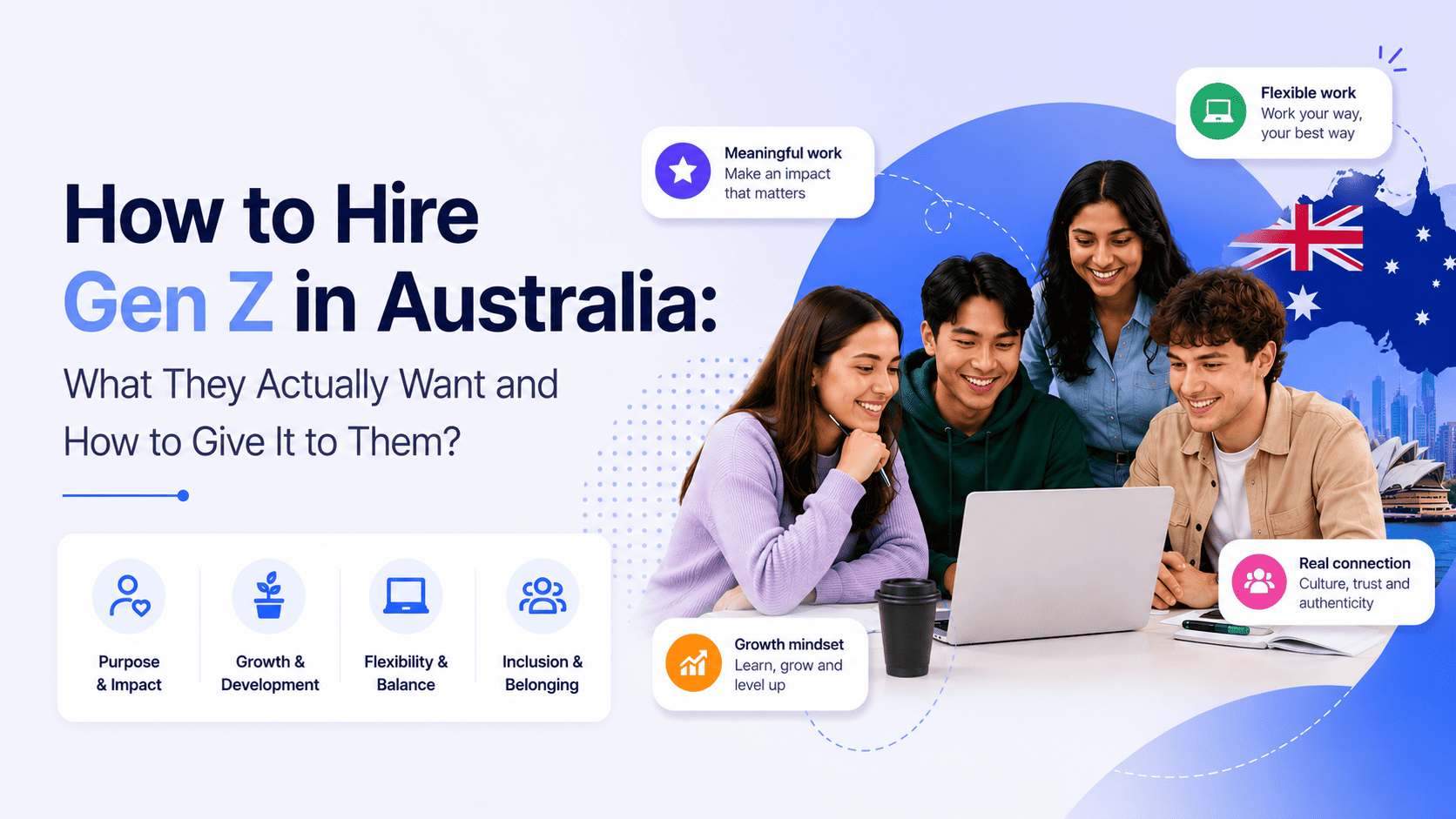
If your business is trying to hire Gen Z in Australia and struggling to get it right, you are not alone. Companies across Melbourne, Sydney, and Brisbane are posting roles that are not converting, onboarding young talent that leaves within 12 months, or managing a growing disconnect between what employers offer and what Gen Z employees expect.
This guide breaks down the real challenges Australian employers face when hiring Generation Z, what this cohort genuinely looks for in a workplace, and the practical strategies that are actually working in 2026. You will find data, entity-rich context, and direct answers instead of generic advice.
Who Is Gen Z and Why Does It Matter for Your Hiring Strategy?
Generation Z refers to individuals born roughly between 1997 and 2012. The oldest are now approaching 30 and moving into mid-level roles, while the youngest are still in secondary school.
Their workforce presence in Australia is already significant. And it is only growing.
| 33% | Gen Z will make up one-third of Australia’s total workforce by 2030, making them the largest generational cohort in the labour market. (Source: McCrindle Research) |
| 47% | Gen Z already accounts for 47% of all shift work hours in Australia, surpassing Millennials for the first time. (Source: Human Resources Director / Appetency Recruitment 2026) |
This is not a future problem. It is a present-day hiring reality. Australian organisations in retail, hospitality, healthcare, technology, and professional services are all competing for the same pool of young, digitally fluent talent.
What makes this generation different is not just their age. It is the context they grew up in. They entered their formative years during a global pandemic, cost-of-living pressure, digital acceleration, and climate anxiety. These experiences have shaped how they think about work, loyalty, and career value.
The Real Problems Australian Employers Are Facing When They Hire Gen Z
Before jumping to solutions, it is worth naming the actual problems. Australian employers consistently report the following issues when trying to attract and retain Gen Z workers:
1. High Turnover and Short Job Tenure
This is the most frequently cited challenge. According to Randstad’s Gen Z Workplace Blueprint, the average Gen Z employee globally stays in a role for just 1.1 years during the first five years of their career. In Australia specifically, average job tenure for this group sits at 1 year and 8 months.
However, a closer look at the data tells a more nuanced story. The New Daily, citing 2025 ABS figures, reported that Gen Z workers aged 15 to 24 have a job mobility rate of just 11.5 percent. That is down from 23 percent in 1996. Today’s Gen Z worker is actually less likely to change jobs than a Gen X worker of the same age was in the mid-1990s.
The real issue is not careless job-hopping. It is misaligned expectations on entry. When Gen Z leaves, it is typically because the role did not deliver what was promised at the recruitment stage.
2. Entry-Level Role Scarcity
A 2026 working paper from economists at the London School of Economics and the University of Oxford scanned hundreds of millions of hiring records and job postings across Australia, the US, UK, and Canada between 2017 and 2025. Their finding: entry-level hiring in Australia has dropped between 14 and 29 percent, while senior-level hiring has increased by 5 to 21 percent.
Remote and hybrid work policies are a key driver of this trend. Companies that shifted to remote-first models now prefer experienced workers who need less in-person mentoring. This creates a structural barrier for Gen Z candidates who are eager to enter competitive industries.
3. The Expectation Gap
A Gartner HR survey found that 41.5 percent of Gen Z employees in Australia are actively seeking new job opportunities, the highest rate in three years. This job-seeking activity is closely tied to a mismatch between what employers assume Gen Z wants versus what they actually need.
Employers often focus on salary and perks. Gen Z is increasingly prioritising financial security alongside purpose, growth infrastructure, and workplace culture. The Deloitte 2026 Gen Z and Millennial Survey, which surveyed over 800 Australian respondents, reported a clear shift away from fast-paced progression towards more deliberate and sustainable career choices. Cost of living remains their top concern, shaping when they enter the workforce and what they expect from employers.
What Gen Z Actually Expects from Employers in Australia?
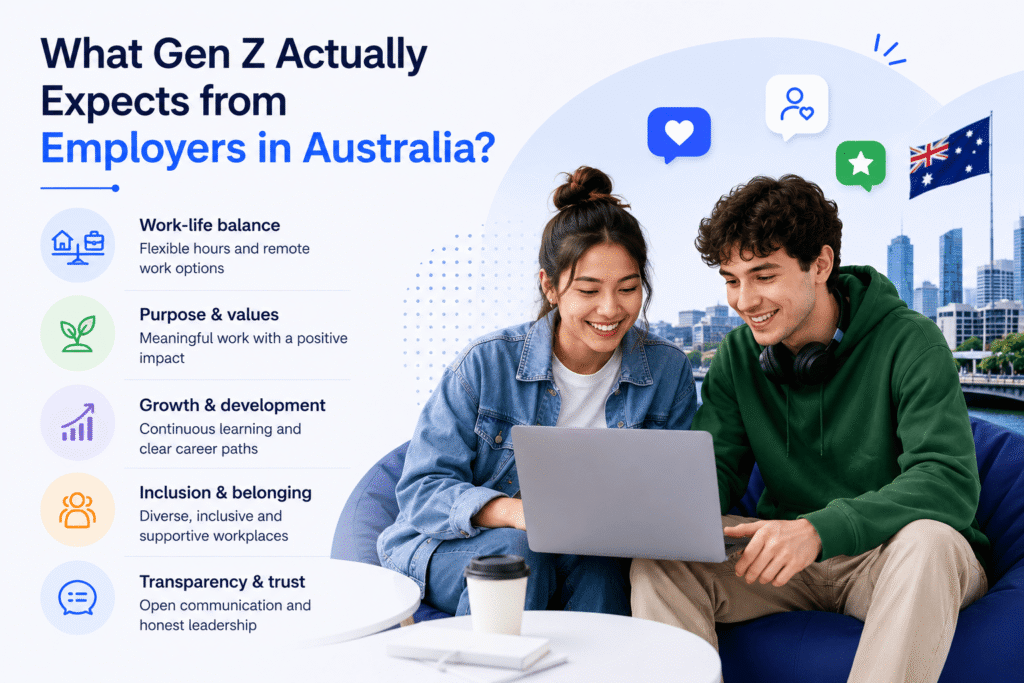
Here is where most hiring guides miss the mark. They list generic preferences without backing them with data. Below are the real expectations that Gen Z in Australia holds when evaluating a potential employer.
Competitive Pay That Reflects Cost of Living
Nearly half of Gen Z, around 48 percent, do not feel financially secure. (Source: Deloitte 2025 Gen Z and Millennial Survey). Financial anxiety is their baseline. They are entering a workforce where median rents in Sydney and Melbourne have surged, and they know it.
Hiding salary ranges in job ads is a disqualifier. Gen Z candidates openly compare pay through platforms like Glassdoor, LinkedIn Salary Insights, and peer networks. Transparency in compensation is no longer optional.
| 48% | Nearly half of Australian Gen Z do not feel financially secure. Salary transparency is essential to earning their trust at the application stage. |
Flexibility That Actually Means Something
Research from McCrindle confirms that 61 percent of Gen Z consider flexible working hours extremely or very important. Critically, this does not mean fully remote. Most Gen Z workers in Australia prefer hybrid arrangements that combine in-person collaboration with the autonomy to manage their schedule.
According to Randstad, 38 percent of Australian Gen Z work full-time, while one in five freelances alongside their primary role. This freelance culture signals a deep need for income control and personal autonomy that rigid nine-to-five structures cannot satisfy.
Genuine Career Development, Not a Checklist
One of the most misunderstood expectations is around growth. Gen Z does not just want a job title that sounds impressive. They want to build real skills they can take anywhere. Deloitte’s 2026 Australian findings show that young workers are moving away from chasing promotions and towards deliberate skill acquisition and meaningful contribution.
Mentorship programs, structured learning pathways, access to cutting-edge tools, and visible internal mobility all rank highly. Four in five Gen Z workers, 80 percent, want to work with cutting-edge technology in their careers. (Source: McCrindle Research)
Purpose-Driven Culture and DEI That Goes Beyond a Policy
More than 63 percent of Gen Z say alignment with company culture and values is more important than compensation alone. (Source: McCrindle via Appetency Recruitment 2026). They research employers on LinkedIn, Glassdoor, and social media before applying. They can identify performative DEI quickly.
Almost 38 percent want to work for a socially or environmentally responsible organisation. This is not just a hiring filter for Gen Z. It affects how long they stay.
Wellbeing as a Non-Negotiable
The Deloitte 2026 survey identifies the Gen Z expectation framework as a trifecta of money, meaning, and wellbeing. Mental health support, reasonable workloads, and psychological safety are increasingly deciding factors. Australian employers who treat wellbeing programs as an afterthought will continue to see Gen Z candidates disengage early.
How to Hire Gen Z in Australia: Practical Strategies That Work?
Understanding expectations is only half the answer. Here is what Australian organisations are actually doing to attract and retain Gen Z talent successfully.
Rewrite Your Job Ads From the Ground Up
Stop writing job ads that describe what the company needs. Start writing ads that describe what the candidate will gain. Gen Z evaluates roles through the lens of growth, purpose, and flexibility, not just responsibilities and requirements.
- Lead with the learning opportunity, not the task list
- Include salary ranges. Hiding them costs you candidates.
- Mention micro-credentials, certifications, and skill pathways explicitly
- Describe hybrid or flexible work arrangements clearly
- Use active language and keep sentences short
Mentioning micro-credentials, internships, and relevant experience rather than defaulting to degree requirements opens your talent pool significantly. Gen Z values practical skill development over traditional academic credentials.
Streamline Your Recruitment Process
A lengthy, multi-stage hiring process is one of the fastest ways to lose a Gen Z candidate. They expect speed, digital-first communication, and transparency throughout.
- Cut application forms to the essentials
- Respond to applications within 48 hours
- Use video or async interview options where possible
- Be clear about timelines from the first touchpoint
- Avoid ghosting. Gen Z will share negative experiences publicly.
Build Your Employer Brand Where Gen Z Spends Their Time
Gen Z discovers jobs through Instagram, TikTok, LinkedIn, and SEEK. If your employer brand is only visible on a static careers page, you are invisible to the majority of this cohort.
Authentic content performs better than polished corporate messaging. Short-form videos featuring real employees, honest culture posts, and behind-the-scenes content build trust before a candidate ever sees a job ad.
Create Visible Career Pathways
One of the most powerful retention tools for Gen Z is showing them exactly where they could be in 18 to 24 months. Organisations that map out internal mobility options, skill development milestones, and promotion criteria early in the employment relationship see significantly longer tenure.
CloudColleague clients operating hybrid and remote-first environments can use tools like structured async check-ins, documented career conversations, and mentorship matching to build this visibility at scale, even across distributed teams.
| 1.1 yrs | Average time Gen Z stays in a role globally during the first five years of their career. Companies that show clear progression pathways at hire reduce this churn significantly. (Source: Randstad) |
Invest in Onboarding That Actually Works
The first 90 days determine whether a Gen Z hire stays or leaves. Many Australian employers lose young talent not during the job search but during onboarding, when the reality of the role diverges from the promise made at interview.
Effective Gen Z onboarding includes structured mentorship from day one, early access to meaningful work rather than admin tasks, regular check-ins at 30, 60, and 90 days, and a clear explanation of how their role contributes to company objectives.
Where Gen Z Is Entering the Australian Workforce in 2026?
It is worth knowing which industries and roles are seeing the most Gen Z hiring activity, as this affects competition for talent and the baseline expectations in each sector.
According to Employment Hero’s Australian payroll data from April 2025:
- Information and Communication Technology saw a 3.5 percent month-on-month growth in Gen Z hires
- Government and Defence recorded a 4.2 percent month-on-month increase
- Consulting and Strategy saw a 41.4 percent year-on-year spike in Gen Z entrants
- CEO and General Management roles involving Gen Z grew 39.5 percent year-on-year
- Construction and Trade Services led employment growth at 6.2 percent year-on-year
This data reveals something important: Gen Z is not just entering entry-level roles. They are moving into strategic and leadership positions faster than previous generations did at the same age. Australian employers in professional services, technology, and consulting should plan for Gen Z contributors in mid-level and project-leadership roles within the next two to three years.
Common Mistakes Australian Employers Make When Hiring Gen Z
Even well-intentioned companies make these errors. Identifying them early saves time, money, and talent.
Assuming they are entitled or disengaged. The data does not support this. Gen Z are strategic, values-driven, and pragmatic. They are navigating a genuinely harder starting point than previous generations and adapting accordingly.
Offering perks instead of substance. Ping-pong tables and free snacks do not move the needle. Career pathways, psychological safety, and meaningful work do.
Using rigid interview processes designed for other generations. Requiring formal CVs, long application forms, and panel interviews can screen out capable Gen Z candidates who perform brilliantly in real-work environments.
Ignoring their values publicly. Gen Z researches employers. If your company’s social media shows no cultural signals, if Glassdoor reviews are negative, or if leadership communication is vague, they will move on before applying.
Treating remote work as a reward rather than a baseline. According to McCrindle research, more than 60 percent of Gen Z consider workplace flexibility and values alignment important when choosing an employer. Flexibility must be built into the role design, not offered conditionally.